ICBC(01398)

Search documents
“国家队”近4万亿持仓曝光:重仓金融,不忘加码科技
2 1 Shi Ji Jing Ji Bao Dao· 2025-11-04 23:26
Core Insights - The "national team" has significantly increased its holdings in A-shares, with a total market value approaching 4 trillion yuan, focusing heavily on financial stocks [1][4] - The top ten holdings of the "national team" are predominantly from the financial sector, with the largest being the Bank of China, valued at over 1 trillion yuan [1][3] Holdings Overview - As of the end of Q3, the "national team" held over 222 A-share stocks, with a total market value of 3.911 trillion yuan, marking an increase from the previous quarter [4][5] - The top three holdings by market value are Bank of China (1.028 trillion yuan), Agricultural Bank of China (957.73 billion yuan), and Industrial and Commercial Bank of China (930.27 billion yuan) [2][3] Sector Focus - The "national team" remains heavily invested in financial stocks, with 9 out of the top 10 holdings being from this sector, accounting for over 83.9% of the total market value of the top ten stocks [3][4] - In addition to financial stocks, the "national team" is diversifying into sectors such as AI, semiconductors, and renewable energy, aligning with national strategic goals [3][4] ETF Investments - The "national team" has also increased its investment in ETFs, with holdings exceeding 40% of the total A-share ETF market, contributing to market stabilization [5][6] - The total market value of ETFs held by the "national team" reached approximately 1.55 trillion yuan, with significant gains from major ETFs like Huatai-PB CSI 300 ETF [6][7] Market Conditions - The current market environment is characterized by ample liquidity and favorable policy support, which is benefiting growth-oriented stocks, particularly in the technology sector [7]




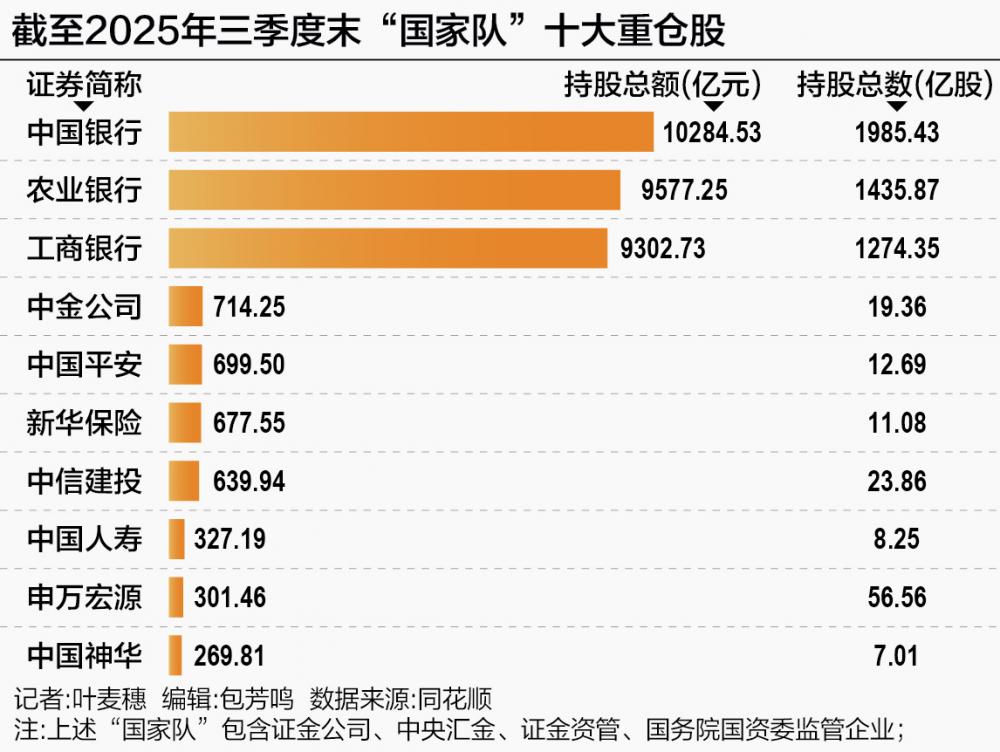
“国家队”重仓股前十
2 1 Shi Ji Jing Ji Bao Dao· 2025-11-04 23:08
Core Insights - The "national team" has heavily invested in over 222 A-share stocks, with a total market value approaching 4 trillion yuan, primarily favoring financial stocks [1][2][3] Group 1: Investment Focus - The top ten holdings of the "national team" are predominantly from the financial sector, with the exception of China Shenhua, and the total market value of these holdings exceeds 3.28 trillion yuan, accounting for over 83.9% of their total portfolio [2][3] - Major holdings include China Bank, Agricultural Bank, and Industrial and Commercial Bank, with respective market values of 1.03 trillion yuan, 957.73 billion yuan, and 930.27 billion yuan [2][3] - The "national team" is also diversifying into sectors such as AI, semiconductors, and renewable energy, aligning with national strategic goals [3] Group 2: ETF Investments - The "national team" has increased its ETF holdings significantly, with a total market value of 1.55 trillion yuan, marking an increase of over 200 billion yuan since the second quarter [4][5] - Key ETFs held include Huatai-PB CSI 300 ETF, which contributed over 55 billion yuan in floating profits, and other ETFs that saw substantial gains, with some exceeding 50% growth in the third quarter [5][6] - The "national team" holds over 40% of the total A-share ETF market, indicating a strong commitment to stabilizing the market [4][5] Group 3: Market Conditions - The current market environment is characterized by ample liquidity and expectations of interest rate cuts by the Federal Reserve, benefiting growth-oriented stocks [6] - The focus on technology stocks, particularly in AI hardware and computing power, is expected to be a key investment theme over the next 3 to 5 years [6]
智通ADR统计 | 11月5日




Xin Lang Cai Jing· 2025-11-04 22:50
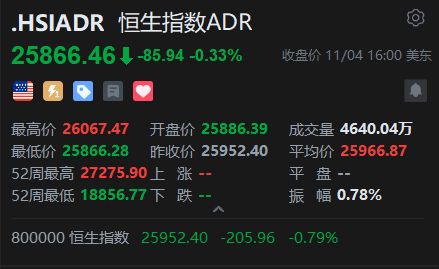
Market Overview - The US stock market indices collectively declined on Tuesday, with the Hang Seng Index ADR falling to 25,866.46 points, down by 85.94 points or 0.33% compared to the Hong Kong close [1]. Company Performance - Major blue-chip stocks mostly experienced declines, with HSBC Holdings closing at HKD 108.602, up by 0.56% compared to the Hong Kong close, while Tencent Holdings closed at HKD 623.88, down by 0.81% [3]. - Tencent Holdings saw a decrease of HKD 5.12 or 0.81% in its ADR price, closing at HKD 623.88 [4]. - Alibaba Group's ADR fell by HKD 4.20 or 2.57%, closing at HKD 159.00 [4]. - Xiaomi Group's ADR dropped by HKD 1.30 or 2.91%, closing at HKD 43.42 [4]. - AIA Group's ADR decreased by HKD 0.30 or 0.38%, closing at HKD 79.62 [4]. - NetEase's ADR fell by HKD 3.40 or 1.54%, closing at HKD 216.80 [4]. - Ctrip Group's ADR declined by HKD 4.50 or 0.81%, closing at HKD 548.50 [4]. - BYD's ADR decreased by HKD 2.00 or 2.02%, closing at HKD 97.10 [4]. - The Hong Kong Stock Exchange's ADR fell by HKD 3.20 or 0.75%, closing at HKD 425.60 [4].
11月3日【輪證短評】小鵬汽車、金沙中國、港交所、工商銀行
Ge Long Hui· 2025-11-04 20:31
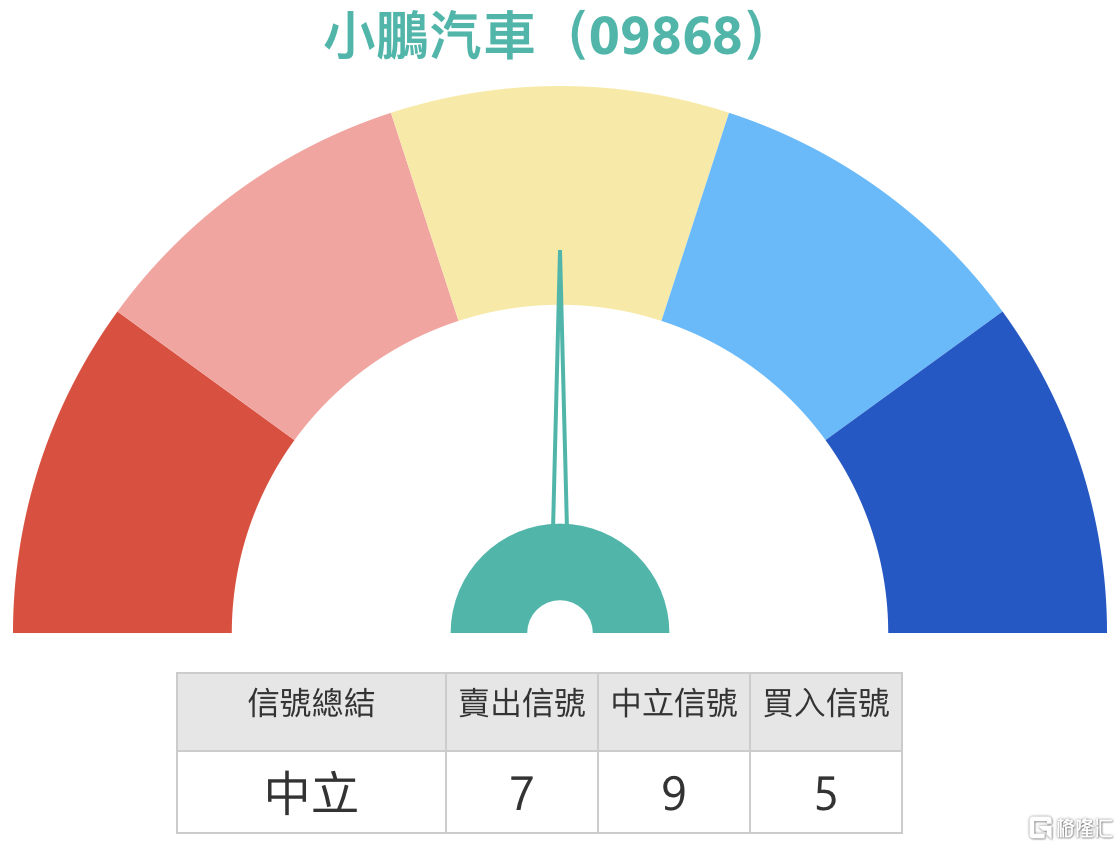
Group 1 - The core viewpoint of the article discusses the performance and investment opportunities related to various stocks, particularly focusing on options and warrants associated with these stocks [3][4][10] - The first stock analyzed is XPeng Motors (09868), which has shown a price increase, closing at 92 HKD, with potential resistance levels at 95.1 HKD and 99.7 HKD [3][4] - The article highlights four warrant products with exercise prices between 60 HKD and 61 HKD, noting their leverage ratios ranging from 3.3x to 3.5x, making them suitable for investors [4][5] Group 2 - The second stock discussed is Sands China (01928), which experienced a decline, closing at 19.95 HKD, but with increased trading volume, prompting interest in call options [10][11] - There is limited choice for January expiration products, leading to a recommendation for looking at April expiration products, which offer various types of options with leverage around 4x [11][12] - The article emphasizes the importance of comparing product terms, as even slight differences in leverage and implied volatility can significantly impact investment decisions [12][13] Group 3 - The third stock is Hong Kong Exchanges and Clearing (00388), which saw a price increase to 428.8 HKD, with a suggested support level at 417 HKD [16][17] - The article recommends selecting bull certificates with a redemption price below 412 HKD for safety, as they are less likely to be triggered compared to those closer to the current price [17][18] - It notes that the premium differences among these products can be significant, urging investors to carefully evaluate product terms [18] Group 4 - The fourth stock analyzed is Industrial and Commercial Bank of China (01398), which has shown a price increase to 6.17 HKD, with a resistance level at 6.2 HKD [21][22] - There are three put options available for January expiration, all being out-of-the-money, with exercise prices around 5.22 HKD [22][23] - The article stresses that while there are options available, none have a clear advantage, and investors should consider the bid-ask spread and the ability of these put options to respond to declines in the underlying stock [23]

南向资金与上市公司回购给力 港股仍有上行空间
Zhong Guo Zheng Quan Bao· 2025-11-04 20:17
Core Insights - Southbound capital has significantly increased its holdings in the Hong Kong stock market, marking it as the largest source of incremental funds this year, with a cumulative net inflow exceeding 1.27 trillion HKD, a historical high [1][4] - The Hong Kong stock market has performed well this year, with the Hang Seng Index and Hang Seng Tech Index rising over 29% and 30% respectively as of November 4 [1][6] - Despite recent market fluctuations, analysts believe that the Hong Kong market is primarily driven by liquidity, with potential for substantial upward movement in the medium to long term [1][7] Southbound Capital Inflows - As of November 4, 2023, southbound capital has recorded a cumulative net inflow of 12,753.21 billion HKD this year, more than double the amount from the same period in 2024, with a single-day record inflow of 358.76 billion HKD on August 15 [1][4] - In 198 trading days this year, there were net inflow days on 166 occasions, accounting for over 80% [1] - Monthly net inflows have consistently exceeded 110 billion HKD in several months, including January through April, July, August, and September [1] Holdings and Sector Preferences - As of November 3, 2023, southbound capital held 5,525.19 billion shares, an increase of 867.34 billion shares since the beginning of 2025, with a market value of 6.29 trillion HKD, up 2.71 trillion HKD [2] - The financial, information technology, and consumer discretionary sectors have the highest holdings, valued at 15,135.25 billion HKD, 13,086.04 billion HKD, and 8,918.34 billion HKD respectively [2] - Major stock holdings include Tencent Holdings over 650 billion HKD, Alibaba-W over 360 billion HKD, and several banks and energy companies exceeding 200 billion HKD [2] Recent Buying Trends - The most significant increases in holdings this year have been in China Construction Bank, Bank of China, and other major banks, with increases of 68.96 billion shares, 52.02 billion shares, and 50.27 billion shares respectively [3] - In the past month, the financial, energy, and communication services sectors saw the highest net buying amounts, with 255.73 billion HKD, 112.20 billion HKD, and 95.67 billion HKD respectively [4] Company Buybacks - As of November 3, 2023, Hong Kong-listed companies have repurchased over 1,460 billion HKD worth of shares, with 239 companies participating in buybacks this year [5] - Tencent Holdings leads in buyback scale with 609.65 billion HKD, followed by HSBC and AIA with 302.57 billion HKD and 176.93 billion HKD respectively [5] - The buyback trend is particularly strong in the technology and financial sectors, with notable increases in consumer companies as well [5] Market Performance and Outlook - The Hong Kong stock market has shown strong performance this year, with all industry sectors experiencing gains, particularly materials, healthcare, and information technology [6] - The Hang Seng Index's rolling P/E ratio has increased from 8.96 to 11.89, indicating a potential for valuation recovery [6] - Analysts suggest that the market may continue to experience fluctuations in the short term but has significant upward potential in the medium to long term due to favorable liquidity conditions and ongoing capital inflows [7]


工行“如意金”一日反转:黄金税收新政下银行合规与市场风险博弈
Sou Hu Cai Jing· 2025-11-04 15:00
Core Viewpoint - The dramatic fluctuations in the "Ruyi Gold" investment service by Industrial and Commercial Bank of China (ICBC) reflect the rapid adjustments banks must make in response to new tax regulations and market risks [2][3][4][7] Group 1: Policy Changes - The trigger for the business suspension was the announcement of new tax policies by the Ministry of Finance and the State Administration of Taxation regarding gold [3] - Following the new regulations, ICBC and China Construction Bank quickly announced the suspension of new account openings, active accumulation, and physical withdrawals for their gold investment services [3] - The implementation of the new tax policy necessitated complex system modifications and adjustments in business processes, prompting banks to take temporary measures to avoid compliance risks [3] Group 2: Market Risks - The changing market environment, including increased volatility in international gold prices and geopolitical tensions, has intensified the pressure on banks to adjust their gold business [4] - Banks are tightening their gold business, particularly services involving physical withdrawals, to mitigate risks associated with inventory management and price fluctuations [4] - The announcements from ICBC and China Construction Bank are seen as proactive defenses against market risks [4] Group 3: Business Recovery - ICBC's rapid restoration of services within hours indicates its flexibility in responding to policy changes [5] - Analysts suggest that the swift recovery may imply that the bank completed necessary system tests and compliance evaluations quickly to ensure smooth operations under the new policy [5] - As a significant player in the domestic gold business, ICBC may have received clearer execution guidelines during policy communications, allowing for quick strategic adjustments [5] Group 4: Investor Considerations - The incident serves as a reminder for investors to be aware of the dual risks posed by policy changes and market conditions in gold investments [6] - Adjustments in tax policies may affect holding costs, while changes in bank operations could lead to decreased transaction convenience [6] - Investors should pay closer attention to the compliance capabilities and risk management levels of banks when selecting gold accumulation products [6] Group 5: Conclusion - The one-day reversal of ICBC's "Ruyi Gold" service highlights the dynamic balance between financial regulation and market practice [7] - The introduction of new tax policies forces banks to adapt quickly, while existing market risks may lead to potential business contractions [7] - The adaptability of banks and the risk awareness of investors are both crucial in this evolving landscape, with future adjustments in the gold market anticipated as policy details become clearer [7]
工商银行董事长廖林:通过融资、融智、融技、融通“四融并举” 更好服务中国企业创新发展
Shang Hai Zheng Quan Bao· 2025-11-04 14:57
Core Insights - The chairman of Industrial and Commercial Bank of China (ICBC), Liao Lin, emphasized the bank's commitment to supporting manufacturing, technological innovation, and trade circulation, maintaining a leading position in these sectors [1] - ICBC aims to align with the spirit of the 20th National Congress of the Communist Party, focusing on responsibility and leadership in financial services, while enhancing its risk management and financial solutions [1] Group 1 - Liao Lin highlighted trends in global technological innovation and ICBC's role as a leading bank in providing financial support to key industries [1] - The bank is committed to a customer-centric approach, market orientation, and value-driven strategies to enhance its service offerings [1] - ICBC plans to implement a comprehensive financial solution framework and deepen its risk management capabilities to better support the innovation and development of Chinese enterprises [1] Group 2 - The bank's strategy includes a focus on "four integrations"—financing, intelligence, technology, and connectivity—to bolster the modernization of the industrial system and promote self-reliance in technology [1] - ICBC aims to inject stronger financial momentum into China's modernization efforts through its initiatives [1]
银行业2025年三季报综述:业绩稳健性凸显,引领银行价值回归
Shenwan Hongyuan Securities· 2025-11-04 14:41
Investment Rating - The report maintains a positive outlook on the banking sector, indicating a potential return to a valuation of 1 times net asset value [4][7]. Core Insights - The banking sector has demonstrated steady performance, with a year-to-date revenue growth of 0.8% and a net profit growth of 1.5% for the first nine months of 2025, reflecting a stable regulatory environment supporting bank profitability [10][14]. - The report highlights a shift in focus from scale to balance in credit growth, with banks increasingly pursuing a "quantity-price balance" strategy [4][7]. - The cost of liabilities has improved more significantly than the decline in asset pricing, leading to a stabilization of net interest margins, which is expected to continue into the next year [4][7]. - Asset quality remains stable but shows signs of divergence, particularly with rising risks in small and micro businesses [4][7]. - The report suggests that the current dividend yield of the banking sector has returned to an attractive range, indicating a significant disconnect between stable earnings and stock holdings, which could lead to a value recovery [4][7]. Summary by Sections Performance Overview - The banking sector's performance has been characterized by a steady increase in revenue and profit, with state-owned banks showing better-than-expected stability and regional banks leading in performance [11][12][15]. - The report notes that the revenue growth of state-owned banks has turned positive, with non-interest income contributing significantly to this growth [12][15]. Credit Growth and Strategy - The report indicates a gradual abandonment of scale-driven growth, with banks focusing on achieving a balance between volume and pricing in their lending practices [4][7]. - The credit growth rate for listed banks decreased by 0.3 percentage points to 7.7% in Q3 2025, with state-owned banks maintaining a growth rate of approximately 8.5% [4][7]. Profitability and Asset Quality - The net interest margin for listed banks remained stable at 1.5%, with a slight quarter-on-quarter increase of 3 basis points in Q3 2025 [4][7]. - The overall non-performing loan ratio remained stable at 1.22%, indicating manageable risk levels across the sector [4][7]. Investment Recommendations - The report recommends focusing on leading banks and undervalued regional banks as key investment opportunities, suggesting that the recovery in valuations is supported by stable earnings and attractive dividend yields [4][7].


中国工商银行董事长廖林出席第八届中国企业论坛并作主旨发言
Xin Lang Cai Jing· 2025-11-04 12:28
第八届中国企业论坛11月3日至4日在京举行。全国工商联主席高云龙,国务院国资委主任张玉卓,新华 社副社长刘健出席并致辞。中国工商银行董事长廖林受邀出席,并围绕论坛主题"中国企业:战略定力 与创新提升"作主旨发言。廖林分享了当前全球科技创新领域一些趋势性变化,指出工商银行始终专注 主责主业,在金融支持制造业、科技创新、商贸流通等领域保持领先优势,有效发挥了领军银行作用。 他表示,工商银行将认真学习贯彻党的二十届四中全会精神,全面落实好"十五五"规划建议提出的战略 任务,坚决扛起责任担当,坚持党建引领、推进五化转型,以客户为中心,以市场为导向,以价值为引 领,加快构建全面金融解决方案,深化全面风险管理体系的对外赋能,通过融资、融智、融技、融 通"四融并举",更好服务中国企业创新发展,全力支持现代化产业体系建设和科技自立自强,助力新质 生产力加快发展,为中国式现代化注入更加强劲的金融动能。(中国工商银行) ...
上市公司前三季度“成绩单”出炉!
Jin Rong Shi Bao· 2025-11-04 11:35
Core Insights - The overall performance of listed companies in China has shown continuous improvement in the first three quarters of 2025, with significant growth in both revenue and net profit [2][3] Group 1: Overall Performance - Total revenue for listed companies reached 53.46 trillion yuan, with a net profit of 4.70 trillion yuan, representing year-on-year growth of 1.36% and 5.50% respectively [2] - In the third quarter alone, revenue and net profit increased by 3.82% and 11.45% year-on-year, and by 2.40% and 14.12% quarter-on-quarter, indicating a solid upward trend [2] - Approximately 4183 companies reported profits, with nearly 80% of the market achieving positive earnings [2] Group 2: Industry Performance - The semiconductor and hardware equipment sectors experienced the fastest revenue growth at 20.9% and 16.8% respectively, while several other industries, including non-bank financials and automotive, saw growth rates above 7% [3] - In terms of net profit growth, the steel, software services, and semiconductor industries led with increases of 402.0%, 121.6%, and 46.6% respectively [3] Group 3: Major Companies - China National Petroleum Corporation topped the revenue list with 2.17 trillion yuan, followed closely by Sinopec at 2.11 trillion yuan and China State Construction at 1.56 trillion yuan [3] - Excluding financial and oil companies, China Mobile led with a net profit of 1154 billion yuan, followed by Kweichow Moutai with 646 billion yuan [3] Group 4: High-Quality Development - The role of technology innovation has become more prominent, with significant revenue and profit growth reported by companies in the ChiNext, STAR Market, and Beijing Stock Exchange [4] - The total market capitalization reached 107.32 trillion yuan, with the electronics sector leading, accounting for 12.42% of the total market [4] Group 5: R&D Investment - Listed companies collectively invested 1.16 trillion yuan in R&D, marking a year-on-year increase of 3.88%, with 168 companies investing over 1 billion yuan [6] - The overall R&D intensity across the market was 2.16%, with the ChiNext and STAR Market showing higher intensities of 4.54% and 11.22% respectively [6] Group 6: Shareholder Returns - A total of 1033 companies announced cash dividend plans, with a total cash dividend amounting to 734.9 billion yuan, an increase from the previous year [7] - The market has seen a total of 1525 share repurchase plans announced, with completed repurchases amounting to 92.3 billion yuan [7]