LI AUTO-W(02015)

Search documents
理想i6的对手是谁,影响最大的是哪个?5位一线销售聊聊各自情况
车fans· 2025-10-29 00:30
Core Viewpoint - The launch of the Li Auto i6 has shown strong sales performance, with a focus on market comparison against competitors like Tesla and Xiaomi, highlighting the i6's advantages in configuration and pricing [1][3]. Group 1: Sales Performance and User Demographics - The i6 has a delivery cycle of 13-16 weeks, with no significant drop in customer traffic observed [3]. - The user base is predominantly younger, mainly from the 90s and 00s generations, attracted by reasonable pricing and substantial initial sales benefits [3]. - Customers appreciate features like air suspension and NVIDIA chips, which were previously exclusive to higher-end models [3]. Group 2: Competitive Analysis - Users primarily compare the i6 with Tesla and Xiaomi, noting that the i6 offers higher configurations at a lower price, along with advantages in range and space [3]. - Some customers still prefer Tesla for its brand reputation and shorter waiting times, while others choose Xiaomi for its aesthetics [3]. - The i6 has received some complaints regarding its low chassis and non-electric front trunk, but overall customer satisfaction remains high [3]. Group 3: Impact on Competitors - The i6's success has notably affected models like the Zhijie R7 and Aito M7, with the R7 being favored for its design and value [5]. - There has been a noticeable shift of customers from the Xiaomi YU7 to the i6, driven by tax incentives and long wait times for deliveries [8]. - The i6's entry into the market has created competitive pressure on other brands, particularly NIO and Tesla, as it captures a significant share of the same price segment [8][13]. Group 4: Market Environment and Future Outlook - The main competitors for the i6 include Xiaomi YU7, Li Auto's own L6/L7/i8, Aito M7, and NIO ES6, with the most significant impact expected on Li Auto's own models [10]. - The market for large electric SUVs is growing, with many buyers transitioning from hybrid or extended-range vehicles to fully electric options [10]. - The i6's competitive pricing and brand reputation are expected to maintain its strong market position, despite the presence of established competitors [10].


港股通(深)净买入4.46亿港元
Zheng Quan Shi Bao Wang· 2025-10-28 16:00
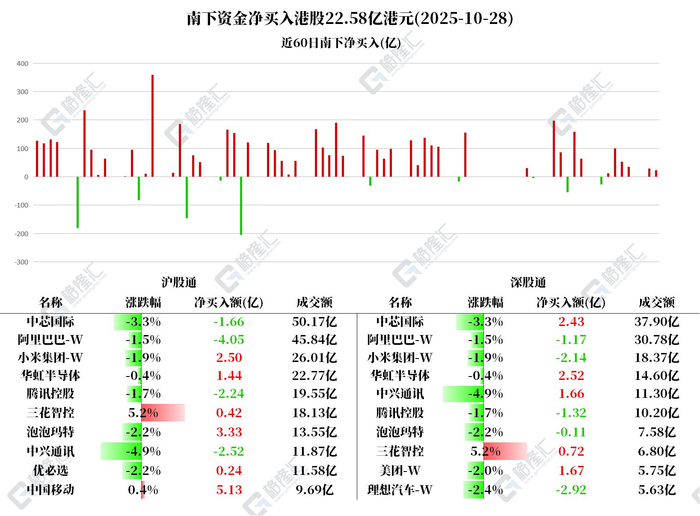
Market Overview - On October 28, the Hang Seng Index fell by 0.33%, closing at 26,346.14 points, while southbound funds through the Stock Connect recorded a net purchase of HKD 2.258 billion [1][3] - The total trading volume for the Stock Connect on the same day was HKD 104.644 billion, with a net purchase of HKD 2.258 billion [1][3] Stock Performance - In the Shanghai Stock Connect, the total trading volume was HKD 65.545 billion, with a net purchase of HKD 1.812 billion; in the Shenzhen Stock Connect, the trading volume was HKD 39.098 billion, with a net purchase of HKD 0.446 billion [1][3] - The most actively traded stock in the Shanghai Stock Connect was SMIC, with a trading volume of HKD 50.17 billion, followed by Alibaba-W and Xiaomi Group-W, with trading volumes of HKD 45.84 billion and HKD 26.01 billion, respectively [1][2] - In terms of net buying, China Mobile led with a net purchase of HKD 0.513 billion, while Alibaba-W had the highest net selling at HKD 0.405 billion, closing down by 1.50% [1][2] Detailed Stock Data - The top ten actively traded stocks in the Shenzhen Stock Connect included SMIC with a trading volume of HKD 37.90 billion, followed by Alibaba-W and Xiaomi Group-W with HKD 30.78 billion and HKD 18.37 billion, respectively [2] - The stock with the highest net purchase was Huahong Semiconductor, with a net purchase of HKD 0.252 billion, while the stock with the highest net selling was Li Auto-W, with a net selling of HKD 0.292 billion [2]




港股通10月28日成交活跃股名单
Zheng Quan Shi Bao Wang· 2025-10-28 15:56
Market Overview - On October 28, the Hang Seng Index fell by 0.33% with a total southbound trading volume of HKD 1,046.44 billion, comprising HKD 534.51 billion in buy transactions and HKD 511.93 billion in sell transactions, resulting in a net buy of HKD 22.58 billion [1] Southbound Trading Activity - The southbound trading through Stock Connect (Shenzhen) recorded a total trading volume of HKD 390.98 billion, with buy transactions at HKD 197.72 billion and sell transactions at HKD 193.26 billion, leading to a net buy of HKD 4.46 billion [1] - The southbound trading through Stock Connect (Shanghai) had a total trading volume of HKD 655.45 billion, with buy transactions at HKD 336.79 billion and sell transactions at HKD 318.67 billion, resulting in a net buy of HKD 18.12 billion [1] Active Stocks - The most actively traded stock by southbound funds was SMIC, with a total trading volume of HKD 88.06 billion, followed by Alibaba-W at HKD 76.62 billion and Xiaomi Group-W at HKD 44.38 billion [1] - In terms of net buying, China Mobile led with a net buy of HKD 5.13 billion, closing up by 0.41%, followed by Huahong Semiconductor with a net buy of HKD 3.96 billion and Pop Mart with HKD 3.23 billion [1] - The stock with the highest net sell was Alibaba-W, with a net sell of HKD 5.23 billion, closing down by 1.50%, followed by Tencent Holdings and Li Auto-W with net sells of HKD 3.56 billion and HKD 2.92 billion respectively [1] Continuous Net Buying - Two stocks, SMIC and Huahong Semiconductor, experienced continuous net buying for more than three days, with SMIC having a net buy of HKD 30.18 billion over six days and Huahong Semiconductor with HKD 14.52 billion over three days [2]



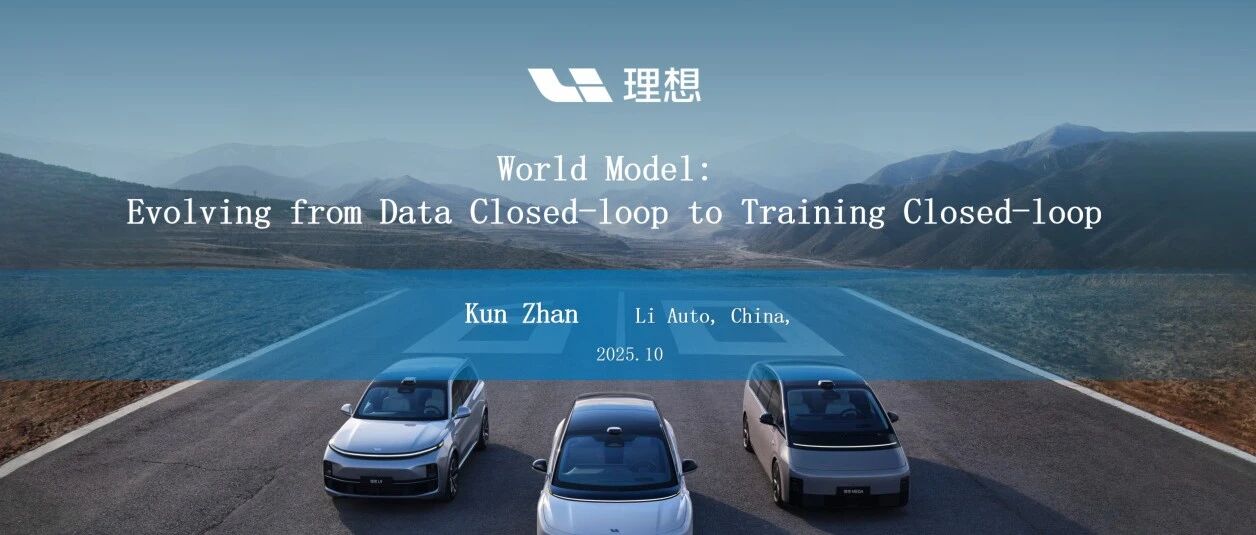
理想詹锟ICCV'25讲世界模型从数据闭环到训练闭环PPT
理想TOP2· 2025-10-28 15:18
Core Insights - The article discusses the evolution of autonomous driving technology, emphasizing the transition from data closed-loop systems to training closed-loop systems, which focus on real-world utility and evaluation of progress [13][14]. Group 1: Data and Infrastructure - The company has accumulated 1.5 billion kilometers of driving data, which is crucial for training autonomous systems [8]. - A closed-loop data system is in place, utilizing over 200 trigger data points for training datasets, with clips ranging from 15 to 45 seconds [8]. - The data scaling law indicates a significant increase in the number of clips used for training, with projections showing up to 600 million clips by 2025 [10]. Group 2: Technology Stack - The key technology stack for autonomous driving includes regional-scale simulation, synthetic data, reinforcement learning, and multimodal generation [18]. - The focus is on enhancing simulation quality through advanced techniques like scene reconstruction and traffic agent modeling [18][19]. - The transition from reconstruction to generation in simulation is highlighted, utilizing diffusion models for improved scene generation [19]. Group 3: Training and Evaluation - The article emphasizes the importance of building a training closed-loop that integrates various models, including VLA (Vision-Language Alignment) and reinforcement learning [15]. - The evaluation environment and reward systems are critical for assessing the performance of autonomous driving systems [14][35]. - Interactive agents are identified as a key challenge in the training closed-loop, necessitating accurate feedback and generalization ability [38][40]. Group 4: Future Directions - The company is working on various projects aimed at enhancing both reconstruction and generation capabilities, with milestones set for 2024 and 2025 [21][24]. - The application of generated data includes scene editing, scene transfer, and scene generation, which are essential for improving the realism of simulations [27][33].
图解丨南下资金连续6日净买入中芯国际,共计30亿港元
Ge Long Hui A P P· 2025-10-28 10:12
Group 1 - Southbound funds net bought Hong Kong stocks worth 2.258 billion HKD today [1] - The top net purchases included China Mobile at 512 million HKD, Hua Hong Semiconductor at 396 million HKD, Pop Mart at 322 million HKD, Meituan-W at 166 million HKD, and Sanhua Intelligent Control at 114 million HKD [1] - The top net sales included Alibaba-W at 522 million HKD, Tencent Holdings at 356 million HKD, and Li Auto-W at 292 million HKD [1] Group 2 - Southbound funds have net bought SMIC for six consecutive days, totaling 3.01773 billion HKD [1]

小鹏汽车港股市值超过理想汽车
Xin Lang Cai Jing· 2025-10-28 04:24
Core Viewpoint - Xiaopeng Motors' stock in Hong Kong has shown strong performance, with a market capitalization reaching 167.4 billion HKD, surpassing Li Auto for the first time [1] Group 1: Stock Performance - Xiaopeng Motors' stock price increased by over 4% during trading, leading to a market capitalization of 167.4 billion HKD [1] - Year-to-date, Xiaopeng Motors' stock has gained more than 80%, significantly outperforming its peers in the industry [2]
理想汽车美股港股市值均被小鹏汽车超越!今年以来小鹏港股涨幅已超过80%
Ge Long Hui· 2025-10-28 04:22
Core Viewpoint - Xiaopeng Motors (9868.HK) has surpassed Li Auto (2015.HK) in market capitalization, reaching HKD 167.4 billion, while Li Auto's market cap stands at HKD 165.7 billion. Xiaopeng's stock has increased over 80% this year [1] Group 1 - Xiaopeng Motors' market capitalization in Hong Kong reached HKD 167.4 billion [1] - Li Auto's market capitalization in Hong Kong is HKD 165.7 billion [1] - Xiaopeng Motors' stock price in the US rose by 6.48% [1] Group 2 - Li Auto's stock price in the US decreased by 1.6% [1] - Xiaopeng Motors' market capitalization in the US is USD 21.981 billion, exceeding Li Auto's USD 21.761 billion by USD 200 million [1]

小鹏汽车市值超过理想汽车
Sou Hu Cai Jing· 2025-10-28 01:28
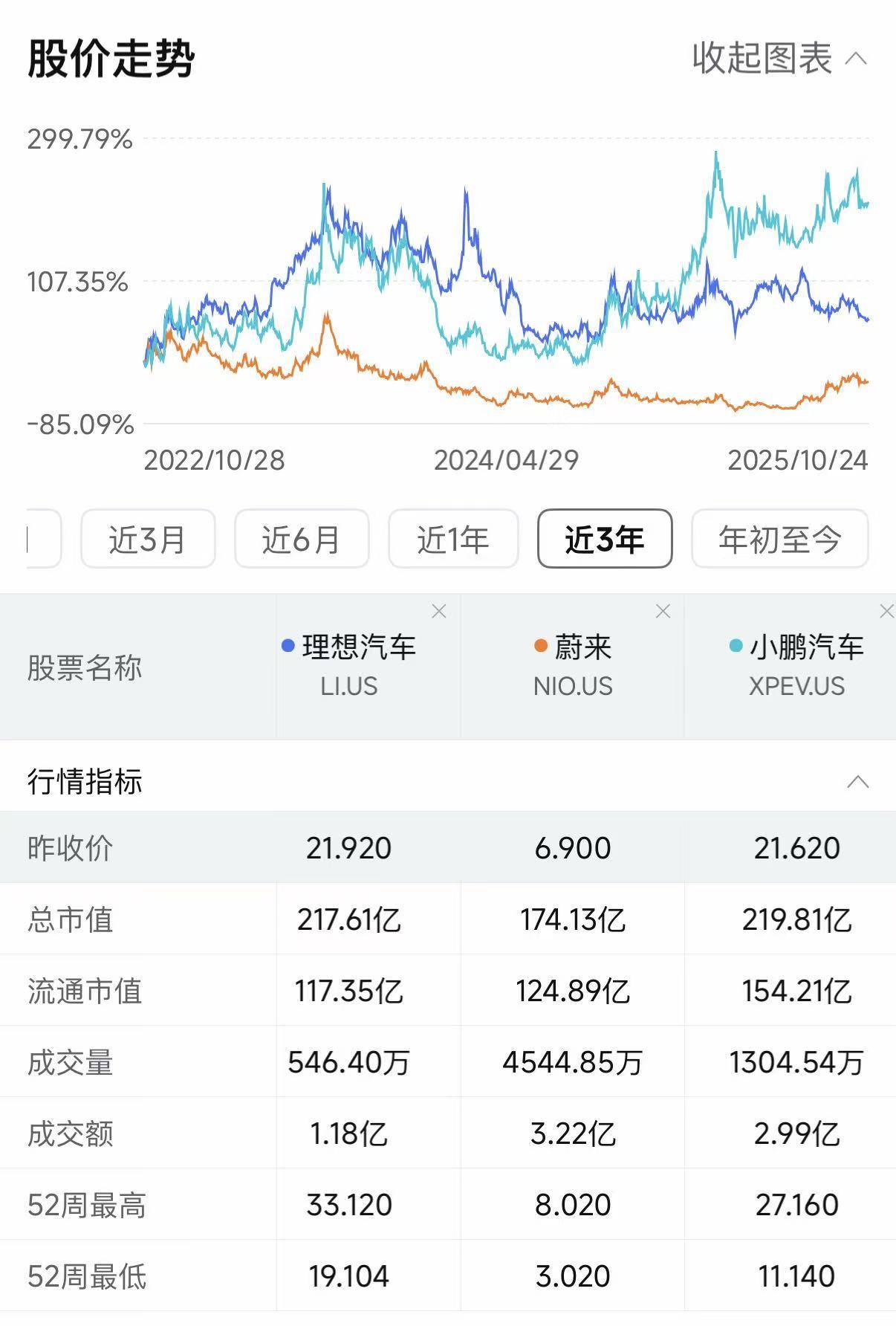
美东时间10月27日美股收盘,蔚小理市值排名出现变化,小鹏汽车219亿美元超过理想汽车的217亿美元,而此前理想汽车曾长时间领先小鹏和蔚来。 从股价走势上也能看出,近一年小鹏上升最为明显,远超蔚来和理想。 | 成父额 | 1.1816 | 5.2216 | 2.49 | | --- | --- | --- | --- | | 52周最高 | 33.120 | 8.020 | 27.16 | | 52周最低 | 19.104 | 3.020 | 11.14 | ...
车企狂抢明年订单,10家车企掏钱补贴购置税,小米理想奇瑞都出手了
3 6 Ke· 2025-10-28 00:30
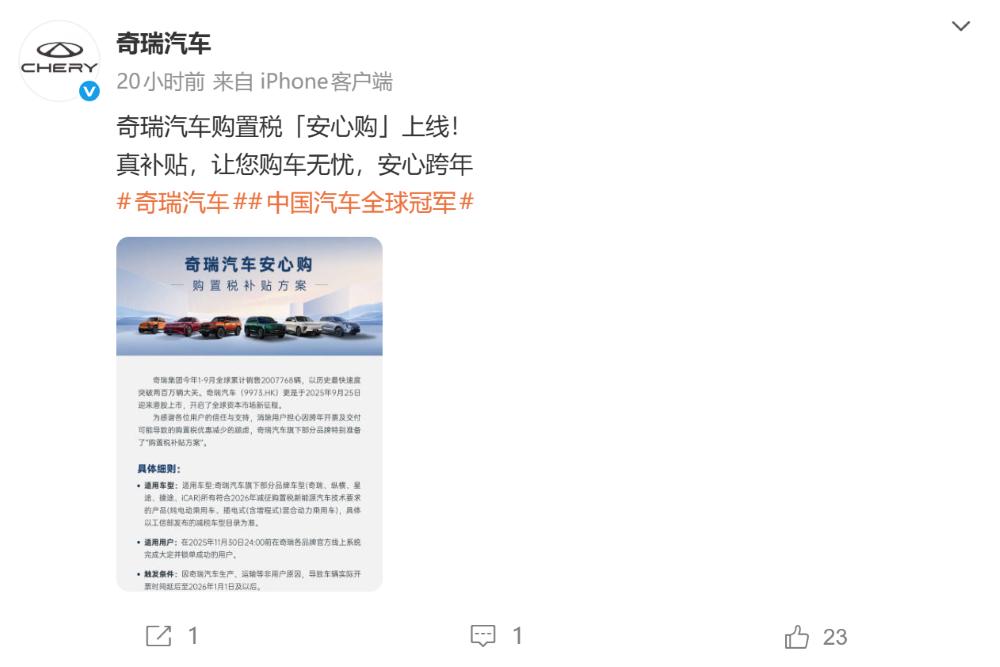
Core Viewpoint - Multiple automotive companies are collectively offering vehicle purchase tax subsidy policies to mitigate the impact of upcoming tax changes on consumers, ensuring that customers do not incur additional costs due to tax adjustments [1][4][24] Group 1: Subsidy Policies - Chery Automobile announced a "安心购" purchase tax subsidy plan, providing full subsidies for eligible users up to 15,000 yuan per vehicle [1][3] - Ten automotive companies have introduced similar purchase tax subsidy policies in recent weeks, indicating a trend among manufacturers to attract customers before the tax changes take effect [3][4] Group 2: Affected Models and Timelines - The subsidy applies to specific models from Chery and other brands that meet the 2026 tax reduction requirements for new energy vehicles [3][4] - The deadline for locking in orders for many of these subsidies is set for the end of November 2025, with some companies like Xiaomi and AITO offering similar deadlines [5][11] Group 3: Market Dynamics - The introduction of these subsidies is a response to the competitive automotive market, where companies are striving to secure orders amid long delivery times for certain models [5][11] - The traditional peak sales season ("金九银十") is influencing companies to launch new models and offer incentives to prevent customer loss due to extended wait times [11][24] Group 4: Tax Policy Changes - The new tax policy, effective from January 1, 2024, will halve the purchase tax for new energy vehicles, leading to increased costs for consumers purchasing vehicles priced above 339,000 yuan [14][19] - Vehicles priced at or below 339,000 yuan will also see increased tax liabilities starting next year, with specific examples illustrating the financial impact on consumers [19][20] Group 5: Competitive Landscape - The collective action of automotive companies to subsidize purchase taxes highlights the intense competition in the market, as they leverage these subsidies as a competitive tool to attract customers [24]


SunCar Announces First Half 2025 Financial Results
Globenewswire· 2025-10-27 20:05
Core Insights - SunCar Technology Group Inc. reported a 9% increase in total revenue to $222.3 million for the first half of 2025, compared to $203.1 million in the same period of 2024 [5][8] - The company achieved a significant increase in EV insurance premiums, which rose by 111.3% to $697.6 million, up from $330.2 million year-over-year [5][8] - SunCar's net loss decreased to $5.5 million in the first half of 2025, a substantial improvement from a net loss of $60.1 million in the prior year [5][8] Financial Performance - Total revenue for the first half of 2025 was $222.3 million, reflecting a 9% increase from $203.1 million in the first half of 2024 [5][8] - Adjusted EBITDA for the first half of 2025 was $2.5 million, down from $6 million in the prior year [5][8] - The company reported a net loss of $5.5 million for the first half of 2025, compared to a net loss of $60.1 million in the same period of 2024 [5][8] Business Highlights - SunCar deepened collaborations with major EV manufacturers, including Tesla, Xiaomi, and NIO, enhancing its insurance offerings and user experience [5][6][9] - The integration of ByteDance's Doubao large language model into SunCar's platform is expected to enhance its AI-driven digitalization efforts [4][5] - The company has initiated innovative auto services projects in partnership with China ZheShang Bank and Shanghai Rural Commercial Bank, expanding its service offerings [5][9] Market Position - SunCar ranked first in China for auto insurance premiums tailored to EV owners, indicating a strong market presence in the growing EV insurance sector [5][8] - Revenue from auto eInsurance services increased by 33% to $97.8 million, driven by strong partnerships with emerging EV OEMs [5][8] - Technology services revenue grew by 11% to $24.3 million, reflecting increased adoption of SunCar's enterprise software tools [5][8] Strategic Outlook - The company is prioritizing profitability and cash generation, withdrawing its previous full-year revenue guidance of $521 million to $539 million [14] - SunCar aims to focus on accounts and partnerships that enhance margins and long-term value, positioning itself for sustainable growth [14]