LI AUTO-W(02015)

Search documents
从 “拒绝代言” 到签约易烊千玺,理想汽车借力明星代言走出转型低谷?
Xin Lang Cai Jing· 2025-09-27 02:56
Core Insights - Li Auto has officially announced Yi Yangqianxi as its brand ambassador, marking a significant shift from its previous stance of not using celebrity endorsements [1][2][4] - The automotive marketing landscape is changing, with new energy vehicle brands increasingly adopting celebrity endorsements to differentiate themselves in a competitive market [4][28] Brand Strategy - Li Auto's decision to hire Yi Yangqianxi aligns with its strategy to appeal to younger consumers, moving away from its previous focus on middle-aged family-oriented branding [21][23] - The company aims to leverage Yi Yangqianxi's popularity to enhance brand recognition and emotional connection with potential customers [4][21] Market Context - The announcement coincided with the launch of the new Li Auto i6, which is positioned in the competitive price range of 250,000 to 300,000 yuan, directly competing with models like Tesla Model Y and Xiaomi Yu7 [10][15] - The i6 is designed to attract younger families and new middle-class consumers, with features such as an 800V high-voltage platform and fast charging technology [13][15] Financial Implications - The endorsement deal with Yi Yangqianxi is expected to be a significant investment, with costs typically in the tens of millions, reflecting the high stakes involved in celebrity marketing [9][16] - Despite the high costs, if the campaign successfully boosts sales, it could be seen as a smart investment for Li Auto, especially given its current financial health with cash reserves of approximately 106.9 billion yuan [27][21] Competitive Landscape - The trend of using celebrity endorsements is not unique to Li Auto; other new energy vehicle brands like NIO and Xpeng are also increasingly engaging celebrities to enhance their marketing efforts [28][4] - The shift towards celebrity endorsements among new energy vehicle brands indicates a broader industry trend where emotional branding is becoming crucial as technical specifications become more standardized [4][28]


从“永不请代言人”到官宣易烊千玺,理想汽车为何“打脸”?
Hu Xiu· 2025-09-27 01:21
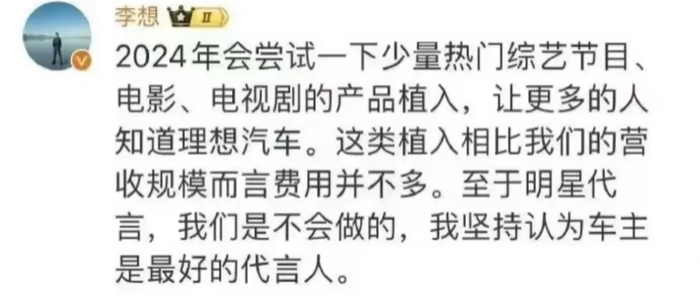
Core Viewpoint - The announcement of Yi Yangqianxi as the brand ambassador for Li Auto marks a significant shift in the company's marketing strategy, moving from a previous stance of not using celebrity endorsements to embracing this classic marketing approach to enhance brand recognition and emotional connection with consumers [1][4][6]. Group 1: Marketing Strategy Shift - Li Auto's founder, Li Xiang, previously stated that car owners are the best ambassadors and that the company would not engage in celebrity endorsements [1][4]. - The automotive marketing landscape is changing, with new energy vehicle brands like Li Auto beginning to adopt celebrity endorsements as a means to differentiate themselves in a market where technical specifications are increasingly homogenized [6][7]. - The choice of Yi Yangqianxi, a popular young actor, aligns with Li Auto's strategy to appeal to younger consumers and families, marking a shift from targeting middle-aged demographics [34][36]. Group 2: Current Challenges and Goals - Li Auto is currently facing challenges in its electric vehicle transition, with recent models like the Li MEGA and Li i8 encountering negative publicity and declining sales [14][18][19]. - The company aims to stabilize monthly sales of its electric models at 18,000 to 20,000 units by the end of the year, with the new Li i6 model expected to contribute significantly to this target [22]. - The marketing push with Yi Yangqianxi is seen as a critical move to counteract previous negative perceptions and boost sales for the newly launched Li i6 [23][24]. Group 3: Financial Implications of Celebrity Endorsement - The cost of hiring Yi Yangqianxi as a brand ambassador is substantial, typically in the tens of millions, but could be justified if it successfully revitalizes sales and brand perception [24][32]. - The effectiveness of celebrity endorsements in driving sales remains uncertain, as consumer purchasing decisions for complex products like cars are influenced by product quality, pricing, and overall value [40][44]. - There are concerns that investing heavily in celebrity endorsements may not yield immediate returns, and some consumers prefer that funds be allocated to vehicle incentives rather than marketing [45][46]. Group 4: Industry Trends - The trend of using celebrity endorsements is becoming more prevalent among new energy vehicle brands, with competitors like NIO and Xpeng also engaging in similar marketing strategies [46][47]. - Li Auto is the first among its peers to officially adopt a celebrity ambassador, while others have utilized "celebrity owners" or "chief experience officers" to promote their brands [47][51]. - The shift towards celebrity endorsements reflects a broader industry trend where brands seek to enhance their appeal to younger consumers and differentiate themselves in a competitive market [70][72].
从半年报看车企销量周期后何时盈亏平衡?
Minmetals Securities· 2025-09-26 23:30
Investment Rating - The investment rating for the automotive industry is "Positive" [1] Core Insights - Since Q2 2024, companies like Geely, Leapmotor, Xiaopeng, and Xiaomi have seen continuous growth in sales and market share, while leading companies have lost market share [5][11] - The growth of new entrants is primarily at the expense of leading companies such as BYD and Tesla, which saw their market shares decrease by 5.1% and 2.3% year-on-year, respectively [5][15] - The scale effect is becoming evident, with Leapmotor and Xiaopeng showing significant improvements in gross margins, reaching 13.6% and 17.3% respectively in Q2 2025, while Xiaomi's gross margin is at 26.4% [5][19] - Companies like Leapmotor, Xiaopeng, and Xiaomi are expected to achieve breakeven on a quarterly basis within the year, with annual sales around 500,000 units likely to lead to single-vehicle profitability [6][24] Sales Trends - The introduction of cost-effective models by Geely, Leapmotor, and Xiaopeng has driven rapid sales growth, with new entrants achieving quarterly sales between 80,000 to 130,000 units [7][11] - The market share of leading companies has been eroded, with a significant portion of growth coming from the exit of weaker competitors [11][15] Revenue Trends - Companies with increasing market shares, such as Geely, Xiaopeng, and Leapmotor, reported revenue growth rates of 41%, 125%, and 166% year-on-year in Q2 2025 [16] - BYD, despite a decline in market share, maintained a revenue growth of 15% year-on-year [16] Gross Margin - The gross margins of new entrants like Xiaopeng and Leapmotor are improving due to scale effects, with margins approaching normal industry levels [19] - Traditional automakers are facing declining gross margins due to the transition to electric vehicles, with some companies like GAC reporting negative margins [19][20] Operating Expenses - Leapmotor and Xiaopeng have seen a significant reduction in per-vehicle operating expenses due to scale effects, with combined R&D, sales, and management expense ratios around 23.9% and 23.1% respectively in Q2 2025 [21] Single Vehicle Profitability - Companies like Xiaopeng and Xiaomi are nearing breakeven points, with Leapmotor already close to breakeven in Q2 2025 [24] - Annual sales of approximately 500,000 units are projected to lead to single-vehicle profitability for these companies [24]





电车需求跟踪8月:以旧换新调整、购置税提前购车共同博弈Q4需求
Minmetals Securities· 2025-09-26 23:30
Investment Rating - The report rates the automotive industry as "Positive" [4] Core Insights - The adjustment of the vehicle replacement policy will slightly weaken demand, but the reduction in vehicle purchase tax will promote early purchases, leading to a competitive demand scenario in Q4. As of September 10, 2025, the number of applications for vehicle replacement reached 8.3 million, indicating a significant policy-driven effect. Despite the adjustments in the replacement policy, the pressure from the tax reduction is expected to encourage consumers to purchase new energy vehicles earlier. The report forecasts that China's new energy vehicle sales will reach 16.25 million units in 2025, representing a year-on-year growth of approximately 26% [2][18]. Monthly Focus - The adjustment of the vehicle replacement policy has increased application difficulty. Since June, applications for vehicle replacement have been suspended due to the exhaustion of funds, but recent funding has led to adjustments in the policy across various regions. The adjustments mainly include changes in application methods and subsidy standards, with some regions reducing the subsidy amount per vehicle [14][15]. - There is a significant funding gap for Q4, as the distribution of funds does not account for seasonal consumption patterns. The central government will allocate 69 billion yuan for Q4, which is the same as Q3, but the demand for vehicle consumption is typically stronger in the second half of the year, leading to an amplified funding gap for Q4 [16][17]. Key Data Tracking - In August, the sales of new energy vehicles in China reached 1.4 million units, a year-on-year increase of 27%. The penetration rate for new energy vehicles was 49%, remaining stable compared to the previous month. However, the sales of plug-in hybrid vehicles (PHEVs) experienced a decline for two consecutive months, primarily due to pressure on sales from major manufacturers [20][28]. - The report highlights that commercial vehicles and exports continue to maintain high growth rates, with new energy commercial vehicle sales in August reaching 70,000 units, a year-on-year increase of 52% [34][35]. - The report also notes that the export of new energy vehicles has been robust, with August exports reaching 224,000 units, a year-on-year increase of 104% [46][48]. Industry and Company Changes - The report indicates progress in the overseas production capacity of automotive companies, with several manufacturers establishing production bases in regions like Brazil and Austria. Additionally, companies like Chery and HeSai have listed on the Hong Kong stock exchange, while Dongfeng Group plans to privatize and spin off its Lantu brand to maintain its listing status [3][45].
热门中概股周四多数下跌
Xin Lang Cai Jing· 2025-09-26 20:09
Group 1 - The majority of popular Chinese concept stocks experienced a decline, with the Nasdaq Golden Dragon China Index falling by 1.56% [1] - Kingsoft Cloud saw an initial drop of over 10%, while Daqo New Energy fell by more than 8% [1] - NIO, Li Auto, Global Data, and Bilibili all recorded declines of at least 4%, whereas New Oriental rose by over 1% and Xpeng increased by 2.5% [1]



港股通净买入105.41亿港元
Zheng Quan Shi Bao Wang· 2025-09-26 15:24
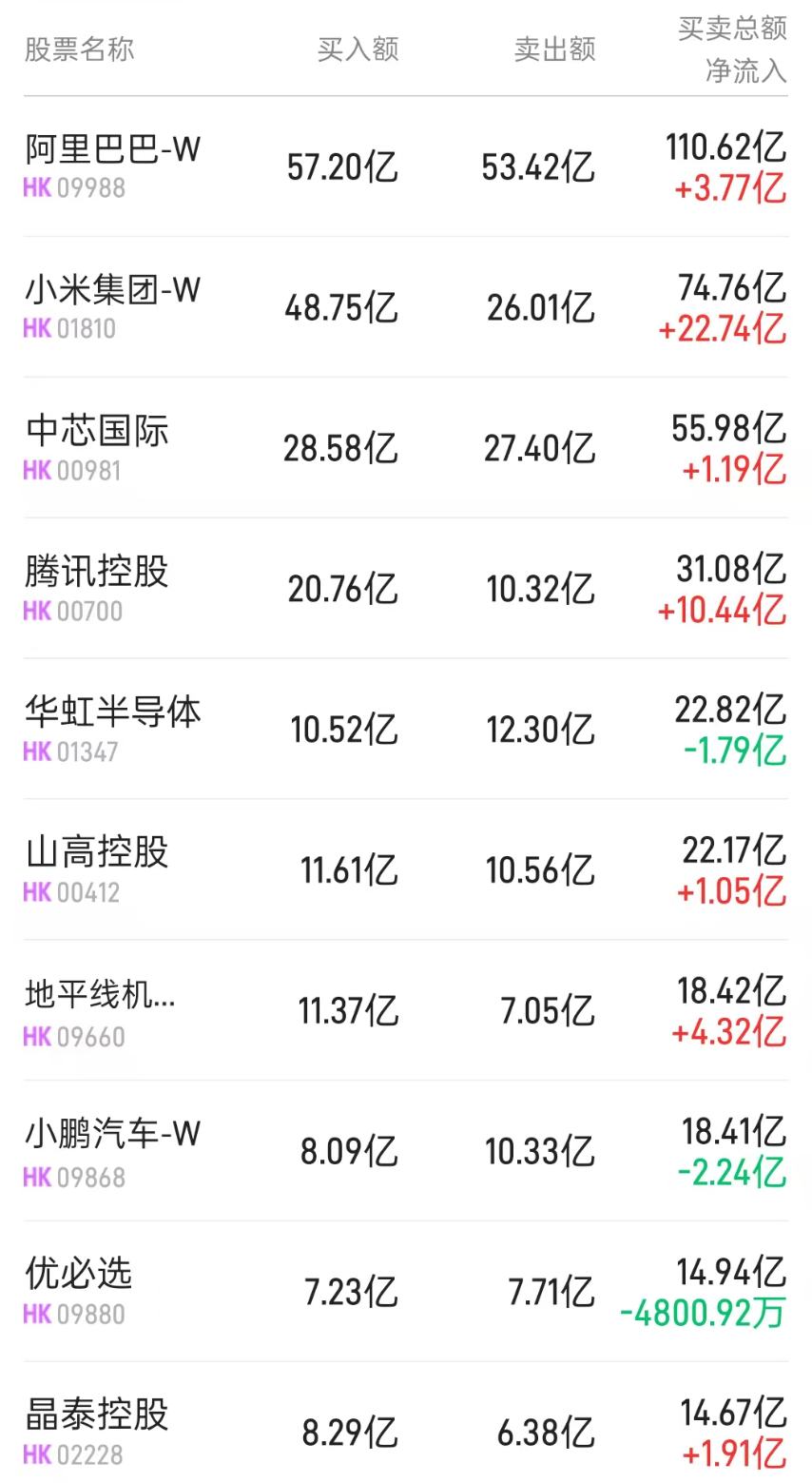
Core Points - The Hang Seng Index fell by 1.35% on September 26, closing at 26,128.20 points, while southbound funds through the Stock Connect recorded a net inflow of HKD 10.541 billion [1] - The total trading volume for the Stock Connect on September 26 was HKD 160.921 billion, with a net buy of HKD 10.541 billion [1] - In the Shanghai Stock Connect, the trading volume was HKD 101.109 billion with a net buy of HKD 7.366 billion, while in the Shenzhen Stock Connect, the trading volume was HKD 59.812 billion with a net buy of HKD 3.174 billion [1] Trading Activity - The most actively traded stock in the Shanghai Stock Connect was Alibaba-W, with a trading volume of HKD 11.062 billion, followed by Xiaomi Group-W and SMIC, with trading volumes of HKD 7.476 billion and HKD 5.598 billion respectively [1] - In terms of net buy amounts, Xiaomi Group-W led with a net buy of HKD 2.274 billion, despite its closing price dropping by 8.07% [1] - The stock with the highest net sell amount was Xpeng Motors-W, with a net sell of HKD 224 million, while its closing price increased by 5.03% [1] Shenzhen Stock Connect Activity - In the Shenzhen Stock Connect, Xiaomi Group-W had the highest trading volume at HKD 6.471 billion, followed closely by Alibaba-W and SMIC, with trading volumes of HKD 6.439 billion and HKD 3.316 billion respectively [2] - Alibaba-W recorded the highest net buy amount in the Shenzhen Stock Connect at HKD 2.035 billion, despite a closing drop of 3.20% [2] - Xiaomi Group-W also had the highest net sell amount in the Shenzhen Stock Connect, with a net sell of HKD 1.669 billion, closing down by 8.07% [2]



理想汽车五座SUV理想i6正式发布,零售价24.98万元起售
Qi Lu Wan Bao· 2025-09-26 13:09
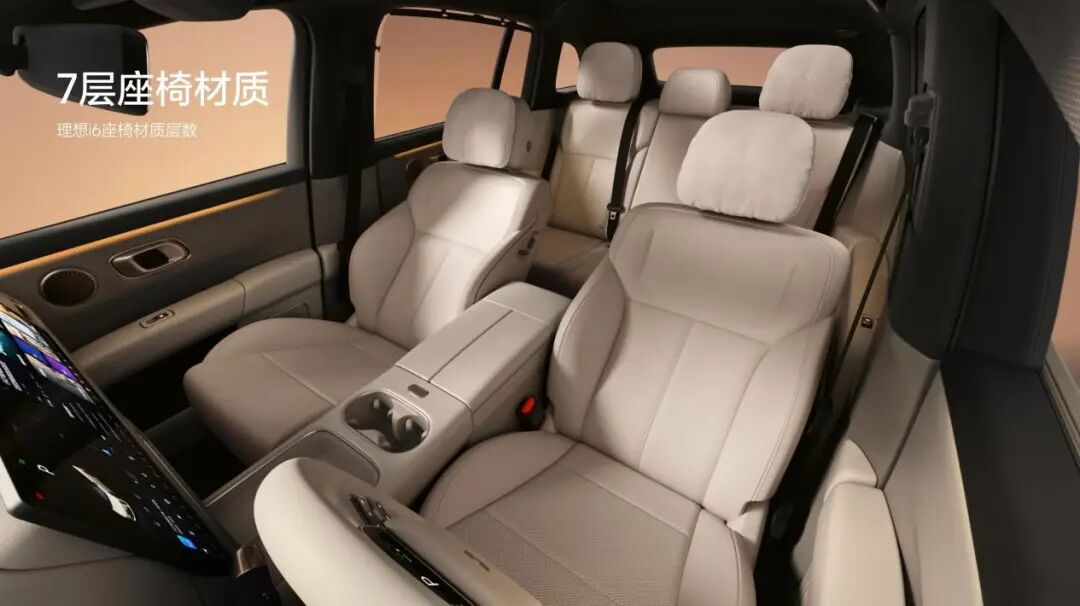
Core Viewpoint - Li Auto officially launched the new five-seat SUV, Li Auto i6, with a nationwide unified price of 249,800 yuan, starting deliveries on September 27 [1] Design and Space - The Li Auto i6 features an original shark-shaped design, emphasizing a sleek body with low wind resistance and energy consumption [2] - Dimensions of the i6 are 4950x1935x1655 mm with a wheelbase of 3000 mm, providing over 3.3 meters of usable interior space [2] - The vehicle includes luxurious seating with seven-layer material, standard ventilation for four seats, heating for five seats, and a ten-point massage function for the front seats [2][4] Comfort and Features - The i6 is equipped with an 8.8-liter smart dual-use refrigerator, a 21.4-inch 3K rear entertainment screen, and platinum audio system, enhancing user comfort [4] - The vehicle offers a "single bed mode" for relaxation, allowing a 1.83-meter tall person to lie down comfortably [4] - The i6 maintains a high level of acoustic performance with 95% soundproofing material coverage and advanced noise cancellation technology [4] Storage and Utility - The i6 features a spacious trunk with a depth of 1.1 meters, accommodating three 28-inch suitcases and two 20-inch suitcases [5] - It includes a front trunk capable of holding a backpack and a standard carry-on suitcase, designed for easy access [5] - The vehicle offers factory towing packages and accessories for outdoor activities, enhancing its utility for users [5] Power and Performance - The i6 is equipped with an 87.3 kWh 5C lithium iron phosphate battery, with a maximum CLTC range of 720 km [7] - It features a self-developed silicon carbide electric drive system with an industry-leading efficiency of 93.08% [7] - The vehicle supports rapid charging capabilities, achieving 500 km of range in just 10 minutes [9] Safety Features - The i6 incorporates over 100 collision development matrices for safety testing, exceeding industry averages [11] - It includes advanced safety features such as full-speed AEB and enhanced automatic emergency steering [13] Intelligent Features - The i6 is equipped with the AD Max advanced driver assistance system and the Li Auto intelligent assistant, enhancing user experience [13] - It features the A2A capability, allowing interaction with external smart systems for services like food ordering [14] Driving Experience - The i6 boasts a premium chassis with independent suspension systems, enhancing both comfort and handling [15] - It achieves a top speed stability rating of 130 km/h in emergency avoidance tests [15] Pricing and Options - The Li Auto i6 is priced at 249,800 yuan, with various optional features available for customization [17] - Customers can enjoy promotional benefits, including cash discounts and free upgrades for early orders [21]
理想汽车牵手易烊千玺,共同讲述从“家庭”到“家”的新故事
Ge Long Hui· 2025-09-26 11:28
9月25日,理想汽车通过官微释放品牌代言人悬念,配文"打破条条框框,创造更好的作品。理想,就是 活成自己喜欢的样子。" 伴随这条文案的是一张代言人剪影与理想i6的合照,引发市场广泛猜测。根据网友推测,这位代言人正 是00后百亿影帝易烊千玺。 9月26日,理想汽车正式官宣易烊千玺成为品牌首位代言人,并与当日上市的理想i6新形态五座SUV同 步亮相。 从新车发布到代言人官宣,理想汽车正通过这一组合拳推进品牌年轻化升级,为资本市场讲述一个超越 传统家庭用户圈层的增长故事。这无疑是理想汽车构建文化信任、重塑价值认同的关键支点,也为投资 者提供了审视其用户增长潜力与品牌溢价能力的全新维度。 一、战略转变:从家庭用户到Z世代的必然选择 在此之前,理想汽车以"家庭用车"这一精准定位迅速崛起,从第一台理想ONE到后面的理想L系列,都 延续了主打家庭用车需求的定位。根据QuestMobile数据,40万元以上高端新能源汽车市场中,31-45岁 用户占比近六成。 而随着理想汽车进一步丰富其车型,逐渐形成"4款增程电动SUV+1款旗舰MPV+2款高压纯电SUV"的产 品矩阵。尤其是理想i6的推出,定位25-30万元的纯电SUV,这 ...
American Lithium Secures Water Reservation Agreement from Tonopah Public Utilities and the Town of Tonopah in Nevada for TLC Project Operations
Globenewswire· 2025-09-26 11:00
Core Points - American Lithium Corp. has signed a binding Water Reservation Agreement with the Town of Tonopah and Tonopah Public Utilities for its wholly-owned subsidiary, Tonopah Lithium Corp., to secure water resources for the TLC Project in Nye County, Nevada [1][4] - The TLC Project is one of the largest lithium-bearing claystone deposits in North America, with a two-phased development approach planned [3][5] - The agreement includes a commitment of $200,000 to support local infrastructure and educational initiatives in Tonopah [4][6] Water Supply Agreement Details - The agreement reserves 900 to 1,250 gallons per minute (1,450 to 2,000 acre-feet annually) of water for TLC, contingent on hydrology and engineering studies [6] - TLC will conduct studies to confirm sustainable pumping rates and will be responsible for constructing necessary water delivery infrastructure [6] - The initial term of the water reservation is three years, with options for up to seven additional one-year renewals [6] Project Development Phases - Phase 1 of the TLC Project aims for a nominal production of approximately 24,000 tonnes per year of lithium carbonate equivalent (LCE) [6] - Phase 2 plans to expand production to a nominal 48,000 tonnes per year of LCE, positioning TLC among the largest lithium operations in the U.S. [6]
北水动向|北水成交净买入105.41亿 北水无惧巨额配售 全天抢筹地平线机器人(09660)超8亿港元
智通财经网· 2025-09-26 10:07
Core Insights - The Hong Kong stock market saw a net inflow of 10.541 billion HKD from Northbound trading on September 26, with the Shanghai Stock Connect contributing 7.366 billion HKD and the Shenzhen Stock Connect contributing 3.174 billion HKD [1] Group 1: Stock Performance - Alibaba-W (09988) received the highest net inflow of 5.720 billion HKD, with total trading volume of 11.062 billion HKD, reflecting a net increase of 3.77 billion HKD [2] - Horizon Robotics-W (09660) attracted a net inflow of 8.63 billion HKD, with plans to use proceeds from a share placement to expand overseas market operations and invest in emerging fields [5] - Tencent (00700) saw a net inflow of 7.92 billion HKD, supported by its global digital ecosystem conference focusing on AI and internationalization [5] - Xiaomi Group-W (01810) recorded a net inflow of 6.05 billion HKD, despite a stock price drop following a product launch event [5] Group 2: Market Trends - Northbound trading has shown a strong interest in technology and AI-related stocks, with significant inflows into companies like Alibaba and Horizon Robotics, indicating a growing demand for digital transformation and AI solutions [4][5] - The semiconductor sector faced selling pressure, with SMIC (00981) and Hua Hong Semiconductor (01347) experiencing net outflows of 1.45 billion HKD and 2.12 billion HKD respectively, amid concerns over U.S. government regulations on semiconductor production [6]