
BANK COMM(03328)

Search documents
交通银行新疆分行被罚没259万 违反征信管理规定等
Zhong Guo Jing Ji Wang· 2026-03-02 09:21
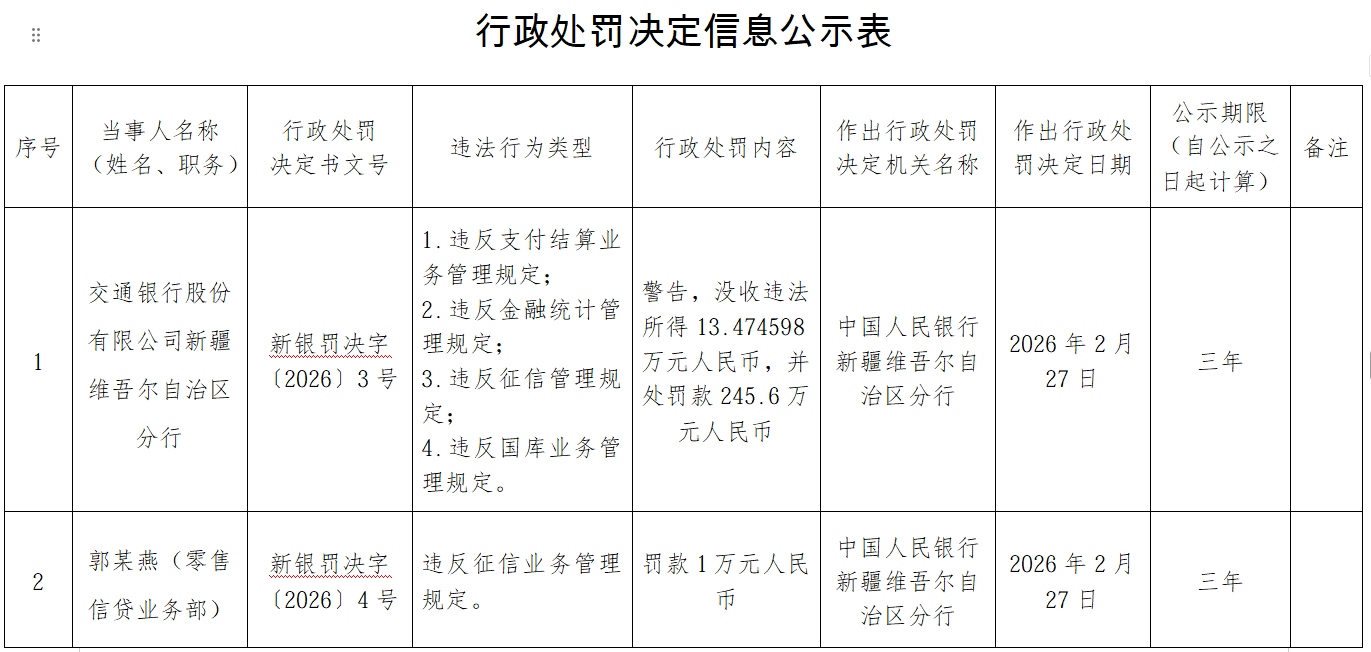
Core Viewpoint - The People's Bank of China (PBOC) Xinjiang Uygur Autonomous Region branch has issued administrative penalties against the Bank of Communications Xinjiang branch for multiple regulatory violations, resulting in a total fine of 2.5907 million RMB [1][3]. Group 1: Violations by Bank of Communications - The Bank of Communications Xinjiang branch was found to have violated several regulations, including payment settlement management, financial statistics management, credit management, and treasury business management [1][3]. - The total penalties imposed on the Bank of Communications include the confiscation of illegal gains amounting to 134,745.98 RMB and a fine of 2,456,000 RMB, leading to a total penalty of 2,590,700 RMB [1][3]. Group 2: Individual Penalty - An individual named Guo Mouyan, from the retail credit business department, was penalized for violating credit business management regulations, resulting in a fine of 10,000 RMB [1][3].


交通银行(03328) - 月报表 - 截至二零二六年二月二十八日止股份发行人的证券变动月报表
2026-03-02 08:30
FF301 股份發行人及根據《上市規則》第十九B章上市的香港預託證券發行人的證券變動月報表 截至月份: 2026年2月28日 狀態: 新提交 呈交日期: 2026年3月2日 I. 法定/註冊股本變動 | 1. 股份分類 | 普通股 | 股份類別 | H | | 於香港聯交所上市 (註1) | | 是 | | | --- | --- | --- | --- | --- | --- | --- | --- | --- | | 證券代號 (如上市) | 03328 | 說明 | H股 | | | | | | | | | 法定/註冊股份數目 | | | 面值 | | 法定/註冊股本 | | | 上月底結存 | | | 35,011,862,630 | RMB | | 1 RMB | | 35,011,862,630 | | 增加 / 減少 (-) | | | | | | RMB | | | | 本月底結存 | | | 35,011,862,630 | RMB | | 1 RMB | | 35,011,862,630 | | 2. 股份分類 | 普通股 | 股份類別 | A | | 於香港聯交所上市 (註1) | | ...
汇率政策组合拳如何影响流动性?
GF SECURITIES· 2026-03-02 03:26
Investment Rating - The industry investment rating is "Buy" [2] Core Insights - The central theme of the report discusses the impact of recent currency policies on liquidity, specifically focusing on the People's Bank of China's (PBOC) measures to adjust the foreign exchange risk reserve ratio and its implications for cross-border liquidity [13][22] - The report highlights that the PBOC's recent policies aim to stabilize the RMB's exchange rate and enhance the liquidity of the offshore RMB market, which is expected to support the internationalization of the RMB [16][22] Summary by Sections 1. Current Observations: How Currency Policies Affect Liquidity - The PBOC introduced two key policies: a notification regarding RMB cross-border interbank financing and a reduction of the foreign exchange risk reserve ratio for forward foreign exchange transactions from 20% to 0% [13][18] - RMB cross-border interbank financing is crucial for providing RMB liquidity to offshore markets, with the potential net outflow limit estimated at approximately 1.79 trillion CNY, significantly higher than the current balance of about 1,942 billion CNY [16][17] 2. Forward Foreign Exchange Business - The adjustment of the foreign exchange risk reserve ratio is designed to lower the costs associated with forward foreign exchange transactions, thereby increasing demand in the forward market and countering expectations of RMB appreciation [18][19] 3. Outlook on Cross-Border Liquidity - The report anticipates that while speculative inflows may slow down, the demand for foreign investment in RMB-denominated assets will remain robust, driven by fundamentals, returns, and safety differentials [22][23] - It is expected that the increase in interbank lending will tighten liquidity in the banking sector, prompting the PBOC to potentially implement additional liquidity measures through government bond transactions and open market operations [23]




银行资负跟踪20260302:月末票据利率反弹,大行净买入同比增量回落
GF SECURITIES· 2026-03-02 03:06
Investment Rating - The industry investment rating is "Buy" [2] Core Views - The report highlights a rebound in month-end bill rates, with a significant decrease in net purchases by major banks year-on-year [1][14] - The central bank's operations included a total of CNY 16,410 billion in 7-day reverse repos at a rate of 1.40%, with a net withdrawal of CNY 4,614 billion [14] - The report anticipates continued flexibility in central bank operations to stabilize liquidity fluctuations, especially with important meetings approaching [14][21] Summary by Sections Section 1: Month-End Bill Rate Rebound - The overall liquidity in the market is balanced due to post-holiday fund recovery and tax payments [14] - Major banks' net purchases of bills have significantly decreased, with only an increase of approximately CNY 320 billion year-on-year as of February 27 [17] Section 2: Central Bank Dynamics and Market Rates - The central bank's MLF (Medium-term Lending Facility) increased by CNY 6,000 billion, continuing to inject long-term liquidity into the market [14] - The end-of-period rates for DR001 and DR007 were 1.32% and 1.50%, reflecting increases of 0.68bp and 18.23bp respectively [15] Section 3: Bank Financing Tracking - The total outstanding amount of interbank certificates of deposit (NCD) reached CNY 18.77 trillion, with a weighted average issuance rate of 1.59% [19] - The issuance of interbank certificates of deposit for the period was CNY 4,545 billion, with a completion rate of 93.3% [19]
流动性观察第 122 期:当同业存款定价再自律
EBSCN· 2026-03-01 10:58
Investment Rating - The report maintains a "Buy" rating for the banking industry, indicating an expected investment return exceeding the market benchmark index by over 15% in the next 6-12 months [1]. Core Insights - The report discusses the implementation of a self-regulatory mechanism for interbank deposit pricing, which aims to manage liquidity and stabilize the banking sector's cost of liabilities. The focus has shifted from merely controlling the scale of interbank liabilities to regulating pricing behavior [4][5][6]. - The introduction of self-regulation for non-bank interbank demand deposit rates is expected to enhance the efficiency of monetary policy transmission and alleviate pressure on bank interest margins [6][9]. - The report highlights the historical evolution of interbank liability management, emphasizing the transition from risk prevention to cost control, and outlines the regulatory framework established over the past decade [4][5][6]. Summary by Sections Regulatory History Review - The regulatory framework for interbank liabilities has evolved through three main phases: establishing a risk prevention framework, deepening regulation to reduce leverage and prevent fund turnover, and focusing on cost control through pricing management [4][5][6]. Cost Management of Interbank Liabilities - The report notes that the cost of interbank liabilities remains relatively high, with significant room for further reduction. The average cost of interbank liabilities for state-owned banks was reported at 2.01%, compared to 1.52% for deposits, indicating a 48 basis point spread [13][20]. - The report emphasizes the need for enhanced management of interbank deposit pricing, particularly for time deposits, which currently do not fall under self-regulatory constraints [20][21]. Future Pathways for Self-Regulation - The report suggests that future regulatory measures may include setting upper limits on the scale of interbank demand deposits priced above self-regulatory levels and implementing self-regulation for time deposit rates [22][25]. - Preliminary estimates indicate that the self-regulation of interbank time deposits could lead to a reduction in interest expenses for banks, improving net interest margins by approximately 2 basis points [25][29]. Impact on Wealth Management Products - The report assesses the impact of interbank deposit self-regulation on wealth management products, indicating that the influence on net asset values is relatively limited due to the diverse nature of interbank deposit configurations [34][37]. - It highlights that wealth management products will continue to maintain a strong allocation to deposit-like assets, with expected fluctuations in allocation ratios [34][37].


中科江南中标:交通银行山西省分行财政专户业务电子化项目结果公告(包件一)
Sou Hu Cai Jing· 2026-03-01 03:27
Group 1 - The core point of the article is that Beijing Zhongke Jiangnan Information Technology Co., Ltd. has won the bid for the electronic project of fiscal special accounts for the Shanxi branch of the Bank of Communications, with a bid amount of 2,880,000 [1][2] - The project announcement was published on February 27, 2026, indicating the ongoing digital transformation efforts within the banking sector [2] - Beijing Zhongke Jiangnan Information Technology Co., Ltd. has made investments in 12 companies and participated in 7,277 bidding projects, showcasing its active role in the industry [1] Group 2 - The company holds 114 trademark registrations, 62 patents, and 165 copyrights, indicating a strong intellectual property portfolio [1] - The company has obtained 7 administrative licenses, which may enhance its operational capabilities [1]
交通银行新疆维吾尔自治区分行被罚45.6万元:违反支付结算业务管理规定等
Xin Lang Cai Jing· 2026-02-28 13:22
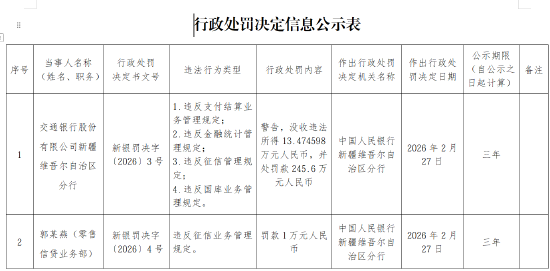
2月28日金融一线消息,中国人民银行新疆维吾尔自治区分行行政处罚信息公开表显示,交通银行股份 有限公司新疆维吾尔自治区分行因违反支付结算业务管理规定、违反金融统计管理规定、违反征信管理 规定、违反国库业务管理规定,被警告,没收违法所得13.47万元,并处罚款245.6万元。同时,郭某燕 (时任零售信贷业务部)因违反征信业务管理规定,被罚款1万元。 | = | | | | 行政处罚决定信息公示表 | | | | | --- | --- | --- | --- | --- | --- | --- | --- | | 印波 | 当事人名称 | 行政处罚 | 进发行为类型 | 行政处罚内容 | 作出行政处罚 | 作出行政处 | 公示期限 (自公示之 各注 | | | (姓名、职务) | 决定书文号 | | | 决定机关名称 | 罚决定日期 | 日起十篇) | | | 交通银行股份 | | 1. 通反支付结算业 务管理规定: | 警告,没收违法 | | | | | | | | 2. 违反金融统计管 | 所得 13.474598 | 中国人民银行 | | | | | 有限公司新疆 | 新银罚决学 | 理规定: | 万元人 ...
涉嫌严重违纪违法,交通银行上海市分行营业部原副总经理梁斌被查
Bei Jing Shang Bao· 2026-02-28 10:38
北京商报讯(记者 孟凡霞 周义力)2月28日,据交通银行上海市分行纪委、上海市黄浦区纪委监委消 息:交通银行上海市分行营业部原副总经理梁斌涉嫌严重违纪违法,目前正在接受交通银行上海市分行 纪律检查委员会纪律审查和黄浦区监察委员会监察调查。 ...
交通银行上海市分行营业部原副总经理梁斌涉嫌严重违纪违法被查
Xin Lang Cai Jing· 2026-02-28 10:02
责任编辑:王馨茹 责任编辑:王馨茹 2月28日金融一线消息,据交通银行上海市分行纪委、上海市黄浦区纪委监委消息:交通银行上海市分 行营业部原副总经理梁斌涉嫌严重违纪违法,目前正在接受交通银行上海市分行纪律检查委员会纪律审 查和黄浦区监察委员会监察调查。 2月28日金融一线消息,据交通银行上海市分行纪委、上海市黄浦区纪委监委消息:交通银行上海市分 行营业部原副总经理梁斌涉嫌严重违纪违法,目前正在接受交通银行上海市分行纪律检查委员会纪律审 查和黄浦区监察委员会监察调查。 ...
交通银行:上调个人客户上金所延期合约保证金比例至100%
Jin Rong Jie· 2026-02-28 08:08
Core Viewpoint - The Bank of Communications has announced an adjustment to the margin ratio for personal clients trading in gold and silver contracts due to increased volatility in domestic and international precious metal prices, aiming to protect investor interests [1] Group 1: Margin Ratio Adjustment - Starting from the close of trading on March 2, 2026, the margin ratio for personal clients trading in Au (T+D), mAu (T+D), and Ag (T+D) contracts will be increased from 80% to 100% [1] - This adjustment follows a previous increase on February 11, when the margin ratio was raised from 60% to 80% for the same contracts [1] Group 2: Risk Management Advisory - The Bank of Communications advises clients to invest rationally within their risk tolerance and to manage their positions carefully to mitigate market risks [1]