CITIC Securities Co., Ltd.(06030)

Search documents
港股概念追踪|证券板块估值处于历史低位 防御反弹攻守兼备(附概念股)
智通财经网· 2026-02-04 01:07
Group 1 - The core viewpoint of the articles highlights the strong performance expectations for listed securities firms in 2025, with major firms like CITIC Securities and Guotai Junan maintaining their market leadership [1][2] - As of January 30, 2025, 21 listed securities firms have disclosed their performance forecasts, with CITIC Securities expected to achieve a net profit exceeding 30 billion yuan and Guotai Haitong projecting a year-on-year net profit growth rate exceeding 100% [1] - Smaller securities firms are anticipated to show even greater profit elasticity, with Guolian Minsheng forecasting a year-on-year net profit growth rate exceeding 400% for 2025 [1] Group 2 - Brokerage and proprietary trading businesses are identified as the core drivers of performance growth for these listed securities firms in 2025 [2] - The A-share market is expected to remain active in 2025, with a high level of performance in the securities industry, suggesting investment opportunities in the sector [2] - Factors such as a stable growth policy, a conducive capital market environment, and the restoration of investor confidence are expected to drive the upward trend in the securities sector [2] Group 3 - The current valuation of the securities sector is at a historical low, presenting a defensive rebound opportunity [2] - It is recommended to focus on leading securities firms with strong overall capabilities and those with differentiated competitive advantages in wealth management, proprietary trading, and cross-border business [2] - Related concepts in the Hong Kong stock market include Huatai Securities, GF Securities, China Galaxy, Guotai Haitong, CICC, CITIC Securities, and others [3]
中信证券:多重因素共振 餐饮行业上行拐点可期
智通财经网· 2026-02-04 00:33
Core Viewpoint - The current restaurant industry is experiencing a phase of "marginal improvement in fundamentals—continuous policy support—price mechanism recovery—valuation uplift" driven by multiple factors [1] Industry - Since the second half of 2025, the restaurant industry has shown a trend of marginal improvement, with retail dining revenue increasing by 3.8%, 3.2%, and 2.2% year-on-year in October to December 2025, significantly outpacing overall retail growth [1] - The growth rate of the total number of food outlets nationwide has decreased compared to the first half of 2025, indicating a reduction in industry competition, which creates a more favorable environment for existing businesses to recover and improve profitability [1] - Major segments such as fast food, tea drinks, coffee, and Western cuisine have shown positive same-store sales growth, with leading companies demonstrating stronger operational resilience due to supply chain advantages, brand strength, and management capabilities [1] Policy - The restaurant sector is a key beneficiary of consumption stimulus policies due to its characteristics of high frequency, daily consumption, low single transaction amounts, and short decision-making chains [2] - Historical data shows that after the issuance of dining consumption vouchers in Shanghai, the year-on-year decline in retail dining revenue significantly narrowed, indicating effective policy execution [2] - If more consumption policies are introduced, the restaurant industry is expected to be a high-probability beneficiary, with improvements likely reflected in short-term operational data [2] Price - Since the fourth quarter of 2025, there have been signs of improvement in the Consumer Price Index (CPI), with the government aiming to "promote a reasonable recovery of prices" as a key macroeconomic goal [3] - Leading companies have begun to implement price adjustments through menu optimization and selective price increases, demonstrating their pricing power and the resilience of end-demand [3] - Historical experience suggests that fluctuations in raw material prices primarily have a short-term impact on restaurant companies' gross margins rather than long-term suppression [3] Valuation - Drawing from overseas experiences in Japan and the United States, CPI is a significant variable affecting restaurant sector valuations [4] - During periods of declining CPI or deflation, increased price competition and weak demand expectations tend to suppress restaurant valuations, while a recovery in CPI and improved inflation expectations can enhance long-term growth prospects and drive valuation recovery [4] - Leading restaurant companies, with stronger supply chains and management capabilities, are expected to see systematic valuation uplifts as the pricing environment improves [4] Investment Strategy - The restaurant industry is gradually entering a recovery phase driven by multiple factors [5] - Since the second half of 2025, retail dining revenue and same-store performance across major restaurant formats have improved, while the pace of new supply has slowed, reducing competitive intensity [5] - The importance of service consumption in the growth stabilization framework continues to rise, with the restaurant sector being a direct beneficiary of consumption stimulus policies [6] - As the government promotes a reasonable recovery of prices, restaurant companies are gradually implementing price adjustments, with historical data indicating that raw material cost fluctuations have a more temporary impact on profitability [6] - Overall, the industry is transitioning to a recovery phase primarily driven by fundamental improvements, with a positive mid-term outlook [6]

中信证券:电子元件涨价浪潮有望不断蔓延 推荐关注存储等在涨价趋势中受益确定性最高的环节
智通财经网· 2026-02-04 00:33
Core Viewpoint - The electronic components industry is experiencing a price increase across various segments, driven by strong downstream demand and rising upstream metal prices, with a recommendation to focus on segments like storage, CCL, BT substrates, wafer foundry, and packaging that are likely to benefit from this trend [1][2]. Downstream Demand - Downstream customer inventory replenishment is stronger than expected, with AI and automotive sectors driving demand despite pressures on automotive sales. The localization of upstream components is accelerating, and low inventory levels among downstream customers are contributing to strong replenishment motivation [2][3]. - Advanced packaging and storage expansions are occupying mature process capacities, leading to increased demand for replenishment from downstream customers [2]. Upstream Costs - Key raw materials for electronic manufacturing, including gold, silver, and copper, are experiencing significant price increases, with futures prices expected to rise by over 50% for gold, 150% for silver, and 50% for copper by 2025 [2]. Midstream Components - Since the downturn in 2022, many segments within the electronic components industry have maintained relatively low profit margins, creating a strong demand for price increases amid tight supply and rising costs [3]. - Price increase notices have been observed across various segments, including storage, CCL, BT substrates, wafer foundry, packaging testing, LED, power devices, analog chips, and passive components, with some segments experiencing multiple rounds of price hikes [3]. Specific Segment Insights - **Storage**: The AI supercycle is causing ongoing shortages, with TrendForce predicting a 55%-60% increase in traditional DRAM contract prices and a 33%-38% increase in NAND Flash contract prices by Q1 2026, with some NAND modules already increasing by over 40% this year [4]. - **CCL**: The latest round of price increases is expected to take effect by December 2025, supported by low industry inventory levels [4]. - **Wafer Foundry**: High utilization rates are reported, with some categories already seeing price increases, and the trend of advanced packaging and storage expansions affecting mature process capacities is beneficial for domestic supply-demand dynamics [4]. - **Packaging Testing**: High utilization rates (80%-90%) are noted among major companies, with some clients actively requesting price increases to secure capacity [4]. - **Analog Chips**: Strong demand from automotive and industrial sectors is driving price increases, with domestic design companies also showing willingness to raise prices [5]. - **Power Devices**: Strong price increase momentum is observed for mid-low voltage products, with extended delivery times reported [5]. - **SoC**: Initial price increases for internal storage SoC products are expected to enhance market share and profitability for leading manufacturers [5]. - **MCU**: A price increase of 15%-50% for MCU and Nor Flash products is set to take effect on January 27, 2026 [5].
中信证券:多重因素共振,餐饮行业上行拐点可期
Xin Lang Cai Jing· 2026-02-04 00:31
Core Viewpoint - The current restaurant industry is in a phase of "marginal improvement in fundamentals - continuous policy support - price mechanism recovery - potential valuation uplift" driven by multiple factors [1] Group 1: Operational Aspects - Since the second half of 2025, the retail dining revenue and same-store performance in major restaurant segments have shown continuous recovery [1] - The pace of supply expansion has slowed down, leading to a marginal decrease in industry competition intensity, which provides a more favorable external environment for business recovery and profit improvement [1] Group 2: Policy Environment - The direction of service consumption continues to strengthen, with the restaurant sector benefiting significantly from consumption stimulus policies due to its high frequency, strong scenarios, and short decision-making chains [1] Group 3: Pricing Dynamics - In the context of the government's clear push for reasonable price recovery, restaurant companies have begun to implement price adjustments [1] - Historical experience indicates that cost disturbances tend to have a more pronounced short-term impact, while medium to long-term gross margins are expected to recover and improve [1] Group 4: Valuation Trends - Drawing from overseas experiences, improvements in inflation expectations often lead to a rebound in the valuation center of the restaurant sector [1] - The restaurant industry is developing towards a more positive recovery direction under the influence of fundamentals, policies, prices, and valuations [1]
非银金融行业周报:上市券商2025年业绩密集预喜,险资加码养老科创
东方财富· 2026-02-04 00:30
Investment Rating - The report maintains an "Outperform" rating for the non-bank financial sector, indicating a positive outlook for investment opportunities in this industry [2]. Core Insights - The report highlights that over 20 A-share listed brokerages have released positive earnings forecasts for 2025, with many expected to double their profits. Major firms like CITIC Securities and Guotai Junan are projected to achieve net profits exceeding 100 billion CNY [13][14]. - The insurance sector is seeing increased investment in pension and technology innovation, with a significant shift towards equity investments due to declining interest rates and new accounting standards. By the end of 2024, insurance equity investment assets are expected to reach 1.92 trillion CNY, a year-on-year increase of nearly 13% [40][41]. Summary by Sections 1. Securities Business Overview and Weekly Review - As of January 30, 2026, more than 20 A-share listed brokerages have issued earnings forecasts for 2025, with most reporting year-on-year profit growth. Notably, CITIC Securities is expected to achieve a net profit of 300.51 billion CNY, a 38.46% increase [13][14]. - The report anticipates a favorable performance for the securities industry in 2025, driven by a recovery in both primary and secondary markets [13]. 2. Insurance Business Overview and Weekly Review - Insurance capital is increasingly directed towards pension and technology sectors, with significant investments in healthcare and elderly care. By the end of 2025, the market size of China's health and elderly care industry is projected to reach 9.8 trillion CNY [41][42]. - Major insurance companies are establishing specialized health management subsidiaries to enhance service offerings and customer retention, aiming to create a second growth curve through a "product + service" model [42]. 3. Market Liquidity Tracking - The report notes that the central bank conducted a net injection of 530.5 billion CNY in the open market during the week of January 26-30, 2026, indicating a proactive approach to managing liquidity in the financial system [47].


南方中证全指红利质量交易型开放式指数证券投资基金基金份额发售公告
Zhong Guo Zheng Quan Bao - Zhong Zheng Wang· 2026-02-03 22:28
Fund Overview - The fund is named "Southern CSI All Share Dividend Quality ETF" and is categorized as an equity fund with an open-ended trading structure [11] - The fund's management company is Southern Fund Management Co., Ltd., and the custodian is CITIC Securities Co., Ltd. [11][42] - The fund will be available for subscription from February 26, 2026, to March 12, 2026 [4][18] Subscription Details - Investors can choose between online cash subscription and offline cash subscription, both available during the same period [18] - The minimum subscription amount for online cash subscription is 1,000 shares or multiples thereof, while for offline cash subscription, it is 100,000 shares or more when subscribed through the fund manager [5][33] - Subscription fees will not exceed 0.30% [19] Fund Management and Operations - The fund aims to track the CSI All Share Dividend Quality Index, and its performance will closely relate to the index's performance [20] - The fund will be subject to a maximum fundraising limit, with specific details to be announced in other announcements [2] - The fund's net asset value may fluctuate due to market conditions, and investors are encouraged to understand the fund's characteristics before investing [20] Investor Requirements - Investors must have a Shanghai Stock Exchange A-share account or a fund account to subscribe [10][22] - New investors are advised to open their accounts at least two working days before the subscription period [24] - The fund's subscription process requires sufficient funds to be deposited in the investor's account prior to subscription [30] Fund Contract and Verification - The fund contract will become effective once the fundraising conditions are met, including a minimum of 200 investors and a total fundraising amount of at least 200 million RMB [16][40] - If the fundraising conditions are not met by the end of the subscription period, the fund manager will return the funds to investors with interest [41]
非银金融行业周报:上市券商2025年业绩密集预喜,险资加码养老科创-20260203
East Money Securities· 2026-02-03 14:22
Investment Rating - The report maintains an investment rating of "Outperform" for the non-bank financial sector, indicating a positive outlook for the industry [2]. Core Insights - The report highlights that over 20 A-share listed brokerages have released performance forecasts for 2025, with most expected to achieve year-on-year profit growth, and several are projected to double their profits [13][14]. - The insurance sector is increasingly focusing on pension and technology innovation investments, with significant capital being allocated to these areas, indicating a shift towards building a health and pension ecosystem [40][41]. Summary by Sections 1. Securities Business Overview and Weekly Review - As of January 30, 2026, more than 20 A-share listed brokerages have issued performance forecasts for 2025, with most reporting positive year-on-year growth in net profit. Notably, major brokerages like CITIC Securities and Guotai Junan are expected to exceed 10 billion CNY in net profit [13][14]. - The report anticipates a favorable performance for the securities industry in 2025, driven by a recovery in both primary and secondary markets, as well as a rebound in margin financing [13]. 2. Insurance Business Overview and Weekly Review - Insurance capital is increasingly directed towards diverse equity investments, with the total equity investment assets reaching 1.92 trillion CNY by the end of 2024, marking a nearly 13% year-on-year increase [40]. - Major insurance companies are establishing funds to invest in the pension and technology sectors, with China Life investing approximately 125 billion CNY in two equity funds focused on the pension industry and technology innovation [41]. 3. Market Liquidity Tracking - The report notes that the central bank conducted a net injection of 530.5 billion CNY into the market during the week of January 26-30, 2026, indicating a proactive approach to managing liquidity [47].
证券行业2025年年报前瞻及展望:权益市场表现亮眼,我们预计2025年净利润同比+50%,2026年高基数下同比+16%
Soochow Securities· 2026-02-03 08:52
Investment Rating - The report maintains an "Overweight" rating for the non-bank financial industry [1] Core Insights - The equity market is expected to perform well, with a projected net profit growth of 50% year-on-year for 2025, and a 16% growth in 2026 from a high base [1][30] - The average daily trading volume of stock funds is anticipated to reach 19.814 trillion yuan in 2025, representing a 67% year-on-year increase [1][9] - The report highlights a significant recovery in IPO and refinancing activities, with IPO fundraising expected to grow by 96% in 2025 [1][14] - The bond issuance scale is expected to increase steadily, with a 13% year-on-year growth in 2025 [1][19] - The report emphasizes the low valuation of brokerage stocks and the potential for valuation recovery, particularly for large brokerages [1][24] Summary by Sections 1. Equity Market Performance - The average daily trading volume of stock funds is projected at 19.814 trillion yuan, a 67% increase year-on-year [1][9] - The number of new accounts opened in the Shanghai market is expected to average 2.5 million per month, an 8% increase from 2024 [1][9] - The financing balance is projected to reach 2.5242 trillion yuan, a 36% increase year-on-year [1][12] - The IPO market is expected to see 116 IPOs raising 131.8 billion yuan, a 96% increase year-on-year [1][14] - The refinancing market is expected to recover significantly, with a total of 950.9 billion yuan raised, a 326% increase [1][18] 2. Profit Forecast for 2025 - The report forecasts a 50% year-on-year increase in net profit for listed brokerages in 2025, with a 16% increase in Q4 [1][30] - The total revenue for the industry is expected to grow by 21% year-on-year [1][30] 3. 2026 Outlook - The report anticipates a 16% year-on-year increase in net profit for the industry in 2026, based on high baseline assumptions [1][37] - The growth in brokerage income from various segments is expected, including a 25% increase in brokerage business revenue [1][37] 4. Valuation and Recommendations - The report notes that the current valuation of brokerages is relatively low, with the CITIC Securities II index at 1.43x PB, indicating potential for valuation recovery [1][24] - Key recommendations include major brokerages such as CITIC Securities, Huatai Securities, and Guotai Junan [1][24]



非银行业周报(2026年第四期):2025券商业绩整体向好,关注券商估值修复-20260203
AVIC Securities· 2026-02-03 06:18
Investment Rating - The industry investment rating is "Overweight," indicating that the growth level of the industry is expected to exceed that of the CSI 300 index over the next six months [3][41]. Core Views - The securities sector has shown a positive performance with a 0.69% decline, underperforming the CSI 300 index by 0.77 percentage points. The current price-to-book (PB) ratio for the brokerage sector is 1.36 times [1][2]. - Major brokerages have reported strong earnings growth for 2025, with Citic Securities achieving a revenue of 74.83 billion yuan, a year-on-year increase of 28.75%, and a net profit of 30.05 billion yuan, up 38.46% [2]. - The growth drivers for the brokerage sector include improved market conditions, optimized business structures, and ongoing policy benefits that enhance profitability channels [2][6]. Summary by Sections Securities Weekly Data Tracking - **Brokerage Business**: The average daily trading volume of A-shares reached 30,632 billion yuan, a week-on-week increase of 9.45% [13]. - **Investment Banking**: As of January 30, 2026, the total equity financing scale for 2026 reached 132.65 billion yuan, with IPOs contributing 9.1 billion yuan [15]. - **Asset Management**: By January 30, 2026, brokerages issued 7.01 billion new asset management products, with a total market share of 32.04 trillion yuan [21]. - **Credit Business**: The margin trading balance was 27,393.27 billion yuan, reflecting a week-on-week increase of 158.78 billion yuan [23]. - **Proprietary Trading**: The CSI 300 index has increased by 1.65% year-to-date [24]. Insurance Weekly Data Tracking - **Asset Side**: As of November 2025, the total assets of the insurance industry reached 4,064.63 billion yuan, with a year-on-year growth of 15.50% [29]. - **Liability Side**: The total original insurance premium income for the industry in November 2025 was 57,628.81 billion yuan, a year-on-year increase of 7.56% [29]. Industry Dynamics - The regulatory environment is encouraging industry consolidation, with mergers and acquisitions being an effective means for brokerages to achieve external growth [3][6]. - The insurance sector is adapting to a low-interest-rate environment by reallocating assets towards private equity funds, which are becoming a crucial source of long-term capital [7][8].

金价银价反弹!
Jing Ji Ri Bao· 2026-02-03 05:36
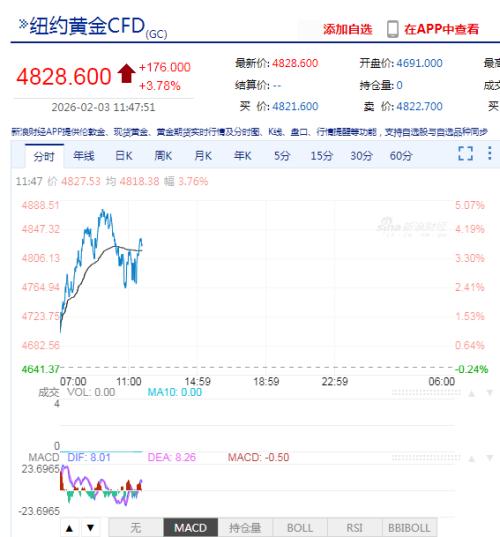
Group 1 - Precious metals prices have rebounded significantly, with gold futures rising above $4,800 per ounce, reported at $4,828.6 per ounce as of 11:47 AM Beijing time [1] - Silver futures are reported at $82.822 per ounce as of 11:48 AM Beijing time [3] Group 2 - Analysts from multiple banks and the Shanghai Gold Exchange have warned investors about market volatility risks, emphasizing the need for rational investment [5] - Nanhua Futures analyst Xia Yingying noted that the recent volatility in precious metal prices has exceeded what fundamentals can explain, with emotional factors becoming dominant. Overcrowded bullish positions led to a rapid activation of negative feedback mechanisms, resulting in a significant sell-off [5] - CITIC Securities indicated that major global economies will continue a loose liquidity stance through 2026, with rising precious metal prices stimulating trading enthusiasm for commodities. Silver, copper, tin, and lithium carbonate may benefit from active trading, leading to price increases beyond expectations. The firm believes that after a significant rally in 2025, the upward momentum for non-ferrous metal prices and stock markets remains strong, supported by supply disruptions, localized high demand, and stockpiling behaviors [5]