NONGFU SPRING(09633)

Search documents
钟睒睒,半年净赚76亿
投中网· 2025-08-28 02:08
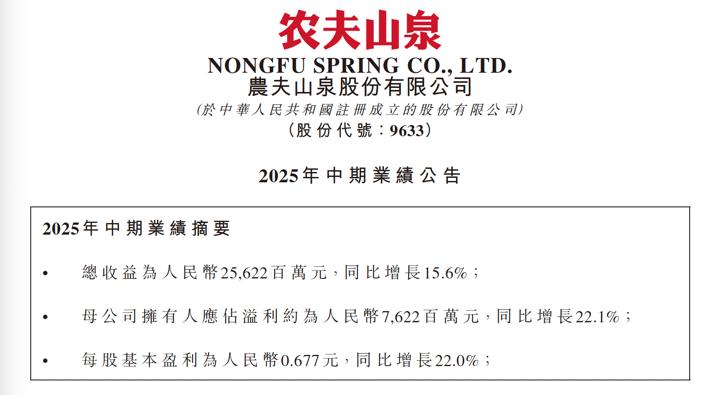
Core Viewpoint - Zhong Shanshan has resumed aggressive strategies, leading to a strong performance in the first half of 2025 for Nongfu Spring, with revenue reaching 25.622 billion yuan, a year-on-year increase of 15.6%, and net profit of 7.622 billion yuan, up 22.1% [6][7][20] Revenue Breakdown - The main revenue sources for Nongfu Spring remain tea beverages and packaged drinking water, accounting for over 70% of total revenue [6] - Tea beverage revenue reached 10.089 billion yuan, marking a significant increase from 8.43 billion yuan in the same period last year, with an additional 1.659 billion yuan in sales [6][7] - Packaged drinking water revenue showed signs of recovery, totaling 9.443 billion yuan, a 10.7% increase year-on-year, although it has not yet returned to the pre-2024 levels [6][7] Market Dynamics - The company has shifted from a defensive to an offensive strategy following last year's public relations issues, focusing on increasing sales of packaged water products [7][9] - Other beverage categories, such as functional drinks and fruit juices, also saw growth, with functional drinks generating 2.898 billion yuan (up 13.6%) and fruit juices 2.564 billion yuan (up 21.3%) [7] Competitive Landscape - The unsweetened tea market, previously experiencing rapid growth, is now facing a slowdown, with only a few brands, including Nongfu Spring, maintaining stable growth [9][10] - Despite being a leading player in the unsweetened tea segment, the company faces competition from promotional activities launched by rivals like Oriental Leaf [10][11] New Product Development - Nongfu Spring is entering the iced tea market with a new product, "Iced Tea," which emphasizes 100% tea leaf extraction and aims to compete with established brands like Yuanqi Forest [13][14] - The company plans to invest 2 billion yuan in research and promotion for this new product, which has already been paired with promotional activities to boost consumer engagement [13][20] Expansion Strategies - The company is enhancing its product offerings and distribution channels, including collaborations with Sam's Club for exclusive products [18][19] - Nongfu Spring has also begun its international expansion, entering the Hong Kong market with seven core brands, aiming for high-end brand validation and exploring further overseas opportunities [19][20]



百亿茶饮料巨头分化:农夫山泉增长,康师傅下滑
2 1 Shi Ji Jing Ji Bao Dao· 2025-08-27 23:54
Core Viewpoint - The tea beverage market is experiencing a divergence, with Nongfu Spring showing strong growth while Master Kong faces a decline in tea beverage revenue [1][4]. Group 1: Nongfu Spring Performance - In the first half of 2025, Nongfu Spring reported a revenue increase of 15.6% to 25.622 billion yuan and a net profit increase of 22.1% to 7.622 billion yuan [1]. - The packaged water segment saw a sales increase of 10.7% to 9.44 billion yuan, while the beverage segment's revenue grew by 18.6% to 16.18 billion yuan [1]. - Ready-to-drink tea remains the largest category within Nongfu Spring, with revenue of 10.09 billion yuan, reflecting a year-on-year growth of 19.7% [1]. Group 2: Master Kong Performance - Master Kong's tea beverage revenue declined by 6.3% to 10.67 billion yuan, resulting in a drop of 722 million yuan [1][2]. - Overall beverage revenue for Master Kong decreased by 2.6% to 26.359 billion yuan [1]. - The reduction in sales may be attributed to a shift in consumer demand, particularly in the sugary tea segment, where Master Kong holds a competitive position [1]. Group 3: Market Dynamics - The divergence in performance between Nongfu Spring and Master Kong may be influenced by differing market strategies, with Nongfu Spring's Oriental Leaf brand dominating the unsweetened tea segment [1]. - Master Kong's reduction in channel numbers, from 67,215 to 63,806 marketing merchants, may also impact sales [2]. - Price adjustments for Master Kong's products, such as the increase in 1L iced tea prices, could further affect consumer purchasing behavior [3].
百亿茶饮料巨头分化:农夫山泉增长,康师傅下滑丨消费参考
2 1 Shi Ji Jing Ji Bao Dao· 2025-08-27 23:53
Group 1: Company Performance - Nongfu Spring reported a revenue increase of 15.6% year-on-year to 25.622 billion yuan and a net profit increase of 22.1% to 7.622 billion yuan in the first half of 2025 [1] - The bottled water segment of Nongfu Spring saw a sales increase of 10.7% to 9.44 billion yuan, while the beverage segment's revenue grew by 18.6% to 16.18 billion yuan [1] - In contrast, Master Kong's tea beverage revenue declined by 6.3% to 10.67 billion yuan, leading to an overall beverage revenue drop of 2.6% to 26.359 billion yuan [1][2] Group 2: Market Dynamics - The tea beverage market is experiencing a divergence, with Nongfu Spring's ready-to-drink tea maintaining its position as the largest category within the company [1] - Master Kong's decline in tea beverage revenue may be attributed to changing demand in the sugary tea market, where it holds an advantage, while Nongfu Spring's Oriental Leaf brand dominates the unsweetened tea segment [1] - Master Kong's reduction in the number of marketing distributors from 67,215 to 63,806 may also be impacting sales [2] Group 3: Pricing Strategies - Master Kong's price increases, particularly for its 1L iced tea, are likely affecting sales negatively [3] - In contrast, Nongfu Spring has implemented promotional activities such as "open cap to win prizes" and competitive pricing strategies, making its products more attractive to consumers [3]
绿瓶退热 农夫山泉“复宠”红瓶水
Bei Jing Shang Bao· 2025-08-27 16:36
Core Viewpoint - Nongfu Spring reported a strong financial performance for the first half of 2025, with revenue of 25.62 billion yuan, a year-on-year increase of 15.6%, and a net profit of 7.62 billion yuan, up 22.1% year-on-year, leading to a significant stock price increase [1][3]. Financial Performance - In the first half of 2025, Nongfu Spring's revenue reached 25.62 billion yuan, reflecting a 15.6% increase compared to the previous year [1]. - The net profit attributable to shareholders was 7.62 billion yuan, marking a 22.1% year-on-year growth [1]. - The gross profit margin improved to 60.3%, up 1.5 percentage points from 58.8% in the same period last year, driven by lower raw material costs [4][7]. Packaging Water Business - The revenue from packaged drinking water was approximately 9.44 billion yuan, showing a 10.7% increase, reversing a decline seen in previous quarters [3][4]. - The company reduced subsidies for the green bottle water product, with subsidies dropping to 1 yuan per case in the first half of 2025, down from 2 yuan in 2024 [4][5]. - The red bottle water's share in packaged water revenue increased from about 75% in the second half of 2024 to over 78% in the first half of 2025, indicating a shift in consumer preference [4]. Market Strategy - Nongfu Spring has been focusing on promoting its red bottle natural water while scaling back on green bottle water subsidies, reflecting a strategic shift towards higher-margin products [5][6]. - The company is expanding its product offerings, including launching new products like "pure transparent ice" and entering the Hong Kong market with core products [6][7]. - The company aims to enhance its distribution network, which has expanded to 3 million outlets, leading to a decrease in sales expense ratio to 19.6%, the lowest in recent years [7]. Tea Beverage Segment - The tea beverage segment generated revenue of 10.09 billion yuan, with a year-on-year growth of 19.7%, although the growth rate has slowed compared to previous years [8]. - The company launched promotional activities for its sugar-free tea product, "Oriental Leaf," which saw its market share increase from 70% to approximately 75% [8][9]. - Despite the strong distribution network, the new carbonated tea product "Ice Tea" has faced challenges in consumer retention and sales performance [8][9].
农夫山泉20250827
2025-08-27 15:19
Summary of Nongfu Spring's Conference Call Company Overview - **Company**: Nongfu Spring - **Date**: August 27, 2025 Key Points Financial Performance - In the first half of 2025, Nongfu Spring achieved total revenue of RMB 25.622 billion, a year-on-year increase of 15.6% [4] - Net profit reached RMB 7.622 billion, up 22.1% year-on-year [4] - Gross margin improved by 1.5 percentage points to 60.3%, while net margin increased by 1.6 percentage points to 29.7% [4][2] - Sales and distribution expenses decreased by 2.8 percentage points to 19.6% of total revenue [4] Product Category Performance - All product categories experienced double-digit revenue growth: - Packaged drinking water: +10.7% [5] - Tea beverages: +19.7% [5] - Functional beverages: +13.6% [5] - Juice beverages: +21.3% [5][6] Cost Control and Efficiency - The increase in gross margin was attributed to lower procurement costs for PET, packaging materials, and sugar [7] - Reduced advertising and promotional expenses, along with lower logistics costs, contributed to the decrease in sales and distribution expenses [7] Water Source Development and Brand Promotion - Three new water sources were added: Hunan Badagong Mountain, Sichuan Longmenshan, and Tibet Nyainqentanglha, bringing the total to 15 nationwide [8] - Enhanced brand promotion through social media and sourcing activities, emphasizing the natural health concept [8] New Product Launches and Marketing Strategies - Introduced several new products, including a zodiac-themed bottle and new tea flavors, supported by online and offline marketing campaigns [9][10] - The company plans to continue exploring overseas markets, with core products launched in Hong Kong covering over 3,500 retail terminals [11] Future Outlook - Full-year revenue is expected to achieve mid-double-digit growth, with stable performance anticipated in the second half of 2025 [3] - Gross and net margins are projected to be slightly higher than in 2024 [3] Innovations and Market Trends - The company is focusing on product innovation, particularly in the functional beverage and juice segments, to meet consumer demand [18][25] - Nongfu Spring is also exploring new retail channels and customized products to cater to high-end consumers [13][14] Capital Expenditure and Growth Strategy - Capital expenditures are expected to be higher than in 2024, particularly for water source development and advanced equipment [19] - The company aims to balance the growth of pure water and natural water products while educating consumers on their differences [26] Dividend Policy - Nongfu Spring does not have a fixed dividend payout ratio, with a 70% payout ratio for 2024, and future dividends will be announced based on investment needs and cash flow [22] International Expansion Plans - The company is considering building a factory in the U.S. and will continue to expand its international presence, focusing on market demand [24] Conclusion - Nongfu Spring's strong financial performance, innovative product launches, and strategic market expansion position the company well for future growth in the competitive beverage industry. The focus on cost control, brand promotion, and consumer education will further enhance its market presence and profitability.
农夫山泉(09633):重回双位数增长,费用使用高效
Haitong Securities International· 2025-08-27 14:42
Investment Rating - The report maintains an "Outperform" rating for Nongfu Spring [2][5]. Core Insights - Nongfu Spring has returned to double-digit growth, with H1 2025 revenue reaching RMB 25.622 billion, a year-on-year increase of 15.6%, and a net profit of RMB 7.622 billion, up 22.1% [3][10]. - The packaged water business has rebounded, generating RMB 9.443 billion in revenue, a 10.7% increase year-on-year, as the impact of previous public opinion issues fades [11][3]. - The tea beverage segment has shown remarkable performance, achieving RMB 10.089 billion in revenue, a 19.7% increase, making it the largest revenue segment [12][4]. - Efficient expense management has led to improved profit quality, with a gross profit margin of 60.3% in H1 2025, up 1.5 percentage points year-on-year [13][4]. Financial Forecast - Revenue projections for 2025-2027 are RMB 49.95 billion, RMB 56.64 billion, and RMB 63.72 billion, with year-on-year growth rates of 16.4%, 13.4%, and 12.5% respectively [14][5]. - Expected net profits for the same period are RMB 14.44 billion, RMB 16.19 billion, and RMB 18.20 billion, corresponding to EPS of RMB 1.28, RMB 1.44, and RMB 1.62 [14][5]. - The company's ROE is among the top tier in the industry, justifying a valuation premium with a target price set at HKD 55.9 for 2025 [14][5].
茶饮料增速放缓,包装水仍未“满血”:农夫山泉增长故事需要新引擎
Hua Xia Shi Bao· 2025-08-27 14:17
Core Viewpoint - Nongfu Spring is gradually overcoming the negative impact of a public relations crisis, with a reported total revenue of 25.622 billion yuan and a net profit of 7.622 billion yuan for the first half of 2025, reflecting year-on-year growth of 15.6% and 22.1% respectively [2] Revenue and Profit Performance - In the first half of 2025, Nongfu Spring's total revenue reached 25.622 billion yuan, marking a 15.6% increase year-on-year, while net profit was 7.622 billion yuan, up 22.1% [2] - The company's core product, packaged drinking water, saw a revenue of 9.443 billion yuan in the first half of 2025, representing a year-on-year growth of 10.7% [3][4] - Despite the recovery, packaged water revenue has not yet returned to the 10.442 billion yuan level of the same period in 2023 [4] Impact of Public Relations Crisis - In early 2024, Nongfu Spring faced its largest public relations crisis, which led to a 21.3% decline in packaged water revenue, dropping from 20.262 billion yuan in 2023 to 15.952 billion yuan [3][4] - The company has since shifted focus away from its green bottle pure water product, which was introduced as a competitive strategy during the crisis [3][4] Product Category Performance - Packaged water's revenue share has decreased from 54.9% in 2022 to 37.2% in 2024, overtaken by tea beverages, which accounted for 39% of revenue in 2024 [5][6] - In the first half of 2025, the revenue share of packaged water and tea beverages was 36.9% and 39.4% respectively, indicating a widening gap [4][6] Challenges in Tea Beverage Segment - Tea beverage revenue reached 10.089 billion yuan in the first half of 2025, with a year-on-year growth of 19.7%, showing a significant slowdown compared to previous years [7] - The competitive landscape for sugar-free tea has intensified, prompting Nongfu Spring to expand its large packaging offerings to maintain market share [7][8] Strategic Developments - Nongfu Spring has expanded its water source locations to ensure quality and create competitive barriers, with three new water sources operational in the first half of 2025 [8]
红瓶水向上,绿瓶水收缩,农夫山泉包装饮用水止跌回暖
Bei Jing Shang Bao· 2025-08-27 13:52
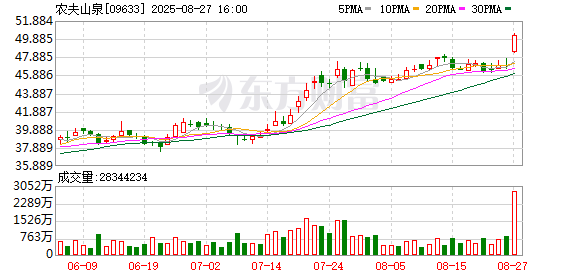
Core Insights - Nongfu Spring reported a revenue of 25.62 billion yuan for the first half of the year, a year-on-year increase of 15.6%, and a net profit of 7.62 billion yuan, up 22.1% [1] - Following the positive earnings report, Nongfu Spring's stock price surged by 7.11% to 50.3 HKD per share, with a total market capitalization of 565.7 billion HKD [1] - The company's bottled water business showed signs of recovery, achieving a revenue of approximately 9.44 billion yuan, a 10.7% increase, after two consecutive quarters of decline [1] Financial Performance - In 2024, Nongfu Spring's total revenue increased by 0.5% to 42.896 billion yuan, but revenue from bottled water products decreased by 21.3% compared to the same period in 2023 [1] - The gross profit margin for the group increased from 58.8% to 60.3%, attributed to lower procurement costs for PET materials and packaging [2] Market Strategy - The company has shifted its focus from the green bottle pure water to the red bottle natural water, with the latter's share in bottled water revenue increasing from approximately 75% in the second half of 2024 to over 78% in the first half of 2025 [2] - Nongfu Spring has reduced subsidies for green bottle water significantly, with subsidies dropping to 1 yuan per case in the first half of 2025, down from 2 yuan [2] - The company is promoting larger packaging sizes of red bottle water (1.5L, 2L, 4L) to cater to household and restaurant needs, which aligns with consumer preferences for health-conscious products [6] Product Development - Nongfu Spring has expanded its product offerings, launching core products like natural drinking water and sugar-free tea drinks in the Hong Kong market, covering over 3,500 retail terminals [4] - The tea beverage segment generated 10.09 billion yuan in revenue, a 19.7% increase, although growth has slowed compared to previous years [7] - The company introduced a new carbonated tea drink, "Ice Tea," and plans to invest 2 billion yuan in its research and promotion [7] Supply Chain and Cost Management - Nongfu Spring has added new water sources in Hunan, Sichuan, and Tibet, bringing the total to 15 major water sources nationwide, which helps in reducing production costs and enhancing supply efficiency [5] - The company has achieved a significant reduction in sales expense ratio to 19.6%, the lowest in recent years, due to an expansion of its distribution network to 3 million terminals [6]
读财报|红瓶水向上,绿瓶水收缩,农夫山泉包装饮用水止跌回暖
Bei Jing Shang Bao· 2025-08-27 13:38
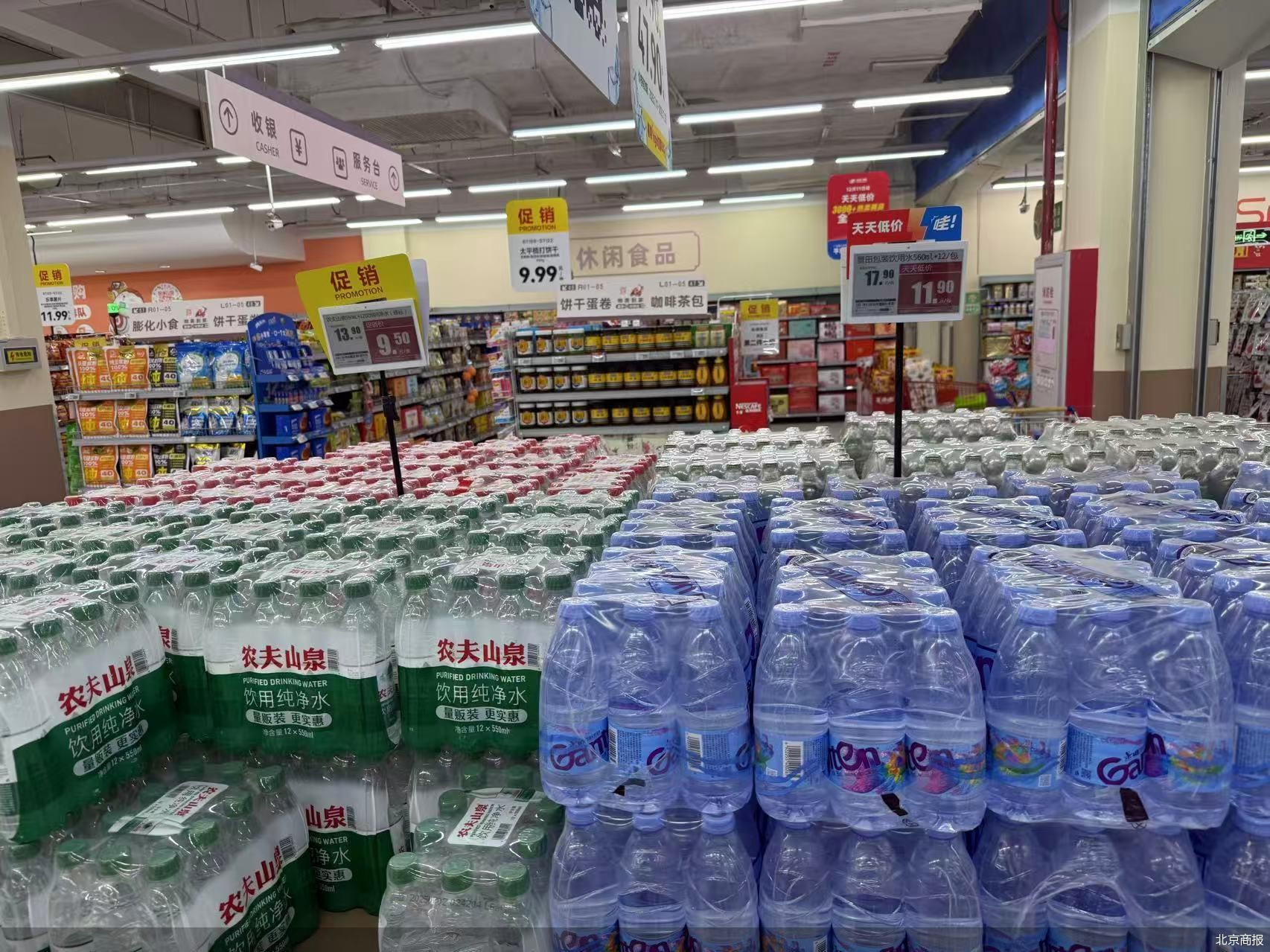
Core Viewpoint - The financial performance of Nongfu Spring in the first half of the year shows significant growth, with revenue reaching 25.62 billion yuan, a year-on-year increase of 15.6%, and net profit attributable to shareholders at 7.62 billion yuan, up 22.1% [1][3]. Financial Performance - In the first half of the year, Nongfu Spring's revenue was 25.62 billion yuan, marking a 15.6% increase year-on-year [1]. - The net profit attributable to shareholders was 7.62 billion yuan, reflecting a 22.1% growth compared to the previous year [1]. - The packaging drinking water segment generated approximately 9.44 billion yuan in revenue, with a year-on-year growth of 10.7%, indicating a recovery after two consecutive quarters of decline [3]. Market Strategy - To regain market share, Nongfu Spring reintroduced the green bottle pure water product in April 2024, employing a low-price promotion strategy [3]. - The green bottle pure water was priced as low as 1 yuan per bottle or 9.9 yuan for a pack of 12 during intense price competition [3]. - The company has shifted focus to promoting the red bottle natural water while reducing subsidies for the green bottle pure water, with subsidies dropping to 1 yuan per pack in the first half of 2025 [4][5]. Product Positioning - The red bottle water has gained consumer preference due to its health label, leading to higher repurchase rates compared to the green bottle [5]. - The gross profit margin for Nongfu Spring increased from 58.8% to 60.3% year-on-year, attributed to lower raw material costs [5]. - The company is optimizing its product structure by reducing reliance on the lower-margin green bottle water and enhancing the red bottle's market presence [5]. Market Expansion - Nongfu Spring is expanding its product offerings, including launching core products like natural drinking water and sugar-free tea in the Hong Kong market, covering over 3,500 retail outlets [6]. - The company has added new water sources in Hunan, Sichuan, and Tibet, increasing its total to 15 major water sources nationwide [7]. - The company is also promoting larger packaging sizes of red bottle water to cater to household and restaurant needs, which aligns with consumer health concerns [8]. Tea Beverage Segment - The tea beverage segment achieved revenue of 10.09 billion yuan, growing 19.7% year-on-year, although growth rates are slowing compared to previous years [9]. - The company launched a promotional campaign for its sugar-free tea product, "Oriental Leaf," increasing its market share from 70% to 75% [9]. - Despite the strong distribution network, the new carbonated tea product "Ice Tea" has faced challenges in consumer retention and sales performance [10].
钟睒睒渡劫:农夫山泉走出舆论与价格战的双重绞杀了吗?
3 6 Ke· 2025-08-27 11:28
Core Viewpoint - The company faced a significant crisis in 2024 due to a sudden wave of public criticism, leading to a sharp decline in sales and revenue, particularly in its core bottled water business, which saw a 21.3% year-on-year revenue drop. However, the company rebounded in the first half of 2025, reporting a 15.6% increase in total revenue and a 22.1% increase in net profit, surpassing market expectations [1][3][21]. Group 1: Bottled Water Business - The bottled water segment was severely impacted by both public opinion and aggressive price competition from rivals, prompting the company to launch a low-priced green bottle water product as a tactical response [4][5]. - The introduction of the green bottle water product aimed to disrupt competitors and penetrate previously inaccessible market segments, leading to a significant price war that forced competitors to react defensively [5][8]. - By mid-2025, the company shifted focus back to its core red bottle natural water, reducing subsidies for the green bottle and increasing the revenue share of red bottle water to over 80% [9][21]. Group 2: Tea Beverage Business - The tea beverage segment, particularly the "Oriental Leaf" brand, demonstrated strong growth, achieving a revenue of 10.1 billion RMB in the first half of 2025, a 19.7% increase year-on-year, and becoming the company's largest business segment [10][11]. - The tea business maintained a high operating profit margin of 48.4%, attributed to effective supply chain management and early investments in the tea production process [12][14]. - The company's proactive marketing strategies, such as the "One Yuan Enjoyment" campaign, helped maintain a market share of 70% in key regions for its tea products [12][14]. Group 3: Other Beverage Segments - The functional beverage segment reported a revenue of 2.9 billion RMB, a 13.6% increase, showcasing the company's strong channel capabilities despite facing tough competition [17][20]. - The juice beverage segment achieved a remarkable growth rate of 21.3%, with revenue reaching 2.6 billion RMB, indicating successful penetration into both high-end and mass-market segments [18][19]. - The company's dual strategy of targeting both premium and value markets in the juice category highlights its operational flexibility and platform capabilities [19][20]. Group 4: Financial Performance and Market Position - The company's financial results for the first half of 2025 indicated a successful recovery from the previous year's crisis, with a gross margin exceeding 60% and a net profit margin close to 30%, positioning it competitively against both domestic and international peers [23][24]. - The rapid recovery and strong financial metrics suggest that the company's true competitive advantage lies in its internal operational structure rather than just its access to natural resources [23][24]. - Following the release of the financial report, the company's stock price surged by 6%, reflecting positive market sentiment and confidence in its recovery strategy [21].