XPENG-W(09868)

Search documents
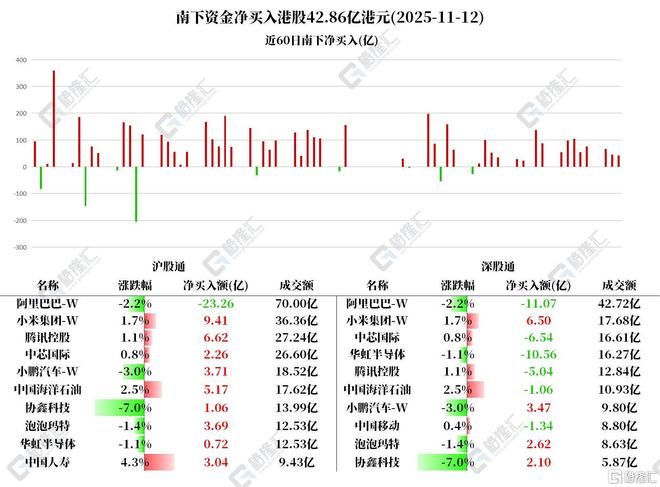
11月12日南向资金净买入42.86亿港元
Zheng Quan Shi Bao Wang· 2025-11-13 00:39
Core Viewpoint - The Hang Seng Index rose by 0.85% to close at 26,922.73 points on November 12, with a net inflow of HKD 4.286 billion through the southbound trading channel [1] Group 1: Market Activity - The total trading volume for the southbound trading on November 12 was HKD 105.405 billion, with a net buy of HKD 4.286 billion [1] - The Shanghai Stock Exchange's southbound trading accounted for HKD 66.456 billion in trading volume and a net buy of HKD 3.397 billion, while the Shenzhen Stock Exchange had HKD 38.949 billion in trading volume and a net buy of HKD 0.889 billion [1] Group 2: Active Stocks - Alibaba-W was the most actively traded stock on the Shanghai Stock Exchange with a trading volume of HKD 70.00 billion, but it experienced a net sell of HKD 23.26 billion, closing down by 2.24% [1][2] - Xiaomi Group-W followed with a trading volume of HKD 36.36 billion and a net buy of HKD 9.41 billion, closing up by 1.68% [1][2] - On the Shenzhen Stock Exchange, Alibaba-W also led with a trading volume of HKD 42.72 billion and a net sell of HKD 11.07 billion, closing down by 2.24% [2] - Other notable stocks included Tencent Holdings with a trading volume of HKD 27.24 billion and a net buy of HKD 6.18 billion, and SMIC with a trading volume of HKD 16.61 billion [2]





南向资金今日成交活跃股名单(11月12日)
Zheng Quan Shi Bao Wang· 2025-11-13 00:32
Group 1 - The Hang Seng Index rose by 0.85% on November 12, with a total southbound trading volume of HKD 105.4 billion, including HKD 54.8 billion in buy transactions and HKD 50.6 billion in sell transactions, resulting in a net inflow of HKD 4.3 billion [1] - The southbound trading through Stock Connect (Shenzhen) totaled HKD 38.9 billion, with buy transactions of HKD 19.9 billion and sell transactions of HKD 19.0 billion, leading to a net inflow of HKD 0.9 billion; while Stock Connect (Shanghai) had a total of HKD 66.5 billion, with buy transactions of HKD 34.9 billion and sell transactions of HKD 31.5 billion, resulting in a net inflow of HKD 3.4 billion [1] - Alibaba-W had the highest trading volume among southbound stocks, totaling HKD 112.72 billion, followed by Xiaomi Group-W and SMIC with HKD 54.04 billion and HKD 43.22 billion respectively [1] Group 2 - Xiaomi Group-W recorded the highest net inflow among stocks, with a net buy of HKD 15.92 billion, closing up by 1.68%; followed by XPeng Motors with a net buy of HKD 7.18 billion, and Pop Mart with a net buy of HKD 6.31 billion [1] - Conversely, Alibaba-W experienced the largest net outflow of HKD 34.34 billion, closing down by 2.24%; Huahong Semiconductor and SMIC also faced significant net outflows of HKD 9.85 billion and HKD 4.28 billion respectively [1] - Over a continuous period, Xiaomi Group-W saw a net inflow for 11 consecutive days, totaling HKD 81.36 billion, while China National Offshore Oil Corporation and Pop Mart had net inflows of HKD 28.21 billion and HKD 14.55 billion respectively [2]



智通港股沽空统计|11月13日
智通财经网· 2025-11-13 00:21
Core Insights - The article highlights the top short-selling ratios and amounts for various companies, indicating significant market sentiment against these stocks [1][2]. Short-Selling Ratios - The top three companies with the highest short-selling ratios are Hang Seng Bank-R (80011) and BYD Company-R (81211), both at 100.00%, followed by Kuaishou-WR (81024) at 90.79% [1][2]. - The short-selling ratio for Shengjing Bank (02066) is 83.46%, while Meituan-WR (83690) has a ratio of 77.62% [2]. Short-Selling Amounts - The companies with the highest short-selling amounts are Xiaomi Group-W (01810) at 2.038 billion, Tencent Holdings (00700) at 1.705 billion, and Pop Mart (09992) at 1.689 billion [1][2]. - Other notable companies include Alibaba-SW (09988) with 1.451 billion and Ping An Insurance (02318) with 1.368 billion [2]. Short-Selling Deviation Values - The top three companies with the highest deviation values are Shengjing Bank (02066) at 71.47%, Hang Seng Bank-R (80011) at 60.71%, and BYD Company-R (81211) at 49.79% [1][2]. - Kuaishou-WR (81024) has a deviation value of 40.46%, indicating a significant difference from its historical short-selling average [2].
上市车企10月销量:整车销量超231万辆北汽蓝谷、蔚来等销量增速加快
Xin Lang Cai Jing· 2025-11-13 00:05
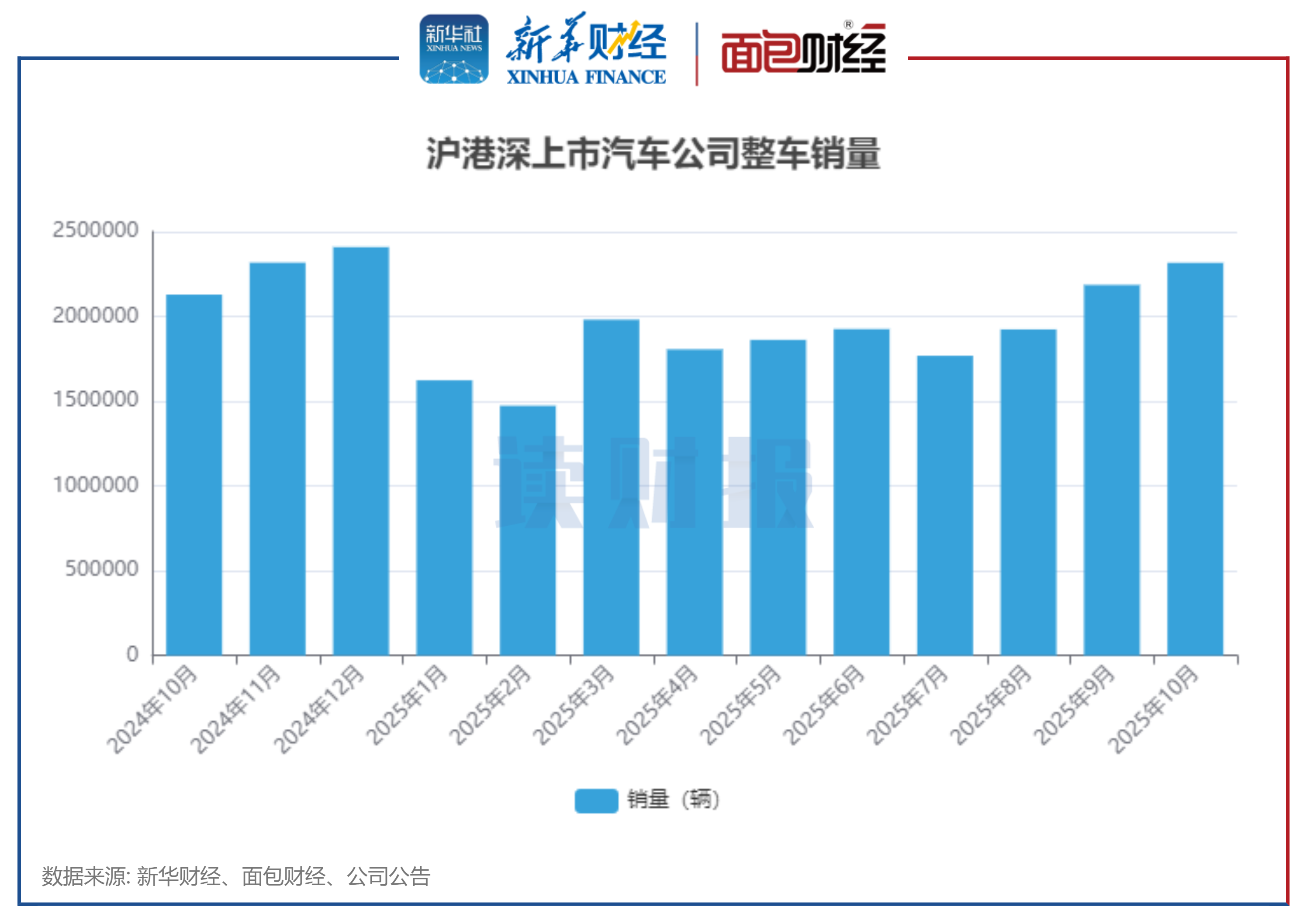
Core Insights - In October 2025, 20 major A and H-share listed automotive manufacturers reported a total vehicle sales of 2.3166 million units, representing a year-on-year increase of 8.82% and a month-on-month increase of 5.97% [1][2] - The total sales of new energy vehicles (NEVs) reached approximately 1.3078 million units, marking a year-on-year increase of 15.63% and a month-on-month increase of 9.68%, with a penetration rate of about 57.48% [1][3] Group 1: Overall Vehicle Sales - The top-selling company in October 2025 was SAIC Motor, with sales of 454,000 units, reflecting a year-on-year growth of 12.96% [2] - Other notable manufacturers included BYD, Geely, and Changan, which followed closely in sales figures [2] - Companies like Beiqi Blue Valley and Qianli Technology saw their sales growth exceed 100% year-on-year, while NIO and XPeng also experienced significant growth [2] Group 2: New Energy Vehicle Sales - The leading companies in NEV sales for October 2025 were BYD, SAIC Motor, and Geely, with sales of 441,700 units, 206,700 units, and 177,900 units respectively [3] - Beiqi Blue Valley's NEV sales growth exceeded 100% year-on-year, while NIO and XPeng also saw substantial increases in their sales growth rates compared to September [3] - BYD's total sales for the year up to October reached 3.7019 million units, showing a year-on-year increase of 13.88% [3]





读财报上市车企10月销量:整车销量超231万辆 北汽蓝谷、蔚来等销量增速加快
Zhong Guo Jin Rong Xin Xi Wang· 2025-11-12 23:48
Core Insights - In October 2025, 20 A and H-share listed automotive manufacturers reported a total vehicle sales of 2.3166 million units, representing a year-on-year increase of 8.82% [1][4] - Among these, 16 companies disclosed their new energy vehicle (NEV) sales, totaling approximately 1.3078 million units, which is a year-on-year increase of 15.63% and a penetration rate of about 57.48% [1][8] Group 1: Overall Vehicle Sales - The total vehicle sales for October 2025 reached 2.3166 million units, marking a month-on-month growth of 5.97% [1][4] - SAIC Motor led the sales with 454,000 units, followed by BYD with 441,706 units and Geely with 307,133 units [5][6] - Notable growth was observed in companies like BAIC Blue Valley and NIO, with sales growth exceeding 100% year-on-year, while companies like Ideal Auto and NIO experienced a decline of over 30% [4][8] Group 2: New Energy Vehicle Sales - The total NEV sales for October 2025 were approximately 1.3078 million units, with a month-on-month increase of 9.68% [8][11] - Leading NEV manufacturers included BYD, SAIC Motor, and Geely, with sales of 441,706 units, 206,692 units, and 177,882 units respectively [11][15] - Companies such as BAIC Blue Valley and NIO saw their NEV sales growth exceed 50%, while Ideal Auto and BYD reported a year-on-year decline in sales [11][15]



美股三大指数收盘涨跌不一 AMD涨9%
Xin Lang Cai Jing· 2025-11-12 23:04
Group 1 - The three major U.S. stock indices closed mixed, with the Dow Jones Industrial Average rising by 0.68%, the Nasdaq Composite falling by 0.26%, and the S&P 500 increasing by 0.06% [1] - AMD saw a significant increase in its stock price, rising by 9% [1] - Oracle's stock declined by over 3%, while Tesla's stock fell by more than 2% [1] Group 2 - Most popular Chinese concept stocks experienced declines, with the Nasdaq Golden Dragon China Index dropping by 1.46% [1] - Stocks of Xpeng Motors, NIO, iQIYI, and Baidu each fell by over 2% [1]


【读财报】上市车企10月销量:整车销量超231万辆 北汽蓝谷、蔚来等销量增速加快
Xin Hua Cai Jing· 2025-11-12 22:59
Core Insights - In October 2025, 20 A and H-share listed automotive manufacturers collectively sold 2.3166 million vehicles, representing a year-on-year increase of 8.82% and a month-on-month increase of 5.97% [2][12]. Group 1: Overall Vehicle Sales - The top-selling company in October was SAIC Motor, with sales of 454,000 vehicles, showing a year-on-year growth of 12.96% [11][19]. - BYD followed closely with sales of 441,706 vehicles, but experienced a decline of 12.13% year-on-year [19]. - Other notable performers included Geely Automobile with 307,133 vehicles sold (up 35.49%) and Changan Automobile with 278,436 vehicles (up 11.00%) [8][19]. - Companies like BAIC Blue Valley and Qianli Technology saw significant growth, with year-on-year increases exceeding 100% [7][11]. Group 2: New Energy Vehicle Sales - A total of 16 companies reported new energy vehicle sales, with approximately 1.3078 million units sold in October, marking a year-on-year increase of 15.63% and a penetration rate of 57.48% [12][15]. - Leading new energy vehicle manufacturers included BYD, SAIC Motor, and Geely, with sales of 441,706, 206,692, and 177,882 units respectively [15][19]. - BAIC Blue Valley and NIO reported growth rates exceeding 100%, while Li Auto and BYD experienced declines in year-on-year sales [15][19].
小鹏汽车-W(09868.HK)2025年10月销量点评:同环比持续增长 月销再破4万辆
Ge Long Hui· 2025-11-12 19:50
Core Viewpoint - Xiaopeng Motors reported a record monthly delivery of 42,013 vehicles in October 2025, marking a year-on-year increase of 75.7% and a month-on-month increase of 1.0% [1] Delivery Performance - In October 2025, the company delivered 42,013 new vehicles, achieving a year-on-year growth of 75.7% and a month-on-month growth of 1.0% [1] - Cumulative deliveries from January to October 2025 reached 355,000 vehicles, representing a year-on-year increase of 190.0% [1] Product Performance - The new P7 model's deliveries accelerated, and the main sales models continued to perform strongly, contributing to the high growth in sales [1] - The MONA M03 model delivered over 15,000 units in October, with cumulative production exceeding 200,000 units since its launch [1] - The SUV family (G6/G7/G9) sold over 10,000 units in October, with the G6 model achieving cumulative deliveries of over 65,000 units, a nearly 60% year-on-year increase [1] - Cumulative deliveries of the P7+ model surpassed 80,000 units by the end of October [1] Future Outlook - The next-generation extended-range product, the Xiaopeng X9 Super Extended Range version, is set to launch, featuring a unique combination of a 63.3-degree large battery and a 60L fuel tank, with a comprehensive range of 1,602 km [1] - The company expects to deliver between 113,000 and 118,000 vehicles in Q3 2025, representing a year-on-year growth of 142.8% to 153.6%, with projected revenue between 19.6 billion and 21 billion yuan, a year-on-year increase of 94.0% to 107.9% [1] International Expansion - In October, Xiaopeng made further breakthroughs in the European, Asian, and African markets, entering seven new markets including Lithuania, Latvia, Estonia, Cambodia, Morocco, Tunisia, and Qatar [1] - The company aims to shift from "rapid layout" to "solid operation" in new markets, focusing on building brand strength and local service networks [1] Financial Performance - The company anticipates achieving a quarterly profit in Q4 2025 and expects to generate positive free cash flow for the entire year [1] - Revenue for 2025 is projected to reach 83.1 billion yuan, corresponding to a price-to-sales ratio of 1.8X, with significant improvements in software revenue reflecting better financial performance [2]
第401批公告:宁德快充电池上车与众08,中航三元配套小鹏X9纯电版
高工锂电· 2025-11-12 12:39
Core Insights - The Ministry of Industry and Information Technology recently released the 401st batch of the "Announcement of Road Motor Vehicle Production Enterprises and Products," featuring 121 new vehicles, with over half being pure electric models [3][4]. Group 1: New Vehicle Overview - A total of 121 new vehicles were announced, including 76 pure electric models, 45 range-extended or plug-in hybrid models, 13 models with ternary batteries, 3 models with nickel-manganese-cobalt batteries, and 105 models with LFP batteries [3][4]. - Chery, BYD, and Audi are the top three companies in this announcement, with Audi introducing 6 new models equipped with ternary batteries sourced from CATL [4]. Group 2: BYD's New Models - BYD launched several new models, including the Ocean, Dynasty, and Fangchengbao series, featuring hybrid models such as the Seal 05, 06, and 07, as well as the Tang, Qin L, Qin Plus, Song Pro, and Titanium 7 [5]. - The BYD Seal 06 is positioned as a successor to the Song PLUS, available in two battery versions: 10.08 kWh (80 km) and 15.87 kWh (120 km), starting at a price of 99,800 yuan [5]. Group 3: New Energy Vehicle Trends - Xpeng introduced the MONA M03 and the pure electric MPV X9, with the M03 being a best-seller, having delivered over 200,000 units by November, achieving over 14 consecutive months of monthly deliveries exceeding 10,000 units [5][6]. - The new M03 features batteries from EVE Energy and Fudi, both of which are lithium iron phosphate systems, while the X9 is an ultra-pure electric version equipped with ternary batteries from Zhongxin Innovation [6]. Group 4: Battery Supply and Market Dynamics - The majority of new vehicles are equipped with lithium iron phosphate batteries, with ternary battery suppliers primarily being CATL, serving brands like Xingtu, Audi, and Jikrypton [7]. - The new 7-seat MPV Ruisheng M8, featuring nickel-manganese-cobalt batteries, was officially launched on November 5, with a pre-sale price ranging from 169,800 to 229,800 yuan [7]. Group 5: Industry Expansion and Future Events - The demand for batteries has been rising throughout the year, prompting leading battery manufacturers to expand production capacity [9]. - The 2025 (15th) High-Performance Lithium Battery Annual Conference will be held in Shenzhen from November 18-20, featuring discussions on the future demand in the lithium battery industry [9].


资金动向 | 北水净买入港股近43亿港元,减持阿里巴巴、华虹半导体
Xin Lang Cai Jing· 2025-11-12 11:57
Group 1: Market Activity - Southbound funds net bought Hong Kong stocks worth 4.286 billion HKD on November 12, with notable purchases including Xiaomi Group (1.592 billion HKD), Xpeng Motors (717 million HKD), and China National Offshore Oil Corporation (411 million HKD) [1] - Continuous net buying trends were observed for Xiaomi (81.3635 billion HKD over 11 days), CNOOC (28.2105 billion HKD over 4 days), and Pop Mart (14.5466 billion HKD over 3 days) [3] Group 2: Company Insights - Xiaomi reported a cumulative payment amount exceeding 29 billion HKD as of November 11, with Goldman Sachs maintaining a "Buy" rating and a 12-month target price of 56.5 HKD, citing its strong balance sheet and competitive advantages in the electric vehicle sector [4] - Morgan Stanley raised the target price for Xpeng Motors to 131 HKD, reflecting growth potential from new AI products and expected market sentiment improvement starting mid-2026 [4] - CNOOC's production cost is projected to be 29.56 USD per barrel in 2024, the lowest among major Chinese oil companies, indicating strong international competitiveness [4] Group 3: Company Developments - Alibaba is set to launch its first self-developed flagship AI glasses, Quark AI Glasses, on November 27, with pre-sales performing strongly during the "Double 11" shopping festival [5] - GCL-Poly Energy responded to market rumors regarding its storage platform, asserting that such claims are unfounded, while the China Photovoltaic Industry Association emphasized the importance of policy support in the solar industry [5]