BIDU(09888)

Search documents
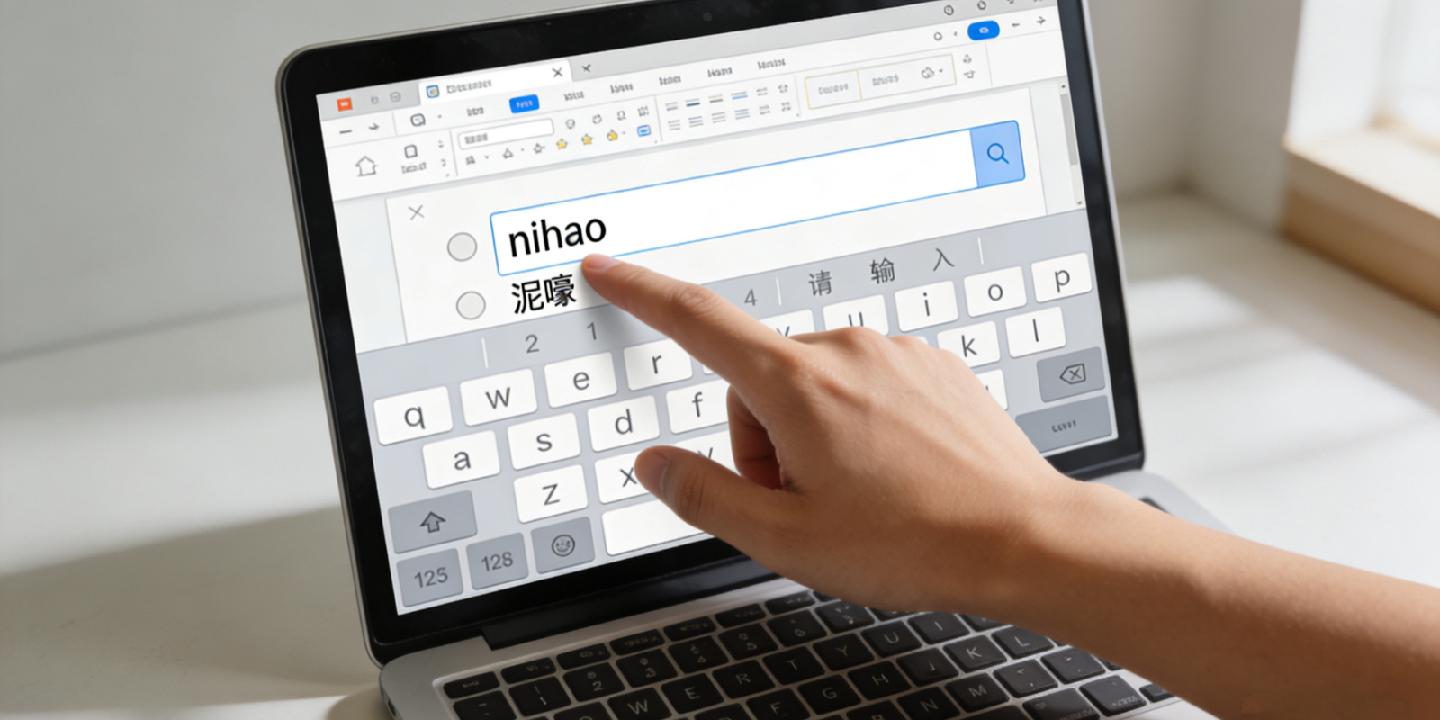
输入法“变笨”了吗?
Jing Ji Guan Cha Wang· 2026-01-11 03:41
Core Insights - The article discusses the challenges faced by input method applications, particularly focusing on Sogou Input Method, as it approaches its 20th anniversary in 2026. Despite advancements in AI capabilities, user experience has deteriorated, leading to complaints about inefficiency and inaccuracies in word prediction and voice recognition [2][3][5]. User Experience Issues - Users express frustration over the declining accuracy of input methods, with complaints about incorrect word suggestions and excessive advertisements disrupting their experience [3][5][6]. - A long-time user of Sogou Input Method reported issues with common character suggestions, indicating a failure to learn user habits despite repeated corrections [4][5]. AI Integration and Competition - Major input method companies, including Tencent's Sogou, Baidu, and iFlytek, are engaged in a competitive race to integrate advanced AI features into their products, aiming to enhance user experience and functionality [3][9][10]. - The input method market is characterized by a concentrated structure, with leading companies holding a combined market share of 84.4% as of July 2025, indicating a fierce competition for user engagement and AI capabilities [9]. Future Development Goals - Sogou Input Method aims to evolve into a "super entrance" for AI, allowing users to interact with AI agents through the input method, which is seen as a key direction for future development [10][11]. - Baidu Input Method also seeks to position itself as a reliable smart entry point for user expression, leveraging AI to enhance communication and collaboration [11][12]. Commercialization Challenges - Input methods face a "high traffic, low value" monetization dilemma, struggling to effectively convert user engagement into revenue [16][17]. - Privacy concerns have led to increased scrutiny and regulatory challenges, prompting companies to adapt their data collection practices to ensure user safety and compliance [18][19]. Technological Limitations - Despite advancements in AI algorithms, challenges remain in accurately understanding user intent, particularly in word prediction, due to the variability in user language habits and the quality of training data [13][19]. - The complexity of multi-modal interactions, where users input data through various means, requires sophisticated algorithms and technology to ensure seamless processing [19].


百度智能云:AI基础设施安全白皮书 2025
Sou Hu Cai Jing· 2026-01-10 09:22
二、政策与技术环境 一、背景与核心诉求 随着人工智能技术飞速发展,AI 基础设施成为产业智能化变革的核心支撑,在国家 "十四五" 数字经济发展规划与 "东数西算" 工程推动下,我国算力中 心建设呈现政策驱动显著、智能化需求爆发、应用场景深化三大特征。但与此同时,AI 基础设施面临合规要求收紧、云平台漏洞频发、大模型新型攻击 涌现等多重安全挑战,构建高效、安全、可靠的 AI 基础设施成为行业刚需。 (一)整体安全架构 百度构建了以合规为纲、技术为骨、管理为翼的全方位多层级安全防护体系,涵盖合规与标准规范、核心安全域分层防护、管理与运行体系三大维度,形 成 "边界 - 平台 - 租户 - 密码 - 模型 - 运营" 六层联动防护,适配 AI 基础设施特性。 (二)关键安全域防护 模型应用安全:从语料安全清洗、输入输出安全管控、数据安全保护、安全评测能力建设四方面入手,通过 prompt 审核、回复干预、数据加密、蓝军评 测等手段,覆盖大模型训练、部署、推理全生命周期。 云平台安全:以 "治理 - 防护 - 合规 - 运营" 为主线,涵盖安全治理(漏洞、基线)、计算 / 存储 / 网络安全、等保与密评合规、物理安全 ...
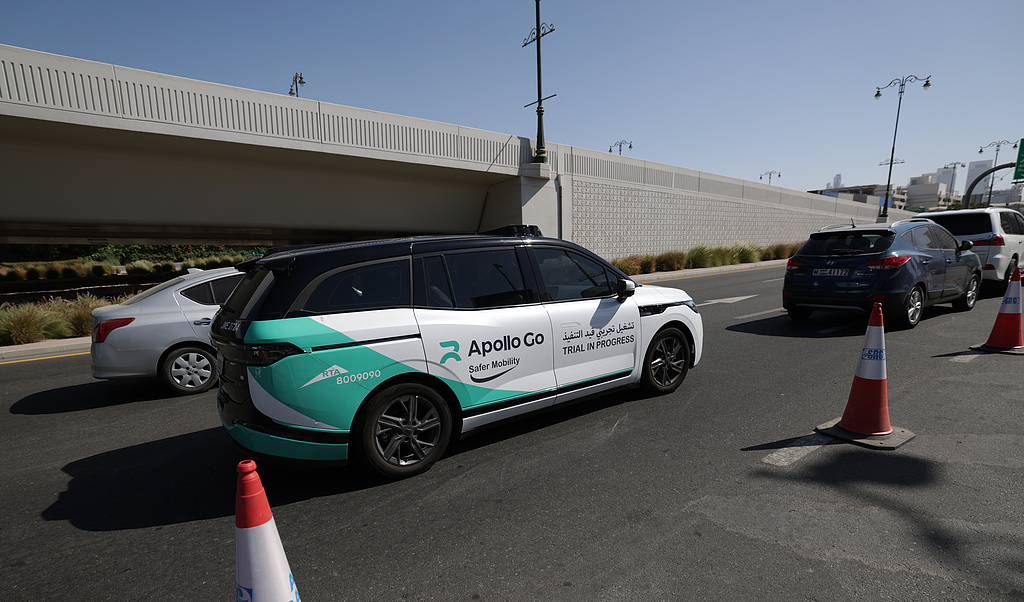
百度获得迪拜首个全无人驾驶测试许可,计划年内推出商业化Robotaxi服务
Shang Wu Bu Wang Zhan· 2026-01-10 03:35
Core Insights - Baidu's Apollo Go has received the first fully autonomous driving test license in Dubai, allowing operation of self-driving vehicles without safety drivers on designated public roads [1] - The company plans to launch commercial autonomous ride-hailing services in Dubai within the first quarter of this year, supported by a 2000 square meter autonomous operations center in the city center [1] - The Dubai Roads and Transport Authority (RTA) aims to evaluate system safety, reliability, and user experience through this testing, paving the way for large-scale commercialization [1] Company Developments - Baidu's Apollo Go is set to expand its fleet to over 1000 vehicles in collaboration with RTA [1] - The establishment of the operations center integrates smart roads, charging, maintenance, and scheduling systems [1] Industry Implications - This initiative marks a significant institutional breakthrough for Chinese autonomous driving technology in the Middle East market [1] - The move reflects the UAE's ongoing policy of openness in the field of smart transportation [1]
火拼AI互联网:2026字节、阿里、腾讯三国杀要来了
3 6 Ke· 2026-01-09 23:34
Group 1 - The article discusses the competitive landscape of the AI industry in China, highlighting the differences in development strategies between Chinese companies and their North American counterparts, particularly focusing on application deployment and cost-effectiveness [1][2] - Chinese tech giants are increasingly promoting both mature and emerging AI products to accelerate user penetration, contrasting with the more capital-intensive approaches seen in North America [1][2] - The article emphasizes the rapid evolution of AI applications, with significant user growth observed in a short time frame, particularly noting the success of ChatGPT and its implications for Chinese AI applications [8][10] Group 2 - The shift from traditional internet services to AI-driven services necessitates a complete overhaul of foundational costs, including computing power, storage, network capacity, and energy consumption [2][3] - The introduction of token-based pricing models for AI services poses challenges to users accustomed to free internet services, complicating the monetization of AI applications in China [3][6] - Despite the rapid growth of AI applications, Chinese companies face challenges in achieving comparable user engagement levels to their international counterparts, with significant differences in monthly active users (MAU) between platforms like ChatGPT and domestic alternatives [10][11] Group 3 - The competitive landscape is characterized by a significant disparity in user engagement and market penetration between leading Chinese AI applications and their international peers, with the article noting that the leading Chinese app has around 200 million MAU compared to ChatGPT's 800 million [10][11] - The article outlines three key factors that could catalyze a competitive surge in China's AI consumer market by 2026: advancements in technology, improved chip availability, and the influence of successful international models like ChatGPT [13][14] - The current market structure is evolving, with leading applications like Doubao capturing 60% of the market, followed by DeepSeek at 30%, indicating a rapidly changing competitive environment [16][18] Group 4 - The article highlights the strategic approaches of major tech companies in China, noting that ByteDance is aggressively pursuing both consumer and enterprise AI applications, while Alibaba is focusing on enhancing its B2B offerings [19][20] - Tencent's approach appears more conservative, with a focus on integrating AI capabilities into existing applications rather than developing new standalone products [19][20] - The competition among these giants is expected to intensify as they seek to establish new AI entry points, with the potential for significant shifts in market dynamics as they adapt to evolving user needs and technological advancements [21][22] Group 5 - The article suggests that the AI landscape in China is still in its early stages, making it difficult to predict future competitive dynamics, but emphasizes the importance of establishing a strong user base and ecosystem for long-term success [19][49] - The potential for smaller companies to carve out niches in less competitive areas is highlighted, as larger firms focus on more prominent market segments [49][50] - The overall investment landscape is characterized by a lower capital expenditure to revenue ratio for Chinese firms compared to their North American counterparts, allowing for more sustainable growth in the AI sector [46][49]
动态百科与AI知识图谱重塑知识获取体验 百度百科词条破3000万
Cai Jing Wang· 2026-01-09 05:19
Core Insights - Baidu Baike is launching a comprehensive upgrade centered around AI, introducing "Dynamic Baike" and "Baike AI Knowledge Graph" to revolutionize knowledge dissemination as it approaches its 20th anniversary [1][3] Group 1: Product Innovations - "Dynamic Baike" utilizes generative UI technology to transform static knowledge into interactive, visual content, allowing users to engage with information in a more immersive way [4][6] - The "Baike AI Knowledge Graph" addresses the fragmentation of traditional entries by creating a structured knowledge network that enhances user exploration through multi-dimensional connections [8][10] Group 2: Collaboration and Content Creation - Baidu Baike's "Star Plan" collaborates with over 100,000 experts and professional creators from leading institutions to build a vast repository of over 1 million specialized knowledge entries [3][7] - A nationwide content creation channel will be opened by the end of January, enabling users to contribute to the "Dynamic Baike" platform through interactive dialogue [6] Group 3: Quality Assurance and Authority - Baidu Baike has established a robust content assurance system over its 20 years, ensuring the reliability of its 30 million entries through strict quality control mechanisms [11][12] - The platform emphasizes the importance of verified content in the age of AI-generated misinformation, positioning itself as a critical resource for accurate knowledge [11][12] Group 4: Challenges and Opportunities - Baidu Baike faces challenges from shifting user preferences towards AI direct answers and the proliferation of low-quality AI-generated content [12] - However, the company sees opportunities in reinforcing its role as a reliable knowledge infrastructure, leveraging its extensive database for fact-checking and enhancing user experience through dynamic content [12]

a16z 创始人:AI 价格打下来了,机会才刚开始
3 6 Ke· 2026-01-09 01:17
Core Insights - The core argument presented is that AI is transitioning from a luxury to a necessity, with costs plummeting dramatically, making it more accessible for businesses and consumers alike [1][4][39]. Cost Structure - AI unit costs are decreasing at a rate faster than Moore's Law, with significant drops in the cost of tokens for large models over the past year [4][10]. - The lifespan of GPUs has increased from 3 years to over 7 years, allowing for more efficient use of hardware [5]. - Companies can now run AI on a single card or server for double the time, significantly reducing the cost per call [6][7]. Revenue Growth - Despite falling costs, revenue for AI companies is soaring, with growth rates surpassing previous technology cycles [8][10]. - Consumers are increasingly willing to pay higher subscription fees for AI services, with premium plans priced between $200 to $300 per month gaining traction [9][10]. Market Dynamics - The focus is shifting from who has the strongest AI to who can make affordable AI a standard process [3]. - The AI industry is expected to evolve into a pyramid structure, with a few supermodels at the top and numerous smaller models at the bottom, similar to the evolution of the computer industry [18][19]. Application Development - Companies are moving from merely integrating existing models to developing and fine-tuning their own models, enhancing functionality and cost-effectiveness [20][22]. - The pricing strategy for AI applications is shifting from cost-based to value-based, allowing for higher pricing based on the results delivered [26][28]. Competitive Landscape - The speed of innovation in AI is accelerating, with new entrants quickly catching up to established players due to open-source models and reduced costs [30][32]. - The competitive environment is characterized by uncertainty, where existing companies must make strategic choices to maintain their advantages [33][34]. Conclusion - The AI industry is at a pivotal moment where affordability is becoming more critical than capability, leading to a redefined competitive landscape [39][40].

智通港股沽空统计|1月9日
智通财经网· 2026-01-09 00:26
Group 1 - The core point of the news highlights the short-selling ratios and amounts for various companies, indicating significant market activity and investor sentiment towards these stocks [1][2][3] Group 2 - The top three companies by short-selling ratio are Anta Sports-R (82020) and Li Ning-R (82331) at 100.00%, and Tencent Holdings-R (80700) at 90.68% [1][2] - The highest short-selling amounts are recorded for Alibaba-W (09988) at 3.199 billion, Meituan-W (03690) at 1.835 billion, and Xiaomi Group-W (01810) at 1.518 billion [1][3] - Tencent Holdings-R (80700) has the highest deviation value at 45.50%, followed by Beike-W (02423) at 40.51% and China National Offshore Oil-R (80883) at 40.26% [1][3]


热门中概股多数上涨,纳斯达克中国金龙指数涨1.09%
Xin Lang Cai Jing· 2026-01-08 23:07
Group 1 - The Nasdaq Golden Dragon China Index increased by 1.09% on January 8 [1] - Key Chinese stocks saw significant gains, with GDS Holdings rising over 8% and Bilibili increasing by more than 6% [1] - Tencent Music and Alibaba both rose by over 5%, while other companies like Kingsoft Cloud and Xpeng Motors saw increases of over 3% [1] Group 2 - JD.com and Vipshop experienced gains of over 2%, while ZTO Express and Futu Holdings rose by more than 1% [1] - Ctrip and NetEase had slight increases, indicating a generally positive market sentiment for these companies [1] - Conversely, Baidu and Bawang Tea House fell by over 3%, with Manbang and NIO also experiencing declines of more than 1% [1]


财经观察:自动驾驶赛道,中国车企能有哪些突破?
Huan Qiu Shi Bao· 2026-01-08 22:40
Core Insights - The CES 2023 highlights a shift in the automotive industry, with a focus on autonomous driving technology rather than new electric vehicle (EV) models, indicating a significant trend towards automation in the next decade [1][3] - The competition between China and the U.S. in the autonomous driving sector is intensifying, with Chinese companies like Baidu's "Luobo Kuaipao" emerging as strong competitors to U.S. firms like Waymo [5][6] Group 1: Autonomous Driving Technology - NVIDIA's CEO predicts that autonomous driving will become one of the fastest-growing technology industries in the next ten years, emphasizing its importance [3] - The differences in autonomous driving services between the U.S. and China are notable, with Chinese services like "Luobo Kuaipao" operating without safety drivers and demonstrating quicker responses to complex situations compared to U.S. counterparts [2][5] - The Middle East is becoming a key market for autonomous driving, with companies like Baidu and WeRide obtaining licenses for fully autonomous operations, showcasing the region's supportive policies and unique challenges [6][7] Group 2: Market Dynamics and Future Trends - The global autonomous driving market is expected to see significant advancements, with predictions of widespread commercial deployment of autonomous taxis by 2030 [7] - The automotive industry is evolving towards a future where vehicles are not just modes of transport but also platforms for computing and energy storage, driven by AI and customization [8] - Despite leading in battery technology, Chinese automakers face challenges in the smart driving sector, indicating a need for advancements in autonomous driving capabilities to enhance market value [9]
智通ADR统计 | 1月9日





智通财经网· 2026-01-08 22:22
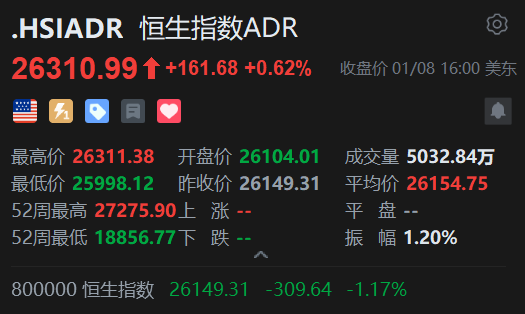
Market Overview - The Hang Seng Index (HSI) closed at 26,310.99, up by 161.68 points or 0.62% as of January 8, 16:00 Eastern Time [1] - The index reached a high of 26,311.38 and a low of 25,998.12 during the trading session, with a trading volume of 50.328 million shares [1] Major Blue-Chip Stocks Performance - HSBC Holdings closed at HKD 125.439, up by 0.92% compared to the Hong Kong close [2] - Tencent Holdings closed at HKD 615.197, down by 0.13% compared to the Hong Kong close [2] Stock Price Movements - Tencent Holdings: Latest price HKD 616.000, down by HKD 8.500 or 1.36%, with an ADR price of 615.197, reflecting a decrease of 0.13% [3] - Alibaba Group: Latest price HKD 142.600, down by HKD 3.300 or 2.26%, with an ADR price of 150.458, reflecting an increase of 5.51% [3] - HSBC Holdings: Latest price HKD 124.300, down by HKD 2.900 or 2.28%, with an ADR price of 125.439, reflecting an increase of 0.92% [3] - Other notable movements include Meituan-W down by 3.35% and JD.com down by 2.02% [3]