BIDU(09888)

Search documents
百度集团-SW现涨超4% 昆仑芯赴港独立上市 百度持股价值或达220亿美元
Zhi Tong Cai Jing· 2026-01-12 03:19
Core Viewpoint - Baidu has announced the spin-off of its AI chip subsidiary Kunlun Chip, submitting a listing application to the Hong Kong Stock Exchange, which is expected to unlock significant value for the company [1] Group 1: Company Developments - Baidu's stock price increased by 4.22%, reaching HKD 143.2, with a trading volume of HKD 866 million [1] - The spin-off of Kunlun Chip is part of Baidu's strategy to evaluate its AI cloud infrastructure as an independent business segment, with an implied value exceeding USD 50 billion [1] Group 2: Market Valuation and Projections - Goldman Sachs estimates that if Kunlun Chip receives a valuation multiple similar to Cambricon (40 times sales), Baidu's 59% stake could be valued at USD 22 billion, representing 45% of Baidu's current total market capitalization [1] - Sales projections for Kunlun Chip indicate expected revenues of RMB 3.5 billion in 2025, increasing to RMB 6.5 billion in 2026, with JPMorgan's more aggressive forecast suggesting revenues could reach RMB 8.3 billion in 2026 [1]

港股异动 | 百度集团-SW(09888)现涨超4% 昆仑芯赴港独立上市 百度持股价值或达220亿美元
智通财经网· 2026-01-12 03:15
Core Viewpoint - Baidu Group-SW (09888) announced the spin-off of its AI chip subsidiary Kunlun Chip, submitting a listing application to the Hong Kong Stock Exchange, which is expected to unlock significant value for the company [1] Group 1: Company Developments - As of the report, Baidu's stock rose by 4.22% to HKD 143.2, with a trading volume of HKD 866 million [1] - The spin-off of Kunlun Chip is part of Baidu's strategy to evaluate its AI cloud infrastructure as an independent business segment, with an implied value exceeding USD 50 billion [1] Group 2: Market Valuation and Projections - Goldman Sachs estimates that if Kunlun Chip receives a valuation multiple similar to Cambricon (40 times sales), Baidu's 59% stake could be valued at USD 22 billion, representing 45% of Baidu's current total market capitalization [1] - Sales projections for Kunlun Chip indicate expected revenues of RMB 3.5 billion in 2025, increasing to RMB 6.5 billion in 2026, with JPMorgan's more aggressive forecast suggesting revenues could reach RMB 8.3 billion in 2026 [1]
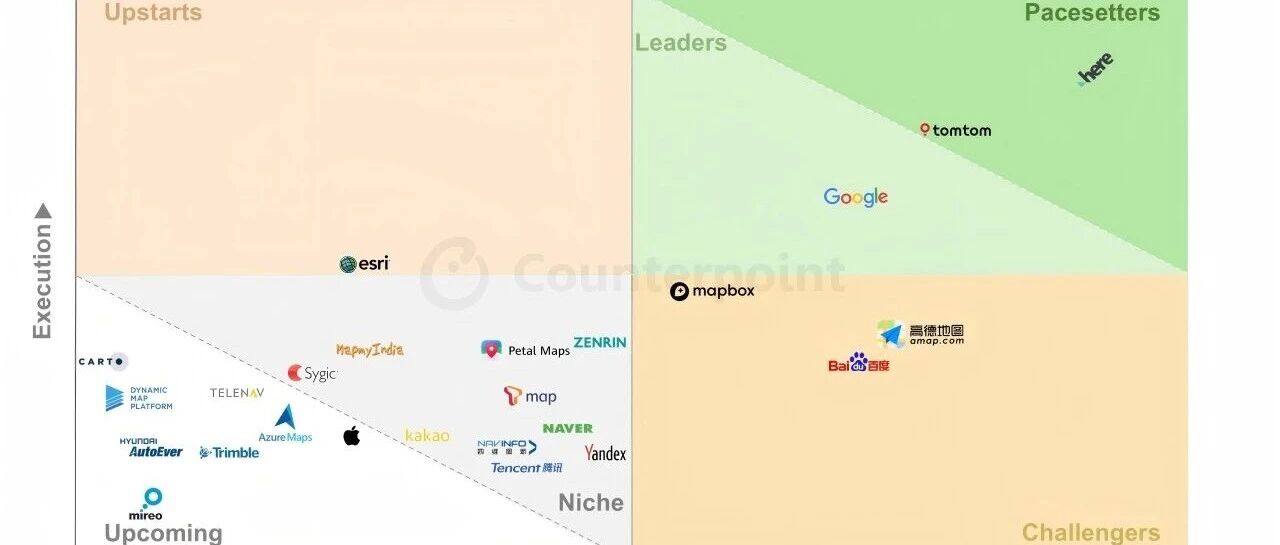
HERE 与 TomTom 在 2026 年定位平台竞争力评估指数中脱颖而出,成为先锋
Counterpoint Research· 2026-01-12 02:45
Core Insights - The article discusses the findings of the "2026 Positioning Platform Competitiveness Assessment Report" by Counterpoint Research, highlighting HERE and TomTom as "Pacesetters" in the positioning platform competitiveness index [4][7] - The report emphasizes the transformation of positioning platforms from traditional mapping solutions to AI-driven data platforms, enhancing user experience through real-time intelligence and personalized services [4][5] Group 1: Positioning Platform Competitiveness - HERE and TomTom are recognized as "Pacesetters" in the positioning platform competitiveness index, while Google is categorized as a "Leader" [4][7] - Baidu, Gaode, and Mapbox are classified as "Challengers" due to their strong platform capabilities but limited market coverage [4][8] - ESRI is noted as an "Upstart" for its execution capabilities, although it still lags behind leading companies in certain dimensions [4] Group 2: HERE's Performance - HERE excels in both platform capability and execution, supported by a comprehensive service product portfolio and a robust partner ecosystem across various verticals like automotive and logistics [5] - The company is leading the transition towards software-defined vehicles (SDVs) and collaborates closely with automakers to guide their transformation [5] - HERE is increasing its R&D investment in product technology and innovation, particularly in AI solutions for the automotive and logistics sectors [5] Group 3: TomTom's Innovations - TomTom has made significant strides with its Orbis map in 3D visualization and traffic analysis, earning its place alongside HERE as a "Pacesetter" [5] - The company is the second global entity, after Google, to launch a Model Context Protocol (MCP) server, facilitating rapid deployment of navigation systems for automakers [5] Group 4: Market Dynamics - The proliferation of location-aware AI features like "search" and "nearby" is leading to hyper-localized and highly personalized user experiences becoming mainstream [7] - Google Maps benefits from its strong core mapping capabilities and vast crowdsourced data from billions of monthly active users, solidifying its "Leader" status [8] - Baidu and Gaode are recognized as regional leaders in China, while Mapbox stands out for its developer-centric approach, offering customizable SDKs for users focused on personalization and visualization [8]


港股科网股持续走强,快手(01024.HK)涨超4%,阿里巴巴(09988.HK)涨超2%,百度(09888.HK)、哔哩哔哩(09626.HK)等跟涨。
Jin Rong Jie· 2026-01-12 02:13
Group 1 - Hong Kong tech stocks continue to strengthen, with Kuaishou (01024.HK) rising over 4% [1] - Alibaba (09988.HK) increased by more than 2% [1] - Baidu (09888.HK) and Bilibili (09626.HK) also experienced gains [1]



GEO专家交流-如何看待GEO底层技术及产业机遇
2026-01-12 01:41
Summary of GEO Technology and Industry Opportunities Company Overview - **Company**: Baidu - **Business Segment**: GEO (Generative Engine Optimization) - **Revenue Contribution**: GEO accounts for approximately 40% of Baidu's advertising search business, which contributes two-thirds of the annual revenue [1][2] Core Insights and Arguments - **Technological Framework**: Baidu's GEO utilizes a technology toolchain that includes RAG optimization, large model base, and vector database retrieval to achieve precise marketing and content distribution [1][2] - **Content Service Ecosystem**: Baidu has established over 20 data crowdsourcing bases across the country to gather data annotation materials, which support AI training and enhance optimization capabilities [5][6] - **Marketing Solutions**: The company offers end-to-end marketing strategies through keyword package services, enabling clients to achieve targeted exposure on various AI platforms [6][7] - **AI Content Generation**: Baidu integrates its Wenxin large model with GPU collaboration to provide toolchain services, allowing users to optimize content through conversational interfaces [1][7] - **Regulatory Compliance**: In response to AI regulatory policies, Baidu has implemented safety controls on its GEO engine and Wenxin model, ensuring that AI-generated content is clearly marked for compliance [8][9] Performance Metrics - **Optimization Results**: The optimization engine has reportedly increased retention rates and click-through rates by approximately 260% across platforms [12] - **GO Advertising Pricing**: GO advertising is priced about 30% higher than traditional advertising, with an expected long-term value increase of around 10% [21][27] Additional Important Points - **Client Industries**: GEO primarily serves industries such as tourism, legal, consumer goods, and e-commerce, with a focus on sectors that benefit from increased exposure and click rates [17] - **Cost Structure**: The pricing model for GEO includes toolchain fees, data services charged by person-days, and project-based pricing for marketing solutions [18][20] - **Competitive Advantage**: Baidu's integration of large model capabilities creates a significant technical barrier, allowing for automated strategy generation and optimization [22][23] - **Future Strategy**: Baidu's future plans focus on technology integration, compliance system development, and ecosystem collaboration to transition smoothly from the search era to new media and short video platforms [10][25] Conclusion Baidu's GEO technology represents a significant advancement in AI-driven marketing and content optimization, with a robust framework that supports compliance and enhances client engagement across various industries. The strategic focus on technology integration and regulatory adherence positions Baidu favorably in the evolving digital landscape.
港股开盘 | 恒指高开0.55% 科网股活跃 美团(03690)、百度(09888)涨超2%
智通财经网· 2026-01-12 01:40
Group 1 - The Hang Seng Index opened up by 0.55%, and the Hang Seng Tech Index rose by 0.88%, with notable gains in tech stocks like Meituan and Baidu, both increasing over 2% [1] - Lithium stocks showed strong performance, with Ganfeng Lithium and Tianqi Lithium both rising over 4%, while the precious metals sector also strengthened, with Zijin Mining up nearly 3% and China Aluminum increasing over 2% [1] - Citic Securities anticipates a second round of valuation recovery and performance resurgence in the Hong Kong stock market by 2026, driven by internal "15th Five-Year Plan" catalysts and external economic stimulus [1] Group 2 - Zheshang International views the fundamentals of the Hong Kong stock market as still weak, with a slight decline in the funding environment, but maintains a cautiously optimistic outlook for the mid-term market trends [2] - The firm highlights sectors that are relatively prosperous and benefit from policy support, including new energy, innovative pharmaceuticals, and AI technology, as well as low-valuation state-owned enterprises [2] - The expected performance of the Hong Kong stock market in spring 2026 is projected to be driven by "AI applications, PPI improvement, and expanded domestic demand," with a recommendation to focus on quality stocks in these areas [2]



智通港股沽空统计|1月12日
智通财经网· 2026-01-12 00:21
Group 1 - Anta Sports-R (82020), Tencent Holdings-R (80700), and Geely Automobile-R (80175) have the highest short-selling ratios at 100.00%, 90.92%, and 80.03% respectively [1][2] - Meituan-W (03690), Alibaba-W (09988), and Tencent Holdings (00700) lead in short-selling amounts, with 1.554 billion, 1.440 billion, and 1.253 billion respectively [1][2] - Tencent Holdings-R (80700), China Wangwang (00151), and Country Garden (02007) have the highest deviation values at 45.18%, 36.17%, and 33.66% respectively [1][2] Group 2 - The top short-selling amounts are led by Meituan-W (03690) at 1.554 billion, followed by Alibaba-W (09988) at 1.440 billion, and Tencent Holdings (00700) at 1.253 billion [2] - The top short-selling ratios include Anta Sports-R (82020) at 100.00%, Tencent Holdings-R (80700) at 90.92%, and Geely Automobile-R (80175) at 80.03% [2] - The highest short-selling deviation values are observed in Tencent Holdings-R (80700) at 45.18%, China Wangwang (00151) at 36.17%, and Country Garden (02007) at 33.66% [2][3]


【重磅深度】全球Robotaxi商业化拐点将现,看好国内L4公司出海再扬帆
东吴汽车黄细里团队· 2026-01-11 14:10
Core Viewpoint - The global shared mobility market is undergoing a critical transition from human-driven to automated services, exhibiting significant regional differentiation [4][9]. North America Market - The North American ride-hailing market is dominated by Uber and Lyft, creating a stable pricing power. In the Robotaxi sector, Waymo holds a monopoly while Tesla aggressively disrupts the market. Chinese Robotaxi companies face barriers due to a 2025 U.S. Department of Commerce ban on hardware and software, complicating their commercialization path [4][9][16]. European Market - The European regulatory environment is fragmented and stringent, with local automakers lagging in L4 algorithm development. This creates a unique "hybrid model" opportunity, where "U.S./local platforms + Chinese technology" could break through. Uber and Lyft's collaboration with Baidu Apollo indicates that de-branding technology output is a favorable solution for entering the European market [4][9][16]. Middle East Market - The Middle East presents a unique "three highs and one low" characteristic: high customer spending, high policy support, high infrastructure investment, and low energy costs. Gulf countries are eager to reduce oil dependency, viewing autonomous driving as a national strategy. Chinese companies like WeRide and Pony.ai benefit from dual advantages of road rights and licenses, making it an ideal training ground and commercialization area for overseas expansion [4][9][16]. Southeast Asia Market - The Southeast Asian ride-hailing market is large but has low customer spending. Low labor costs may lead to economic challenges for Robotaxi operations. In the short term, large-scale deployment of Robotaxis is not cost-effective, and two-wheeled vehicles remain mainstream. Singapore, with its high labor costs, may achieve Robotaxi commercialization [4][5][9]. Investment Focus - Focus on the L4 RoboX industry chain, prioritizing B-end software over C-end hardware. Recommended stocks include: - Hong Kong stocks: Xpeng Motors, Horizon Robotics, Pony.ai, WeRide, Cao Cao Mobility, and Black Sesame Technology - A-shares: Qianli Technology, Desay SV, and Jingwei Hirain - Downstream application-related stocks from the Robotaxi perspective include integrated models (Tesla, Xpeng Motors), technology providers with revenue-sharing models (Horizon, Baidu, Pony.ai, WeRide, Qianli Technology), and the transformation of ride-hailing/taxi services (Didi, Cao Cao Mobility, Ruqi Mobility, Dazhong Transportation, Jinjiang Online) [6][9]. Regulatory and Market Barriers - The regulatory landscape for Robotaxis abroad features a dual approach of support and regulation. Companies must assume clear accident liability and purchase sufficient liability insurance. Vehicles must have complete data recording capabilities and undergo third-party safety assessments. Operationally, there are restrictions on operational areas, fleet size, and speed [12][14]. Market Size and Growth - The North American shared mobility market is projected to grow significantly, with the total Gross Transaction Value (GTV) expected to reach billions by 2030. The European market also shows substantial potential, albeit with slower conversion rates. The Middle East is characterized by strong government support, while Southeast Asia presents a high-growth potential due to infrastructure gaps [21][22][27]. Pricing Dynamics - Pricing dynamics vary significantly across regions, influenced by local labor costs and regulatory environments. North America has high labor costs, allowing Robotaxis to survive without extreme price reductions. In contrast, Europe faces stringent labor protections that increase operational costs. The Middle East's pricing is shaped by government-led transportation strategies, while Southeast Asia's ultra-low fares are supported by low labor costs [33][34]. Profitability Disparities - Profitability varies significantly across countries, with developed regions showing higher absolute margins per Robotaxi. Revenue per vehicle in China, UAE, UK, and the US is estimated at approximately $40,000, $90,000, $250,000, and $250,000 respectively, with gross margins reflecting these disparities [34][35].




计算机行业研究:国内算力斜率陡峭
SINOLINK SECURITIES· 2026-01-11 09:14
Investment Rating - The report does not explicitly state an investment rating for the industry Core Insights - The competition in AI entry points is intensifying, with major companies increasing their investments. China's AI presence globally has significantly improved, with domestic large models continuously iterating. Despite GPT-5.2 and Gemini 3 Pro leading, Chinese models have effectively altered the North American dominance in the competitive landscape. In the global Top 10, three positions are held by Chinese models, and in the Top 15, there are six Chinese companies. By 2025, China's open-source AI model usage is expected to account for over 70% of the global market [2][11][19] - The demand for inference has surged, with the emergence of o1 class inference models unlocking approximately 10 times the potential of traditional models in terms of inference-time compute. The demand for computing power has shifted from being solely "training-driven" to a dual focus on "training + inference" [2][5][37] - The battle for entry points has evolved beyond mobile devices to OS-level intelligent agents and super apps. By December 24, 2025, ByteDance's AI application Doubao announced daily active users (DAU) exceeding 100 million, while Qianwen App reached over 30 million monthly active users within 23 days of public testing, becoming the fastest-growing AI application globally. Doubao bypasses traditional interfaces, creating an "AI operating system" that directly interacts with super apps like WeChat and Alipay, challenging the rules of the traditional app era [2][44][45] Summary by Sections AI Entry Point Competition - China's AI global presence has significantly improved, with domestic large models continuously iterating. In the global Top 10, three positions are held by Chinese models, and in the Top 15, there are six Chinese companies. By 2025, China's open-source AI model usage is expected to account for over 70% of the global market [2][11][19] - The competition for entry points has evolved beyond mobile devices to OS-level intelligent agents and super apps, with significant user engagement reported for new AI applications [2][44][45] Domestic Chip Breakthroughs - The smart computing center in China is expanding, with a projected compound annual growth rate (CAGR) of 57% from 2020 to 2028, reaching 2,781.9 EFLOPS by 2028. Domestic chip technology is steadily improving, with local cloud service providers accelerating the construction of heterogeneous environments [5][50] - Domestic general-purpose GPUs are upgrading from "usable" to "good," with performance metrics approaching those of leading international models. The production capacity of domestic chip manufacturers like SMIC is continuously increasing, providing solid support for domestic AI chip production [5][53][54] Supply and Demand Dynamics - The demand side is characterized by a surge in inference demand as AI applications become more prevalent, while the supply side sees continuous improvements in domestic GPU performance and accelerated adaptation by cloud service providers [5][59] - The AI server market is expected to see a shift towards inference servers becoming the mainstream, with a projected market size of approximately $39.3 billion in 2024, reflecting a year-on-year growth of 49.7% [5][64]




输入法“变笨”了吗?
经济观察报· 2026-01-11 07:29
Core Viewpoint - The article discusses the challenges faced by input method applications in the era of AI, highlighting user frustrations with accuracy and excessive advertisements, despite significant investments from major tech companies in enhancing these tools [2][4][14]. Group 1: User Experience Issues - Users are increasingly dissatisfied with input methods, reporting issues such as inaccurate word predictions and excessive advertisements, which detract from the overall user experience [2][4]. - A specific case is mentioned where a long-time user of Sogou Input Method uninstalled the app due to frequent incorrect suggestions, indicating a decline in basic functionality despite advanced AI features [4]. - Complaints about the voice recognition capabilities of input methods have also surfaced, with users noting that corrections often take longer than typing the text directly [4]. Group 2: AI Integration and Competition - Major input method providers, including Sogou, Baidu, and iFlytek, are engaged in a competitive race to integrate advanced AI capabilities into their products, aiming to enhance user experience and functionality [2][8][9]. - The input method market is characterized by a concentrated structure, with leading companies holding a combined market share of 84.4% as of July 2025, indicating a competitive landscape [8]. - Input methods are evolving from simple typing tools to becoming the primary interface for AI interactions, with companies aiming to position their products as essential gateways to AI capabilities [9][10]. Group 3: Commercialization and Privacy Concerns - Input methods face challenges in monetization, struggling with a "high traffic, low value" dilemma, which complicates their ability to generate revenue despite having a large user base [15][16]. - Privacy concerns are paramount, as input methods have been criticized for collecting unnecessary personal information, leading to regulatory scrutiny and the need for companies to adapt their data collection practices [16]. - Companies are implementing features that allow users to choose between different modes of data collection, balancing functionality with privacy protection [16]. Group 4: Future Directions - The future of input methods is seen as a shift towards becoming intelligent agents that can understand user intent and context, moving beyond basic text input to more complex interactions [12]. - Companies are exploring multi-modal input methods that incorporate voice, text, and images, which require sophisticated algorithms and technology to manage effectively [17].