
BABA(09988)

Search documents
智通港股通活跃成交|1月12日
智通财经网· 2026-01-12 11:01
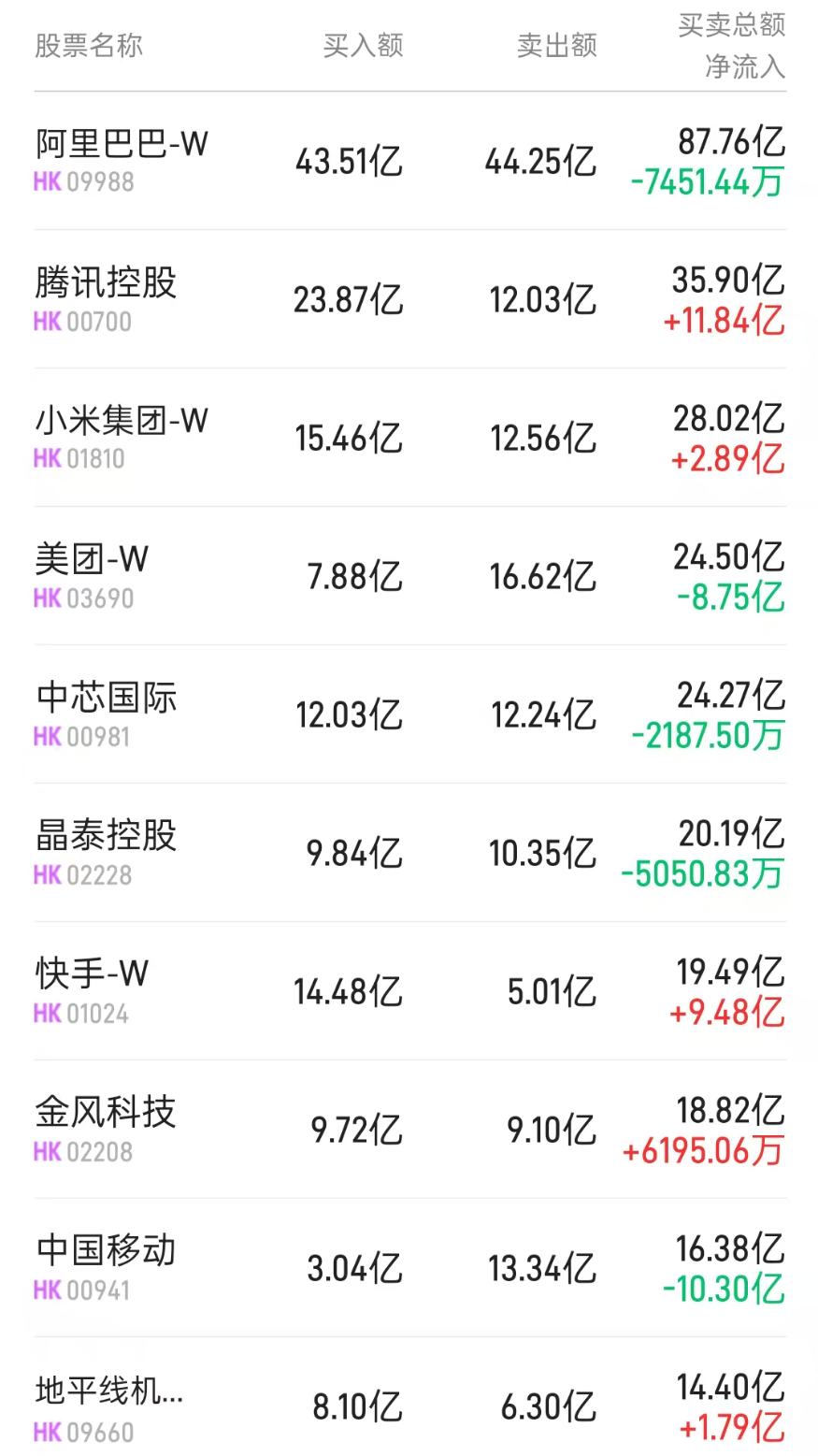
Core Insights - On January 12, 2026, Alibaba-W (09988), Tencent Holdings (00700), and Xiaomi Group-W (01810) were the top three companies by trading volume in the Southbound Stock Connect, with trading amounts of 8.776 billion, 3.590 billion, and 2.802 billion respectively [1] - In the Shenzhen-Hong Kong Stock Connect, Alibaba-W (09988), Tencent Holdings (00700), and Meituan-W (03690) also led the trading volume, with amounts of 6.830 billion, 3.416 billion, and 2.100 billion respectively [1] Southbound Stock Connect Trading Activity - **Top Active Companies in Southbound Stock Connect:** - Alibaba-W (09988): Trading amount of 8.776 billion, net buy of -74.5144 million [2] - Tencent Holdings (00700): Trading amount of 3.590 billion, net buy of 1.184 billion [2] - Xiaomi Group-W (01810): Trading amount of 2.802 billion, net buy of 289 million [2] - Meituan-W (03690): Trading amount of 2.450 billion, net buy of -875 million [2] - SMIC (00981): Trading amount of 2.427 billion, net buy of -21.875 million [2] - Other notable companies include Kuaishou-W (01024) with a trading amount of 1.949 billion and a net buy of 948 million [2] Shenzhen-Hong Kong Stock Connect Trading Activity - **Top Active Companies in Shenzhen-Hong Kong Stock Connect:** - Alibaba-W (09988): Trading amount of 6.830 billion, net buy of 278 million [2] - Tencent Holdings (00700): Trading amount of 3.416 billion, net buy of 828 million [2] - Meituan-W (03690): Trading amount of 2.100 billion, net buy of 393 million [2] - Kuaishou-W (01024): Trading amount of 1.990 billion, net buy of 1.298 billion [2] - Xiaomi Group-W (01810): Trading amount of 1.869 billion, net buy of 484 million [2]




跳出手机屏幕,千问正在改变物理世界
Jing Ji Guan Cha Wang· 2026-01-12 10:19
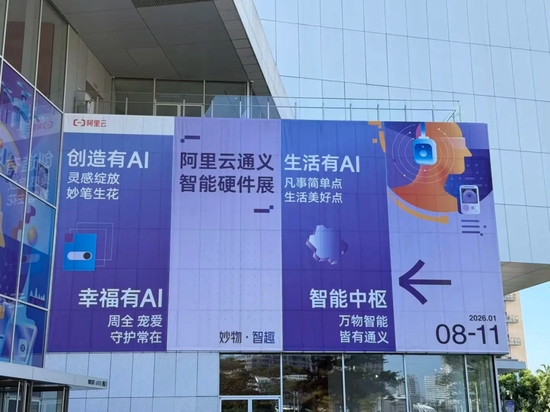
Core Insights - The CES 2026 highlighted the arrival of the "Physical AI" era, with a shift from AI generating text and images to interacting with the real world [1] - The Alibaba Cloud Tongyi Intelligent Hardware Exhibition showcased over 1,500 AI-integrated hardware products, emphasizing practical applications rather than theoretical concepts [1][3] - The focus of hardware manufacturers is on embedding AI capabilities into everyday products, transforming how people live and work [3][6] Group 1: AI Hardware Development - The exhibition featured 76 categories and over 200 brands, including major players like Honor and OPPO, as well as innovative startups [1] - AI hardware is moving beyond traditional smartphone applications, with products capable of tasks such as driving, assisting the visually impaired, and adjusting lighting [1][3] - Companies are leveraging the Qianwen model to enhance their products, enabling functionalities like health monitoring and automatic report generation [3][4] Group 2: Market Trends and Innovations - The focus is on practical AI applications that address specific needs, such as the YoooTek AI ONE device that captures voice notes and organizes information [4][6] - The shift towards AI hardware is supported by a new multi-modal interaction development kit, allowing even non-coders to integrate AI into their devices [6] - The competitive landscape is evolving, with a focus on reducing costs and improving efficiency in AI hardware development [6][7] Group 3: Industry Dynamics - The integration of AI into hardware is seen as a way to enhance productivity and redefine interactions in various sectors, including automotive and healthcare [10][11] - The Chinese manufacturing ecosystem is characterized by low trial costs and a willingness to innovate, positioning it as a leader in AI hardware development [11][12] - The Qianwen model's open-source strategy is enabling a broader range of developers to create AI hardware, democratizing innovation [8][12]
北水动向|北水成交净买入73.06亿 AI概念股受追捧 快手(01024)获北水加仓超22亿港元
智通财经网· 2026-01-12 09:57
Core Viewpoint - The Hong Kong stock market experienced significant net inflows from northbound trading, with a total net buy of HKD 73.06 billion on January 12, 2023, indicating strong investor interest in certain stocks [1]. Group 1: Northbound Trading Activity - Northbound trading through Stock Connect saw a net buy of HKD 15.46 billion from Shanghai and HKD 57.6 billion from Shenzhen [1]. - The stocks with the highest net buy included Kuaishou-W (01024), Tencent (00700), and Southern Hang Seng Technology (03033) [1]. - The stocks with the highest net sell included China Mobile (00941) and Goldwind Technology (02208) [1]. Group 2: Individual Stock Performance - Kuaishou-W (01024) received a net buy of HKD 22.45 billion, driven by its AI capabilities gaining popularity globally, with a reported 102% increase in daily revenue from December 2025 to January 2026 [4]. - Tencent (00700) saw a net buy of HKD 20.11 billion, with a positive outlook from Zhongtai Securities, highlighting its potential in the AI sector [5]. - Xiaomi Group-W (01810) had a net buy of HKD 7.73 billion, with plans for a significant increase in R&D investment over the next five years [5]. - Alibaba-W (09988) experienced a net buy of HKD 2.03 billion amid ongoing regulatory scrutiny in the food delivery sector [5]. - Horizon Robotics-W (09660) received a net buy of HKD 1.79 billion, with optimistic growth expectations due to advancements in smart driving technology [6]. - Jingtai Holdings (02228) had a net buy of HKD 42.04 million, with a focus on its AI and robotics platform [7]. - Southern Hang Seng Technology (03033) and SMIC (00981) received net buys of HKD 8.57 billion and HKD 2.334 million, respectively [7].


美股中概股盘前多数上涨,阿里巴巴涨4%


Jin Rong Jie· 2026-01-12 09:19
Core Viewpoint - The majority of Chinese concept stocks in the US pre-market are experiencing gains, indicating positive market sentiment towards these companies [1] Group 1: Company Performance - Alibaba's stock has increased by 4% [1] - Baidu's stock has risen by 3% [1] - NIO's stock has gone up by 2% [1] - Pinduoduo's stock has seen a modest increase of 0.8% [1] - Pony.ai's stock remains unchanged [1]
2025年Q4电商平台商家投诉数据报告
网经社电子商务研究中心· 2026-01-12 07:59
Investment Rating - The report does not explicitly provide an investment rating for the e-commerce industry Core Insights - The fourth quarter is the most critical operational peak for e-commerce merchants, supported by various platforms like JD, Taobao, Pinduoduo, and Douyin through promotional activities and resources [5] - Intense competition for advertising during key events like "Double 11" and "New Year Goods Festival" may increase customer acquisition costs and marketing expenditures [5] - Merchants face pressure on profit margins due to fierce price competition and evolving platform policies, requiring continuous adaptation to maintain traffic support [5] - A significant complaint from merchants involves issues like arbitrary refunds and excessive consumer protection measures, leading to widespread dissatisfaction [5][6] Overall Data Complaint Platform Distribution - The distribution of complaints across platforms in Q4 is as follows: Douyin E-commerce (38.75%), Pinduoduo (33.55%), Taobao (10.92%), JD (2.08%), and others [7] Complaint Issue Type Distribution - The main types of complaints include: arbitrary refunds (37.09%), excessive consumer protection (19.97%), withholding deposits (9.99%), arbitrary fines (9.73%), arbitrary store closures (2.72%), and mandatory shipping insurance (0.52%) [10] Complaint Regional Distribution - The top 10 regions for merchant complaints are Guangdong (23.86%), Zhejiang (14.53%), Shandong (11.80%), Hebei (6.10%), Jiangsu (5.71%), Henan (5.45%), Fujian (3.76%), Shaanxi (3.50%), Anhui (3.37%), and Hunan (2.72%) [12] Complaint Business Category Distribution - The top 10 business categories for complaints are: apparel (15.95%), 3C digital products (10.64%), fresh food (9.08%), outdoor products (6.49%), home goods (6.36%), personal care (3.89%), home appliances (3.50%), maternal and infant products (2.98%), jewelry (2.46%), and pet supplies (2.33%) [14] Complaint Amount Distribution - The majority of complaint amounts are concentrated in the range of 0-50,000 (95.07%), with smaller percentages in higher ranges [16] Complaint Merchant Responsible Gender Distribution - The gender distribution of complaint merchants shows 70.78% are male and 29.22% are female [17] Platform Data Douyin E-commerce - In Q4, Douyin E-commerce had 298 merchant complaints, with the highest issue being arbitrary refunds (46.64%) [18] Taobao - For Taobao, the main complaint issues are arbitrary refunds (30.95%), excessive consumer protection (28.57%), arbitrary fines (13.10%), withholding deposits (8.33%), and arbitrary store closures (2.38%) [25] Typical Cases - The report includes ten typical complaint cases involving various platforms, highlighting issues such as arbitrary fines, unreasonable penalties, excessive consumer protection, and arbitrary store closures [31]
华强北迎来第二春,这次不靠苹果,是千问!
Xin Lang Cai Jing· 2026-01-12 07:25
Core Insights - The article discusses the transformation of Huaqiangbei from a hub for counterfeit mobile phones to a center for AI-driven smart hardware, driven by the introduction of the Qianwen AI model [1][32][34] Group 1: Industry Transformation - Huaqiangbei, once thriving on counterfeit mobile phones, has pivoted to become the "global 3C accessories center" after the advent of the iPhone [1][32] - The recent AI hardware exhibition showcased over 1,000 AI hardware products, indicating a significant shift towards AI integration in traditional hardware [32][34] - The Qianwen AI model is the backbone of many innovative products, enabling ordinary hardware to be transformed into intelligent devices [34][39] Group 2: Product Innovations - The article highlights several innovative products, such as a blood pressure smartwatch that generates health reports and a pet translator that can interpret animal sounds with a 94.6% accuracy [5][9][38] - The Qianwen AI model supports various applications, including professional translation for cross-border business, enhancing communication for merchants [37][39] Group 3: Qianwen AI Model Features - Qianwen is the first open-source model capable of processing text, images, audio, and video, with over 200 model variants to cater to different hardware needs [12][40][41] - The model's pricing structure is based on the number of hardware terminals rather than token usage, making costs predictable for manufacturers [17][44] - Qianwen's popularity is attributed to its comprehensive support from Alibaba Cloud, which provides a complete solution from chips to applications [22][48] Group 4: Future Implications - The integration of Qianwen AI is expected to democratize innovation, allowing small and medium enterprises to compete on equal footing with larger companies [26][52] - The technology is reshaping the relationship between humans and hardware, moving towards a model where devices can understand and respond to human needs [28][52] - The ongoing development of the AI ecosystem in Huaqiangbei may lead to the emergence of more groundbreaking smart products in the future [30][53]
港股科网股午后持续走强,快手(01024.HK)涨近7%,美团(03690.HK)涨超6%,百度(09888.HK)、阿里巴巴(09988.HK)涨超5...
Jin Rong Jie· 2026-01-12 06:33
Group 1 - Hong Kong tech stocks showed strong performance in the afternoon session, with Kuaishou (01024.HK) rising nearly 7% [1] - Meituan (03690.HK) increased by over 6% [1] - Baidu (09888.HK) and Alibaba (09988.HK) both saw gains of over 5% [1] - Other companies such as NetEase-S (09999.HK) and Tencent Holdings (00700.HK) also experienced upward movement [1]

资本市场丨跻身市值榜上市企业 须从规模优势转向质量优势
Sou Hu Cai Jing· 2026-01-12 05:45
Core Insights - The latest "Top 500 Listed Companies in China" list for 2025 showcases leading enterprises in finance, energy, technology, consumption, and intelligent manufacturing, with major players like Tencent and ICBC demonstrating their industry leadership through trillion-level market capitalizations [1][10] - The presence of companies like Industrial Fulian, SMIC, and Cambricon in the rankings reflects the deep structural transformation of China's economy, indicating these firms are both stabilizers and pioneers in industrial upgrades [1][10] Group 1: Market Capitalization Rankings - The companies ranked from 21 to 30 include Sinopec (700.7 billion), Zhongji Xuchuang (677.8 billion), Yangtze Power (665.3 billion), Postal Savings Bank (641.7 billion), SMIC (632.9 billion), NetEase (614.0 billion), Midea Group (592.9 billion), Bank of Communications (590.8 billion), Cambricon (571.6 billion), and Meituan (570.2 billion) [3][10] Group 2: Economic Structural Transformation - The success of these companies is attributed to multiple factors, including industry scarcity, technological barriers, and stable business models, which create competitive advantages [4][11] - Companies like Zhongji Xuchuang and SMIC exemplify the dual drivers of technological innovation and market opportunities, with Zhongji Xuchuang capitalizing on the AI infrastructure wave [4][11] Group 3: Challenges and Opportunities - Companies face the challenge of transitioning from scale advantages to quality advantages, with risks related to technological iteration and high valuation sustainability [6][12] - The need for technological independence and improved profitability models is highlighted, particularly for firms like Zhongji Xuchuang and Cambricon, which must navigate rapid technological changes [6][12] Group 4: Future Trends - Future market leaders are expected to emerge from sectors such as high-end manufacturing, green energy, and innovative pharmaceuticals, with a focus on hard technology like semiconductors and AI [8][9] - The anticipated market structure will feature a three-tier system, with traditional giants at the base, tech newcomers leading, and niche champions filling in [8][9] Group 5: Investment Opportunities - The average market capitalization of the top 500 companies reached 185.6 billion, reflecting a significant increase, particularly in information technology, finance, and consumer discretionary sectors [23] - Companies are expected to enhance their value and market capitalization through innovation, digital transformation, and sustainable practices, aligning with national policies and market demands [21][24]


观察 | 阿里双线作战:押注闪购与AI,不是左右互搏是大棋?
未可知人工智能研究院· 2026-01-12 05:02
Core Viewpoint - Alibaba is strategically focusing on both instant retail and AI, aiming to establish a strong user mindset and market position in the evolving landscape of consumer services [1][12][68]. Group 1: Market Positioning - Alibaba plans to invest heavily in instant retail, targeting to become the leader in this sector by 2026, indicating a rare assertive stance [1][12]. - The primary competition is not with Meituan or ByteDance, but rather in capturing user attention and decision-making processes [6][8]. - The instant retail market is projected to exceed 1 trillion by 2026 and reach 2 trillion by 2030, highlighting the significant growth potential [13]. Group 2: Strategic Resource Allocation - Alibaba's strategy involves concentrating resources on key areas during critical market phases, with over hundreds of billions allocated to instant retail in 2025 [19][20]. - The company is currently in a pivotal phase where its market share in instant retail has reached 42%, narrowing the gap with the leader [20][21]. - By focusing on instant retail, Alibaba aims to leverage this sector to enhance its overall local service ecosystem [23]. Group 3: Dual Focus on AI and Instant Retail - The simultaneous investment in AI is not a distraction but a strategic combination of short-term and long-term initiatives [30][41]. - AI is seen as a tool to reconstruct the consumer decision-making process, potentially increasing efficiency significantly [35][36]. - The integration of AI into various service scenarios aims to create a comprehensive ecosystem that connects shopping, delivery, and local services [40][62]. Group 4: Long-term Vision and Strategy - Alibaba's approach is to maintain a balance between immediate market needs and future technological advancements, avoiding a binary choice between focusing solely on instant retail or AI [45][68]. - The company is adopting a "rural encirclement of cities" strategy, starting with AI tools to capture users and gradually expanding into broader service areas [63]. - The success of Alibaba's strategy will be evident by 2026, depending on its ability to lead in instant retail and establish a strong user base for its AI initiatives [70].
阿里巴巴-W再涨超4% 淘宝闪购声明坚决维护行业公平有序竞争
Zhi Tong Cai Jing· 2026-01-12 04:04
Core Viewpoint - Alibaba-W (09988) saw a rise of over 4%, closing at HKD 152.8 with a trading volume of HKD 12.93 billion, indicating positive market sentiment towards the company amid ongoing regulatory developments in the industry [1] Group 1: Regulatory Environment - On January 9, the State Council's Anti-Monopoly and Anti-Unfair Competition Committee announced an investigation into the market competition status of the food delivery platform service industry [1] - Taobao Flash Purchase announced its commitment to cooperate with the industry market competition investigation and to strictly implement compliance responsibilities [1] Group 2: Company Performance and Outlook - CITIC Securities maintained a "Buy" rating for Alibaba, highlighting the company's increased investment in "consumption + AI" and accelerated development of its cloud business [1] - The company is focusing on AI and international expansion, with a significant investment of HKD 380 billion in infrastructure to enhance its global competitiveness [1] - While the e-commerce segment remains stable, growth is slowing; however, losses in Flash Purchase are narrowing, and it holds the top market share [1] - The long-term dual-core driving logic for Alibaba is clear, with controllable investment pace, indicating strong long-term value potential [1]