
BABA(09988)

Search documents
美股异动丨阿里巴巴大涨超7% 小摩预期阿里云收入增长将在未来几季持续加速
Ge Long Hui· 2026-01-12 15:04
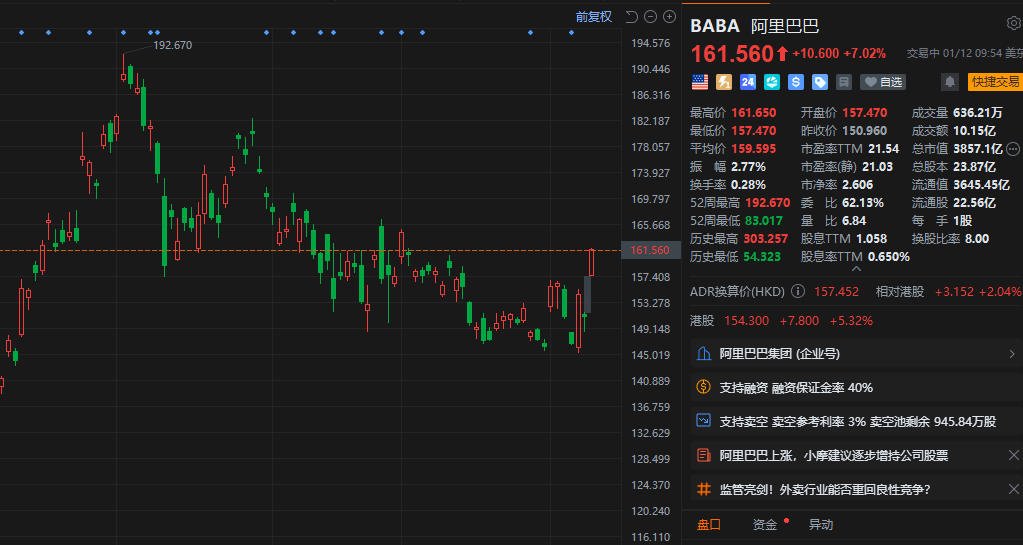
Core Viewpoint - Alibaba (BABA.US) shares have seen an initial increase of over 7%, with Morgan Stanley suggesting investors consider gradually accumulating shares due to a constructive outlook for the next 6 to 12 months [1] Group 1: Company Performance - Morgan Stanley anticipates that Alibaba Cloud's revenue growth will accelerate in the coming quarters as generative AI workloads transition from pilot phases to broader deployment, indicating Alibaba's capability to capture and realize AI-driven demand in China [1] - The consistent growth momentum in Alibaba's cloud business over several quarters is expected to shift investor focus from short-term expenditures to the sustainability of higher-quality growth engines, which could support an expansion in valuation multiples [1]


美股低开,中概股逆势走强
Di Yi Cai Jing Zi Xun· 2026-01-12 14:56
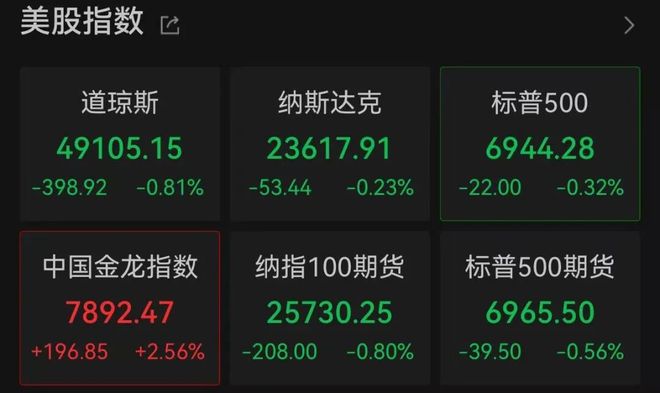
Market Overview - The three major U.S. stock indices opened lower on January 12, with the Dow Jones down 0.81%, the Nasdaq down 0.23%, and the S&P 500 down 0.32% [1][2]. Index Performance - Dow Jones: 49,105.15, down 398.92 points (-0.81%) [2] - Nasdaq: 23,617.91, down 53.44 points (-0.23%) [2] - S&P 500: 6,944.28, down 22.00 points (-0.32%) [2] - China Golden Dragon Index: 7,892.47, up 196.85 points (+2.56%) [2] - Nasdaq 100 Futures: 25,730.25, down 208.00 points (-0.80%) [2] - S&P 500 Futures: 6,965.50, down 39.50 points (-0.56%) [2] Sector Performance - Technology stocks experienced a broad decline, with Intel falling over 3% and Nvidia down nearly 1% [2]. - Banking stocks collectively dropped, with American Express down over 4% and JPMorgan Chase down more than 2% [2]. Chinese Stocks - Chinese stocks surged against the trend, with the China Golden Dragon Index rising over 2% [2]. - Notable performers included Kingsoft Cloud, which rose over 16%, Zhihu up over 15%, Alibaba up nearly 5%, Xpeng up over 4%, and Baidu up over 3% [2].



外媒关注2026开年中国消费市场新趋势——中国消费迎来“开门红”(国际论道)
Xin Lang Cai Jing· 2026-01-12 14:51
Core Insights - The Chinese consumer market is experiencing a significant transformation, shifting from quantity to quality, driven by increased consumer confidence and innovative policies [6][9][10]. Consumer Activity - During the New Year holiday, 142 million domestic trips were made in China, with total spending reaching 84.789 billion yuan, indicating a robust recovery in consumer activity [6][14]. - Hainan's duty-free sales on January 1 reached 251 million yuan, a year-on-year increase of 93.8%, showcasing the growing appeal of domestic tourism and shopping [7][14]. Market Trends - The rise of "China Shopping" alongside "China Travel" reflects a shift in consumer preferences, with tourists increasingly purchasing high-tech products and cultural items rather than traditional souvenirs [7][8]. - The Z-generation in China is gravitating towards new domestic products and services that blend tradition with modern technology, enhancing the appeal of local brands [7][8]. Policy Support - The Chinese government is implementing a series of policies aimed at stimulating consumption, including financial incentives and support for green technology products [9][10]. - The Central Economic Work Conference emphasized the continuation of proactive fiscal policies in 2026 to maintain high growth rates, focusing on boosting consumer spending and investment [9][10]. Economic Resilience - China's consumer market is not only recovering but also reflecting structural optimization and enhanced internal dynamics, contributing to economic resilience [11][19]. - The retail sales of consumer goods increased by 4% year-on-year in the first eleven months of 2025, indicating a steady release of consumer demand [11][19]. Global Perspective - International media highlight the opportunities for global businesses to adapt to the evolving Chinese market, particularly in sectors like retail and services, where consumer preferences are shifting towards local and value-driven products [12][19]. - The focus on service experiences among younger consumers presents significant opportunities for foreign companies in sectors such as tourism, cultural events, and entertainment [12][19].

美股开盘,三大股指小幅低开,道指跌0.32%,纳指跌0.4%
Mei Ri Jing Ji Xin Wen· 2026-01-12 14:51
Group 1 - The core market sentiment shows a slight decline in major U.S. stock indices, with the Dow Jones down 0.32%, Nasdaq down 0.4%, and S&P 500 down 0.45% [1] - Walmart's stock increased by nearly 2.5% following Google's announcement of a partnership with Walmart and other large retailers to develop the Gemini chatbot as a virtual merchant and assistant [1] - Chinese concept stocks performed well, with Alibaba rising over 4% as JPMorgan suggested gradually increasing holdings in the company, Baidu up 3.5%, and XPeng gaining nearly 5% [1] Group 2 - XPeng is reportedly preparing to submit a confidential application for an IPO in Hong Kong, with the potential to list on the Hong Kong Stock Exchange as early as this year [1]



美股三大股指小幅低开,纳指跌0.4%,中概股逆势走强
Feng Huang Wang Cai Jing· 2026-01-12 14:42
沃尔玛涨近2.5%,谷歌宣布与沃尔玛等大型零售商达成合作,计划将聊天机器人Gemini打造为虚拟商 家和助手。 中概股逆势走强,阿里巴巴涨超4%,小摩建议逐步增持公司股票;百度涨3.5%,小鹏涨近5%,小鹏汇 天据悉以保密形式提交港股IPO申请,最早今年登陆港交所。 凤凰网财经讯 1月12日,美股三大股指小幅低开,道指跌0.32%,纳指跌0.4%,标普500指数跌0.45%。 ...
阿里巴巴(BABA.US)盘前涨逾4% 小摩建议逐步增持公司股票
Zhi Tong Cai Jing· 2026-01-12 14:32
Group 1 - Alibaba's stock rose over 4% to $157.45 ahead of market opening on Monday [1] - JPMorgan suggests investors consider gradually accumulating Alibaba shares, maintaining a constructive outlook for the next 6 to 12 months [1] - The company is facing short-term pressure on profit margins due to increased investments in food delivery, fast e-commerce, and generative AI applications, alongside a weak macroeconomic environment affecting its core domestic e-commerce growth [1] Group 2 - Market has largely absorbed the negative factors impacting Alibaba, with the pace and scale of investments being controllable strategic inputs by the company [1] - Morgan Stanley anticipates that Alibaba Cloud's revenue growth will accelerate in the coming quarters as generative AI workloads expand from pilot phases to broader deployment [1] - Stable growth momentum in cloud business over several quarters is expected to shift investor focus from short-term expenditures to the sustainability of higher-quality growth engines, supporting valuation multiple expansion [1]
美股异动 | 阿里巴巴(BABA.US)盘前涨逾4% 小摩建议逐步增持公司股票
智通财经网· 2026-01-12 14:16
Core Viewpoint - Alibaba (BABA.US) is experiencing a pre-market increase of over 4%, reaching $157.45, as Morgan Stanley suggests investors consider gradually accumulating shares, maintaining a constructive outlook for the next 6 to 12 months [1] Group 1: Investment Strategy - Morgan Stanley advises that while Alibaba's short-term profitability may be pressured due to increased investments in food delivery, e-commerce, and generative AI applications, these negative factors are largely priced in by the market [1] - The pace and scale of Alibaba's investments are largely controllable by the company, indicating a strategic approach to investment [1] Group 2: Cloud Business Outlook - Morgan Stanley anticipates that Alibaba Cloud's revenue growth will accelerate in the coming quarters as generative AI workloads transition from pilot phases to broader deployment, showcasing Alibaba's capability to capture AI-driven demand in China [1] - The sustained growth momentum in cloud business over several quarters is expected to shift investor focus from short-term expenditures to the continuity of higher-quality growth engines, thereby supporting valuation multiple expansion [1]
马云豪赌未来,淘宝闪购正在起飞
Xin Lang Cai Jing· 2026-01-12 12:32
Group 1 - Alibaba is intensifying its efforts in the instant retail sector, aiming to become the market leader by 2026 with a focus on high-frequency transactions and a complete overhaul of its business logic [2][3][34] - Taobao Flash Purchase has achieved significant milestones, including a daily order volume stabilizing at 10 million for non-food items, indicating strong growth and commitment to the business [5][36] - The integration of various platforms under Alibaba's ecosystem, such as Hema and Ele.me (now Taobao Flash Purchase), is enhancing operational efficiency and market presence [6][37] Group 2 - In Q1 of the 2026 fiscal year, Taobao Flash Purchase reached a peak daily order volume of 120 million, with a monthly active buyer count increasing by 200% since its launch [8][39] - Alibaba's Q2 fiscal report for 2026 showed revenues of approximately 247.8 billion, a 5% year-on-year increase, with a 15% increase when excluding divested businesses [10][41] - The company is investing heavily in instant retail, with a reported 60% year-on-year revenue growth in this segment, despite a significant drop in overall operating profit [13][45] Group 3 - The strategic restructuring of Alibaba's organizational framework aims to transition from an e-commerce platform to a comprehensive consumer platform, enhancing its competitive edge in instant retail [15][46] - The launch of a 50 billion subsidy plan for Taobao Flash Purchase demonstrates Alibaba's commitment to capturing market share in the instant retail space [24][55] - The potential market size for instant retail in China is projected to exceed 1 trillion by 2026, with expectations to double by 2030, highlighting the growth opportunities for Taobao Flash Purchase [30][60] Group 4 - Taobao Flash Purchase has attracted approximately 100 million new users, primarily from urban high-income demographics, which could lead to increased sales across various product categories [30][61] - The competitive landscape in instant retail is intensifying, with major players like Meituan and JD.com already established, necessitating Taobao Flash Purchase to leverage its ecosystem for differentiation [31][62] - The focus on optimizing delivery efficiency and cultivating consumer habits in instant purchasing remains critical for Taobao Flash Purchase's success in the competitive market [31][62]
跳出手机屏幕,千问正在改变物理世界
经济观察报· 2026-01-12 11:48
Core Viewpoint - The article emphasizes the emergence of "Physical AI," which signifies the integration of AI into various hardware products, moving beyond traditional mobile applications to interact with the physical world [1][4][22]. Group 1: AI Hardware Development - The CES (Consumer Electronics Show) is highlighted as a global technology trendsetter, where the focus is shifting from conceptual displays to practical, mass-produced AI hardware products [2][6]. - The AI hardware showcased at the Aliyun Tongyi Intelligent Hardware Exhibition includes over 1,500 diverse products, indicating a significant shift towards practical applications of AI in everyday devices [1][2]. - Companies are now focusing on integrating AI capabilities into their products to enhance user experience, rather than just showcasing hardware specifications [2][6]. Group 2: Innovations in AI Applications - New AI hardware products, such as AI translators and health monitoring devices, are being developed to provide real-time insights and recommendations based on user data [7][9]. - The article mentions the introduction of AI hardware that can operate independently without the need for mobile applications, showcasing a trend towards more user-friendly designs [9][10]. - The integration of AI into various sectors, including automotive and health, is transforming how users interact with technology, making it more intuitive and responsive [16][17]. Group 3: Market Dynamics and Competitive Landscape - The article discusses how the Chinese hardware industry is leveraging its supply chain advantages to rapidly innovate and bring AI products to market [6][19]. - The shift from traditional business models to a more open-source approach with the Tongyi Qianwen model is enabling smaller companies and individual developers to participate in the AI hardware ecosystem [15][19]. - The competitive landscape is evolving, with companies focusing on practical applications of AI that address specific user needs, rather than just competing on technical specifications [13][21]. Group 4: Future of AI in Physical World - The article posits that the future of AI lies in its ability to seamlessly integrate into everyday objects, enhancing their functionality and user interaction [22][23]. - The concept of "AI as the new electricity" is introduced, suggesting that AI will become a fundamental part of various industries, similar to how electricity transformed society [19][22]. - The ongoing development of AI hardware is expected to lead to a significant transformation in productivity and user experience across multiple sectors [17][22].

阿里巴巴(BABA):阿里云继续加速增长,投入即时零售深化生态协同
Shenwan Hongyuan Securities· 2026-01-12 11:04
Investment Rating - The report maintains a "Buy" rating for Alibaba (BABA) [4][5] Core Insights - Alibaba Cloud continues to accelerate growth, with a significant investment plan of 380 billion over three years, potentially exceeding expectations [3] - The AIDC strategy focuses on high-potential markets, with expected revenue growth slowing but losses significantly narrowing [3] - The report anticipates a challenging macro environment affecting e-commerce growth, with a projected revenue of 286.6 billion for Q3 FY26, reflecting a 2.3% year-on-year increase [4] - The report highlights the success of Taobao's flash purchase business, which has seen substantial growth in market share and order volume [4] - Alibaba Cloud is expected to maintain its leading position, with a projected revenue growth of 35% year-on-year for Q3 FY26 [4] - The report emphasizes the strategic direction of integrating ecosystem collaboration and deep AI empowerment, focusing resources on key areas like "AI + Cloud" technology and instant retail [4] Financial Data and Profit Forecast - Projected revenue (in million RMB) for FY24 to FY28: 941,168; 996,347; 1,023,358; 1,118,672; 1,215,861, with growth rates of 8.3%, 5.9%, 2.7%, 9.3%, and 8.7% respectively [5] - Non-GAAP net profit (in million RMB) for FY24 to FY28: 158,359; 158,393; 95,827; 122,157; 157,095, with a significant decline of 39.5% expected in FY26 [5] - Adjusted EPS (in RMB) for FY24 to FY28: 62.11; 65.59; 39.69; 50.59; 65.06, with a projected ROE of 16% for FY24 and FY25, dropping to 8% in FY26 and FY27 [5]