
NTES(09999)

Search documents
暑假首月,29款国产游戏赚了35亿元
3 6 Ke· 2025-08-10 01:23
Core Insights - The summer gaming season is a critical period for game developers to capture traffic and increase revenue, with a notable rise in player engagement and game duration [1] - Compared to the upcoming summer releases in 2024, this year's summer lineup appears relatively subdued, with new titles failing to disrupt the dominance of established games [1][2] - The "Evergreen Games List" and "Potential Evergreen Games List" have been compiled to highlight games that have shown sustained revenue performance [1] Evergreen Games - In July, 29 games made it to the "Evergreen Games List," a decrease of 4 from the first half of the year [2] - The top three games on the list are "Honor of Kings," "Peacekeeper Elite," and "Fantasy Westward Journey," with estimated revenues of approximately $147 million, $76.83 million, and $34.27 million respectively [8][9] - Tencent and NetEase dominate the list, with 12 and 5 games respectively, accounting for nearly 60% of the total entries [8] Potential Evergreen Games - The "Potential Evergreen Games List" expanded to 11 titles, with a cumulative estimated revenue of $152 million in July [13] - The top three games on this list are "Endless Winter," "Dungeon & Fighter Mobile," and "Honkai: Star Rail," with revenues of approximately $32.25 million, $29.30 million, and $24.13 million respectively [13][14] - Notable updates and events in July for these games contributed to their performance, such as new content and gameplay enhancements [14][15] Market Trends - The summer gaming market has seen a variety of new game types, but few have emerged as blockbuster hits, indicating a market still led by established titles [15] - The potential for new games to gain traction may increase in the upcoming fall and winter seasons as developers refine their offerings [15]



腾讯《虚环》《穿越火线:虹》公开实机演示;心动投资AI游戏公司;GPT-5可分钟级生成3D游戏 | 氪游周报8.4-8.10
3 6 Ke· 2025-08-10 00:59
Game Releases - Tencent's new game "Virtual Ring" released a 21-minute gameplay demonstration on August 4, with the first test scheduled for January 2026, and the video has garnered over 14.25 million views [1] - NetEase launched the 3D turn-based pet-catching game "Spirit Beast Adventure" on August 7, featuring five major factions and a home-building system [3] - Perfect World released the ancient fantasy MMORPG "Zhu Xian 2" on August 7, which quickly reached the number one spot on the iOS free chart [6] - Tencent's survival mobile game "Out of Control Evolution," authorized by "Rust," began testing recruitment on August 8, with large-scale testing set for September 19 [8] - Anuttacon's AI interactive game "Whispers from the Star" will launch on Steam on August 15, priced at $9.99, focusing on real-time dialogue with AI characters [11] - Tencent's new FPS game "Crossfire: Rainbow" was officially announced on August 9, featuring a PVPVE mode and a unique "San value" mechanic [12] - Tencent's 3D cultivation RPG project "Code: Carefree Journey" was unveiled on August 8, emphasizing exploration and action-based combat [13] Industry News - Xindong Company announced a strategic investment of $14 million in AI game company MiAO, acquiring a 5.3% stake, with MiAO's valuation at $264 million [19] - Nintendo warned the organizers of Japan's largest speedrunning charity event "RTA Summer 2025" to remove all Nintendo games due to unauthorized use, affecting the event scheduled for August 9 [20] - OpenAI launched the new AI model GPT-5 on August 8, capable of generating 3D games from text instructions and enhancing game development efficiency [21]


非常看好中国资产!景林资产,二季度持仓曝光!
券商中国· 2025-08-09 15:11
Group 1 - The core viewpoint of the article highlights significant adjustments in the overseas holdings of domestic private equity firms, particularly focusing on the changes in the portfolio of Jinglin Asset Management [1][2][3] Group 2 - Jinglin Asset's top holdings in US stocks as of the end of Q2 2025 include Meta, which accounts for 25.46% of its portfolio, with a market value exceeding $730 million [2] - The total value of Jinglin Asset's US stock holdings reached $2.873 billion, approximately 20.6 billion RMB, indicating a substantial shift towards internet companies [2] - The firm has sold off several major tech stocks, including Apple, UnitedHealth Group, Regeneron Pharmaceuticals, Pfizer, Legend Biotech, and ZTO Express [2] - The new focus on internet stocks is evident, with significant positions in companies like NetEase, Manbang Group, Pinduoduo, Futu Holdings, and 360 DigiTech [2] Group 3 - Jinglin Asset expressed optimism about China's future development, noting a shift in the competitive strength of Chinese companies from being undervalued to attracting global investment [3] - The new generation of Chinese entrepreneurs is seen as having advantages over the previous generation, leveraging a strong supply chain and engineering talent to create aesthetically pleasing products [3] - Dongfang Harbor's overseas fund has also accelerated its portfolio adjustments, reducing holdings in Nvidia, Amazon, and Apple, while increasing positions in Alphabet, Montreal Bank, and initiating purchases of Tesla, Netflix, and Coinbase [3]



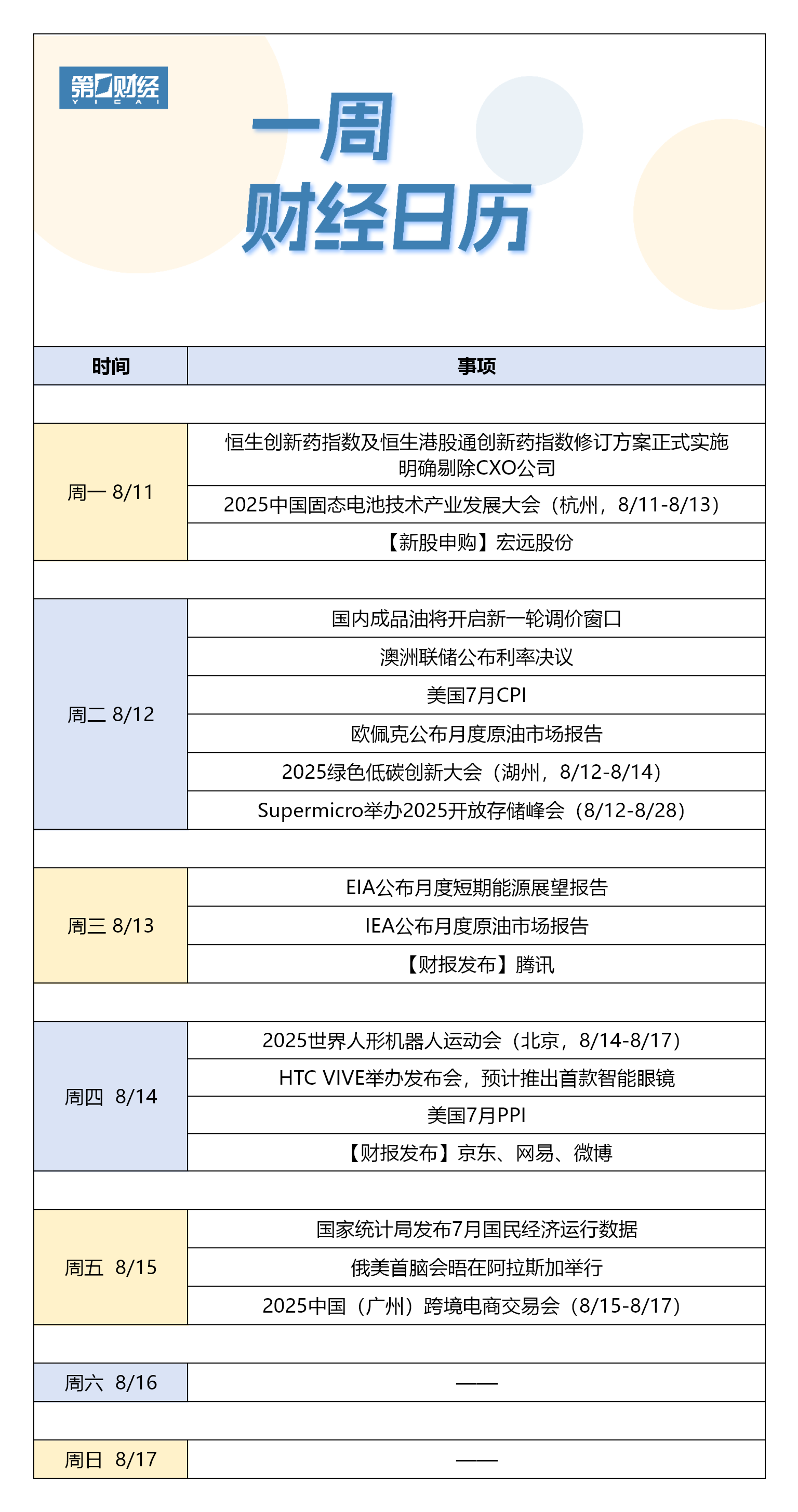
下周财经日历:8月11日-8月17日
Di Yi Cai Jing· 2025-08-09 12:17
Group 1 - The Hang Seng Innovation Drug Index and the Hang Seng Hong Kong Stock Connect Innovation Drug Index will explicitly exclude CXO companies [1] - The 2025 China Solid-State Battery Technology Industry Development Conference is scheduled [1] - New stock subscription for Hongyuan Co., Ltd. is announced [1] Group 2 - The domestic refined oil will enter a new round of adjustment [2] - The Reserve Bank of Australia will announce its interest rate decision [2] - The US Consumer Price Index (CPI) for July will be released [2] - OPEC will publish its monthly oil market report [2] - The 2025 Green Low-Carbon Innovation Conference will take place in Huzhou [2] - Supermicro will host the 2025 Open Storage Summit [2] Group 3 - The EIA will release its monthly Short-Term Energy Outlook [2] - The IEA will publish its monthly oil market report [2] - Tencent will release its financial report [2] Group 4 - The 2025 World Humanoid Robot Games will be held in Beijing [2] - HTC VIVE will hold a press conference, expected to launch official products [2] - The US Producer Price Index (PPI) for July will be released [2] - JD.com and NetEase will release their financial reports [2] Group 5 - The National Bureau of Statistics will release the national economic operation data for July [2] - A summit between the US and Russian leaders will take place in Alaska [2] - The 2025 China (Guangzhou) Cross-Border E-Commerce Trade Fair is scheduled [2]

智通ADR统计 | 8月9日





智通财经网· 2025-08-08 23:56
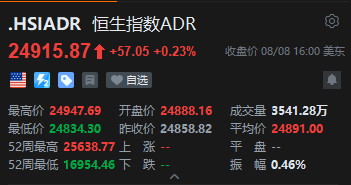
Market Overview - US stock indices rose on Friday, with the Hang Seng Index ADR up, closing at 24,915.87 points, an increase of 57.05 points or 0.23% compared to the Hong Kong close [1]. Major Blue-Chip Stocks - Most large-cap stocks saw gains, with HSBC Holdings closing at HKD 100.023, up 1.86% from the Hong Kong close; Tencent Holdings closed at HKD 562.679, up 0.30% [2]. Stock Performance Summary - Tencent Holdings (HKD 561.000) decreased by HKD 6.000 or 1.06%, while its ADR price was HKD 562.679, reflecting an increase of HKD 1.679 or 0.30% [3]. - Alibaba Group (HKD 116.300) fell by HKD 2.900 or 2.43%, with its ADR at HKD 118.101, up HKD 1.801 or 1.55% [3]. - HSBC Holdings (HKD 98.200) dropped by HKD 0.650 or 0.66%, while its ADR was HKD 100.023, up HKD 1.823 or 1.86% [3]. - Other notable declines included Meituan (HKD 120.800, down 0.98%) and Baidu Group (HKD 85.650, down 1.21%) [3].
走进交个朋友&网易云商,看AI如何为品牌增长铺路搭桥
Sou Hu Cai Jing· 2025-08-08 17:56
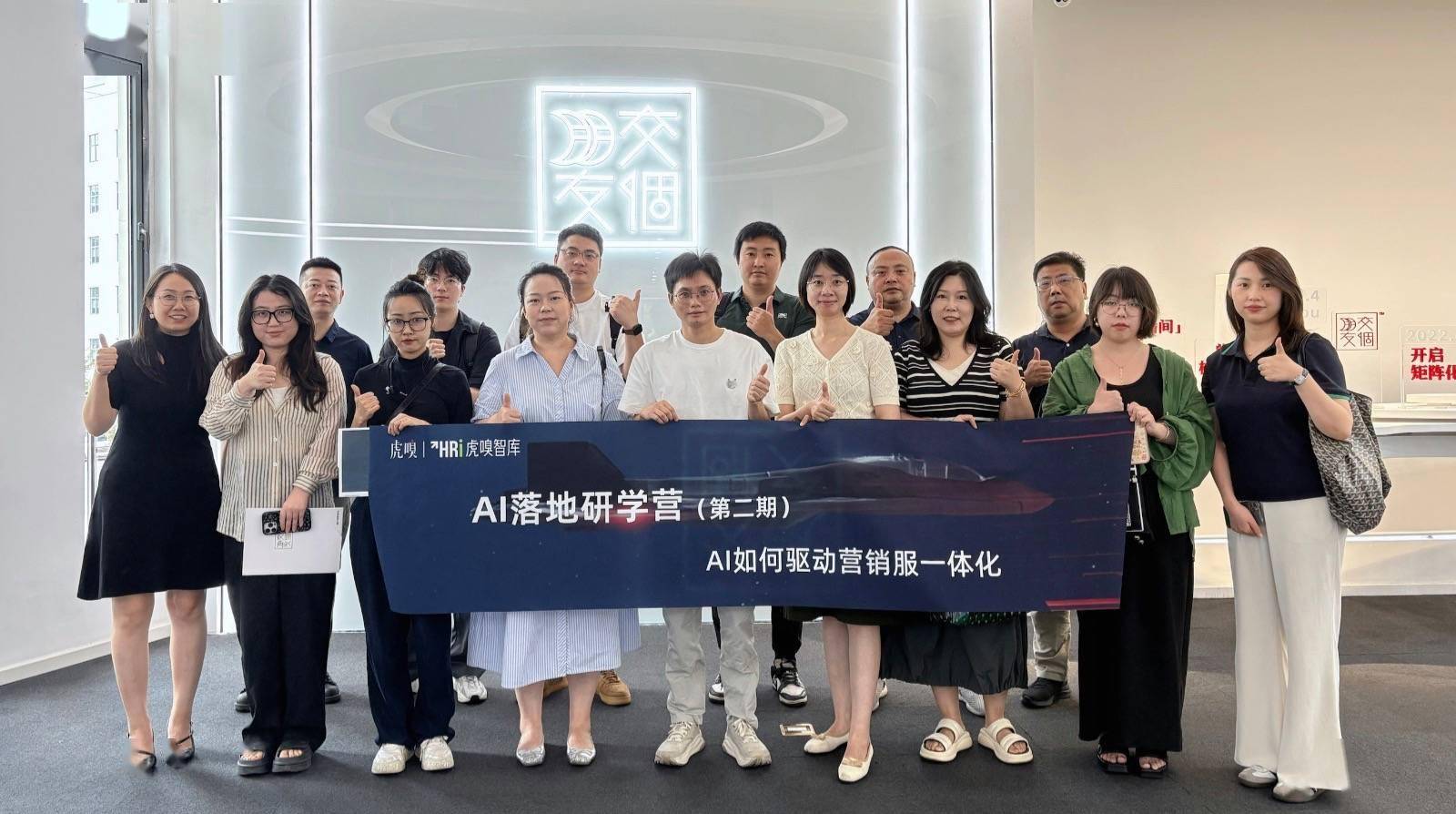
Core Insights - The core viewpoint of the articles emphasizes that AI has transitioned from a trial phase to being fully integrated into core business operations, yielding significant results across various sectors [2][3]. Group 1: AI Implementation in E-commerce - Companies are now focused on how to effectively utilize AI rather than whether to adopt it [3]. - "交个朋友" has established a comprehensive live-streaming e-commerce platform called "Friends Manus," which integrates AI for product selection, legal review, and content generation, aiming for a fully automated live-streaming process [6][7]. - The "双数字人互动直播间" launched by "交个朋友" achieved a GMV of 55 million in a single session, showcasing the potential of AI in enhancing live-streaming interactions [7]. Group 2: Customer Service Transformation - "网易云商" is evolving customer service from a passive role to an active one, utilizing AI to create a "digital employee" matrix that enhances user engagement and growth [9][10]. - The "金牌推荐官" initiative by 王府井集团 and "网易云商" employs AI agents for personalized shopping assistance, significantly improving customer experience and order conversion rates [9][10]. Group 3: Cost Efficiency in Product Photography - "WeShop唯象" has developed an AI-driven tool that allows merchants to generate high-quality commercial images and videos without the need for traditional photography setups, drastically reducing costs and time [10][11]. - The platform has gained over one million global users since its launch in May 2023, indicating strong market demand for AI solutions in e-commerce [11]. Group 4: Streamlining Fashion Design and Production - "凌迪科技" employs AI and 3D technology to streamline the entire clothing design process, reducing the time required for sample production from weeks to just two hours [13][14]. - The introduction of the Style3D AI module allows for automated garment pattern generation and design, significantly enhancing efficiency in the fashion industry [13][14]. Group 5: Industry Consensus on AI Adoption - Industry leaders agree on the importance of identifying specific pain points for AI implementation, emphasizing the need for structured data and user-friendly technology to facilitate adoption [15]. - The consensus also highlights the necessity of cultivating talent that understands both AI technology and business operations to bridge the gap between the two [15].
中华交易服务中国香港内地指数下跌1.17%,前十大权重包含中国平安等
Jin Rong Jie· 2025-08-08 14:20
Group 1 - The core index, the CESHKM, experienced a decline of 1.17%, closing at 6700.92 points with a trading volume of 605.59 billion [1] - Over the past month, the CESHKM index has increased by 1.47%, by 5.41% over the last three months, and has risen by 19.71% year-to-date [1] - The CESHKM index is part of a series of indices that reflect the performance of large and mid-cap securities listed in Shanghai, Shenzhen, and Hong Kong, with a base date of December 31, 2004, and a base point of 2000.0 [1] Group 2 - The top ten holdings in the CESHKM index include Tencent Holdings (10.76%), Alibaba-W (9.85%), and China Construction Bank (7.97%) [1] - The index is fully composed of stocks listed on the Hong Kong Stock Exchange [2] - In terms of sector allocation, consumer discretionary accounts for 30.40%, communication services for 23.13%, and financials for 22.31% of the index [2]

律师谈网易游戏遭大量玩家维权
Bei Jing Ri Bao Ke Hu Duan· 2025-08-08 08:23
Core Viewpoint - The recent controversies surrounding gaming companies like NetEase and Tencent highlight the legal and ethical implications of user agreements, particularly regarding account ownership and data management, leading to significant player dissatisfaction and potential legal challenges [1][2]. Group 1: User Agreements and Rights - Many gaming companies, including NetEase and Tencent, assert that game account ownership belongs to the company, while players only have usage rights, causing confusion among players regarding their investments in the game [2]. - Legal experts indicate that clauses limiting player rights, such as account usage and data control, may be deemed invalid under the Civil Code and Consumer Rights Protection Law, especially if companies fail to notify players before account deletions or price changes [2]. Group 2: Company Practices and Player Reactions - Game companies implement these agreements to manage data storage costs and encourage player engagement, but this can lead to perceived "unfair terms" that prioritize company interests over consumer rights [1]. - Players have expressed outrage over sudden price increases and the loss of virtual assets without compensation, as seen in the case of the game "Zhenhun Street: Born to be King," where a player lost nearly 10,000 yuan in virtual assets after the game was shut down [1].
中证香港300通信服务指数报1584.28点,前十大权重包含中国铁塔等
Jin Rong Jie· 2025-08-08 07:47
Core Points - The China Securities Hong Kong 300 Communication Services Index (H300 Communication) reported a value of 1584.28 points, with a monthly increase of 6.91%, a three-month increase of 17.10%, and a year-to-date increase of 32.99% [1] - The index is designed to reflect the overall performance of different industries in the Hong Kong market, using a sample of all securities classified under the China Securities industry classification standards [1] Index Composition - The top ten weighted stocks in the H300 Communication Index are Tencent Holdings (15.18%), NetEase-S (13.99%), China Mobile (13.6%), Baidu Group-SW (13.07%), Kuaishou-W (12.81%), Cheung Kong (7.31%), China Telecom (4.42%), China Unicom (3.16%), China Tower (2.88%), and Bilibili-W (2.85%) [1] - The index is fully composed of stocks listed on the Hong Kong Stock Exchange, with a 100% allocation [1] Industry Breakdown - The industry composition of the H300 Communication Index includes Digital Media (47.42%), Telecommunications Services (29.86%), Cultural Entertainment (15.86%), Communication Technology Services (2.88%), Data Centers (2.04%), Communication Equipment (1.01%), and Marketing & Advertising (0.93%) [2] - The index samples are adjusted biannually, with adjustments occurring on the next trading day following the second Friday of June and December [2]



游戏玩家的数字资产究竟属于谁
Bei Jing Ri Bao Ke Hu Duan· 2025-08-08 07:26
记者梳理发现,"在一定期限内不登录游戏则不予保管"的类似表述,在腾讯游戏、搜狐畅游等行业头部 公司的服务协议中均有提及。此类协议是否涉及"霸王条款"?玩家的数字资产究竟属于谁?这成为游戏 行业不容回避的问题。@北京日报 记者 鹿杨 【#游戏玩家的数字资产究竟属于谁#】#网易游戏一年不登录或被删号#"网易游戏一年不登录或被删除 账号""网易游戏遭大量玩家维权"等词条近日相继登上微博热搜,网易多款游戏开机页面出现的使用许 可及服务协议引发玩家争议。 ...