NTES(09999)

Search documents
哔哩购 小鹅通 网易严选等入选双11期间数字零售电商十大典型投诉案例
Sou Hu Cai Jing· 2025-12-03 04:14
Core Insights - The "Double 11" shopping festival has evolved from a simple promotional event to a significant symbol of China's economic vitality, but it also highlights various structural issues within the e-commerce sector [1] - The prolonged promotional cycles have led to consumer fatigue, diminishing the initial excitement of shopping [1] - New business models like live-streaming sales have created sales miracles but also exposed risks related to product quality and after-sales service [1] E-commerce Complaint Data - A report released on December 2, 2025, based on data from the "Electric Complaint Treasure" platform, analyzed consumer complaints during the Double 11 period [3][5] - The report covers two main sectors: digital retail and life service e-commerce, detailing complaint data and typical complaint cases [5] Digital Retail Ratings - In the digital retail rating list for Double 11, platforms received various ratings: "Recommended" for Zhuanzhuan and Tuhu Car Maintenance, "Cautious Order" for Douyin E-commerce, and "Not Recommended" for Xiaohongshu [6] - Major platforms like Taobao, Tmall, Xianyu, Kuaishou, and WeChat did not receive any ratings [6] Complaint Statistics - A total of 33 platforms were listed in the digital retail complaint rankings, with the top 10 platforms by complaint volume being Pinduoduo, Douyin E-commerce, Taobao, JD.com, Kuaishou, Xianyu, WeChat, Zhuanzhuan, Xiaohongshu, and Weidian [7] - The report also categorized platforms ranked 11-33, including Tmall, Tuhu Car Maintenance, and others [7] Typical Complaint Cases - The report identified ten typical complaint cases in the digital retail sector, involving platforms such as Bilibili Purchase, Xiaoe Tong, and others [9] - Specific complaints included issues like logistics refund disputes, product quality concerns, and inadequate customer service responses [10][11][12][13][14][15][16][17][18][19][20][21]


AI降本,版号放量?游戏行业开启黄金时代?
2025-12-03 02:12
Summary of the Conference Call on the Gaming Industry Industry Overview - The gaming industry is experiencing a golden era characterized by significant revenue growth and improved profitability. In Q3 2025, the total revenue of the gaming concept companies reached 30.362 billion yuan, a year-on-year increase of 27%-29%, with net profit around 6 billion yuan, up 19% year-on-year, marking a three-year high in profit margins [1][2][9]. Key Players and Performance - **Tencent**: In Q3 2025, Tencent's total revenue from online games was 63.6 billion yuan, with international market revenue growing 43% year-on-year, significantly outpacing the domestic market's 15% growth [4]. - **NetEase**: Reported revenue of 28.4 billion yuan in Q3 2025, an 8.2% increase year-on-year, driven by the success of the game "Yanyun Sixteen Sounds" and AI technology applications [4]. - **A-Share Companies**: Companies like Century Huatong and Cupid saw substantial profit increases, with Century Huatong's net profit soaring 141.65% year-on-year [5]. Market Dynamics - The gaming market in China showed a total sales revenue of 88.026 billion yuan in Q3 2025, a quarter-on-quarter increase of 6.96%, ending a five-quarter decline [8][9]. - The gaming sector's investment logic is centered around policy support, technological advancements, and globalization, with a focus on AI empowerment and high-potential overseas business [3][15]. AI Technology Impact - AI technology is widely applied in game development, operations, and user experience, with over 80% application rate among leading companies, significantly reducing costs and enhancing efficiency [7][11]. - The integration of AI is expected to further strengthen the competitive edge of large enterprises and attract more investment into the industry [7]. Future Outlook - The gaming industry is anticipated to continue its upward trajectory, with new game supply peaks expected to drive user growth and revenue increases. The global strategy for Chinese games is entering a harvest phase, with significant potential in both traditional and emerging markets [16][20]. - Despite the optimistic outlook, potential risks include intensified competition, regulatory changes, and geopolitical uncertainties that could affect company performance [17]. Investment Considerations - The current valuation of the gaming sector is seen as attractive, with the average price-to-earnings ratio around 28 times, below the historical average of 35 times. This suggests significant upside potential as the industry returns to a growth cycle [18]. - For new investors, tracking the CSI Animation and Gaming Index through ETFs is recommended, providing exposure to leading companies in the sector while mitigating individual stock risks [21].

资金持续加仓!港股科技ETF天弘(159128)昨日获净申购达7500万份,机构:港股科技板块行情有望反弹回升
2 1 Shi Ji Jing Ji Bao Dao· 2025-12-03 01:30
Group 1 - The Hong Kong technology sector experienced a decline, with the Hang Seng Technology Index falling by 0.37% and the Hong Kong Stock Connect Technology Index down by 0.42% as of the close on December 2 [1] - Notable gainers among constituent stocks included BYD Company, Lenovo Group, which both rose over 2%, while other stocks like BYD Electronics, Midea Group, Alibaba-W, Xiaomi Group-W, NetEase-S, Kuaishou-W, and Baidu Group-SW also saw increases [1] - The Hong Kong Technology ETF Tianhong (159128) recorded a net subscription of 75 million units yesterday, with a total trading volume exceeding 50 million yuan [1] Group 2 - The Tianhong Hang Seng Technology ETF (520920) closely tracks the Hang Seng Technology Index, focusing on leading technology companies in Hong Kong [2] - The ETF utilizes the QDII mechanism to invest in high-quality technology companies not included in the Hong Kong Stock Connect, such as NetEase, JD.com, and Trip.com [2] - Recent reports indicate that the market is nearing a "bad news fully priced" state, with core risk points impacting the profitability of the Hong Kong internet sector having been sufficiently released during the recent corrections [2]




智通ADR统计 | 12月3日
智通财经网· 2025-12-02 22:39
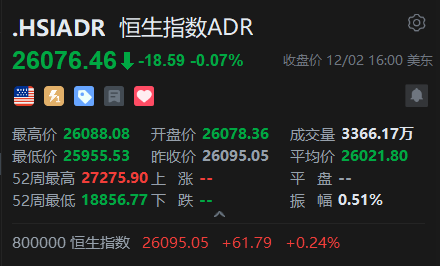
Market Overview - The Hang Seng Index (HSI) closed at 26,076.46, down by 18.59 points or 0.07% on March 10 [1] - The index reached a high of 26,088.08 and a low of 25,955.53 during the trading session, with a trading volume of 33.66 million [1] Blue-Chip Stocks Performance - HSBC Holdings closed at HKD 112.111, up by 1% compared to the previous close [2] - Tencent Holdings closed at HKD 616.297, down by 0.11% compared to the previous close [2] Individual Stock Movements - Tencent Holdings: Latest price HKD 617.000, down by HKD 2.500 or 0.40% [3] - Alibaba Group: Latest price HKD 157.000, up by HKD 2.100 or 1.36% [3] - China Construction Bank: Latest price HKD 8.160, up by HKD 0.010 or 0.12% [3] - HSBC Holdings: Latest price HKD 111.000, up by HKD 0.500 or 0.45% [3] - Xiaomi Group: Latest price HKD 40.700, up by HKD 0.400 or 0.99% [3] - AIA Group: Latest price HKD 80.800, up by HKD 0.300 or 0.37% [3] - NetEase: Latest price HKD 224.400, up by HKD 2.000 or 0.90% [3] - BYD Company: Latest price HKD 100.100, up by HKD 2.150 or 2.19% [3] - Ctrip Group: Latest price HKD 543.000, down by HKD 1.000 or 0.18% [3] - JD Group: Latest price HKD 116.000, down by HKD 1.100 or 0.94% [3]


网易不忍了,带头抵制安卓税:比苹果税还高,达50%,全球最高
Sou Hu Cai Jing· 2025-12-02 11:50
Core Viewpoint - The article discusses the rising resistance from gaming companies against the high commission fees imposed by Android app stores, referred to as "Android tax," which can reach up to 50%, significantly higher than Apple's 30% fee for in-app purchases [1][5]. Group 1: Background on Commission Fees - Apple charges a 30% commission on in-app purchases for apps on the App Store, with a reduced rate of 15% for small businesses [1]. - In contrast, Android platforms in China impose a 50% commission, which is considered the highest globally [5]. Group 2: Industry Response - NetEase has taken the lead in resisting the Android tax by removing several of its game apps from mobile manufacturers' app stores, opting instead to distribute them through short video and social media channels [3][10]. - Other major companies like Tencent and Alibaba are also following suit, indicating a broader industry shift away from traditional app store distribution to alternative channels to avoid high commission fees [5][10]. Group 3: Changes in Market Dynamics - Historically, mobile manufacturers held significant power over app distribution, forming alliances that enforced high commission rates on game developers [7]. - The rise of alternative promotional channels, such as social media and short video platforms, has provided game developers with more options, reducing their reliance on traditional app stores [9]. - This shift in distribution strategy suggests a potential restructuring of the Android gaming distribution landscape, as companies are now willing to challenge the established norms [10].

50%的安卓税,网易带头抵制:比苹果还高,全球最高了
Sou Hu Cai Jing· 2025-12-02 10:57
Core Viewpoint - The article discusses the significant impact of the high "Android tax" imposed by domestic smartphone manufacturers on game developers, leading to a shift in distribution strategies towards more cost-effective platforms like short video and social media channels [1][3][10]. Group 1: Android Tax and Its Implications - The "Android tax" in China is notably high at 50%, which is criticized by game developers as the highest globally compared to Apple's and Google's 30% cut [1][5]. - Major game companies like NetEase, Tencent, and Alibaba are moving away from traditional app stores to avoid the high fees, opting for platforms like Douyin and WeChat for distribution [3][5][10]. Group 2: Changes in Distribution Strategies - The formation of the "Hardcore Alliance" by major smartphone manufacturers in 2014 has historically enforced the 50% cut, making it difficult for game developers to bypass this fee [7][8]. - The rise of short video and social media platforms has provided game developers with alternative, lower-cost distribution channels, allowing them to reach users directly without incurring the high fees [8][10]. Group 3: Future Outlook - The shift in distribution strategies is seen as a "burden reduction" for game developers, potentially leading to a more competitive environment for users, with lower prices and more promotional activities [12]. - Smartphone manufacturers may respond by adjusting their commission rates or enhancing services to attract game developers back to their platforms, indicating a potential evolution in the market dynamics [12].

大行评级丨花旗:中国互联网板块成为今年迄今表现最好板块,明年上半年首选腾讯、阿里、携程等
Ge Long Hui· 2025-12-02 03:23
Core Insights - The Chinese internet sector has emerged as the best-performing sector this year, with a cumulative return of 36.5% [1] - In comparison, other indices such as the Seoul Composite Index, Hang Seng Index, Nikkei Index, S&P 500, and India's Nifty 50 have shown lower cumulative returns of 64%, 29%, 26%, 15.8%, and 10.4% respectively [1] - There is a growing risk-averse sentiment in the markets of China, Japan, and the United States, attributed to year-end profit-taking and portfolio rebalancing [1] Industry Analysis - Ongoing debates regarding whether AI valuations are excessively high persist, but geopolitical risks and AI supply chain issues are expected to keep the valuations of Chinese internet companies at a discount compared to global peers [1] - The acceleration of AI adoption is anticipated to intensify competition among Chinese AI participants by 2026, covering areas such as AI cloud infrastructure, chatbots, and various application scenarios [1] Company Preferences - Citigroup's top picks for the first half of 2026 include core AI concept stocks: Tencent and Alibaba [1] - Companies with stable profit growth and anti-cyclical characteristics include Trip.com and NetEase [1] - Companies with high exposure to cross-border business include Jitu Express [1] - Potential stocks in gaming and AI applications include Century Huatong [1]

恒生科技ETF鹏华(520590)红盘向上,可灵AI发布全新视频和图像模型
Xin Lang Cai Jing· 2025-12-02 02:59
Core Insights - The Hang Seng Tech Index (HSTECH) has shown a positive trend, with notable increases in key component stocks such as BYD (3.52%), Alibaba (2.39%), Kuaishou (2.27%), Xiaomi (2.23%), and NetEase (1.89%) [1][2] - The launch of AI applications, particularly Alibaba's Quark AI glasses and Keling AI's new product, is expected to drive demand for AI computing power and upgrade the edge hardware industry [1][2] Company Developments - Alibaba has officially released the Quark AI glasses, featuring the latest Qianwen AI assistant, which integrates deeply with Alibaba's application ecosystem [1] - Keling AI has introduced the Keling O1, a multi-modal creation tool that addresses consistency issues in AI video generation, providing a comprehensive solution for various applications [1] Industry Trends - Open-source securities highlight that AI edge applications, such as the Quark AI glasses, may reshape AI interaction modes and accelerate the deployment of AI applications [2] - Dongwu Securities notes that the current AI development is primarily driven by large models, with the US and China being the leading regions in AI infrastructure and hardware investments, indicating rapid growth in the global AI industry [2] Market Composition - As of December 1, 2025, the top ten weighted stocks in the Hang Seng Tech Index account for 69.48% of the index, including Alibaba, Tencent, SMIC, NetEase, Meituan, BYD, Xiaomi, Kuaishou, JD.com, and Trip.com [2]


热门中概股开盘涨跌不一


Xin Lang Cai Jing· 2025-12-02 02:09
Core Viewpoint - The stock performance of major Chinese tech companies shows mixed results, with NetEase experiencing a significant increase while several electric vehicle manufacturers face declines [1] Group 1: Stock Performance - NetEase's stock rose over 4% [1] - Alibaba's stock increased by more than 2% [1] - Baidu's stock saw an increase of over 1% [1] - Li Auto and NIO both experienced declines of over 2% [1] - Xpeng Motors' stock fell by more than 1% [1]
12月2日早餐 | Deepseek发布新模型;大摩大幅上调谷歌TPU产量预测
Xuan Gu Bao· 2025-12-02 00:00
Market Overview - US stock markets experienced a decline, with the Dow Jones down 0.9%, Nasdaq down 0.38%, and S&P 500 down 0.53% [1] - Notable stock movements included Google A down 1.65%, Meta down 1.09%, and Microsoft down 1.07%, while Tesla rose 0.01% and Apple increased by 1.52% [1] - The Nasdaq Golden Dragon China Index rose by 0.96%, with significant gains from NetEase (up 4.9%) and Alibaba (up 4.4%) [1] Company Developments - Nvidia announced a $2 billion investment in EDA giant Synopsys [1] - Apple is accelerating the development of its first foldable iPhone, expected to launch in Fall 2026, following the departure of its AI chief [2] - Google introduced the Gemini 3 AI model into its search engine, covering nearly 120 countries and regions [2] Industry Insights - The cobalt market saw prices surpass $50,000 per ton, with ongoing export bans affecting supply from the Democratic Republic of Congo [3] - A report from Morgan Stanley indicated a significant increase in Google's TPU chip production forecast, with expectations to reach 5 million units by 2027, potentially generating an additional $13 billion in revenue for every 500,000 units sold [7][10] - The NAND Flash market is experiencing strong demand driven by AI applications, with prices expected to rise by 20% to 60% across various products [6][7] - Rare earth prices, including praseodymium and neodymium, have increased by 3-6%, driven by tight supply and stable demand from domestic and overseas markets [8] Strategic Moves - DeepSeek announced the launch of its DeepSeek V3.2 model, achieving top performance in AI assessments, which may enhance its competitive position in the AI market [6] - Barclays predicts that AI inference computing demand will reach 4.5 times that of training demand by 2026, indicating a shift in the AI market focus [10]