
SPD BANK(600000)

Search documents
浙商早知道-20250922





ZHESHANG SECURITIES· 2025-09-21 23:30
Group 1: Key Recommendations - The report highlights Jiangbolong (301308) as a leading player in the full matrix storage industry, driven by "main control expansion + enterprise-level breakthroughs" [3] - The recommendation logic emphasizes the company's continuous breakthroughs and growth in the enterprise storage segment, with expected revenue growth rates of 41.09%, 26.39%, and 23.65% from 2025 to 2027 [3] - The report also identifies Stik (300806) as a leader in functional coating composite materials, with a growth inflection point approaching, supported by a significant increase in electronic-grade adhesive material demand [4] Group 2: Financial Projections - Jiangbolong's projected revenues for 2025-2027 are 24,639.91 million, 31,141.96 million, and 38,506.08 million yuan, with net profits expected to reach 843.17 million, 1,491.97 million, and 2,166.77 million yuan respectively [3] - Stik's projected revenues for the same period are 3,405.54 million, 4,540.38 million, and 5,834.50 million yuan, with net profits forecasted at 102.45 million, 287.35 million, and 464.63 million yuan [4] Group 3: Market Insights - The banking sector report indicates that the recent decline in bank stocks, down 7.3% from July 1 to September 19, 2025, is primarily due to increased risk appetite and liquidity withdrawal [5] - The report suggests that as risk-free interest rates decline and risk appetite stabilizes, the pressure on bank stock outflows is expected to ease, potentially opening up absolute return opportunities [5] Group 4: Catalysts and Drivers - For Jiangbolong, the key catalyst is the increase in storage prices, which is expected to drive revenue growth [3] - For Stik, the demand surge for OCA (Optically Clear Adhesive) in end products is identified as a significant growth driver [4] - In the banking sector, the anticipated decline in risk-free interest rates and stabilization of risk appetite are seen as crucial factors for recovery [5]
银行业周度追踪2025年第37周:银行股调整后股东增持加速-20250922
Changjiang Securities· 2025-09-21 23:30
Investment Rating - The report maintains a "Positive" investment rating for the banking sector [11] Core Insights - Recent adjustments in bank stocks have led to accelerated share buybacks by state-owned shareholders and management, indicating strong recognition of investment value [2][6] - The systematic increase in holdings by state-owned shareholders reflects a demand to optimize financial equity layouts amid asset scarcity, highlighting the core advantages of low valuations, stable profits, and dividends in bank stocks [7][41] - The report emphasizes the long-term investment value of regional leading city commercial banks, particularly after two rounds of debt restructuring [7][41] Summary by Sections Shareholder Activity - In the past week, banks such as Qingdao Bank, Nanjing Bank, and Chengdu Bank have disclosed progress in share buybacks by state-owned shareholders, showcasing their confidence in investment value [2][6] - Nanjing Bank has seen its state-owned shareholder, Nanjing High-tech, increase its stake by 1.05%, bringing its total holding to 9.99% [6][41] - Other banks, including Suzhou Bank and Qingdao Bank, have also reported significant buyback plans, with Suzhou Bank's shareholders increasing their holdings by 856 million yuan earlier this year [6][41] Market Performance - The banking index has experienced a cumulative decline of 4.1% this week, underperforming the CSI 300 index by 3.6% and the ChiNext index by 6.4% [9][20] - Despite the recent downturn, the long-term investment logic remains solid, with individual stocks like Qilu Bank showing resilience due to management buybacks [9][20] Dividend and Earnings Outlook - The report notes that the expected dividend yield for leading city commercial banks has risen to around 5%, with specific banks like Jiangsu Bank and Chengdu Bank reaching yields of 5.5% [7][8] - The stability of the banking sector's fundamentals is highlighted, with expectations for net interest income to maintain stable growth despite market fluctuations [8][40] - Mid-term dividends are set to commence, with several banks planning to distribute dividends in the fourth quarter, creating an attractive entry point for absolute return funds [8][40] Valuation and Investment Opportunities - The report suggests that the recent valuation adjustments have created significant investment opportunities in bank stocks, particularly for those focusing on dividend yields [7][44] - The ongoing adjustments in the bond market and the anticipated stabilization of loan interest rates are expected to support the banks' revenue streams [8][44]
信用卡境外被盗刷风波,到底谁的错?
Zhong Guo Jing Ying Bao· 2025-09-21 12:18
Core Viewpoint - The recent incidents of overseas fraudulent transactions on the "World Mastercard" issued by Shanghai Pudong Development Bank have raised significant concerns regarding the security of chip card technology and the effectiveness of cross-border transaction monitoring systems [1][2]. Group 1: Incident Overview - Multiple users reported unauthorized transactions on their credit cards, leading to investigations by both Shanghai Pudong Development Bank and Mastercard [1]. - Affected cardholders have had their bills cleared temporarily, and the bank has stated that customers will not bear the losses if the transactions are confirmed as fraudulent [2][3]. Group 2: Security Concerns - Analysts highlighted that the incident reveals vulnerabilities in chip card technology, which was previously considered secure, and emphasizes the need for upgrades [1]. - The failure of real-time monitoring systems for cross-border transactions was noted, particularly in regions like Brazil, where fraudulent activities went undetected [1][4]. Group 3: Responsibilities and Collaboration - The primary responsibility for monitoring and intercepting fraudulent transactions lies with the issuing banks, while card organizations are responsible for ensuring the security of the payment network [3][4]. - Experts pointed out that the collaboration between issuing banks and card organizations is currently fragmented, and there is a need for improved data sharing and risk monitoring systems [5]. Group 4: Prevention Measures - Recommendations for cardholders include avoiding letting cards out of sight during transactions, replacing magnetic stripe cards with chip cards, and closing overseas payment functions if not needed [6][7]. - Banks are enhancing their security measures, such as implementing features like "overseas lock" to prevent unauthorized transactions in foreign countries [7].
本周聚焦:三阶段视角:银行资产质量及拨备计提力度如何?
GOLDEN SUN SECURITIES· 2025-09-21 10:34
Investment Rating - The report maintains a positive outlook on the banking sector, suggesting potential investment opportunities due to favorable policy catalysts and improving fundamentals in certain banks [12]. Core Insights - The report highlights the adequacy of loan loss provisions among listed banks, with a provision coverage ratio of 70.8% for Stage 3 loans, indicating limited future impact on profits [2][12]. - It emphasizes the improvement in asset quality, particularly in Stage 3 loans, with notable reductions in the proportion of such loans for several banks compared to the end of Q4 2024 [1][2]. - The report suggests a focus on banks with positive fundamental changes and continuous improvement in financial statements, recommending specific banks for investment [12]. Summary by Sections 1. Loan Quality and Provisioning - The proportion of Stage 3 loans is relatively low for banks like Chengdu Bank (0.66%) and Ningbo Bank (0.76) [1]. - Significant improvements in Stage 3 loan ratios were observed for Chongqing Bank (-61bp) and Guiyang Bank (-48bp) compared to Q4 2024 [1]. - The provision coverage for Stage 3 loans is high, with leading banks like Qingnong Bank (4.35%) and Yunan Bank (4.16%) showing strong provisioning ratios [2]. 2. Financial Assets - The proportion of Stage 3 financial assets is low, with most banks not exceeding 0.05%, indicating manageable asset quality pressure [4]. - The report notes that the provision coverage for financial investments is also robust, with Zhejiang Bank (3.16%) and Qingdao Bank (2.85%) leading in provisioning ratios [8]. 3. Sector Outlook - The report anticipates that expansionary policies aimed at stabilizing the economy will benefit the banking sector, with a focus on banks like Ningbo Bank and Jiangsu Bank for potential investment [12]. - It highlights the ongoing economic recovery and the potential for interest rate cuts, suggesting a sustained dividend strategy for certain banks [12].





转债周度跟踪:浦发转债即将到期,低价券疲软-20250920
Shenwan Hongyuan Securities· 2025-09-20 15:25
Report Industry Investment Rating - Not provided in the content Core Viewpoint of the Report - This week, micro - cap stocks declined again, and the convertible bond market continued to be weak. The convertible bond valuation compressed by about 1 percentage point, and its anti - decline performance was not prominent compared to the underlying stocks. Attention should be paid to whether the "double bottom" can form an effective support level. In the shock repair market since September 3, the high - price area of the convertible bond market was relatively resilient, but low - price bonds performed weakly, especially bank and non - bank convertible bonds. Considering the relatively thick bond floor and reasonable valuation from the perspective of the bottom - support premium rate, with the maturity of Pufa Convertible Bonds, the scarcity of large - cap convertible bonds will become more prominent, and the supply - demand contradiction may become the pricing mainline after valuation digestion [1][4]. Summary by Relevant Catalogs 1. Weekly Viewpoint and Outlook - Micro - cap stocks declined again this week, and the convertible bond market remained weak. The convertible bond valuation compressed by about 1 percentage point. Key indicators were slightly higher than the阶段性 low on September 2. The high - price area was resilient, while low - price bonds, especially bank and non - bank convertible bonds, performed weakly. Due to factors like institutional profit - taking and high valuations, but considering the thick bond floor and reasonable valuation from the bottom - support premium rate perspective, the supply - demand contradiction may become the pricing mainline after the maturity of Pufa Convertible Bonds [1][4]. 2. Convertible Bond Valuation - The convertible bond market fluctuated downward this week. The market - wide 100 - yuan valuation dropped by about 1 percentage point, slightly higher than the阶段性 low on September 2. The latest 100 - yuan premium rate was 33.6%, down 1.1% week - on - week, at the 87.2% percentile since 2017. High - and low - rated convertible bond valuations declined by about 1 percentage point [3][5]. - Compared with last week, the median conversion premium rate and bottom - support premium rate in each parity range decreased. The conversion premium rate percentile in the high - parity area was relatively low. The overall convertible bond market valuation declined this week, with both the conversion premium rates in the bond - biased and stock - biased areas decreasing. Although the conversion premium rate of bond - biased convertible bonds was still relatively high, its valuation percentile was not high from the bottom - support premium rate perspective [3][8]. - The median convertible bond price and the yield to maturity were reported at 129.25 yuan and - 5.92% respectively. Compared with last week, they changed by - 2.62 yuan and + 0.43% respectively, at the 97.70% and 1.00% percentiles since 2017 [3][13]. 3. Clause Tracking 3.1 Redemption - This week, 4 convertible bonds, including Jiuzhou Zhuan 2, Sanyang Convertible Bond, Keda Convertible Bond, and Lushan Convertible Bond, issued early redemption announcements. There were 27 convertible bonds that had issued early redemption or maturity redemption announcements but had not delisted, with a potential conversion or maturity balance of 35.1 billion yuan. Also, 4 convertible bonds issued non - redemption announcements. Currently, 38 convertible bonds were in the redemption process, and 8 were expected to meet the redemption conditions next week [3][17][21]. 3.2 Downgrade - This week, 2 convertible bonds, including Huitong Convertible Bond, proposed a downgrade, and Jiayuan Convertible Bond announced the downgrade result, reaching the lowest limit. As of now, 117 convertible bonds were in the non - downgrade period, 23 could not be downgraded due to net asset constraints, 1 had triggered the condition but the stock price was still below the downgrade trigger price without an announcement, 25 were accumulating downgrade days, and 5 had issued the board of directors' downgrade plan but had not held a general meeting of shareholders [3][24]. 3.3 Put - back - This week, Fuhan Convertible Bond issued a put - back announcement. As of now, 3 convertible bonds were accumulating put - back trigger days, with 1 proposing a downgrade, 1 in the non - downgrade period, and 1 accumulating downgrade days [3][27].
信用卡境外盗刷风波:银行与卡组织如何补位?
Zhong Guo Jing Ying Bao· 2025-09-20 13:06
Core Viewpoint - The recent incidents of overseas fraudulent transactions on the "World Mastercard" issued by Shanghai Pudong Development Bank have raised significant concerns regarding payment security and the effectiveness of fraud monitoring systems [1][2]. Group 1: Incident Overview - Multiple users reported unauthorized transactions on their credit cards, leading to investigations by both Shanghai Pudong Development Bank and Mastercard [1]. - Affected cardholders have had their bills cleared temporarily, and the bank has stated that customers will not bear the losses if the transactions are confirmed as fraudulent [2][3]. Group 2: Security Concerns - Analysts highlighted that the incident reveals vulnerabilities in chip card technology and the lag in monitoring cross-border transactions, which failed to trigger real-time alerts for suspicious activities [1][4]. - The lack of effective communication and data sharing between banks and card organizations has been identified as a critical issue in preventing such frauds [5]. Group 3: Responsibilities and Collaboration - The primary responsibility for monitoring transactions and intercepting risks lies with the issuing banks, while card organizations are responsible for ensuring the security of the payment network [3][4]. - Experts suggest that improving collaboration between banks and card organizations is essential, including establishing real-time data sharing mechanisms and enhancing fraud detection technologies [5]. Group 4: Prevention Measures - Recommendations for cardholders include avoiding letting cards out of sight during transactions, replacing magnetic stripe cards with chip cards, and closing overseas payment functions if not needed [6]. - Banks are also enhancing their security measures, such as implementing features like "overseas lock" to prevent unauthorized transactions in foreign countries [7].
上海浦东发展银行股份有限公司 关于“浦发转债”到期兑付暨摘牌的 第三次提示性公告
Zhong Guo Zheng Quan Bao - Zhong Zheng Wang· 2025-09-20 00:29
证券代码:600000证券简称:浦发银行 公告编号:临2025-056 优先股代码:360003 360008优先股简称:浦发优1 浦发优2 转债代码:110059转债简称:浦发转债 上海浦东发展银行股份有限公司 关于"浦发转债"到期兑付暨摘牌的 第三次提示性公告 重要内容提示: ● 可转债到期日和兑付登记日:2025年10月27日 自2025年10月23日至2025年10月27日,浦发转债持有人仍可以依据约定的条件将浦发转债转换为公司普 通股。 经中国证券监督管理委员会《关于核准上海浦东发展银行股份有限公司公开发行可转换公司债券的批 复》(证监许可〔2019〕1857号)核准,上海浦东发展银行股份有限公司(以下简称"公司")公开发行 了50,000万张可转换公司债券(以下简称"可转债""浦发转债"),每张面值人民币100元,发行总额人 民币500亿元,期限6年。经上海证券交易所自律监管决定书〔2019〕247号文同意,公司500亿元可转债 于2019年11月15日起在上海证券交易所挂牌交易,债券简称"浦发转债",债券代码"110059"。 根据《上市公司证券发行注册管理办法》《上海证券交易所股票上市规则》及 ...
浦发银行:关于“浦发转债”到期兑付暨摘牌的第三次提示性公告
Zheng Quan Ri Bao· 2025-09-19 15:44
Group 1 - The core announcement is that Shanghai Pudong Development Bank (SPDB) will stop trading its convertible bonds on October 23, 2025, with the last trading day being October 22, 2025 [2] - After the trading suspension, bondholders can still convert their bonds into common shares of the company from October 23, 2025, to October 27, 2025, under agreed conditions [2]

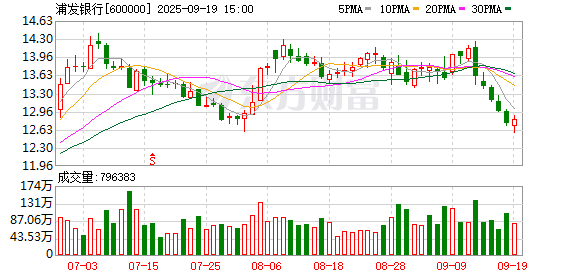
半年赚了297亿的浦发银行,可转债将迎来摘牌
Sou Hu Cai Jing· 2025-09-19 13:39
Core Viewpoint - Shanghai Pudong Development Bank (SPDB) has entered a growth phase in its revenue for the first half of the year, primarily driven by a significant increase in investment income within non-interest income, alongside a slight growth in net interest income, reversing the declining trend of previous years [1][3]. Revenue Growth - In the first half of the year, SPDB achieved operating revenue of 90.559 billion yuan, a year-on-year increase of 2.62%, with Q1 and Q2 revenues of 45.922 billion yuan and 44.637 billion yuan, respectively, reflecting growth rates of 1.31% and 4% [3]. - The slight increase in net interest income is notable, as the bank has faced challenges with narrowing interest margins, with the net interest margin decreasing from 2.02% in 2020 to 1.41% in the first half of this year [3][4]. - Interest income for the first half was 134.089 billion yuan, down 8.09% year-on-year, while interest expenses decreased by 13.73%, leading to a key growth in net interest income [3][5]. Non-Interest Income Performance - Non-interest income showed improvement, with a total of 32.252 billion yuan in the first half, an increase of 6.79% year-on-year, outperforming net interest income [6]. - Investment income significantly contributed to this growth, amounting to 14.998 billion yuan, a year-on-year increase of 79.41 billion yuan [6][7]. Profit Growth - SPDB reported a net profit attributable to shareholders of 29.737 billion yuan for the first half, a year-on-year increase of 10.19%, with Q1 and Q2 profits of 17.598 billion yuan and 12.139 billion yuan, respectively [8]. - The bank's credit impairment losses decreased slightly, while losses from loans and advances increased, indicating a focus on managing non-performing loans [8][10]. Loan Quality and Risks - Overall loan quality has improved, with non-performing loans decreasing from 784.61 billion yuan to 731.54 billion yuan over the past few years, although there has been a rise in non-performing loans in the real estate sector [17][20]. - Non-performing loans in the real estate sector reached 14.744 billion yuan, up from 9.925 billion yuan at the beginning of the year, indicating a need for heightened attention [20][22]. Capital and Debt Management - SPDB's capital adequacy ratios have improved, with the capital adequacy ratio, tier 1 capital ratio, and core tier 1 capital ratio at 13.55%, 10.38%, and 8.91%, respectively, as of the end of the reporting period [12]. - The bank has issued multiple bonds to strengthen its capital base, including a 30 billion yuan bond and a 15 billion yuan technology innovation bond [12][14]. Compliance and Internal Control - The bank has faced several penalties related to loan management, highlighting weaknesses in internal controls that need to be addressed [27][29]. - SPDB is focusing on compliance and risk management, implementing measures to enhance internal controls and training for employees [29].

金融活水涌动长三角 浦发银行科技金融跑出加速度
Zheng Quan Ri Bao Wang· 2025-09-19 11:56
Core Insights - The article highlights the significant role of Shanghai Pudong Development Bank (SPDB) in promoting technology finance in the Yangtze River Delta region, particularly in cities like Nanjing and Hangzhou, since the establishment of the Sci-Tech Innovation Board six years ago [1][10] - SPDB has successfully supported over 240,000 technology enterprises and accounted for more than 70% of the companies listed on the Sci-Tech Innovation Board, with technology finance loans exceeding 100 billion yuan [1][9] Group 1: Technology Finance Development - SPDB is expanding its technology finance services by adopting a "technology finance + industry characteristics" approach, focusing on high-end manufacturing and high-tech enterprises [1][2] - The bank has established a comprehensive financial irrigation network for chain-leading enterprises through project loans, merger loans, and supply chain finance [2][3] - SPDB's supply chain finance solutions have alleviated financial pressures for upstream and downstream enterprises, enhancing cash flow and operational efficiency [3][5] Group 2: Case Studies of SPDB's Support - Nanjing Estun Automation Co., Ltd. is a representative case where SPDB provided tailored financial solutions to support its extensive supply chain, which includes over 1,000 customers and 800 suppliers [2][3] - Zhejiang Wusiyuan Communication Technology Co., Ltd. received support from SPDB for its industrial park construction and equipment procurement, showcasing the bank's commitment to fostering innovation in the robotics sector [4][5] - SPDB's rapid response to the needs of innovative companies like Jiachen Xihai Biotechnology Co., Ltd. demonstrates its ability to provide timely funding, such as a 60 million yuan research loan, to help them navigate the challenges of the biopharmaceutical industry [6][7] Group 3: Strategic Initiatives and Future Outlook - SPDB has positioned technology finance as a primary strategic focus, enhancing its organizational structure to better serve technology enterprises [6][9] - The bank's innovative financing models, such as the "domestic guarantee + overseas loan" approach for mergers and acquisitions, have facilitated significant transactions for companies like Estun [8] - SPDB aims to become a key partner in the technology finance ecosystem, driving high-quality economic development and supporting the modernization of the industrial system in China [9][10]