DFAC(600006)

Search documents
东风股份(600006.SH)2025年汽车销量同比下降23.22%
Zhi Tong Cai Jing· 2026-01-09 11:55
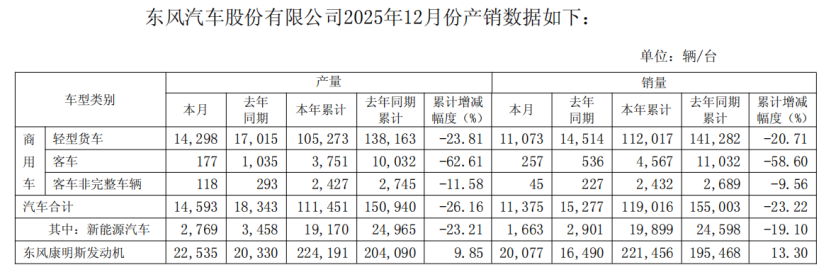
Group 1 - The core point of the article is that Dongfeng Motor Corporation (600006.SH) announced a total automobile sales of 11,375 units for December 2025, with a cumulative sales figure of 119,000 units for the year, representing a year-on-year decline of 23.22% [1]

东风汽车2025年销售汽车11.9万辆,同比下降23.22%
Ju Chao Zi Xun· 2026-01-09 10:38
Group 1 - The core viewpoint of the articles indicates a significant decline in Dongfeng Motor's production and sales figures for December 2025, particularly in commercial vehicles, with production down by 20.44% and sales down by 25.54% year-on-year [1] - For the entire year of 2025, Dongfeng's total production reached 111,451 vehicles, reflecting a year-on-year decrease of 26.16%, while total sales amounted to 119,016 vehicles, down 23.22% compared to the previous year [1] - The light-duty truck segment, which is a core business for the company, saw a total production of 105,273 units and sales of 112,017 units, with respective declines of 23.81% and 20.71% year-on-year [2] Group 2 - Despite the overall decline, the passenger vehicle segment maintained stable market supply, although it also experienced a decrease in production and sales [2] - The new energy vehicle segment showed a steady performance, with total production of 19,170 units and sales of 19,899 units for the year, representing declines of 23.21% and 19.1% year-on-year, respectively [2] - Dongfeng Cummins Engine Company, a joint venture, performed well with total production of 224,191 units and sales of 221,456 units, achieving year-on-year growth of 9.85% and 13.3% [2]

东风股份(600006) - 东风汽车股份有限公司2025年12月份产销数据快报
2026-01-09 09:45
单位:辆/台 证券代码:600006 证券简称:东风股份 公告编号:2026--001 东风汽车股份有限公司 2025年12月份产销数据快报 本公司董事会及全体董事保证本公告内容不存在任何虚假记载、误导性陈述或者重 大遗漏,并对其内容的真实性、准确性和完整性承担法律责任。 东风汽车股份有限公司2025年12月份产销数据如下: | 车型类别 | | | | 产量 | | | | | 销量 | | | | --- | --- | --- | --- | --- | --- | --- | --- | --- | --- | --- | --- | | | | 本月 | 去年 | 本年累计 | 去年同期 | 累计增减 | 本月 | 去年 | 本年累计 | 去年同期 | 累计增减 | | | | | 同期 | | 累计 | 幅度(%) | | 同期 | | 累计 | 幅度(%) | | 商 | 轻型货车 | 14,298 | 17,015 | 105,273 | 138,163 | -23.81 | 11,073 | 14,514 | 112,017 | 141,282 | -20.71 | | 用 | 客车 | 1 ...
东风股份:12月汽车产量14593辆、销量11375辆
Jin Rong Jie· 2026-01-09 09:41
Core Viewpoint - Dongfeng Motor announced its production and sales figures for December 2025, indicating a significant decline in overall automotive production and sales compared to previous periods [1] Group 1: Production and Sales Data - In December 2025, the production of light trucks reached 14,298 units, while sales were 11,073 units [1] - The production of buses was 177 units, with sales of 257 units; non-complete bus vehicles had a production of 118 units and sales of 45 units [1] - Total automotive production amounted to 14,593 units, with total sales of 11,375 units, including 2,769 units of new energy vehicles produced and 1,663 units sold [1] Group 2: Cumulative Data - Cumulatively, the automotive production for 2025 was 111,500 units, reflecting a decrease of 26.16%, while total sales were 119,000 units, showing a decline of 23.22% [1] - Dongfeng Cummins engine production totaled 224,200 units for the year, with a cumulative increase of 9.85%, and sales reached 221,500 units, marking a cumulative increase of 13.30% [1]

商用车板块1月9日涨0.41%,江淮汽车领涨,主力资金净流出8050.68万元
Zheng Xing Xing Ye Ri Bao· 2026-01-09 08:54
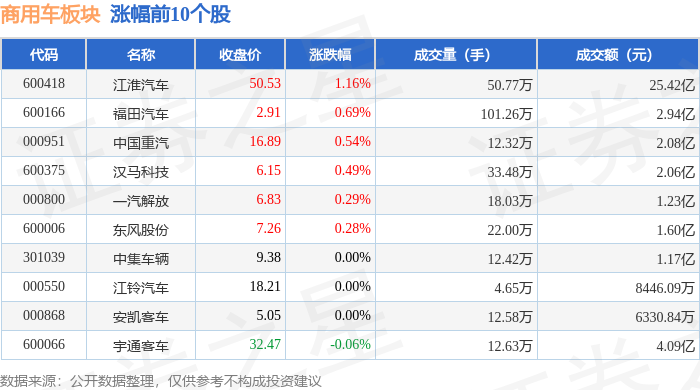
Core Viewpoint - The commercial vehicle sector experienced a slight increase of 0.41% on January 9, with Jianghuai Automobile leading the gains. The Shanghai Composite Index rose by 0.92%, while the Shenzhen Component Index increased by 1.15% [1]. Group 1: Market Performance - Jianghuai Automobile closed at 50.53, up by 1.16% with a trading volume of 507,700 shares [1]. - Foton Motor and China National Heavy Duty Truck both saw increases of 0.69% and 0.54%, closing at 2.91 and 16.89 respectively [1]. - The overall trading volume for the commercial vehicle sector was significant, with Foton Motor achieving a transaction value of 294 million [1]. Group 2: Fund Flow Analysis - The commercial vehicle sector saw a net outflow of 80.51 million from institutional investors, while retail investors contributed a net inflow of 31.18 million [2]. - Among individual stocks, Zhongshun Vehicle had a net inflow of 12.14 million from institutional investors, while it faced a net outflow of 1.44 million from speculative funds [3]. - China National Heavy Duty Truck experienced a net inflow of 2.94 million from speculative funds, despite a net outflow of 3.27 million from retail investors [3].


四川明确脑机接口医疗服务价格,置入费最高6583元/次|首席资讯日报
首席商业评论· 2026-01-09 04:51
Group 1 - Sichuan has set a maximum price of 6,583 yuan per session for brain-computer interface medical services, effective from April 30 this year, which is expected to promote industry standardization and prevent speculation [2] - WeChat has clarified that normal social behaviors will not be restricted under the new rules, ensuring users' accounts will not be penalized for typical usage patterns [3] - Aima Technology has denied rumors of a workforce reduction exceeding 50%, stating that personnel optimization is a normal adjustment for business development [4] Group 2 - Ant Group and Meituan Longzhu have invested in Shenzhen Guangzhi Shikong Technology Co., a developer of AI interactive devices, increasing its registered capital from approximately 1.6435 million yuan to about 2.1062 million yuan [5] - The film "The Legend of the Condor Heroes" has surpassed 200 million yuan in box office revenue within 9 days of its release [6][7] - IKEA announced the closure of 7 stores, including one in Shanghai, as part of its strategy to optimize business operations and focus on consumer-centric channels [8][13] Group 3 - Bawang Tea has responded to rumors of a potential IPO in Hong Kong, stating that there are currently no plans for such an initiative [9] - Lin Yunfeng, head of NetEase's DreamWorks division, has left the company, with the DreamWorks mobile game team being integrated into the Sea God division [10] - Chinese automotive brands are performing well in Ecuador, with BYD's sales expected to grow by 243.1% in 2025, and overall new car sales projected to increase by 15% [11] Group 4 - JD.com has established a "Chameleon Business Unit" to focus on the development and commercialization of core AI products [12] - JD.com is reportedly considering the issuance of dim sum bonds to raise approximately 10 billion yuan, although the company has stated there are no current plans for such an issuance [14]




2025年中国汽车车桥行业发展历程、产业链、市场规模、重点企业及趋势研判:车桥行业正加速向轻量化与高效化迭代[图]
Chan Ye Xin Xi Wang· 2026-01-09 01:43
Core Insights - The automotive axle industry in China is experiencing significant growth driven by increasing demand for vehicles, particularly SUVs, and advancements in automotive technology [1][11] - The market size of China's automotive axle industry is projected to reach 67.158 billion yuan in 2025, reflecting a year-on-year growth of 5.93% in 2024 [1][12] - The global automotive axle market is expected to grow to 49.526 billion USD by 2030, indicating a robust demand for high-performance axles [11] Industry Overview - Automotive axles, also known as vehicle axles, connect the wheels to the vehicle frame and are crucial for transmitting forces and maintaining vehicle stability [2][9] - The industry is categorized into light, heavy, and suspension axles, with light axles primarily serving passenger vehicles and heavy axles for commercial vehicles [2][4] Industry Development History - The axle industry began in the early 20th century, evolving from simple steel and chain constructions to advanced materials and manufacturing processes [4][5] - Significant advancements occurred in the 1980s in China, transitioning from reliance on foreign technology to independent research and development [5][6] Industry Value Chain - The upstream of the axle industry includes raw materials like high-strength steel and production equipment, while the midstream focuses on manufacturing, and the downstream encompasses various vehicle applications [7][8] Current Industry Status - The global automotive market is recovering post-pandemic, with production expected to reach 93.95 million units by 2024, which positively impacts the axle industry [10][11] - China's automotive production is projected to be 31.28 million units in 2024, with a notable increase in new energy vehicles [10][11] Competitive Landscape and Key Players - The global axle market is dominated by international giants like ZF, Bosch, and Cummins, while Chinese manufacturers focus on commercial vehicle axles [12] - Key players in China include Liaoning Shuguang Automotive Group, Dongfeng Dana Axle Company, and others, with a strong emphasis on technology and product development [12][13] Industry Trends - The future of the axle industry is leaning towards specialization, with customized solutions for different vehicle types and driving conditions [14] - Lightweight designs using advanced materials and integrated systems are becoming a priority to enhance vehicle efficiency and performance [15][16]




汽车早餐 | 四部门联合召开动力和储能电池行业座谈会;吉利获L3级自动驾驶道路测试牌照;广汽国际与Grab达成战略合作
Zhong Guo Qi Che Bao Wang· 2026-01-09 01:21
Group 1: Battery Industry - A joint meeting was held by four government departments to discuss the regulation of the power and energy storage battery industry, involving 16 companies including major players like CATL and BYD [2] Group 2: Automotive Industry - The Ministry of Industry and Information Technology is soliciting public opinions on seven proposed mandatory national standards for intelligent connected vehicles, including safety requirements for automatic parking systems [3] - Geely has obtained a Level 3 autonomous driving road test license for its Zeekr 9X model in Hangzhou [9] - Xpeng Motors' CEO predicts that 2026 will mark the true beginning of autonomous driving in China and the U.S., with the company's second-generation VLA achieving Level 4 autonomous driving capabilities [11] - Dongfeng Motor is in discussions to produce passenger vehicles in Turkey, with plans to start production within the year [12] Group 3: Strategic Partnerships and Investments - GAC International has formed a strategic partnership with Grab to collaborate on delivering 20,000 high-performance electric vehicles in Southeast Asia over the next two years [10] - Intramco, a company under Xincheng Capital, has partnered with Leap Motor to supply charging products for its future electric vehicles produced in Europe [14] - Faraday Future aims to achieve positive cash flow and a gross margin of 20% within three years, as announced during its shareholder day event [15] Group 4: Technology and Innovation - Hyundai's stock price surged following the announcement of increased investments in robotics and artificial intelligence, alongside a meeting between its chairman and NVIDIA's CEO [6] - Elon Musk's AI startup xAI completed a $20 billion funding round, exceeding its initial target of $15 billion, with investors including NVIDIA and Cisco [7] Group 5: Economic Cooperation - The Ministry of Commerce is accelerating negotiations for the second phase of the China-South Korea Free Trade Agreement, focusing on enhancing economic cooperation and exploring new areas such as high-end manufacturing and green industries [4] - Guangzhou's government has released a plan to cultivate strategic industries, including artificial intelligence and new energy storage, as part of its advanced manufacturing strategy [5]


东风本田新版HR-V正式上市
Di Yi Cai Jing· 2026-01-08 12:49
(文章来源:第一财经) 据东风汽车消息,1月8日,东风本田新版HR-V正式上市,新车共推出2个版本车型,其中Pro版现时售 价为10.99万元,Max版现时售价为11.29万元。 ...
特斯拉、小米、宝马等车企密集降价促销应对购置税调整
Cai Jing Wang· 2026-01-08 12:03
Group 1 - Multiple car manufacturers are launching price reduction promotions to respond to the impact of the new energy vehicle purchase tax [1][2] - Tesla China has introduced purchase incentives for Model 3/Y/Y L, including a "7-year ultra-low interest" financing plan with a minimum down payment of 79,900 yuan and monthly payments starting at 1,918 yuan [1] - GAC Group announced promotional activities for its self-owned brands, including limited-time purchase tax guarantees and additional subsidies for trade-ins or scrappage [1] - Xiaomi Auto is offering various promotions for its models YU7 and SU7 Ultra, with a "3-year 0% interest" option and a minimum down payment of 74,900 yuan [1] - BMW has initiated a significant official price adjustment for 31 models, with the highest reduction for the iX1, dropping from 299,900 yuan to 228,000 yuan, a decrease of 24% [1] - Volvo is promoting its new XC70 model with a limited-time offer that includes a direct purchase tax subsidy of 14,000 yuan [1] Group 2 - Wuling Motors announced full purchase tax subsidies for several new energy models, along with trade-in subsidies up to 8,000 yuan and limited-time financial interest subsidies up to 5,000 yuan [2] - Traditional car manufacturers such as Dongfeng, Chery, Deep Blue, FAW-Volkswagen, and GAC Toyota are also launching new year price reduction promotions for certain brands or models [2]