DFAC(600006)

Search documents
【环球财经】抑价提质 中国品牌改写埃及汽车市场格局
Xin Hua She· 2026-01-12 12:53
Core Viewpoint - The Egyptian automotive market is experiencing significant changes, with improved supply and more affordable prices, largely due to the influence of Chinese automotive brands [1][6]. Group 1: Market Dynamics - The supply of vehicles in Egypt is increasing, leading to more reasonable pricing, making new cars accessible to ordinary families [1]. - In 2024, sales of Chinese brand vehicles in Egypt reached 30,441 units, marking a year-on-year increase of 37.3% [3]. - The introduction of 18 new models by various Chinese automakers in July 2025, primarily priced below 1.5 million EGP (approximately 230,000 RMB), caters to the Egyptian consumer market [3]. Group 2: Local Production and Economic Factors - The Egyptian automotive market is transitioning to a phase characterized by local manufacturing and healthy competition, which is beneficial for consumers and the economy [6][7]. - The local assembly of vehicles is increasing, with a reported 31.7% year-on-year growth in CKD (Completely Knocked Down) vehicles in 2024, while CBU (Completely Built Up) vehicles only grew by 5.2% [10]. - The Egyptian government has implemented a national automotive industry development plan to promote local assembly and reduce import tariffs, which can lower costs significantly [11]. Group 3: Future Outlook - The strengthening of the Egyptian pound, increased local production, and reduced shipping costs are contributing to a downward trend in car prices, expected to continue at least until 2026 [7]. - The potential for growth in the Egyptian automotive market is substantial, driven by a young population and low car ownership rates [4]. - Chinese automotive brands are encouraged to invest in brand building, after-sales service, and customer-centric experiences to achieve greater market penetration in Egypt [13].





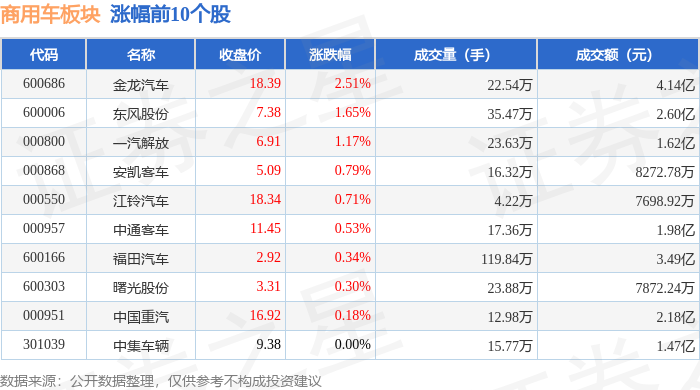
商用车板块1月12日跌0.69%,宇通客车领跌,主力资金净流出5.05亿元
Zheng Xing Xing Ye Ri Bao· 2026-01-12 09:04
Group 1 - The commercial vehicle sector experienced a decline of 0.69% on January 12, with Yutong Bus leading the drop [1][3] - The Shanghai Composite Index closed at 4165.29, up 1.09%, while the Shenzhen Component Index closed at 14366.91, up 1.75% [1] - Major stocks in the commercial vehicle sector showed varied performance, with Jinlong Automobile increasing by 2.51% and Yutong Bus decreasing by 2.65% [1][3] Group 2 - The net outflow of main funds in the commercial vehicle sector was 505 million yuan, while retail investors saw a net inflow of 314 million yuan [3][4] - The trading volume for major stocks included 248,600 shares for Yutong Bus and 578,000 shares for Jianghuai Automobile, with transaction amounts of 784 million yuan and 2.851 billion yuan respectively [3][4] - The fund flow analysis indicated that retail investors had a significant net inflow in several stocks, including Jiangling Motors, which saw a net inflow of 11.05% [4]



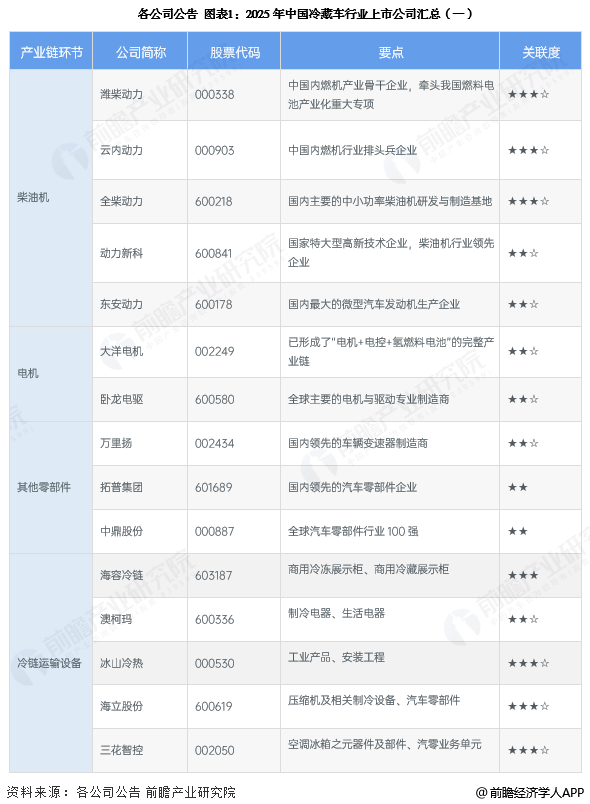
【全网最全】2025年冷藏车行业上市公司全方位对比(附业务布局汇总、业绩对比、业务规划等)
Qian Zhan Wang· 2026-01-12 07:41
Core Insights - The report focuses on the market demand and investment planning for the cold chain vehicle industry in China, highlighting key players and their revenue performance [1][12]. Group 1: Industry Overview - The cold chain vehicle industry in China has limited companies primarily engaged in this sector, but the supply chain is extensive [1]. - Major listed companies in the cold chain vehicle manufacturing segment include CIMC Vehicles, Foton Motor, Dongfeng Motor, FAW Jiefang, and China National Heavy Duty Truck [1]. Group 2: Company Summaries - Foton Motor has the highest registered capital and the most bidding information among cold chain vehicle companies [12]. - Jiangling Motors, established the earliest, focuses on light commercial vehicles [12]. - CIMC Vehicles leads in semi-trailer production globally [14]. Group 3: Revenue Performance - In the first three quarters of 2025, Foton Motor reported a revenue of 454.49 billion, while FAW Jiefang and Jianghuai Automobile reported revenues of 439.96 billion and 308.73 billion, respectively [17]. - CIMC Vehicles achieved the highest gross margin at 15.17% among the listed companies [14]. Group 4: Product and Business Strategies - Foton Motor is advancing pure electric refrigerated vehicles and has delivered its first batch of cold chain vehicles [18]. - FAW Jiefang focuses on long-distance cold chain vehicles, promoting the JH6 model [18]. - Jianghuai Automobile is developing a range of refrigerated vehicles to cover various lengths and applications [18]. - CIMC Vehicles is exploring the development of new energy semi-trailers for the North American market [18].


江淮/东风领衔 江铃/远程晋级 12月轻卡影响力榜单出炉 | 头条
第一商用车网· 2026-01-11 13:20
Core Viewpoint - The "Light Truck First Influence Index" for December 2025 shows a total score of 1408, reflecting a 4.3% increase from November 2025 but a 2.3% decrease compared to December 2024 [1]. Group 1: Influence Index Rankings - The top three brands in the "Light Truck First Influence Index" for December 2025 are Jianghuai 1 Card (298 points), Dongfeng Light Truck (261 points), and FAW Jiefang Light Truck (206 points) [2][12]. - Jianghuai 1 Card maintains its position as the leader, while Jiangling Light Truck and YuTong Light Truck have improved their rankings to fifth and ninth, respectively [12][17]. Group 2: Key Events and Developments - December 2025 saw significant industry events, including annual meetings and product launches, contributing to the increase in the influence index [3][19]. - Jianghuai 1 Card's annual meeting highlighted its success in the new energy light truck sector, with sales of high-end models exceeding 20,000 units and a 20% increase in wide-body model sales [6]. - Dongfeng Light Truck's annual meeting focused on long-term development and improving operational quality [8]. - FAW Jiefang's global partner conference emphasized deepening global cooperation and enhancing brand narrative [9]. - China National Heavy Duty Truck launched two new models aimed at addressing operational cost and range anxiety issues [9][17]. - YuTong Light Truck delivered multiple new energy refrigerated trucks, showcasing its commitment to smart and efficient cold chain logistics [11][12]. Group 3: Market Trends and Insights - The overall market for light trucks is experiencing a transformation, with a focus on new energy vehicles and digital marketing strategies [6][19]. - The competitive landscape remains stable, with established brands maintaining their positions while new entrants and innovations are emerging [12][19].
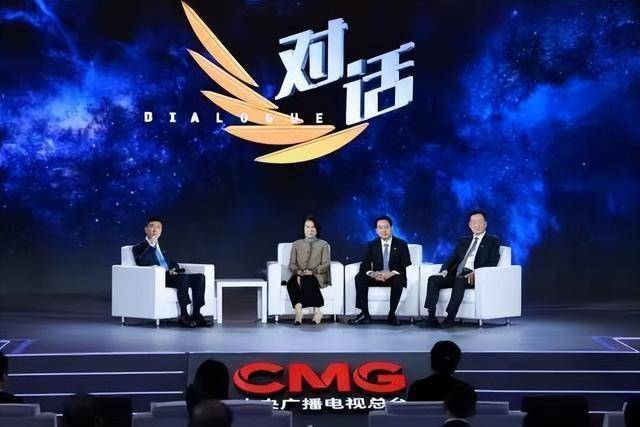
董明珠、冯长军亮相央视《对话》:家电汽车行业共谋消费新潜力
Sou Hu Cai Jing· 2026-01-11 11:51
Core Insights - The dialogue between industry leaders highlights the new trends in China's consumption market, emphasizing the importance of new demand leading to new supply and vice versa [1] - The shift from "price competition" to "value competition" is a significant transformation in the Chinese consumer market, as companies focus on quality and innovation [3][20] Group 1: Industry Trends - The Chinese consumer market is undergoing profound changes, with a focus on high-quality development and consumer satisfaction [3] - The automotive industry is experiencing growth driven by both supply and demand, with technological innovations encouraging consumers to upgrade their vehicles [5] - The automotive market has stabilized in pricing since 2025, leading to improved profit margins across the industry [6] Group 2: Company Strategies - Dongfeng Motor has achieved a historic milestone with over 1 million electric vehicles sold in 2025, marking a 21% year-on-year increase [7] - Dongfeng's success is attributed to its commitment to high-level technological self-reliance and innovation, with significant advancements in hybrid engine efficiency [9] - Gree Electric's vision has evolved from producing "good air conditioners" to "good appliances," reflecting a broader ambition in product quality [12] Group 3: Technological Innovations - Both companies emphasize the importance of smart technology, with Gree focusing on whole-home smart systems and Dongfeng transforming vehicles into "third living spaces" [16] - Dongfeng's "Tianyuan Smart" technology brand aims to establish a comprehensive intelligent system, achieving L4-level autonomous driving in multiple regions [11] - The integration of smart home devices with automotive technology is seen as a key area for future development, enhancing user experience through seamless connectivity [16] Group 4: Future Outlook - The dialogue indicates a shared commitment to innovation and value creation, with both industries aiming to meet and create new consumer demands [20] - The automotive sector is set to implement large-scale applications of L3 and L4 autonomous driving during the "14th Five-Year Plan" period [20] - Both Gree and Dongfeng are positioned to lead their respective industries towards a more intelligent, green, and integrated future, contributing to the revitalization of the domestic consumption market [20]

熊征宇赴武汉经开区调研汽车产业发展:强化创新驱动改革赋能,推动汽车产业转型升级做大做强
Chang Jiang Ri Bao· 2026-01-11 00:54
Core Insights - The government emphasizes the importance of transforming and upgrading the automotive industry in Wuhan, focusing on new energy and intelligent connected vehicles to enhance competitiveness and innovation [1][3]. Group 1: Government Initiatives - The city government aims to support the automotive industry in becoming a global leader, transitioning from "China's Car Valley" to "World's Car Valley" [1][3]. - There is a strong focus on innovation and reform to drive the automotive sector's growth, with an emphasis on collaboration between leading enterprises and academic institutions [3]. Group 2: Company Developments - XPeng Motors' Wuhan base is highlighted as a key facility for new vehicle and component manufacturing, with encouragement for the company to accelerate production and new model launches [1]. - Dongfeng Motor is recognized as a pillar of the local automotive industry, with expectations for the company to enhance its R&D capabilities and expand both domestic and international markets [2][3]. Group 3: Industry Strategy - The strategy includes strengthening the supply chain and localizing component production to create a new ecosystem for the automotive industry [3]. - The government plans to implement a mechanism that integrates various stakeholders to provide better support in terms of talent, financing, and market access for automotive enterprises [3].

山东各地新一轮以旧换新政策落地,高“得补率”激活新年消费市场
Da Zhong Ri Bao· 2026-01-11 00:40
Core Viewpoint - The new round of vehicle trade-in policies in Shandong is expected to stimulate consumer spending in the automotive market, with a focus on precise subsidies that enhance the effectiveness of the policies [1][3]. Group 1: Automotive Industry - The new trade-in policy offers subsidies based on a percentage of the vehicle price, ranging from 6% to 12%, which increases the "subsidy rate" for consumers [2][3]. - In Shandong, consumers can receive a subsidy of up to 20,000 yuan for trading in old vehicles for new energy vehicles, with a 12% subsidy for eligible old cars [3]. - The trade-in ratio for new car purchases has reached 40%, indicating a significant increase in consumer interest driven by the new policies [3]. - The demand for new energy vehicles, particularly plug-in hybrids and extended-range models, has surged, with dealers reporting a notable increase in foot traffic and sales [3]. Group 2: Consumer Electronics Industry - The new trade-in policies have expanded support for digital smart products, including smartphones, tablets, and smart glasses, reflecting consumer demand for new technologies [4]. - The current trade-in policy for 3C products is the most substantial in recent years, with improvements in subsidy rates, product categories, and ease of application [4]. - Consumers are increasingly valuing the transparency and fairness of old device valuations, leading to the introduction of third-party assessments in retail environments [5]. - There is a growing expectation for subsidies to cover high-end products, such as foldable smartphones, indicating a shift in consumer preferences towards premium devices [5].
东风汽车股份有限公司 2025年12月份产销数据快报
Zhong Guo Zheng Quan Bao - Zhong Zheng Wang· 2026-01-09 23:07
Core Viewpoint - Dongfeng Motor Corporation reported its production and sales data for December 2025, ensuring the accuracy and completeness of the information provided [1]. Group 1: Production and Sales Data - The production and sales data for December 2025 is summarized in the report, with specific figures to be confirmed in the regular report [1]. - Dongfeng Cummins Engine Company, a joint venture between the company and Cummins (China) Investment Co., Ltd., is noted as a 50% owned entity [1].
东风股份:2025年累计汽车销量11.9万辆 同比减少23.22%
Xin Lang Cai Jing· 2026-01-09 13:37
Core Viewpoint - Dongfeng Motor Corporation (600006) announced a total automobile production of 14,600 units and sales of 11,400 units for December 2025, with new energy vehicles accounting for 2,769 units in production and 1,663 units in sales [1] Production and Sales Summary - The cumulative automobile production for 2025 is projected to be 111,500 units, representing a year-on-year decrease of 26.16% [1] - The cumulative automobile sales for 2025 are expected to reach 119,000 units, reflecting a year-on-year decline of 23.22% [1]
固态电池供应商备战2027:目标定好了,路线还在争
Jing Ji Guan Cha Wang· 2026-01-09 12:33
Core Insights - The solid-state battery industry is experiencing renewed interest from investors due to clear profitability and order visibility in the supply chain, with a significant focus on achieving mass production by 2027 [2][3][6] - Major automotive companies are targeting 2027 for the application of solid-state batteries in vehicles, with many planning to complete product development or testing by 2026 [4][5] Industry Developments - Companies like Tian Shi Ke Feng have begun to engage with potential investors after overcoming initial funding challenges, with plans to expand production capacity significantly in 2026 [2] - The Ministry of Industry and Information Technology has identified solid-state batteries as a key area for development, aiming to establish 3-5 leading companies by 2027 [3] Technical Challenges - The path to mass production of solid-state batteries is fraught with challenges, including material technology discrepancies and shortages in core equipment [6][8] - The industry is divided on material technology routes, with significant competition between oxide and sulfide electrolytes, each having distinct advantages and challenges [10][12] Material Innovations - Solid-state batteries are recognized for their high energy density and intrinsic safety, making them suitable for various applications, although their cost-effectiveness in electric vehicles remains a concern [7][8] - The development of silicon-carbon and lithium metal anodes is ongoing, with companies reporting progress in small-scale trials [9][10] Equipment and Production - The lack of mature mass production equipment poses a significant barrier, with many companies resorting to self-developed solutions to meet production demands [14][19] - The production process for solid-state batteries requires high precision and specialized equipment, which increases costs and complicates the manufacturing process [20][21] Market Dynamics - The solid-state battery supply chain is characterized by a collaborative approach among suppliers and manufacturers, with a focus on meeting evolving technical requirements from cell manufacturers [23][24] - The competitive landscape is marked by a "race" among cell manufacturers to explore various material suppliers, emphasizing the need for continuous innovation and adaptation [24]