
DFAC(600006)

Search documents
长安破万 大通涨46% 东风上升三位 10月轻客销量榜单新鲜出炉
第一商用车网· 2025-11-14 13:21
Core Viewpoint - In October 2025, China's bus market experienced a year-on-year growth of 15%, with total sales reaching 49,600 units. The light commercial vehicle (LCV) segment, which is the largest in the bus market, continued its growth trend, marking its seventh consecutive month of increase [1][2]. Summary by Sections Market Performance - In October 2025, the LCV market sold 38,700 units, reflecting a year-on-year increase of 19% but a month-on-month decline of 11%. The growth rate compared to the previous month decreased by 18 percentage points [2][4]. - The LCV's market share in the overall bus market was 77.99%, slightly down from 78.17% in the previous month. For the year-to-date period from January to October, the LCV's market share reached 79.48%, an increase from 77.18% in the entire year of 2024 [2][4]. Historical Trends - An analysis of the LCV sales trends over the past five years shows a pattern of decline and growth, with October 2025 achieving the highest sales volume of 38,700 units, surpassing the lowest point in October 2022 by 12,700 units and exceeding last year's sales by over 6,000 units [5][20]. - Cumulatively, from January to October 2025, the total sales reached 363,200 units, marking the highest figure in five years and an increase of over 35,000 units compared to the same period last year [5][20]. Company Performance - In October 2025, the top ten companies in the LCV market accounted for 95.90% of total sales, with the top three companies—Changan, Jiangling, and Maxus—each holding over 20% market share, totaling 73.98% [11][12]. - Among the top ten companies, five experienced sales growth while five saw declines. Notably, Changan, Maxus, Foton, and Yutong achieved significant growth rates of 50%, 46%, 27%, and 32% respectively, while one company faced a drastic decline of 48% [12][16]. Market Share Dynamics - From January to October 2025, Changan, Jiangling, and Maxus captured 29.20%, 21.85%, and 20.75% of the LCV market share, respectively. Foton's market share was close to 10%, at 9.21% [18][20]. - Compared to the same period last year, Changan, Jiangling, and Maxus saw their market shares increase by 4.67, 0.99, and 2.73 percentage points, respectively, indicating a positive shift in market dynamics [18][20].






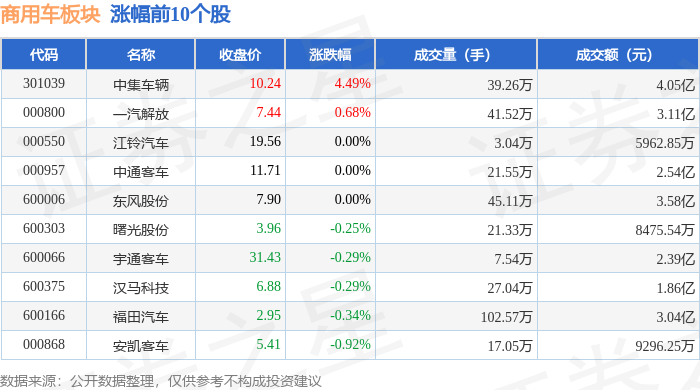
商用车板块11月14日跌0.8%,金龙汽车领跌,主力资金净流出3.01亿元
Zheng Xing Xing Ye Ri Bao· 2025-11-14 08:49
Market Overview - The commercial vehicle sector experienced a decline of 0.8% on November 14, with Jinlong Automobile leading the drop [1] - The Shanghai Composite Index closed at 3990.49, down 0.97%, while the Shenzhen Component Index closed at 13216.03, down 1.93% [1] Stock Performance - Among the commercial vehicle stocks, Zhongji Vehicles saw a significant increase of 4.49%, closing at 10.24 [1] - Other notable performances include: - FAW Jiefang: +0.68% at 7.44 - Jiangling Motors: unchanged at 19.56 - Dongfeng Motor: unchanged at 7.90 - Yutong Bus: -0.29% at 31.43 - Foton Motor: -0.34% at 2.95 [1][2] Trading Volume and Capital Flow - The commercial vehicle sector had a net outflow of 301 million yuan from institutional investors, while retail investors saw a net inflow of 283 million yuan [2] - The trading volume for Zhongji Vehicles was 392,600 shares, with a transaction value of 405 million yuan [1] Individual Stock Capital Flow - Dongfeng Motor had a net inflow of 4.04 million yuan from institutional investors, while it faced a net outflow of 13.47 million yuan from speculative funds [3] - FAW Jiefang experienced a net inflow of 2.29 million yuan from institutional investors, but a net outflow of 16.28 million yuan from retail investors [3] - Ankai Bus saw a significant net outflow of 21.14 million yuan from institutional investors, despite a net inflow of 9.48 million yuan from retail investors [3]


徐工/三一争冠 重汽猛追解放!新能源重卡10月销量再破2万 全年剑指20万辆 | 头条
第一商用车网· 2025-11-14 07:01
Core Viewpoint - The sales of China's new energy heavy truck market are expected to exceed 200,000 units in 2025, with October sales reaching a record high of 20,100 units, marking a year-on-year increase of 144% [1][4][6]. Sales Performance - In October 2025, the domestic new energy heavy truck market sold 20,100 units, a decrease of 17% month-on-month but a significant increase of 144% year-on-year [3][4]. - Cumulatively, from January to October 2025, the new energy heavy truck sales reached 157,900 units, representing a year-on-year growth of 178% [19][22]. Market Trends - The new energy heavy truck market has shown consistent growth, with 33 consecutive months of year-on-year increases, and has outperformed the overall heavy truck market for 29 months [6][8]. - The penetration rate of new energy heavy trucks in the overall heavy truck market reached 24.69% from January to October 2025, significantly higher than the previous year's 11.93% [8][19]. Company Performance - In October 2025, 15 companies sold over 100 units, with 12 companies exceeding 300 units and 5 companies surpassing 2,000 units [10][15]. - The top three companies in sales for October were XCMG with 3,453 units, SANY with 3,030 units, and FAW Jiefang with 2,693 units [12][15]. Market Share - In October 2025, the market shares of the top five companies were XCMG (17.19%), SANY (15.08%), FAW Jiefang (13.41%), Sinotruk (12.54%), and Shaanxi Automobile (10.44%) [15]. - The cumulative market share of the top ten companies reached 92.38%, with the top five accounting for 66.65% [15]. Future Outlook - The expectation for the new energy heavy truck market in 2025 is to maintain high sales levels, with an average monthly sales target of over 21,000 units in the last two months to ensure the annual target is met [6][24].




关口勋:东风日产将在2027年底推出6款全新新能源车型
Bei Ke Cai Jing· 2025-11-13 13:57
Core Viewpoint - Dongfeng Nissan is committed to a "For China, By China, To the World" strategy, focusing on the GLOCAL model and fully investing in the Chinese market while advancing multiple powertrain technologies to meet diverse consumer needs [1][2]. Group 1: Strategic Direction - Dongfeng Nissan is deepening its GLOCAL model and is fully committed to the Chinese market [1]. - The company is advancing three technology routes: pure electric, plug-in hybrid, and range-extended vehicles to cater to various family user needs [1]. Group 2: Product Development - By the end of 2027, Dongfeng Nissan plans to launch six new energy vehicle models [1]. - The N6 model has officially started pre-sales, with three variants priced between 109,900 yuan and 121,900 yuan [2]. - The N6 features a 1.5L plug-in hybrid power system with a pure electric range of 180 kilometers [2]. Group 3: Customer Insights - Over half of the N7 owners are young, with more than 60% choosing the model for its comfort in driving and riding [2]. - Dongfeng Nissan is enhancing its new comfort concept starting with the N7, which will be integrated into future models [2]. Group 4: Technical Specifications - The N6 dimensions are 4831mm in length, 1885mm in width, and 1494mm in height, with a wheelbase of 2815mm [2]. - The N6 is equipped with an AI assistant named "Xiao Ni," which integrates advanced models from iFLYTEK and DeepSeek-R1 for enhanced user experience [2].
东风汽车:目前已建成0.2GWh固态电池中试线并投入使用,预计350Wh/kg固态电池将于2026年9月正式量产上车!届时整车可实现1000公里续航
Ge Long Hui· 2025-11-13 11:55
格隆汇11月13日|据东风汽车(600006)研发总院消息,11月12日-15日,2025世界动力电池大会在四川宜 宾国际会展中心举行。东风汽车携新一代高比能固态电池和马赫超千伏纯电平台展品,以及多款自主品 牌新能源车型亮相。东风汽车表示,目前已建成0.2GWh固态电池中试线并投入使用,预计350Wh/kg固 态电池将于2026年9月正式量产上车,届时整车可实现1000公里续航。 ...
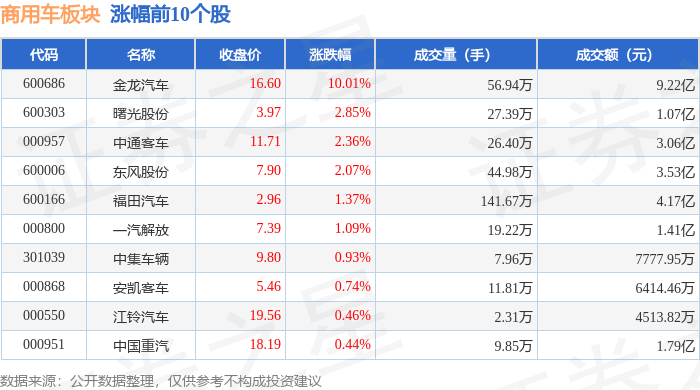
商用车板块11月13日涨0.72%,金龙汽车领涨,主力资金净流入4790.19万元
Zheng Xing Xing Ye Ri Bao· 2025-11-13 08:44
Group 1 - The commercial vehicle sector increased by 0.72% on November 13, with King Long Automobile leading the gains [1] - The Shanghai Composite Index closed at 4029.5, up 0.73%, while the Shenzhen Component Index closed at 13476.52, up 1.78% [1] - The top 10 gainers in the commercial vehicle sector included King Long Automobile, which rose by 10.01% to a closing price of 16.60 [1] Group 2 - The net inflow of main funds in the commercial vehicle sector was 47.90 million yuan, while retail investors saw a net inflow of 13.99 million yuan [1] - The top stocks by trading volume included King Long Automobile with 569,400 shares traded and a transaction value of 9.22 million yuan [1] - The overall trading activity showed a mixed trend with main funds flowing in while speculative funds experienced a net outflow of 61.90 million yuan [1]


明年起购置税将减半征收,17家汽车品牌承诺兜底
Di Yi Cai Jing· 2025-11-13 08:07
Core Viewpoint - The end of the full exemption policy for new energy vehicle (NEV) purchase tax in 2025 has triggered a competitive order-seizing battle among car manufacturers, with many offering tax subsidy schemes to lock in consumers before the policy change [2][3]. Group 1: Policy Changes and Impacts - From January 1, 2026, the NEV purchase tax will be halved, with a maximum tax reduction of 15,000 yuan per vehicle [2]. - The current exemption policy allows for a maximum tax exemption of 30,000 yuan for NEVs purchased between January 1, 2024, and December 31, 2025 [2]. - The urgency among consumers to purchase vehicles has increased due to the impending policy changes, influencing their choice of models based on delivery timelines [3]. Group 2: Manufacturer Responses - 17 mainstream automotive brands have introduced purchase tax subsidy schemes to cover the tax difference for consumers whose vehicles are delivered after the policy change [2][3]. - The subsidy schemes include various forms such as tax difference vouchers, cash reductions on final payments, and direct cash subsidies, with a maximum subsidy of 15,000 yuan [3]. - The competition among manufacturers is expected to intensify as they aim to capture market share amid the changing tax policies [4]. Group 3: Market Trends and Performance - In October, NEV production and sales reached 1.772 million and 1.715 million units, respectively, both showing over 20% year-on-year growth, with a market penetration rate surpassing 50% [3]. - The cumulative production and sales of NEVs in the first ten months of the year exceeded 13 million units, marking a year-on-year increase of approximately 33% [3]. - The automotive market continues to show strong growth, with new models being launched and production rates maintained to meet demand [4]. Group 4: Future Outlook - The technical threshold for NEV purchase tax exemptions will increase starting in 2026, as plug-in hybrid vehicles with an electric range of less than 100 kilometers will no longer qualify for tax reductions [4]. - This change is expected to lead to a clearer market differentiation, with companies possessing core technological competitiveness likely to gain a larger market share [4].





明年起购置税将减半征收,17家汽车品牌承诺兜底
第一财经· 2025-11-13 07:49
Core Viewpoint - The article discusses the impending end of the full exemption from purchase tax for new energy vehicles (NEVs) in China, leading to a competitive order-seizing battle among car manufacturers as they introduce tax subsidy plans to attract consumers before the policy changes take effect [3][4]. Group 1: Policy Changes and Impacts - Starting January 1, 2026, the purchase tax for NEVs will be halved, with a maximum tax reduction of 15,000 yuan per vehicle [3]. - From January 1, 2024, to December 31, 2025, NEVs will continue to be exempt from purchase tax, with a maximum exemption of 30,000 yuan per vehicle [3][4]. - The adjustment in tax policy has intensified consumer urgency to purchase vehicles, influencing their choice of models based on delivery timelines [4]. Group 2: Manufacturer Responses - 17 major automotive brands, including Li Auto, NIO, and BYD, have introduced purchase tax subsidy plans to cover the tax difference for consumers whose vehicles are delivered after the policy change [3][4]. - The subsidy methods include tax difference vouchers, cash reductions on final payments, and direct cash subsidies, with a maximum subsidy of 15,000 yuan [4]. - The competition among manufacturers is expected to increase as they strive to maintain market share amid changing tax incentives [5]. Group 3: Market Trends and Performance - In October, NEV production and sales reached 1.772 million and 1.715 million units, respectively, with year-on-year growth exceeding 20% and a market penetration rate surpassing 50% [4][5]. - Cumulative NEV production and sales for the first ten months of the year exceeded 13 million units, reflecting a year-on-year growth of approximately 33% [4]. - The market is witnessing a shift as consumers, influenced by the availability of popular models, are increasingly opting for less popular models, contributing to sustained sales growth [4].

福田5.6万领跑!重汽/解放涨超五成 江淮连跳 10月商用车销36万辆 | 头条
第一商用车网· 2025-11-13 07:44
Core Viewpoint - The commercial vehicle market in China has shown a fluctuating trend in 2025, with a notable increase in sales during the latter part of the year, achieving a cumulative sales volume of over 3 million units by September, reflecting a net increase of over 220,000 units compared to the previous year [1]. Sales Performance - In October 2025, the commercial vehicle market sold 360,700 units, representing a month-on-month decrease of 2% but a year-on-year increase of 21%. The growth rate compared to the previous month narrowed by 9 percentage points [4][5]. - The cumulative sales from January to October 2025 reached 3,478,700 units, marking a year-on-year growth of 9%, with an increase of nearly 290,000 units compared to the same period last year [9][17]. Market Share and Rankings - In October 2025, the top ten companies in the commercial vehicle market accounted for a combined market share of 76.19%, with the top five companies exceeding 50% [15]. - Foton led the sales with 56,100 units, followed by China National Heavy Duty Truck with 38,500 units, and Changan with 33,300 units [11][13]. Competitive Landscape - The competitive landscape remains intense, with small differences in market share among neighboring companies. For instance, the market share difference between Jianghuai and Jiangling was only 0.06% [25]. - The rankings of the top ten companies remained stable, with Jianghuai moving up three positions to seventh place [16]. Cumulative Sales by Company - Foton's cumulative sales exceeded 500,000 units, reaching 530,800 units, while China National Heavy Duty Truck, Dongfeng, and Changan all surpassed 300,000 units [19][23]. - The growth rates of major companies varied, with China National Heavy Duty Truck, Shaanxi Automobile, and SAIC Maxus showing significant increases of 25%, 20%, and 28% respectively [19].

冲刺年度新能源100万辆销量 东风如何从“燃油车老将”变“新能源先锋”?
Zhong Guo Jing Ying Bao· 2025-11-13 07:04
Core Insights - Dongfeng Motor Corporation aims to achieve a high-quality target of 1 million annual sales of new energy vehicles by the end of 2025, as highlighted in their recent promotional campaign [1][4] - The company has seen significant growth in its subsidiary, Lantu Motors, which reached a production milestone of 300,000 vehicles in just 7 months, becoming the first high-end new energy brand from a state-owned enterprise to achieve this scale [1][3] Group 1: Strategic Initiatives - Dongfeng is focusing on transforming from a traditional fuel vehicle manufacturer to a leader in new energy vehicles, emphasizing the need to break industry inertia and external skepticism [2] - The company is implementing a "three-year action plan for transformation and upgrading," which includes enhancing its brand matrix with new energy brands like Lantu, Mengshi, and Yipai [2][3] - Dongfeng is also investing in platform architecture for passenger vehicles, developing various frameworks such as M TECH, Dongfeng Quantum, and green energy DSMA [3] Group 2: Sales Performance - In October, Dongfeng sold 241,000 vehicles, marking a 16.6% year-on-year increase, with new energy vehicle sales reaching 112,000 units, a 42.17% increase [4][5] - Lantu Motors achieved a record delivery of 17,218 vehicles in October, with a cumulative year-on-year growth of 82% from January to October [5] - Mengshi and Yipai also reported significant sales growth, with Mengshi's sales increasing by 197% and Yipai's by 43.6% year-on-year for the same period [5] Group 3: Future Outlook - Dongfeng plans to continue its dual strategy of independent development and open collaboration, focusing on innovation and deepening reforms to ensure the successful implementation of its strategic goals [6] - The company aims to achieve its long-term vision of becoming a world-class enterprise by 2030 and a benchmark for international competitiveness by 2035 [6]