DFAC(600006)

Search documents
汽车行业跟踪报告:10月批发同比+7%,新能源渗透率超55%
Huachuang Securities· 2025-11-11 09:16
Investment Rating - The industry investment rating is "Recommended," indicating an expected increase in the industry index by more than 5% over the next 3-6 months compared to the benchmark index [70]. Core Insights - In October, the wholesale sales of narrow passenger vehicles reached 2.93 million units, a year-on-year increase of 7% and a month-on-month increase of 4% [2]. - The penetration rate of new energy vehicles exceeded 55%, with wholesale sales of electric vehicles at 1.62 million units, marking an 18% year-on-year increase [8]. - The report highlights potential investment opportunities in companies such as Geely Automobile and BYD, with a focus on Geely's low valuation for the upcoming year [4]. Summary by Sections Industry Overview - In October, the production of narrow passenger vehicles was 2.95 million units, reflecting an 11% year-on-year increase and a 4% month-on-month increase [2]. - The report estimates that retail sales for October were approximately 2.34 million units, showing a 3% year-on-year increase [8]. Sales Performance - The wholesale sales of new energy vehicles in October were 1.62 million units, with a penetration rate of 55%, which is a 5 percentage point increase year-on-year [8]. - The report indicates that the wholesale sales of domestic car manufacturers reached 2.14 million units in October, a 12% year-on-year increase [8]. Pricing and Inventory - The industry discount rate slightly increased in late October, with an average discount rate of 9.6%, reflecting a 0.1 percentage point increase month-on-month [8]. - The total inventory is estimated to be around 3.1 million units, with fuel vehicle inventory at approximately 850,000 units, indicating a higher overall inventory compared to the same period last year [8]. Future Outlook - The report anticipates that the fourth quarter will see a seasonal inventory reduction, with retail sales expected to reach 7.73 million units, a 6% year-on-year increase, while wholesale sales are projected to be 8.67 million units, a 1% year-on-year decrease [8]. - Potential catalysts for recovery in the automotive sector include better-than-expected retail sales post-Spring Festival and improved export performance [8].




重新定义年轻人的第一台智能轿跑,东风奕派eπ007+上市售13.99万元起
Zhong Guo Jing Ji Wang· 2025-11-11 08:59
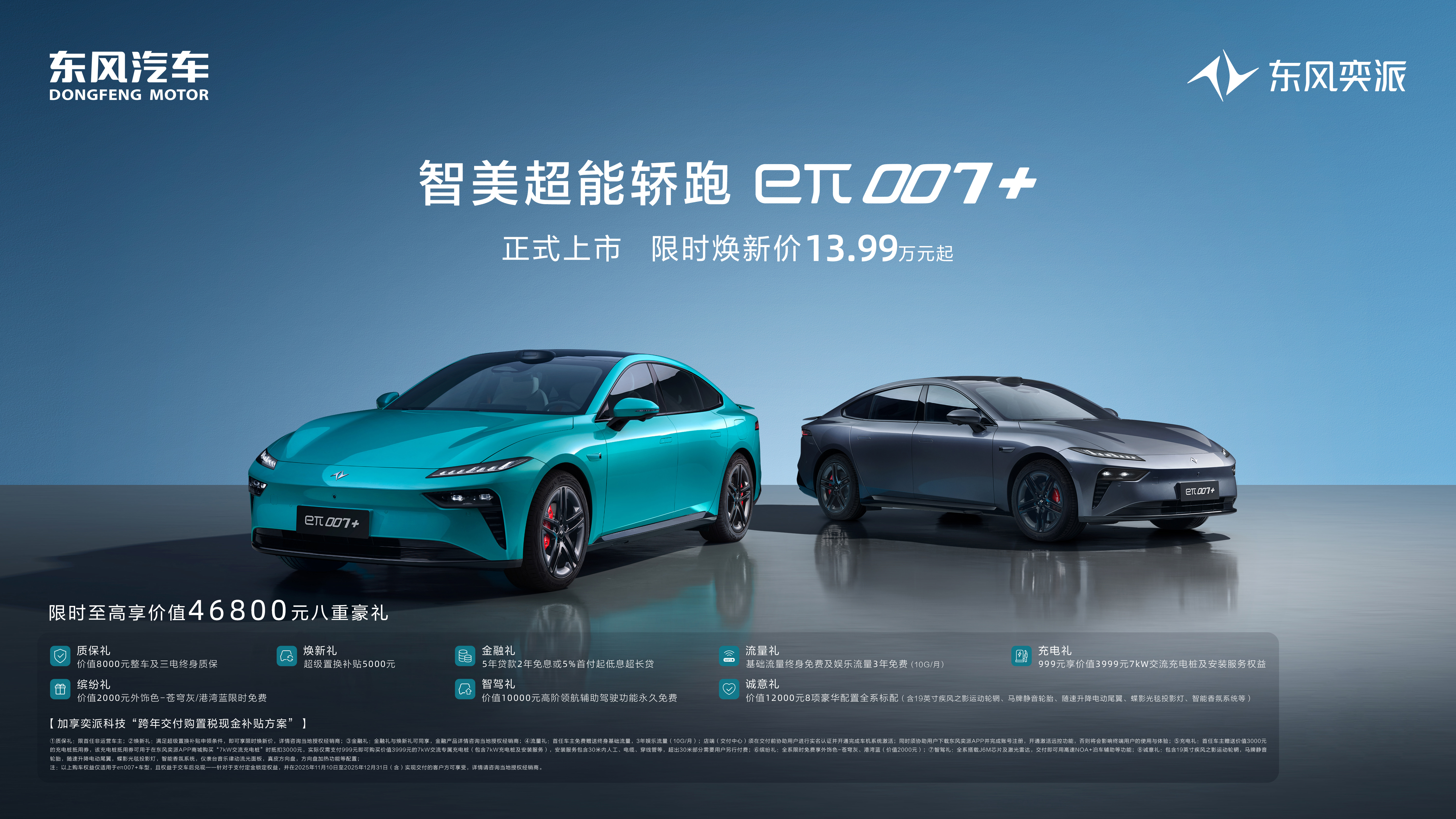
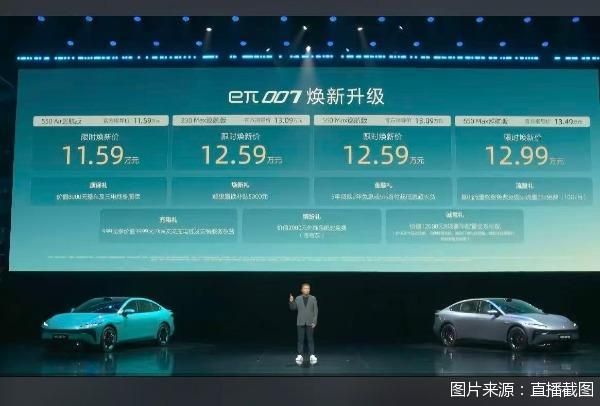
在东风奕派品牌发布两周年之际,拳头产品eπ007正式升级为eπ007+。 11月10日,东风奕派品牌全新"智美超能轿跑"eπ007+正式上市,限时焕新价13.99万元起。 作为弈派品牌首款产品,eπ007于2024年3月上市伊始便被寄予厚望,是东风汽车加力布局新能源市 场投下的重磅产品。时隔不到一年半时间,2025年8月1日,东风汽车集团组建东风奕派科技,并整合了 奕派、风神、纳米三大品牌,新公司名称也凸显了奕派品牌的重要性,而本次焕新上市的eπ007+无疑 也将肩负起更大责任。 在市场销量层面,重组整合后的奕派科技正渐入佳境,9月、10月销量接连突破3万辆大关。而作为 主打产品之一,定位14万元级主流市场的eπ007+"提量"仍是主要任务,其也是东风汽车冲刺年度新能源 车100万销量目标的重要动力。 产品实力的全面升级,则是保证销量向上的基础,eπ007+拥有"性能驾控、超能智慧、高能颜值、 全能品质"四大核心优势,全系标配119项智能舒适安全配置,致力于重新定义年轻人的第一台智能轿跑 标准。 在超能智慧方面,新车首发搭载天元T200辅助驾驶系统,全系标配禾赛科技ATX激光雷达以及29 个感知硬件,标配20 ...


商用车板块11月11日跌1.11%,江淮汽车领跌,主力资金净流出3.6亿元
Zheng Xing Xing Ye Ri Bao· 2025-11-11 08:37
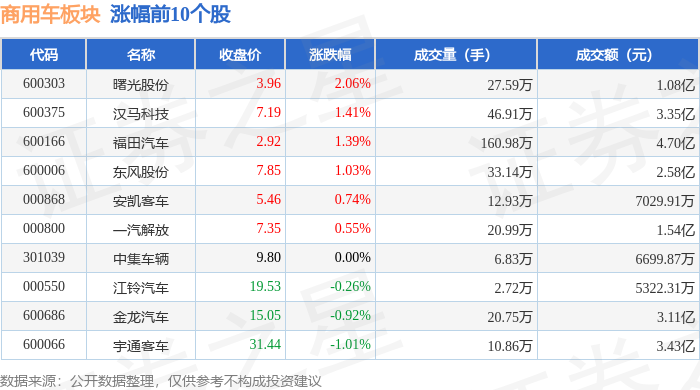
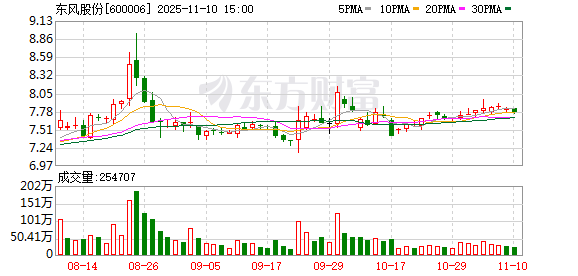
Core Points - The commercial vehicle sector experienced a decline of 1.11% on November 11, with Jianghuai Automobile leading the drop [1] - The Shanghai Composite Index closed at 4002.76, down 0.39%, while the Shenzhen Component Index closed at 13289.0, down 1.03% [1] Commercial Vehicle Sector Performance - The following companies showed notable performance: - Shuguang Co., Ltd. (600303) closed at 3.96, up 2.06% with a trading volume of 275,900 shares and a transaction value of 108 million [1] - Hanma Technology (600375) closed at 7.19, up 1.41% with a trading volume of 469,100 shares and a transaction value of 335 million [1] - Foton Motor (600166) closed at 2.92, up 1.39% with a trading volume of 1,609,800 shares and a transaction value of 470 million [1] - Dongfeng Motor (600006) closed at 7.85, up 1.03% with a trading volume of 331,400 shares and a transaction value of 258 million [1] - Jianghuai Automobile (600418) closed at 46.16, down 3.19% with a trading volume of 413,700 shares and a transaction value of 1.927 billion [2] Fund Flow Analysis - The commercial vehicle sector saw a net outflow of 360 million from institutional investors, while retail investors contributed a net inflow of 261 million [2] - The following companies had significant fund flows: - Foton Motor (600166) had a net inflow of 39.94 million from institutional investors, but a net outflow of 43.89 million from retail investors [3] - Hanma Technology (600375) had a net inflow of 13.05 million from institutional investors, with retail investors contributing a net inflow of 0.62 million [3] - Dongfeng Motor (600006) had a net inflow of 9.45 million from institutional investors, but a net outflow of 12.84 million from retail investors [3]


13.99万元起,3.7秒加速的激光雷达四驱轿跑东风奕派eπ007+上市
Yang Zi Wan Bao Wang· 2025-11-11 05:00
Core Points - The Dongfeng Yipai eπ007+ has been officially launched on November 10, featuring a unique laser radar system and two power options: pure electric and range-extended, with a starting price of 139,900 yuan [1][3] - The vehicle boasts impressive performance metrics, achieving 0-100 km/h in just 3.7 seconds and a comprehensive efficiency of 89.1% under CLTC conditions, with a maximum range of 650 km [1][3][5] Performance Control - The eπ007+ offers a 3.7-second acceleration to 100 km/h, appealing to driving enthusiasts [5] - The range-extended version features the Super Sense Range Extender 2.0 system, providing a pure electric range of 308 km and a total range of 1,308 km, along with 4C fast charging capabilities [7] - The vehicle is designed with a 50:50 weight distribution and a low center of gravity, enhancing stability and handling [7] Intelligent Features - The eπ007+ is equipped with the Tianyuan T200 driver assistance system and HESAI ATX laser radar, offering over 20 advanced driving assistance features [8] - The vehicle includes a powerful Qualcomm Snapdragon SA8295P chip and a 15.6-inch central control screen, facilitating a smooth user experience [10] Aesthetic Appeal - The design philosophy of the eπ007+ emphasizes simplicity and functionality, achieving a low drag coefficient of 0.209 and winning the German Red Dot Product Design Award [11][13] - New color options include Cang Qiong Grey and Gang Wan Blue, along with various sporty features that enhance its appeal to younger consumers [13] Quality and Safety - The interior features high-quality materials, including ultra-fine suede and leather, along with advanced audio and ambient lighting systems [14] - The eπ007+ includes over 30 safety features and has achieved a C-NCAP five-star safety rating, utilizing high-strength materials for enhanced protection [16]
东风股份铺路“十五五”绿色发展战略 2030年新能源渗透率将超60%
Zhong Guo Jing Ying Bao· 2025-11-11 03:00
Core Insights - Dongfeng Motor Group has launched its high-end brand "Dongfeng Qiankun" and its first new vehicle K6, along with a 2030 new energy strategy goal to achieve over 60% penetration of new energy vehicles by that year [1][4] Group 1: New Brand and Strategy - Dongfeng Light Commercial Vehicles is rebranding and introducing new products and strategies to enhance its market position during the "14th Five-Year Plan" [1] - The company aims to establish itself as a leader in high-end, green, intelligent, and eco-friendly development within the light commercial vehicle sector [1][4] Group 2: Product Offerings - The K6 model is designed for efficient cold chain and green transportation, with a starting price of 114,500 yuan for the green transport version and 139,500 yuan for the cold chain version [2] - The Dongfeng Dolika D6 model features a starting price of 81,000 yuan for the cargo version and 85,000 yuan for the box version, showcasing significant fuel efficiency improvements [2][3] Group 3: Technological Advancements - Dongfeng Light Commercial Vehicles is focusing on three core technologies: Qiankun intelligent chassis, efficient "three electric" systems, and self-developed DEA architecture to enhance user experience [4][5] - The new technologies aim to provide extreme energy efficiency, safety, and overall cost-effectiveness, aligning with the industry's shift towards green and intelligent solutions [5]
东风股份取得汽车气制动储能测试装置专利
Jin Rong Jie· 2025-11-11 02:51
Group 1 - The core point of the article is that Dongfeng Motor Corporation has obtained a patent for a device related to automotive air brake energy storage testing, with the patent application date being June 2024 [1] Group 2 - Dongfeng Motor Corporation was established in 1999 and is located in Xiangyang, primarily engaged in the automotive manufacturing industry [1] - The company has a registered capital of 2 billion RMB [1] - Dongfeng Motor Corporation has invested in 16 enterprises and participated in 3,502 bidding projects [1] - The company holds 154 trademark registrations and 2,957 patents, along with 733 administrative licenses [1]
东风奕派007完成申报:功率400千瓦,中国首款量产四轮毂电机车型
Feng Huang Wang· 2025-11-11 00:19
Core Insights - Dongfeng Yipai 007 Wheel Hub Motor Version has completed its declaration, becoming the first mass-produced four-wheel hub motor vehicle in China [1] Vehicle Specifications - The vehicle is based on the existing Dongfeng Yipai 007, maintaining the same dimensions: 4880mm in length, 1915mm in width, and 1476mm in height, with a wheelbase of 2915mm [1] - The design retains the current model's features, including a coupe-style body and a贯穿式 tail light [1] Powertrain and Efficiency - The vehicle is equipped with four hub motors produced by Shanghai Automotive Electric Drive Co., with each motor having a maximum power of 100 kW, resulting in a total system power of 400 kW [1] - Compared to traditional drive systems, the hub motor setup reduces mechanical losses by approximately 30% by eliminating components like drive shafts and differentials, leading to lower maintenance costs [1] Technical Advancements - The independent motor layout allows for precise torque distribution, reducing the turning radius by 10%-15% and supporting millisecond-level power response [1] - Optimized chassis layout increases space for battery capacity and enhances passenger comfort [1] - The energy recovery system can independently adjust for all four wheels, improving recovery efficiency by about 25% [1] Industry Implications - The approval of this declaration signifies the official entry of hub motor technology into mass production within the Chinese passenger vehicle sector [1]
限时起售价13.99万元,东风奕派eπ007+正式上市
Bei Jing Shang Bao· 2025-11-10 13:51
Core Points - Dongfeng Yipai eπ007+ has officially launched on November 10, with a starting price of 139,900 yuan for three configuration models [1] - The vehicle offers both pure electric and range-extended power options, featuring standard laser radar and Tianyuan T200 driver assistance system across all models [1] Performance - The four-wheel drive version of eπ007+ boasts a 0-100 km/h acceleration time of 3.7 seconds, equipped with FSD variable damping shock absorbers and a 50:50 weight distribution [3] - The range-extended model is powered by a 1.5L hybrid engine with a thermal efficiency of 43.5%, achieving a comprehensive range of 1,308 kilometers [3] Intelligent Features - All models are equipped with laser radar and Tianyuan T200 driver assistance system, supporting high-speed NOA and full-scene parking [3] - The vehicle integrates Qualcomm Snapdragon 8295P chip and AI voice assistant for efficient human-vehicle interaction [3] Interior and Safety - The eπ007+ features suede-like upholstery, a music cabin, intelligent fragrance system, and 64-color ambient lighting [3] - It includes an air purification system and high-strength battery protection for enhanced safety [3]
东风股份发布东风轻型车新品牌、新产品、新战略
Zheng Quan Ri Bao· 2025-11-10 13:10
Core Insights - Dongfeng Motor Corporation is launching a new high-end brand, Dongfeng Qiankun, under its light commercial vehicle segment, aiming to lead in high-end, green, and intelligent development in the industry [2][3][6] - The company plans to achieve a new energy penetration rate of over 60% by 2030, significantly exceeding industry standards, as part of its commitment to green development [4][5] Group 1: New Brand and Product Launch - Dongfeng Qiankun brand was officially introduced, focusing on both fuel and electric vehicles to balance efficiency and cost while advancing smart features [3][4] - The first model, Dongfeng Qiankun K6, features advanced technology to reduce cold chain transport costs, with an annual fuel cost saving of over 5,400 yuan [4] - The K6 includes a spacious cabin with innovative features like a "sleeping cabin" concept and a 10-inch smart central control screen, enhancing driver comfort [4] Group 2: Strategic Goals and Technological Advancements - Dongfeng's strategy includes focusing on niche markets such as small trucks, light trucks, and sanitation vehicles, aiming to redefine value through technology [5][6] - Key technologies include the Qiankun intelligent chassis, efficient three-electric systems, and a self-developed DEA architecture to enhance user experience and safety [5][7] - The company emphasizes the importance of green and intelligent development trends to lead the future of the light commercial vehicle industry [7]
商用车板块11月10日跌0.28%,宇通客车领跌,主力资金净流出1.74亿元
Zheng Xing Xing Ye Ri Bao· 2025-11-10 08:50
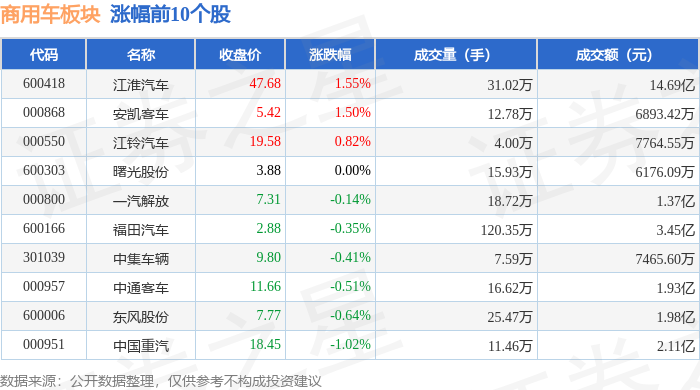
Market Overview - The commercial vehicle sector experienced a decline of 0.28% on November 10, with Yutong Bus leading the drop [1] - The Shanghai Composite Index closed at 4018.6, up 0.53%, while the Shenzhen Component Index closed at 13427.61, up 0.18% [1] Individual Stock Performance - Jianghuai Automobile (600418) closed at 47.68, up 1.55% with a trading volume of 310,200 shares and a turnover of 1.469 billion yuan [1] - Ankai Bus (000868) closed at 5.42, up 1.50% with a trading volume of 127,800 shares and a turnover of 68.9342 million yuan [1] - Yutong Bus (600066) closed at 31.76, down 2.58% with a trading volume of 124,800 shares and a turnover of 399 million yuan [3] - The overall trading data for the commercial vehicle sector shows mixed performance among individual stocks, with some experiencing gains while others faced losses [1][3] Capital Flow Analysis - The commercial vehicle sector saw a net outflow of 174 million yuan from institutional investors, while retail investors contributed a net inflow of 254 million yuan [4] - Notable capital flows include: - Foton Motor (600166) had a net inflow of 17.9142 million yuan from institutional investors [4] - Yutong Bus (600066) experienced a net outflow of 7.5470 million yuan from institutional investors [4] - Ankai Bus (000868) saw a net inflow of 0.9552 million yuan from retail investors [4] Summary of Trading Data - The trading data for key stocks in the commercial vehicle sector indicates varied performance, with some stocks showing resilience while others are under pressure [1][3][4] - The overall sentiment in the sector appears cautious, reflecting broader market trends and investor behavior [1][4]