CMBC(600016)

Search documents
彭博独家 | 2025年第一季度彭博中国债券承销排行榜
彭博Bloomberg· 2025-04-11 03:24
Core Insights - The 2025 Q1 Bloomberg China Bond Underwriting Rankings reveal significant trends in the bond market, highlighting the performance of various banks and securities firms in the issuance of bonds [2][3]. Group 1: Market Overview - The total issuance of Panda bonds in 2024 exceeded 208.25 billion RMB, while in Q1 2025, the issuance by foreign institutions in the domestic market reached 41.6 billion RMB, showing a decrease of 38.28% compared to the same period last year [4]. - The overall issuance of domestic credit bonds in Q1 2025 was approximately 3.77 trillion RMB, reflecting a decline of about 12.61% year-on-year [6]. - The issuance of interbank certificates of deposit increased to approximately 8.35 trillion RMB in Q1 2025, up 11.97% from the previous year [10]. Group 2: Rankings and Performance - In the Bloomberg Q1 2025 China Bond Rankings, the top three positions were held by Bank of China (5.918%), CITIC Bank (5.675%), and Industrial Bank (5.297%) [7]. - For corporate bonds, CITIC Securities (13.450%), CITIC Jiantou (9.988%), and former Guotai Junan Securities (8.053%) maintained their top three positions [7]. - In the offshore RMB bond rankings (excluding certificates of deposit), the top three were held by Amundi (12.248%), HSBC (7.117%), and Standard Chartered Bank (5.021%) [7]. Group 3: Local Government Bonds - The issuance of local government bonds in Q1 2025 was approximately 2.66 trillion RMB, a significant increase of about 78.26% year-on-year [12]. - The issuance included about 0.38 trillion RMB in general bonds and approximately 2.28 trillion RMB in special bonds, with debt resolution remaining a key focus [12]. Group 4: Offshore Bond Market - The issuance of offshore bonds (excluding certificates of deposit) by Chinese enterprises exceeded 401.4 billion RMB in Q1 2025, marking a year-on-year growth of approximately 35.36% [16]. - The issuance of "Kung Fu Bonds" surpassed 30 billion USD (approximately 219.2 billion RMB), showing a significant increase of over 122.20% compared to the previous year [16].


深挖“人工智能+金融”潜力
Jing Ji Ri Bao· 2025-04-10 21:53
Core Insights - The integration of artificial intelligence (AI) in financial services is a significant topic of discussion among listed financial institutions, with many increasing their investments in fintech for 2024 [1] - Major Chinese banks have reported substantial financial technology investments, with amounts reaching billions, indicating a strong commitment to AI and digital transformation [1] Investment in Fintech - China Construction Bank, Agricultural Bank of China, Bank of China, China Merchants Bank, and Postal Savings Bank of China have made significant fintech investments, amounting to 28.518 billion, 24.97 billion, 23.809 billion, 24.433 billion, and 11.433 billion yuan respectively for 2024 [1] Development of Financial Models - The construction of financial large models is crucial for the development of digital finance, with China Construction Bank adapting 16 versions of general large models for various business scenarios [2] - The bank's computing power has reached 62,700 servers, and its data lake storage exceeds 29 petabytes, showcasing a robust infrastructure for AI applications [2] Application of AI in Financial Services - AI models are being applied across over 200 business scenarios in major banks, significantly improving efficiency and accuracy in services such as credit approval and customer interaction [4] - For instance, the response time for customer inquiries has been reduced by 79%, and the time taken for financial analysis has been cut from 30 minutes to 5 minutes [4] User Experience Enhancement - Postal Savings Bank has integrated AI into its mobile banking services, creating a "companion-style digital employee" to enhance customer experience [5] - The bank aims to embed AI into decision-making processes and accelerate the intelligent transformation of financial services [5] Future Prospects of AI in Banking - Industry leaders believe that the application of generative AI will reshape the banking ecosystem, with significant potential for future development [6] - Agricultural Bank of China has outlined a roadmap for AI implementation, targeting specific milestones for the rollout of AI applications [6][7] Strategic Focus Areas - Agricultural Bank of China plans to leverage AI in eight key areas, including credit, risk control, and marketing, to enhance operational efficiency [7] - China Construction Bank emphasizes the importance of safety and compliance in AI model development, aiming to mitigate issues related to "model hallucination" [7]



银行高管降薪:兴业银行“老将”腰斩,招行行长年薪跌破300万
Bei Ke Cai Jing· 2025-04-10 13:23
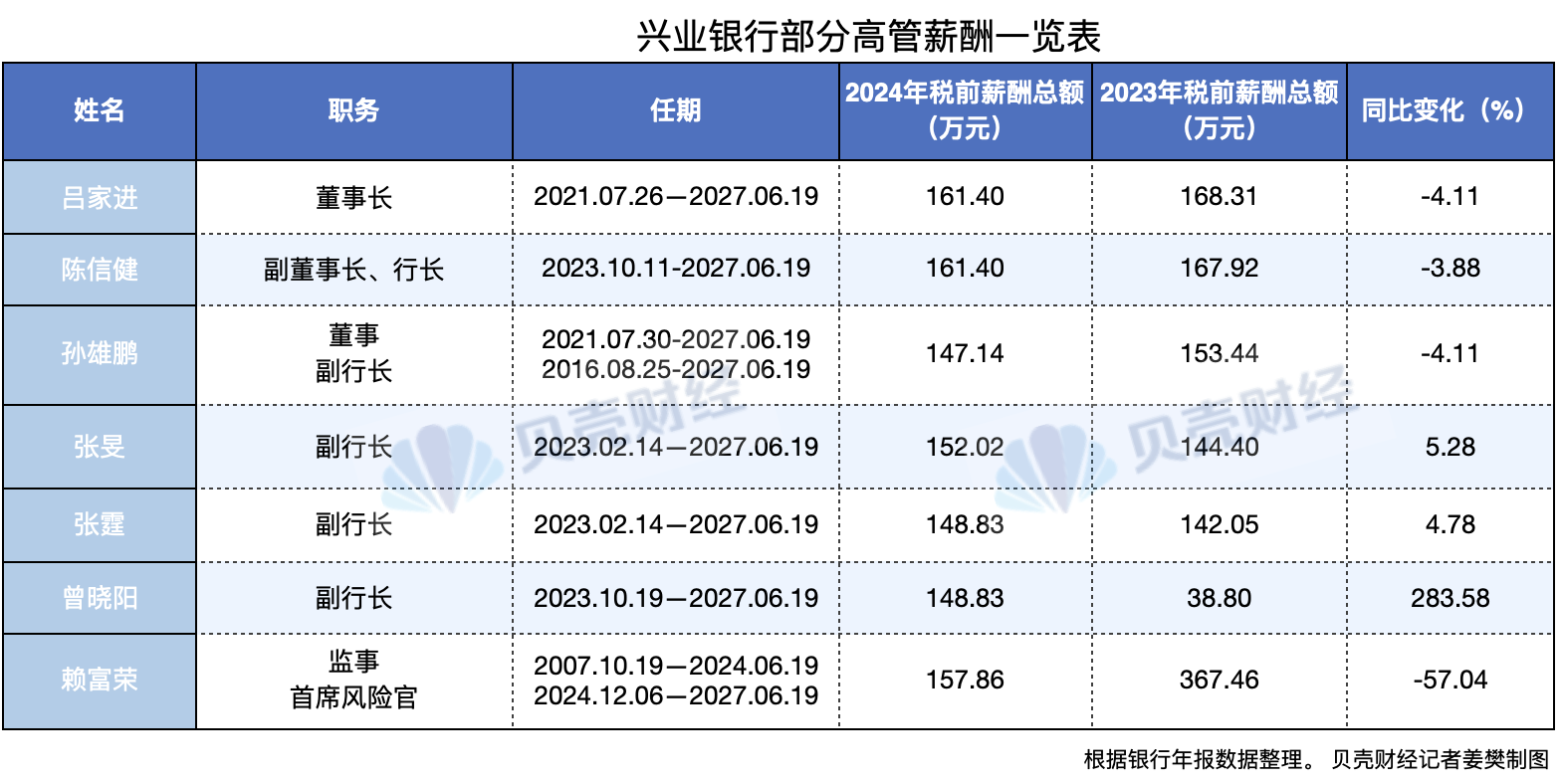
随着A股上市银行业绩披露,银行高管的薪酬逐渐浮出水面。 贝壳财经记者梳理多家股份制银行高管薪酬发现,部分出现了两位数的降幅。其中,招商银行行长兼首席执行官王良的去年税前薪酬同比下降了14.23%; 兴业银行监事、首席风险官赖富荣的薪酬则同比下降了50%以上。此外,招商银行、平安银行、兴业银行、民生银行等多家银行的副行长均出现了薪酬下降 的情况。 不过,并非所有银行高管的薪酬都处于下行通道。在2023年至2024年中,部分银行高管大规模更迭,薪酬也出现了不同程度的上涨。 "在金融行业中,银行业的薪酬水平相对合理,银行业本身降薪压力并不大。部分股份制银行薪酬市场化程度较高,薪酬水平与业绩挂钩较为紧密,在目前 情况下小幅波动是正常现象。"招联首席研究员、上海金融与发展实验室副主任董希淼表示,银行业薪酬管理的重点是进一步优化结构,从期限结构看,应 推出股权、期权等激励方式,逐步提高长期激励力度;从人员结构看,向重点岗位、重要人才倾斜,如提高金融科技人才的薪酬待遇。 367万→158万,兴业银行"高管最高薪酬"缩水 过去一年,兴业银行"老将"赖富荣税前薪酬总额为157.86万元,较2023年的367.46万元大幅缩水了 ...





“五全”赋能科技金融 战略驱动发展引擎 访中国民生银行党委委员、副行长石杰
Jin Rong Shi Bao· 2025-04-09 02:55
Core Viewpoint - The article emphasizes the role of financial support in advancing technological innovation and how China Minsheng Bank is aligning its services with national strategies to foster a "technology-industry-finance" cycle [1][2]. Group 1: Financial Support and Strategy - China Minsheng Bank has a loan balance for technology enterprises exceeding 420 billion yuan, with specialized loans for "specialized, refined, distinctive, and innovative" enterprises reaching 120 billion yuan [1]. - The bank has established a three-year development plan for its technology finance business, focusing on a systematic operational mechanism, intelligent platform tools, specialized product models, and comprehensive service strategies [2]. - The bank's service architecture includes a dedicated support system with a technology finance committee and specialized branches to enhance service delivery [2][3]. Group 2: Support for Innovation and Growth - Minsheng Bank is actively supporting sectors like autonomous driving and smart wearables, aiming to cultivate high-growth consumer markets and invest early in hard technology [3]. - The bank has developed a "Firefly Platform" that integrates various data sources to provide real-time digital profiles of technology enterprises, enhancing service precision [4]. - The bank tailors its services to different stages of technology enterprises, offering products like "Talent Loans" for startups and "Easy Creation Loans" for growth-stage companies [5]. Group 3: Ecosystem and Collaboration - Minsheng Bank is building a "production-finance investment ecosystem" by collaborating with enterprises, investment funds, and government agencies to enhance service offerings [6]. - The bank has over 300 partners in its ecosystem and plans to conduct nearly 100 joint roadshows in 2024 to provide comprehensive services to technology clients [6]. - The bank aims to deepen its technology finance layout in key regions such as Beijing-Tianjin-Hebei, the Yangtze River Delta, and the Guangdong-Hong Kong-Macao Greater Bay Area [6].
民生银行(600016) - 中国民生银行关于2025年第一季度主要经营情况的公告
2025-04-08 12:31
证券简称:民生银行 A 股代码:600016 优先股简称:民生优 1 优先股代码:360037 编号:2025-016 中国民生银行股份有限公司 关于 2025 年第一季度主要经营情况的公告 本行董事会及董事会全体成员保证本公告内容不存在任何虚假记载、误导性 陈述或者重大遗漏,并对其内容的真实性、准确性和完整性承担法律责任。 中国民生银行股份有限公司董事会 2025 年 4 月 8 日 1 2025 年以来,中国民生银行股份有限公司(以下简称"本行")坚持金融服务 实体经济的根本宗旨,保持战略定力,持续夯实基础,积极进取、精细管理,以"强 客群、优结构、控风险、促增收"为工作主线,推动经营业绩稳步改善。 一季度,本行资产负债结构不断优化,存贷款规模稳健增长,净息差稳中改善, 营业收入同比增长超过 7%,其中净利息收入与净非利息收入均实现同比正增长。 特此公告 ...
超5000亿“红包雨”!谁最大手笔?
21世纪经济报道· 2025-04-08 11:51
Core Viewpoint - The article highlights the significant increase in cash dividends among listed banks in 2024, with state-owned banks leading in both total dividend amounts and payout ratios, reflecting a strong commitment to shareholder returns [2][7]. Summary by Sections Dividend Distribution Overview - As of April 8, 2024, 23 A-share listed banks have disclosed their annual reports, collectively distributing cash dividends of 56.8862 billion yuan, an increase of over 10.1887 billion yuan year-on-year [2][3]. - The six major state-owned banks are identified as the primary contributors, proposing a total cash dividend exceeding 420 billion yuan, with payout ratios consistently above 30% [7][8]. Individual Bank Performance - Industrial and Commercial Bank of China (ICBC) leads with a cash dividend of 109.773 billion yuan, followed by China Construction Bank and Agricultural Bank of China with 100.754 billion yuan and 84.661 billion yuan respectively [3][8]. - Among joint-stock banks, China Merchants Bank stands out with a dividend payout ratio of 35.32%, distributing over 50 billion yuan [4][9]. Trends in Dividend Frequency and Ratios - The article notes a shift in dividend frequency for state-owned banks to twice a year, enhancing their attractiveness to investors [8][9]. - In contrast, city commercial banks and rural commercial banks generally exhibit lower dividend scales and ratios, with Zhengzhou Bank having the lowest payout ratio at 9.69% [5][9]. Market Valuation and Investor Sentiment - The banking sector is currently experiencing a comprehensive decline in valuation, with an overall price-to-book (PB) ratio below 1, indicating a potential undervaluation of bank stocks [5][17]. - Over 20 banks have announced valuation enhancement plans in response to prolonged low valuations, aiming to improve investor returns and confidence [16][19]. Regulatory and Strategic Considerations - Regulatory bodies have been encouraging listed companies to increase dividend distributions, which has influenced the banks' decisions to enhance their payout strategies [7][12]. - The article emphasizes the importance of maintaining a balance between dividend payouts and capital retention for risk management and growth [10][19].



消费贷进退:交行规模增超90%,张家港行减逾42%!个别行消费贷不良率激增近8个百分点|年报观察
Xin Lang Cai Jing· 2025-04-07 12:20
Core Viewpoint - The A-share listed banks are experiencing significant changes in their business structures, particularly in the consumer loan sector, amidst a challenging macroeconomic environment and tightening interest margins [1][2]. Group 1: Consumer Loan Growth - The total consumer loan balance has surged by nearly 750 billion yuan, with most banks reporting substantial increases in their consumer loan portfolios [3][5]. - Among 23 listed banks, only six reported a decrease in consumer loan balances for 2024, with Ping An Bank seeing the largest reduction of 70.63 billion yuan [5]. - Major banks like Postal Savings Bank, China Construction Bank, and Agricultural Bank of China have reported double-digit growth in consumer loans, with increases of 17.88%, 26.21%, and 38.03% respectively [6][7]. Group 2: Risk Management Concerns - Industry insiders express concerns about rising non-performing loans (NPLs) in the consumer loan sector, indicating that banks must tighten risk controls as economic cycles fluctuate [2][12]. - Several banks, including Industrial and Commercial Bank of China and Agricultural Bank of China, have reported increases in their consumer loan NPL ratios, highlighting the need for enhanced risk management strategies [12][13]. - The rapid growth of consumer loans has raised alarms about potential risks, with banks emphasizing the importance of maintaining asset quality and effective post-loan management [12][14]. Group 3: Regulatory Changes and Market Dynamics - In March, regulatory changes extended the repayment period for consumer loans from five to seven years and increased the maximum loan amount, aiming to support consumer spending [10]. - Following these changes, banks quickly halted low-interest consumer loans to prevent a price war that could lead to increased risks [12]. - The competitive landscape for consumer loans is shifting, with banks focusing on the relatively lower costs and stable returns associated with consumer lending compared to corporate lending [9].



超50家银行宣布,停止这一服务
凤凰网财经· 2025-04-06 14:40
来源:21世纪经济报道 你有多久没用过ATM扫码存款了? 日前,招商银行发布公告称, 该行将于4月9日起停止ATM扫码存款服务 ,后续,客户可持银行卡,通过招商银行ATM或前往该行营业网点办理存款业 务。 近年来, 多家银行都在收紧无卡存取款业务 。谈及调整此类业务的原因,多家银行表示,是基于优化金融服务、风险管理以及成本效率等方面的考量。 01 近一年来,超50家银行暂停各类无卡业务 据不完全统计,近一年来已经有超过50家银行机构宣布,停止无卡存款、无卡取款、扫描取款等各类业务。 去年三、四月份 多家国有大行率先作出调整 比如, 工商银行 率先表示,其个人手机银行无卡取现功能已于去年4月17日起暂停服务,客户可通过ATM机手机银行扫码取现功能提取现金,或在ATM机 上插卡提现。 交通银行 随后发布公告称,于2024年5月24日起停止个人手机银行无卡取款功能中的预约取款服务。客户仍可通过交通银行智能机具办理有卡取款、扫码 取款或前往银行营业网点办理取款业务。 去年下半年 多家股份行、头部城商行持续跟进 去年6月4日, 民生银行 发布公告称,将于2024年6月7日起停止个人手机银行"ATM无卡取现"功能,现金机 ...
本周聚焦:23家上市银行零售资产质量:不良率上行,大行加大信用成本计提力度
GOLDEN SUN SECURITIES· 2025-04-06 10:18
Group 1 - The retail non-performing loan (NPL) ratio of 23 listed banks continues to rise, with a slight decrease in overall NPL ratio to 1.25% as of Q4 2024, down 2bps from Q4 2023. However, retail loan NPL ratios have generally increased, with state-owned banks seeing an average rise of 29bps compared to Q4 2023 [1][2][3] - The average retail credit cost for listed banks in 2024 is 1.24%, a decrease of 3bps year-on-year. State-owned banks have a lower average retail credit cost of 0.99%, attributed to a higher proportion of lower-risk personal housing loans [2][3] - Looking ahead, banks are expected to manage retail loan risks by tightening customer eligibility and employing various asset disposal strategies, with the impact on asset quality being relatively controllable [4] Group 2 - The report highlights that the retail loan structure of banks has shifted, with personal housing loans making up an average of 60.9% of the total retail loans for state-owned banks, which is 17.6 percentage points higher than the sample average [2][16] - Specific banks such as Ping An Bank and Everbright Bank have seen a decrease in retail credit costs, with Ping An Bank's credit cost dropping by 34bps year-on-year, largely due to a reduction in credit card NPLs [3][4] - The report suggests that banks like Postal Savings Bank have improved their asset quality, with a notable decrease in consumer loan NPLs by 12.2 billion yuan, resulting in a NPL ratio decline of 47bps to 1.34% [4][8]
超50家银行宣布,停止这一服务
21世纪经济报道· 2025-04-06 00:39
Core Viewpoint - The article discusses the recent trend of banks, including China Merchants Bank, discontinuing cardless deposit and withdrawal services, citing reasons such as risk management, cost efficiency, and the optimization of financial services [1][2][4]. Group 1: Industry Trends - Over the past year, more than 50 banks have suspended various cardless services, including cardless deposits and withdrawals [3][4]. - Major state-owned banks initiated these changes in early 2023, with Industrial and Commercial Bank of China halting its cardless cash withdrawal service on April 17, 2023 [5]. - Following this, other banks like China Communications Bank and Minsheng Bank have also announced similar service suspensions [6][7]. Group 2: Reasons for Changes - Banks are adjusting these services primarily to enhance financial service quality, manage risks, and improve cost efficiency [2][8]. - The low security of identity verification in cardless transactions is a significant factor driving these changes [9]. - The overall demand for cardless deposit and withdrawal services from customers is relatively low, making the impact of these adjustments minimal for banks [9]. Group 3: Customer Impact - Customers will now need to carry their bank cards for deposits and withdrawals, which may lead to some inconvenience [10]. - The shift aligns with the decreasing frequency of cash usage due to the rise of mobile payments, prompting banks to close ATM QR code deposit functions [7].