
CITIC Securities Co., Ltd.(600030)

Search documents
2026年1-2月IPO中介机构排名(A股)
Sou Hu Cai Jing· 2026-02-27 03:49
Summary of Key Points Core Viewpoint - In the first two months of 2026, the A-share market saw a total of 17 new listed companies, marking a 31% increase compared to the same period last year, with total fundraising reaching 13.946 billion yuan, up 118.25% year-on-year [1]. Group 1: New Listings and Fundraising - A total of 17 new companies were listed in January and February 2026, including 4 on the Shanghai Main Board, 4 on the Sci-Tech Innovation Board, 1 on the Shenzhen Main Board, and 8 on the Beijing Stock Exchange [1]. - The net fundraising amount for these new listings was 13.946 billion yuan, significantly higher than the 6.390 billion yuan raised in the same period last year [1]. Group 2: Underwriting Institutions Performance - Eleven underwriting institutions participated in the IPOs of the 17 new companies, with China International Capital Corporation (CICC) leading with 4 deals [2]. - Other notable institutions included Guotou Securities, Dongwu Securities, and CITIC Securities, each handling 2 deals [2][3]. Group 3: Legal Services Performance - Nine law firms provided legal services for the IPOs, with Shanghai Jintiancheng and Beijing Zhonglun both ranking first, each handling 4 cases [5]. - Beijing Kangda followed with 3 cases, while several other firms contributed to the total of 17 cases [5][7]. Group 4: Accounting Firms Performance - Seven accounting firms provided auditing services for the IPOs, with Rongcheng and Lixin both leading with 4 cases each [8]. - Tianjian handled 3 cases, while Xinyong Zhonghe and Zhonghui each managed 2 cases [8][10].



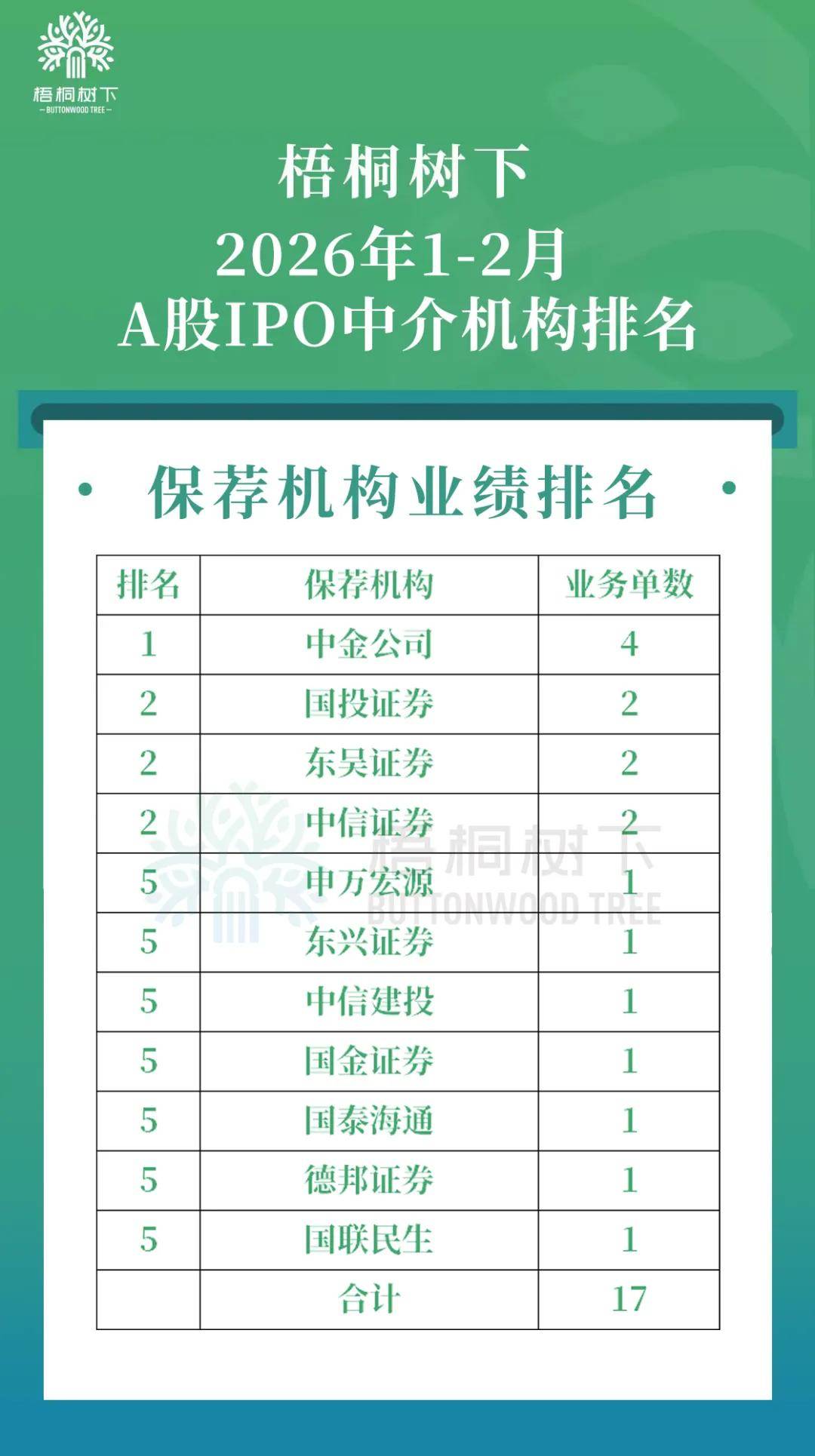
2026年1-2月IPO中介机构排名(A股)
梧桐树下V· 2026-02-27 03:33
Summary of Key Points Core Viewpoint - In the first two months of 2026, the A-share market saw a total of 17 new listed companies, marking a 31% increase compared to the same period last year, with a net fundraising amount of 13.946 billion yuan, up 118.25% year-on-year [1]. Group 1: Underwriting Institutions Performance Ranking - A total of 11 underwriting institutions were involved in the IPO business for the 17 new listed companies [2]. - China International Capital Corporation (CICC) ranked first with 4 deals, while Guotai Junan Securities, Dongwu Securities, and CITIC Securities each handled 2 deals [3][4]. Group 2: Law Firms Performance Ranking - Nine law firms provided legal services for the 17 new listed companies during the same period [5]. - Shanghai Jintiancheng and Beijing Zhonglun ranked first, each with 4 deals, followed by Beijing Kangda with 3 deals [6][8]. Group 3: Accounting Firms Performance Ranking - Seven accounting firms provided auditing services for the 17 new listed companies [9]. - Rongcheng and Lixin both ranked first with 4 deals each, while Tianjian had 3 deals, and Xinyong Zhonghe and Zhonghui each had 2 deals [10][12].

国泰海通:国际业务或成券商业绩成长重要驱动 个股推荐华泰证券等
Zhi Tong Cai Jing· 2026-02-27 02:52
Core Viewpoint - The internationalization of securities firms is both a proactive choice for their own business development and a necessary step towards building a world-class investment bank, with the expectation that international business will become a significant driver of performance growth for these firms [1][3]. Group 1: International Business Growth - The contribution of international business to the profits of securities firms has become increasingly significant, with the profit contribution from international subsidiaries of 18 sample firms rising from 0.7% in 2018 to 258.2% in the first half of 2023 [2]. - Leading firms such as CITIC Securities, China International Capital Corporation (CICC), and Huatai Securities have seen international business contribute 20%, 55%, and 14% to their profits, respectively, indicating that international business is a major driver of profit growth for top firms [2]. - There is a clear trend of Chinese securities firms increasing capital investment in their international subsidiaries since 2025, with firms like GF Securities and Huatai Securities planning to enhance their international business capital strength [2]. Group 2: Strategic Importance of Internationalization - The internationalization of securities firms is an inevitable path under the strategy of becoming a financial powerhouse, as seen in global leaders like Goldman Sachs and Morgan Stanley, which capitalized on domestic enterprises' cross-border operations and overseas expansion needs [3]. - The development of international business is essential for building a world-class investment bank, as it enables firms to have a say in capital allocation and asset pricing in the international market, supporting high-level openness and national rise [3]. - International business is expected to be a primary direction for the expansion of top securities firms' balance sheets, especially in a context where the room for long-term interest rate declines is limited [3]. Group 3: Business Segments in International Operations - Wealth management is becoming a new growth engine for international business, driven by the increasing demand from Chinese residents for cross-border wealth management services [4]. - The investment banking sector is witnessing more Chinese companies going overseas for development, leading to frequent global capital operations such as overseas financing and cross-border mergers and acquisitions [4]. - Cross-border proprietary trading has gained traction as firms explore opportunities in overseas bond markets, which offer significant yield spreads compared to the domestic fixed income market [4]. Group 4: Future Outlook - The international business of leading securities firms is expected to steadily increase its profit share, driven by the rising demand for domestic enterprises to go abroad and the growing cross-border investment needs of domestic investors [5]. - The global leaders in the securities industry typically have an international business share of over 30%, indicating a benchmark for future growth in this area [5].





国泰海通:国际业务或成券商业绩成长重要驱动 个股推荐华泰证券(601688.SH)等
智通财经网· 2026-02-27 02:51
Core Viewpoint - The internationalization of securities firms is a proactive choice for their business development and is essential for building a world-class investment bank, with the expectation that international business will become a significant driver of performance growth for leading firms [1][2]. Group 1: International Business Development - International business has become a crucial focus for securities firms, with the profit contribution from international subsidiaries of 18 sample firms increasing from 0.7% in 2018 to 58.2% in the first half of 2023 [1]. - Leading firms like CITIC Securities, China International Capital Corporation (CICC), and Huatai Securities have seen international business profit contributions of 20%, 55%, and 14% respectively, indicating that international business is a major driver of profit growth for top firms [1]. - There is a noticeable trend of capital increase in international subsidiaries by Chinese securities firms since 2025, with firms like GF Securities and Huatai Securities planning to enhance their international business capital strength [1][2]. Group 2: Strategic Importance of Internationalization - The internationalization of securities firms is a necessary path under the strategy of becoming a financial powerhouse, as seen in global leaders like Goldman Sachs and Morgan Stanley, which leveraged local enterprises' cross-border needs to transition into international investment banks [2]. - The construction of a world-class investment bank requires firms to have a voice in capital allocation and asset pricing in international markets, supporting high-level openness and national rise [2]. - International business is expected to be a primary direction for the expansion of leading securities firms, especially in a context where domestic equity self-operation has not seen significant expansion [2]. Group 3: Business Segments in International Operations - Wealth management is witnessing growth in demand from Chinese residents for cross-border asset allocation services, which is expected to become a new growth engine for international business [3]. - The investment banking sector is increasingly active due to the Belt and Road Initiative and the globalization strategies of Chinese enterprises, leading to more overseas development, cross-border financing, and mergers and acquisitions [3]. - Cross-border proprietary trading has gained attention as the domestic fixed income market shows signs of "asset scarcity," making the overseas bond market more attractive for investment opportunities [3]. Group 4: Future Outlook - Global leading securities firms typically have over 30% of their business in international operations, and with the rising demand for overseas expansion from domestic enterprises and cross-border investment needs from domestic investors, international business is expected to steadily increase its profit share among leading firms [4].
【行业深度】一文洞察2026年中国私募股权投资行业发展前景及投资趋势研究报告
Sou Hu Cai Jing· 2026-02-27 02:46
Group 1: Overview of Private Equity and Venture Capital - Private equity (PE) and venture capital (VC) investments are divided into four stages: fundraising, project investment, post-investment management, and exit [2][7] - PE funds primarily invest in private equity of non-listed companies, while VC funds focus on equity investments in early-stage companies with growth potential [4][5] Group 2: Fundraising Stage - Since 2022, the number of registered private equity and venture capital fund managers in China has decreased, with a total of 11,567 managers as of November 2025, down by 516 from the end of 2024 [2][7] - The number of fund registrations has shown a recovery in 2025, with 1,456 private equity funds registered, totaling 135.25 billion yuan, and 2,780 venture capital funds registered, totaling 124.81 billion yuan [2][8] Group 3: Project Investment Stage - In 2025, the number of investment cases in China's VC/PE market reached 11,015, a year-on-year increase of 30.6%, with an investment scale of 1,339.68 billion yuan, up 23.43% [2] - The average investment amount was 12.2 million yuan, driven by improved macroeconomic expectations and supportive government policies in technology innovation and industrial upgrades [2] Group 4: Exit Stage - From 2022 to 2024, the number of exit cases in the equity investment market decreased, with 2,029 exits recorded in the first three quarters of 2025, a year-on-year decline of 29.2% [2] - IPOs remain the primary exit method, accounting for 49.4% of exits, while mergers and acquisitions have seen a significant increase of 84.3% year-on-year, indicating a growing importance as an exit strategy [2]


中信证券:维持右侧窗口期判断,AI机遇大于挑战
Ge Long Hui· 2026-02-27 02:03
Core Viewpoint - The narrative surrounding AI has led to a decline in domestic and foreign insurance stocks, primarily due to concerns over interest rate predictions and the sustainability of insurance companies' business models. However, the company believes that the potential negative impacts have been exaggerated, and the opportunities in the insurance sector outweigh the challenges, maintaining that the industry is in a significant opportunity period [1]. Group 1: Market Dynamics - Since early 2026, insurance stocks have experienced a notable correction, influenced by factors such as the stock market decline in Q4 2025 affecting 2025 annual reports, increased ETF volumes leading to funding pressures, and AI narratives causing emotional concerns [1]. - From an interest rate perspective, insurance stocks benefit from the steepening of China's bond yield curve. The company anticipates that China's fiscal deficit will be around 4% in 2026, with long-term bond supply remaining high. In a loose monetary policy environment, the bond yield curve is expected to continue its steepening trend observed since 2025 [1]. - The company projects that due to the unclear real estate situation and low CPI, interest rates in China will likely remain low for an extended period. Leading insurance companies are actively selling policies during this phase, expanding low-cost liabilities through dividend insurance and bank insurance channels, thus enjoying the benefits of term spreads [1]. Group 2: AI Impact on Insurance Value Chain - The company identifies six attributes that redefine the insurance value chain in the AI era, including necessity, amount, human behavior, frequency, service requirements, and trust requirements. The key is to balance human weaknesses (such as procrastination and optimism bias) with risk management needs. Products that counter human tendencies require stronger trust intermediaries and scenario-triggered mechanisms [2]. - AI applications present more opportunities than challenges for both tech companies and traditional insurers, given China's relatively low insurance penetration and diverse customer needs [2]. Group 3: Traditional vs. Tech Insurance Companies - Traditional insurance companies possess a strong competitive advantage, particularly in areas requiring long-term trust and complex service demands. They can continue to invest in extending their value into the physical world and human relationships, while also integrating technology to enhance standardization and data-driven processes [4]. - Tech companies have potential breakthroughs in various combinations of insurance products, including high-risk, scale, barrier, and flow combinations, each with specific characteristics and market opportunities [3]. Group 4: Investment Strategy and Regulatory Environment - The insurance sector is still in a significant opportunity period, with the adjustment of AI narratives creating a right-side investment window. Over the next 3-5 years, insurance companies are expected to benefit from a highly regulated and competitive environment, with market share likely to continue concentrating among the top seven companies [6]. - Regulatory policies are pushing the industry to strengthen asset-liability management and encourage insurance companies to participate as strategic investors in large-scale equity offerings. These policies are expected to act as catalysts for insurance stock prices [7].
破发股中科微至两年连亏 上市超募14亿中信证券保荐
Zhong Guo Jing Ji Wang· 2026-02-27 01:50
Group 1 - The company, Zhongke Weizhi (688211.SH), forecasts a revenue of between 235 million to 285 million yuan for the year 2025, with a projected net loss attributable to shareholders of between 13 million to 8.8 million yuan [1] - For the years 2022 to 2024, Zhongke Weizhi reported revenues of 2.315 billion yuan, 1.957 billion yuan, and 2.474 billion yuan respectively, with net losses attributable to shareholders of -119 million yuan, 20.85 million yuan, and -84.75 million yuan [1] - The company was listed on the Shanghai Stock Exchange's Sci-Tech Innovation Board on October 26, 2021, with an initial issuance of 33 million shares at a price of 90.20 yuan per share [1] Group 2 - On its first day of trading, Zhongke Weizhi opened at 90.00 yuan, which was the highest price since its listing, but is currently in a state of decline [2] - The total funds raised from the initial public offering amounted to 2.977 billion yuan, with a net amount of 2.749 billion yuan after deducting issuance costs, which was 1.409 billion yuan more than originally planned [2] - The company intended to use the raised funds for various projects, including the intelligent equipment manufacturing center and digital workshop construction, as well as for working capital [2]

2026年国际货币秩序重构仍是全球资产主线 | 券商晨会
Sou Hu Cai Jing· 2026-02-27 01:37
Group 1 - The restructuring of the international monetary order will remain a key theme for global assets in 2026, with trends supporting a bull market for Chinese stocks and gold, and favoring Chinese stocks over US stocks [1] Group 2 - In the domestic blood products industry, the proportion of domestic albumin batch approvals is increasing, with stable performance in albumin, immunoglobulin, and fibrinogen approvals expected in 2025 [2] - The growth rate of approvals for VIII factor and PCC is rapid, while the approvals for certain products like immunoglobulin are also showing good growth [2] - Companies are focusing on the development of recombinant products and new immunoglobulins, with ongoing research and development efforts [2] - The blood products industry in 2026 should focus on plasma station expansion, industry mergers and acquisitions, and progress in new product development [2] Group 3 - The insurance sector is expected to continue benefiting from strict regulations and a competitive environment over the next 3-5 years, leading to increased market share concentration among major players [3] - The low interest rate environment is driving savings deposits towards insurance companies, creating a win-win situation for banks, insurance companies, and customers, which is likely to persist long-term [3] - There is high certainty for growth in policy sales, investment income, and profits in 2026, especially given the low base in 2025, with recent adjustments in AI narratives providing investment opportunities [3]

国泰海通晨报-20260227
GUOTAI HAITONG SECURITIES· 2026-02-27 01:22
Group 1: China Ping An - The core strategy of China Ping An is "comprehensive finance + medical care and elderly care," which aims to create a new value growth pole through a "product + service" model, leading to long-term stable profit growth [3][4] - The report suggests that the current market valuation of China Ping An is low, with a PEV of 0.75, and recommends a target market value of 1.6 trillion yuan, corresponding to a target price of 88.53 yuan per share [3][4] - The aging population in China and the increasing importance of commercial health insurance in medical payments are expected to enhance the effectiveness of the "product + service" model, positioning it as a new growth driver for the company [3][4] Group 2: Steel Research High Temperature Alloy - Steel Research High Temperature Alloy is a leading company in the high-temperature alloy sector, benefiting from strong demand in the aerospace industry and the trend towards technological self-sufficiency [5][6] - The company is expected to achieve steady growth in net profit, with forecasts of 132 million yuan, 152 million yuan, and 172 million yuan for 2025 to 2027, respectively [5][6] - The report highlights the resilience of the high-temperature alloy industry, driven by increasing defense budgets and the upgrade of aerospace equipment, which supports long-term demand [6][7] Group 3: CSPC Pharmaceutical Group - CSPC Pharmaceutical Group is recognized for its strong innovation capabilities, with a focus on oncology and chronic disease treatment pipelines, and has established an international business development ecosystem [8][9] - The company has entered a strategic collaboration with AstraZeneca to develop innovative long-acting peptide drugs, which is expected to generate significant revenue potential [9][10] - The report predicts EPS growth of 48%, 36%, and -7% for 2025 to 2027, with a target price of 16.58 HKD per share [8][9] Group 4: Real Estate Market - The real estate market in China is currently in a deep adjustment phase, with only 19% of cities showing signs of bottoming out as of Q4 2025 [18][19] - New home prices are experiencing significant fluctuations, particularly in first-tier cities, while second-hand home prices are generally declining [19][20] - The report indicates that the inventory clearance cycle is extending, with first-tier cities reaching 19-28 months and some second-tier cities exceeding 38 months [20] Group 5: Robotics and Automation - The company is actively expanding into the humanoid robotics sector, with new product launches expected to drive growth [21][22] - The report forecasts EPS of 1.14, 1.47, and 1.83 yuan for 2025 to 2027, with a target price of 147.00 yuan per share [21][22] - The company is leveraging its expertise in micro-drive systems to enhance its competitive position in the robotics market [22][23] Group 6: Energy Storage Sector - The energy storage sector is anticipated to see significant growth, with the introduction of capacity pricing mechanisms in provinces like Qinghai [36][37] - The report suggests that the demand for energy storage systems and batteries will increase, recommending several key stocks in this sector [36][37] - The expected growth rate for energy storage demand in 2026 is projected to be around 50% [38]






中信证券:低利率环境下,储蓄存款向保险公司迁移趋势有望长期持续
Zhi Tong Cai Jing· 2026-02-27 01:16
Core Viewpoint - The insurance industry is expected to benefit from strict regulations and a competitive environment over the next 3-5 years, leading to increased market share concentration among the top seven companies [1] Group 1: Market Dynamics - The low interest rate environment is driving a migration of savings deposits to insurance companies, resulting in a win-win situation for banks, insurance companies, and customers [1] - This trend is anticipated to continue long-term, supporting capital patience and bolstering the development of the stock and bond markets as well as the real economy [1] Group 2: Regulatory Environment - Ongoing regulatory efforts are pushing the industry to enhance asset-liability management and advance the construction of the second and third phases of solvency regulations [1] - Smaller insurance companies are encouraged to reduce scale while improving quality, and insurance companies are being incentivized to act as strategic investors in large-scale equity financing for listed companies [1] - The southbound trading scheme is expected to increase its quota, allowing insurance companies to allocate more towards overseas high-yield bonds, with these policies acting as catalysts for stock prices in the insurance sector [1] Group 3: Future Outlook - For the first quarter and mid-year reports of 2026, there is a high certainty of growth in policy sales, investment returns, and profits based on a low base in 2025 [1] - Recent adjustments in AI narratives have created an investment window, with a recommendation to focus on leading companies that exhibit rapid growth in new business value, stable profitability and dividends, and low valuations [1]