CM BANK(600036)

Search documents
CM BANK(03968) - 2025 Q2 - Earnings Call Transcript
2025-09-01 02:30
Financial Data and Key Indicators Changes - The bank achieved a net operating income of RMB 169.9 billion, a year-on-year decrease of 1.73% [6] - Net profit attributable to shareholders was RMB 74.9 billion, reflecting a year-on-year increase of 0.25% [6] - Return on average assets (ROAA) and return on average equity (ROAAE) were 1.21% and 13.85% respectively, maintaining industry-leading levels [7] - Net interest margin (NIM) was 1.88%, a decrease of 12 basis points year-on-year [7] - Non-interest income was RMB 63.8 billion, a year-on-year decrease of 6.77% [7] - Cost-to-income ratio remained stable at 30.11% [8] Business Line Data and Key Indicators Changes - Retail loans accounted for 51.68% of total loans, a decrease of 1.23 percentage points [12] - Net operating income from retail business accounted for 56.6% of total, representing a year-on-year increase of 1.12 percentage points [13] - Wealth management fee and commission income increased by 11.89% year-on-year, reversing a downward trend since 2022 [7] - The balance of retail wealth management products (WMP) increased by 8.84% [25] Market Data and Key Indicators Changes - Total assets amounted to RMB 12.66 trillion, an increase of 4.16% [8] - Total loans and advances reached RMB 7.12 trillion, up by 3.31% [9] - Total deposits from customers were RMB 9.42 trillion, an increase of 3.58% [11] - The number of retail customers increased by 2.86% to 216 million [16] Company Strategy and Development Direction - The bank aims to enhance refined management practices and optimize customer base [35] - Focus on differentiated development to expand core competitive advantages, particularly in retail finance [36] - Plans to enhance global and integrated operation capabilities, particularly in overseas markets [38] - Emphasis on innovation-driven growth and digital transformation, leveraging AI technology [39] Management Comments on Operating Environment and Future Outlook - The banking industry faces challenges such as low interest rates and intensified competition, but China's economy shows signs of recovery [35] - Management expressed confidence in achieving steady progress in the second half of the year despite external pressures [44] - The bank will continue to balance business development across different lines and improve cost control [44] Other Important Information - The bank's capital adequacy ratio experienced a slight decline, with CET1 CAR at 14% [13] - Non-performing loan (NPL) ratio was 0.93%, a decrease of 0.02 percentage points [14] - The bank's overseas institutions saw total assets increase by 6.56% [28] Q&A Session All Questions and Answers Question: Can CMB continue to have a positive growth trend in the second half? - Management indicated that while the first quarter faced significant pressure, the second quarter showed improvement, and they expect steady progress in the second half [44] Question: How will CMB carry out its retail strategy amidst challenges? - Management highlighted three major areas of focus: enhancing settlement and clearing services, integrating AI into retail banking, and optimizing team structures to improve efficiency [48][50] Question: How will the bank manage NIM in the current interest rate environment? - Management noted that while they face pressure on NIM, they maintain a leading position in the industry and are focused on managing costs and optimizing asset allocation [60][62] Question: What are the implications of the anti-evolution policy for the bank? - Management explained that the anti-evolution policy aims to stabilize competition and improve asset quality, which they believe will benefit the bank's operations [81]

CM BANK(03968) - 2025 Q2 - Earnings Call Transcript
2025-09-01 02:30
Financial Data and Key Indicators Changes - The bank achieved a net operating income of RMB 169.9 billion, a year-on-year decrease of 1.73% [6] - Net profit attributable to shareholders was RMB 74.9 billion, reflecting a year-on-year increase of 0.25% [6] - Return on average assets (ROAA) and return on average equity (ROAAE) were 1.21% and 13.85% respectively, maintaining industry-leading levels [7] - Net interest margin (NIM) was 1.88%, a decrease of 12 basis points year-on-year [7] - Non-interest income was RMB 63.8 billion, a year-on-year decrease of 6.77% [7] - Cost-to-income ratio remained stable at 30.11% [8] Business Line Data and Key Indicators Changes - Retail loans accounted for 51.68% of total loans, a decrease of 1.23 percentage points [12] - Net operating income from retail business accounted for 56.6% of total, representing a year-on-year increase of 1.12 percentage points [13] - Wealth management fee and commission income increased by 11.89% year-on-year, reversing a downward trend since 2022 [7] - The balance of retail wealth management products (WMP) increased by 8.84% [25] Market Data and Key Indicators Changes - Total assets amounted to RMB 12.66 trillion, an increase of 4.16% [8] - Total loans and advances reached RMB 7.12 trillion, up by 3.31% [9] - Total deposits from customers were RMB 9.42 trillion, an increase of 3.58% [11] - The number of retail customers increased by 2.86%, totaling 216 million [16] Company Strategy and Development Direction - The bank aims to advance its value creation strategy, focusing on quality, profitability, and scale [5] - Plans to enhance refined management practices and optimize customer base [35] - Emphasis on differentiated development in retail finance and wealth management [36] - Focus on global and integrated operations, particularly in overseas markets [38] Management Comments on Operating Environment and Future Outlook - The banking industry faces challenges such as low interest rates and intensified competition, but China's economy shows signs of recovery [35] - Management expressed confidence in achieving steady progress in the second half of the year despite external pressures [44] - The bank will continue to implement strategies to manage costs and improve non-interest income [44] Other Important Information - The bank's capital adequacy ratio experienced a slight decline, with CET1 CAR at 14% [13] - Non-performing loan (NPL) ratio was 0.93%, a decrease of 0.02 percentage points [14] - The bank is enhancing its digital transformation and technology capabilities, implementing AI across various business areas [32] Q&A Session Summary Question: Can CMB continue its positive growth trend in the second half? - Management believes that despite pressures in the first quarter, the second quarter showed improvement and expects steady progress in the second half [44] Question: How will CMB carry out its retail strategy amidst challenges? - Management highlighted a focus on deposit and settlement services, technology integration, and AI application to enhance retail banking [48][49] Question: How will the anti-evolution policy affect CMB's NIM and asset quality? - Management indicated that the anti-evolution policy aims to stabilize competition and improve asset quality, which could benefit the bank's NIM [79] Question: What opportunities does the recovery in the capital market present for corporate finance? - Management noted that CMB has a strong customer base and unique financing perspectives, positioning it well to capitalize on opportunities in corporate finance [81]
招商银行行长王良:继续保持稳中求进、逐季向好的发展态势
Zheng Quan Shi Bao Wang· 2025-09-01 02:20
Core Viewpoint - The president of China Merchants Bank, Wang Liang, indicated that the bank faced significant operational pressure in the first quarter due to loan repricing, which further widened the interest margin decline, impacting revenue growth. However, the second quarter showed improvement, and the bank is optimistic about maintaining steady progress in the second half of the year [1] Group 1 - The bank will implement its development strategies and fulfill the board's work requirements, particularly in the context of declining interest rates and narrowing interest margins [1] - There is a focus on accelerating strategic transformation to achieve balanced and coordinated development across four major business segments [1] - The bank aims to enhance non-interest income and wealth management revenue while managing asset quality to meet the budget targets set at the beginning of the year [1]
13家银行个人存款同比增11.9万亿
Di Yi Cai Jing Zi Xun· 2025-09-01 00:57
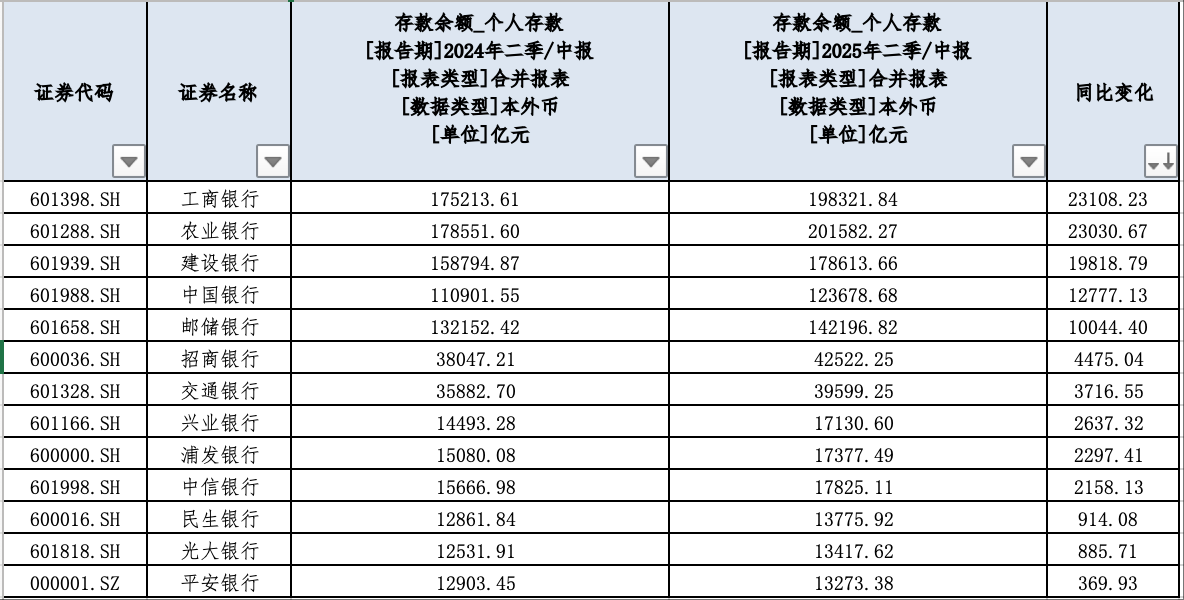
Core Viewpoint - The trend of deposit "migration" is emerging, with residents shifting their bank deposits towards funds and wealth management products, as indicated by multiple brokerage reports. Despite an increase in total deposits, there are signs of funds flowing into the wealth management market, leading to significant growth in wealth management income for several banks [2][3][4]. Group 1: Deposit Trends - In the first half of the year, the total deposit balance of 13 major commercial banks reached 187.4 trillion yuan, an increase of 13.78 trillion yuan year-on-year, with personal deposits totaling 112.07 trillion yuan, up 11.9 trillion yuan year-on-year [3]. - The trend of deposit regularization continues, with the proportion of time deposits among these banks at approximately 59.7%, an increase from 58.48% in the previous year [8][9]. - However, in July, new deposits from households decreased by 1.1 trillion yuan, indicating a potential shift in deposit behavior [4]. Group 2: Wealth Management Growth - The wealth management business of banks is expanding, with significant growth in income from wealth management services. For example, Agricultural Bank's agency business income grew by 62.3% in the first half of the year [4][5]. - The total scale of bank wealth management products reached 30.67 trillion yuan by the end of June, with an estimated increase to 32.67 trillion yuan by the end of July [4][10]. Group 3: Cost of Deposits - The average cost of deposits for the 13 banks was 1.61% in the first half of 2025, a decrease of 34 basis points compared to the same period in 2024 [10]. - The decline in deposit rates is expected to improve the cost of liabilities for banks, with projections indicating a reduction in costs for various types of banks in the coming years [10][11]. Group 4: Net Interest Margin - The net interest margin for commercial banks continued to narrow, reaching 1.42% in the second quarter of 2025, reflecting ongoing pressure on banks' profitability [12][13]. - Most banks reported a decline in net interest margins, with the average margin for the 13 banks at 1.5%, down 12 basis points year-on-year [13][15].







13家银行个人存款同比增11.9万亿
第一财经· 2025-09-01 00:46
2025.09. 01 第一财经还注意到,上半年存款定期化趋势依然存在。但业内认为,随着存款利率持续走低,加上定 存集中到期重定价,银行负债端成本有望较大幅度改善。Choice数据显示,今年上半年,上述13家 银行的存款平均成本率为1.61%,较2024年上半年下降34BP(基点)。 尽管如此,多数银行净息差仍存在压力。根据国家金融监督管理总局数据,2025年第二季度商业银 行净息差环比继续收窄,已降至1.42%。近期中期业绩发布会上,多家大行提及,主要是受LPR(贷 款市场报价利率)下调、存量房贷利率调整等因素影响。 银行存款是否"分流"? 中国银河证券研究院在研报中表示,存款搬家是居民将银行存款转移到其他资产的过程,因此一要看 到存款下降,二要看到存款流向其他资产。 今年上半年,国内大行的存款是否出现下降?在财报中,并未有明显信号。 本文字数:3300,阅读时长大约5.5分钟 作者 | 第一财经 王方然 近期存款"搬家"声浪渐起,多份券商研报称,居民存款正持续向基金、理财等资管产品转移。 从最新财报来看,今年上半年,大行负债端仍"按兵不动",13家主要商业银行个人存款余额合计为 112.07万亿元,同比增 ...

破局低利率周期,招商银行的应对之道
经济观察报· 2025-09-01 00:30
Core Viewpoint - The low interest rate environment is significantly impacting the banking industry in China, leading to a potential restructuring of the competitive landscape. China Merchants Bank (CMB) is taking various strategic measures to navigate these challenges, including accelerating internationalization, enhancing comprehensive services, leveraging AI for smart banking, and improving management and risk control [1][2]. Group 1: Impact of Low Interest Rates - The one-year and five-year Loan Prime Rates (LPR) in China have been cumulatively reduced by 70 basis points and 105 basis points from 2022 to 2024, respectively [2]. - As a result, the net interest margin for the banking sector has declined to 1.42% in Q2 of this year, putting pressure on revenue and profit growth, as net interest income accounts for over 70% of bank revenues [2]. - The low interest rate scenario is described as the biggest "gray rhino" for the Chinese banking industry, with historical precedents from Europe, the US, Japan, and Taiwan indicating that prolonged low rates can lead to significant operational difficulties for banks [2]. Group 2: Internationalization Strategy - CMB is accelerating its internationalization to adapt to the growing demand for financial services as Chinese enterprises expand overseas. The bank aims to diversify its revenue sources beyond the low-interest domestic market [5][6]. - CMB has established a global presence with branches in major financial centers such as Hong Kong, Singapore, New York, and London, and is leveraging these platforms to enhance its multi-currency operations [6]. - The bank's international business has shown significant growth, with total assets and operating income from its Hong Kong institutions increasing by 9.49% and 25.28%, respectively, in the first half of 2025 [6]. Group 3: Comprehensive Business Development - CMB has been expanding its financial licenses, recently obtaining a Financial Asset Investment Company (AIC) license, which enhances its comprehensive business model [12][13]. - The bank's subsidiaries are performing well, with total assets of major subsidiaries growing by 9% year-on-year, indicating an upward trend in its overall competitive capability [12]. - CMB is focusing on providing integrated services across various business lines to enhance customer loyalty and achieve diversified revenue streams [13]. Group 4: Differentiated Competitive Strategy - CMB emphasizes differentiation in a highly competitive banking environment, aiming to create a unique value proposition through innovation and specialized services [15]. - The bank's retail customer base has reached 216 million, with retail assets under management surpassing 16 trillion yuan, reflecting its strong performance in retail banking [15][16]. - CMB is also investing in key regional branches to enhance its presence in economically vibrant areas, which is expected to drive further growth [17]. Group 5: AI and Digital Transformation - CMB is committed to becoming a smart bank by leveraging AI technologies to enhance service delivery and operational efficiency [19][20]. - The bank has developed a comprehensive AI technology framework, with 184 application scenarios across various functions, resulting in significant labor hour savings [19][21]. - CMB's historical focus on technology adoption positions it well to capitalize on the ongoing AI competition in the banking sector [20]. Group 6: Management and Cost Control - In response to the low interest rate environment, CMB is shifting towards more refined management practices, emphasizing cost control and operational efficiency [22][24]. - The bank has implemented strict cost management measures, resulting in a decrease in business and management expenses over the past two years [22]. - CMB maintains a strong focus on risk management, with a non-performing loan ratio of 0.93% and a provision coverage ratio of 410.93%, indicating robust risk management capabilities [24].

招商银行(600036):非息降幅收窄 营收业绩环比改善
Xin Lang Cai Jing· 2025-09-01 00:29
Core Viewpoint - The company reported a slight decline in revenue for the first half of 2025, but net profit showed a modest increase, indicating resilience in its financial performance despite challenging market conditions [1] Financial Performance - The company achieved a revenue of 169.97 billion yuan in 1H25, a year-on-year decrease of 1.7%, with the decline narrowing by 1.4 percentage points compared to 1Q25 [1] - The net profit attributable to shareholders was 74.93 billion yuan, reflecting a year-on-year increase of 0.3%, with growth accelerating by 2.3 percentage points from 1Q25 [1] - The net interest margin stood at 1.63%, down 12 basis points year-on-year, but the decline was less severe than the 17 basis points drop in 2024 [1] Income Sources - Net interest income grew by 1.6% year-on-year to 106.09 billion yuan, supported by volume despite a slight drag from net interest margin [2] - Non-interest income saw a reduced decline, with net commission and fee income at 37.6 billion yuan, down 1.9% year-on-year, an improvement from the 2.5% decline in 1Q25 [2] - Investment income increased by 12.3% year-on-year to 21.89 billion yuan, contributing to a narrowing of the decline in other non-interest income [2] Loan Growth and Quality - The loan balance reached 7.1166 trillion yuan at the end of 1H25, a year-on-year increase of 5.5%, slightly lower than the 5.8% growth at the end of 2024 [3] - Corporate loans grew by 11.5% to 3.0897 trillion yuan, with manufacturing loans increasing by 18.4%, while real estate loans continued to decline by 8.3% [3] - Retail loans increased by 3.9% to 3.6782 trillion yuan, with a slowdown attributed to external factors affecting consumer leverage [3] Cost of Liabilities and Asset Quality - The net interest margin was 1.88%, down 12 basis points year-on-year, but the decline was less than the previous year's [4] - The cost of interest-bearing liabilities decreased by 37 basis points to 1.35%, reflecting effective management of funding costs [4] - The non-performing loan ratio was 0.93% at the end of 1H25, stable compared to 1Q25, with corporate non-performing loans improving while retail non-performing loans showed slight increases [4] Investment Outlook - The company is expected to continue benefiting from its wealth management strategy, with strong growth in retail assets under management, suggesting potential for sustained performance improvement as the economy recovers [5]
上海多家银行房贷利率细则落地 新增房贷利率不再区分首套、二套
Mei Ri Jing Ji Xin Wen· 2025-09-01 00:25
Core Viewpoint - The introduction of the "825 New Policy" in Shanghai has led to multiple banks adjusting their commercial personal housing loan interest rate pricing mechanisms, eliminating the distinction between first and second homes, allowing banks to set rates based on market conditions and individual risk profiles [1][2]. Group 1: Policy Changes - Several banks in Shanghai have announced adjustments to their commercial personal housing loan interest rate pricing mechanisms, following the issuance of a notification by six departments in Shanghai [1]. - The new pricing mechanism allows banks to determine specific interest rates based on the Shanghai market interest rate pricing self-discipline mechanism, as well as their operational conditions and customer risk profiles [2]. Group 2: Implementation Details - Different banks have varying procedures for borrowers to apply for interest rate adjustments, including in-person applications, phone notifications, and mobile banking options [3]. - The effective dates for these adjustments vary, with some banks implementing changes as early as September 1, while others may start on September 5 [3]. Group 3: Interest Rate Adjustments - For existing second-home loans, if the current interest rate exceeds the average new loan interest rate by 30 basis points, borrowers can apply for a rate adjustment [2]. - The minimum interest rate for first-time home loans is currently 3.05%, while some banks are offering a minimum of 3.09% for new second-home loans [3]. Group 4: Recommendations - It is suggested that relevant departments enhance their communication regarding the new policies to clarify the specifics of loan interest rates and ensure effective implementation to stimulate housing demand [4].
超17家银行将派发2375亿“红包”,国有大行成绝对主力
Bei Jing Shang Bao· 2025-08-31 14:05
Core Viewpoint - The mid-term profit distribution plans of listed banks in A-shares for 2025 show a significant increase in total dividends, reaching 237.54 billion yuan, with state-owned banks being the primary contributors [2][3][4]. Group 1: Dividend Distribution Overview - Among 42 listed banks, 17 have announced their mid-term dividend plans for 2025, with a total dividend amount of 237.54 billion yuan [2][3]. - The six major state-owned banks contributed 204.66 billion yuan, accounting for 86% of the total dividends announced by the 17 banks [3][4]. - Industrial and Commercial Bank of China leads with a dividend of 50.40 billion yuan, followed by China Construction Bank and Agricultural Bank of China with 48.61 billion yuan and 41.82 billion yuan respectively [3][4]. Group 2: Factors Influencing Dividend Decisions - The ability of state-owned banks to distribute dividends is supported by their strong capital strength, stable profitability, and ample cash flow, allowing them to maintain high dividend payouts [4][9]. - The decision to distribute dividends is influenced by a balance of capital adequacy, business expansion needs, regulatory requirements, and shareholder return expectations [4][9][10]. - Some banks, such as Zhengzhou Bank and Qingdao Rural Commercial Bank, have explicitly stated they will not distribute dividends for the first half of 2025, citing performance pressures and capital replenishment needs [8][9]. Group 3: Trends in Dividend Distribution - The trend of increasing mid-term and quarterly dividends among listed banks has been noted since the introduction of the new "National Nine Articles" policy, which encourages multiple dividend distributions within a year [2][4]. - Several joint-stock banks, including CITIC Bank and Minsheng Bank, have announced their mid-term dividend plans, with CITIC Bank aiming for a dividend payout ratio of 30.7% [4][6]. - The distribution landscape shows a clear differentiation, with some banks actively pursuing dividends while others pause due to various operational challenges [8][9].


13家银行个人存款同比仍增11.9万亿,定期化趋势未显著缓解
Di Yi Cai Jing· 2025-08-31 12:40
Core Viewpoint - The continuous decline in deposit rates, coupled with the concentration of fixed deposits maturing, is expected to significantly improve the cost of liabilities for banks [1][8]. Group 1: Deposit Trends - Recent reports indicate a trend of residents moving deposits from banks to other financial products such as funds and wealth management products [2][3]. - As of mid-2025, the total personal deposit balance of 13 major commercial banks reached 112.07 trillion yuan, an increase of 11.9 trillion yuan year-on-year [4][5]. - The average cost of deposits for these banks in the first half of 2025 was 1.61%, a decrease of 34 basis points compared to the same period in 2024 [12]. Group 2: Wealth Management Business Growth - The shift of deposits to wealth management products has led to significant growth in banks' wealth management income, with Agricultural Bank's wealth management income increasing by 62.3% [6]. - The total scale of bank wealth management products reached 30.67 trillion yuan by the end of June, with an estimated increase of about 2 trillion yuan by the end of July [6]. Group 3: Interest Margin and Cost of Liabilities - Despite the reduction in deposit costs, banks are still facing pressure on net interest margins, which have decreased to 1.42% as of the second quarter of 2025 [15][16]. - The average net interest margin for the 13 banks was 1.5%, down from 1.62% year-on-year [15]. - The decline in net interest margins is attributed to factors such as the reduction in the Loan Prime Rate (LPR) and adjustments in existing mortgage rates [17][18]. Group 4: Future Outlook - Analysts predict that the concentration of maturing fixed deposits will lead to a significant reduction in the cost of liabilities for banks in the coming years, with expected decreases of 17 to 24 basis points across different types of banks [11]. - The trend of increasing fixed deposits is expected to continue, with the proportion of fixed deposits among total deposits rising to approximately 59.7% in the first half of 2025 [9][10].