PDH(600048)

Search documents
房企座次再洗牌,万科下滑中旅投资成“黑马”
第一财经· 2026-02-01 05:21
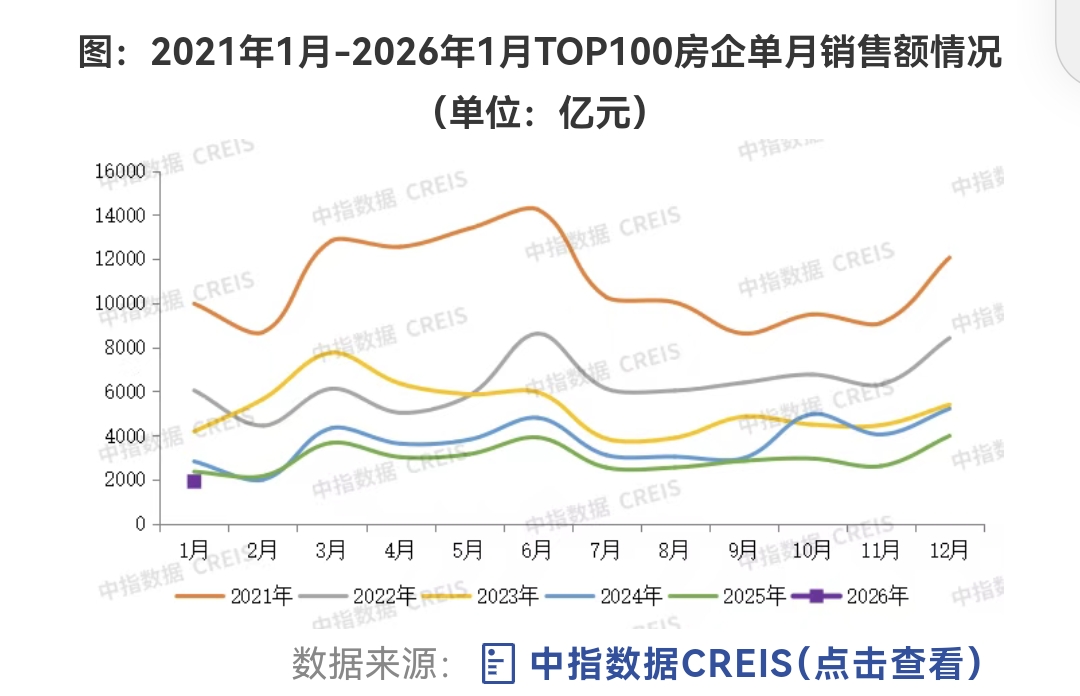
Core Insights - In January 2026, the total sales of the top 100 real estate companies amounted to 190.52 billion yuan, a year-on-year decrease of 18.9% [3] - The equity sales for the same group reached 132.14 billion yuan [3] - The top ten companies by sales include Poly Development, China Overseas, China Resources, Greentown China, China Travel Investment, China Merchants Shekou, China Jinmao, Jianfa Real Estate, Vanke, and Binjiang Group, with only Poly, China Overseas, and China Resources exceeding 10 billion yuan in sales for the month [3] Sales Performance - The average sales for the top 10 companies was 9.33 billion yuan, down 11.6% year-on-year, while the average for companies ranked 11-30 was 2.6 billion yuan, also showing a decline [4] - The ranking of companies has shifted significantly compared to the previous year, with Vanke dropping from 5th to 9th place, while China Travel Investment emerged as a "dark horse" in 5th place [3][4] Market Trends - The decline in sales is attributed to the high base from January of the previous year when the market was more active following the September 2024 policy changes [6] - The industry is undergoing an adjustment phase, with a decrease in the number of companies achieving over 10 billion yuan in sales, while those achieving over 5 billion yuan have increased, indicating a shift from "scale competition" to "quality competition" [6] - In January 2026, 32 companies among the top 100 saw year-on-year sales growth, with 10 companies experiencing growth exceeding 100% [6] Real Estate Market Dynamics - The new housing market showed weak performance in January, with approximately 8.1 million square meters of new residential sales in 50 key cities, while the second-hand housing market saw a notable increase, with transaction volumes rising by 33% year-on-year [7][8] - The second-hand market's recovery is contributing to stabilizing market expectations, with some cities experiencing a reduction in listing volumes [8] Policy and Future Outlook - The central government has been signaling a focus on stabilizing market expectations, with recent policy measures including interest rate cuts and adjustments to down payment ratios for commercial properties [9] - The upcoming Spring Festival may lead to increased marketing efforts from real estate companies, and the introduction of quality projects could maintain a certain level of market activity in core cities [9] - As of the end of 2025, 21 distressed real estate companies have made progress in debt restructuring, but the challenge remains in converting financial relief into sustainable operational capacity [9]






百强房企1月卖房“成绩单”出炉!
Shen Zhen Shang Bao· 2026-02-01 03:22
Core Viewpoint - The sales performance of the top 100 real estate companies in January shows a total sales amount of 190.5 billion yuan, reflecting an 18.9% year-on-year decline, consistent with the overall decline observed in the previous year [1] Group 1: Sales Performance - In January, the top three companies by sales were Poly Developments, China Overseas Land & Investment, and China Resources Land, each exceeding 10 billion yuan in sales [1] - The equity sales amount for the top 100 companies was 132.14 billion yuan, with an equity sales area of 6.548 million square meters [1] - The average sales amount for the top 10 companies was 9.33 billion yuan, down 11.6% year-on-year; for companies ranked 11-30, the average was 2.6 billion yuan, down 25.6%; for 31-50, it was 1.03 billion yuan, down 21.0%; and for 51-100, it was 490 million yuan, down 26.7% [1] Group 2: Market Trends - The number of companies achieving over 10 billion yuan in sales decreased by 2 compared to the previous year, while the number of companies achieving over 5 billion yuan increased by 2, indicating a shift towards healthier and more sustainable development in the industry [2] - The focus of competition is shifting from "scale racing" to "quality racing," which is expected to concentrate resources on outstanding companies, thereby reducing systemic risks and enhancing the industry's resilience [2] - Various cities have released "14th Five-Year" planning suggestions, emphasizing the need for a new development model in real estate, increasing the supply of affordable housing, and improving safety management systems for housing [2] Group 3: Policy Environment - The central government has repeatedly signaled the importance of "stabilizing expectations" for the real estate market, emphasizing the need for effective expectation management [2] - The People's Bank of China has lowered the interest rates on structural monetary policy tools, while several provinces have reduced the down payment ratio for commercial property loans to 30% [2] - Local governments, such as Sichuan and Zhejiang, have issued approximately 10.5 billion yuan in special bonds to recover and acquire idle land [2] Group 4: Market Outlook - As the Spring Festival approaches, real estate companies are expected to increase marketing efforts, and the core city real estate market is likely to maintain a certain level of activity due to the introduction of quality projects [3] - However, market expectations remain weak, necessitating coordinated policy efforts from both the demand and supply sides to effectively reverse market sentiment [3]

房企座次再洗牌,万科下滑、中旅投资成“黑马”
Di Yi Cai Jing· 2026-01-31 15:00
Core Insights - In January 2026, the top 100 real estate companies in China reported a total sales revenue of 190.52 billion yuan, a year-on-year decrease of 18.9% [1] - The equity sales amount for the same group was 132.14 billion yuan [1] - The top ten companies by sales included Poly Developments, China Overseas Land, and China Resources Land, with only Poly, China Overseas, and China Resources exceeding 10 billion yuan in sales for the month [1] Sales Performance - The average sales revenue for the top 10 companies was 9.33 billion yuan, down 11.6% year-on-year [2] - Companies ranked 11-30 had an average sales revenue of 2.6 billion yuan, a decline of 25.6% [2] - Companies ranked 31-50 reported an average sales revenue of 1.03 billion yuan, down 21.0% [2] Market Dynamics - The decline in sales is attributed to the high base from January of the previous year when the market was more active due to policy changes [5] - The real estate industry is undergoing an adjustment, with a shift from "scale competition" to "quality competition," leading to resource concentration among stronger companies [5] - In January 2026, 32 companies among the top 100 reported year-on-year sales growth, with 10 companies experiencing growth exceeding 100% [5] Market Trends - The new housing market showed weak performance in January, while the second-hand housing market demonstrated notable growth, with transaction volumes increasing by 33% year-on-year [6] - The central government has been signaling stability in market expectations, emphasizing the importance of managing expectations to stabilize the real estate market [6] - Recent policy measures include lowering the down payment ratio for commercial property loans and adjusting monetary policy tools [6] Future Outlook - As the Chinese New Year approaches, real estate companies are expected to increase marketing efforts, which may sustain some activity in core city markets [7] - There are ongoing challenges for companies to convert financial restructuring into sustainable operational capabilities [7]

房企座次再洗牌,万科下滑中旅投资成“黑马”
Di Yi Cai Jing· 2026-01-31 14:52
Group 1 - The core viewpoint of the article highlights that the sales performance of the top 100 real estate companies in January 2026 shows a significant decline, with total sales amounting to 190.5 billion yuan, a year-on-year decrease of 18.9% [2] - The top ten real estate companies by sales in January 2026 are Poly Developments, China Overseas Land, China Resources Land, Greentown China, China Travel Investment, China Merchants Shekou, China Jinmao, Jianfa Real Estate, Vanke, and Binjiang Group, with only Poly, China Overseas, and China Resources exceeding 10 billion yuan in sales for the month [2] - The ranking of real estate companies has changed significantly compared to the same period last year, with Vanke dropping from 5th to 9th place, while China Travel Investment has emerged as a "dark horse," rising to 5th place in January 2026 [2] Group 2 - Overall, the sales scale of real estate companies continues to shrink, with all segments experiencing declines; the average sales amount for the top 10 companies was 9.33 billion yuan, down 11.6% year-on-year, while the average for companies ranked 11-30 was 2.6 billion yuan, down 25.6% [3] - The decline in sales is attributed to the high base from January of the previous year when core city markets were more active; however, the decline in January 2026 is consistent with the overall decline seen throughout the previous year [6] - Despite the overall downturn, 32 companies among the top 100 reported year-on-year sales growth in January 2026, with 10 companies experiencing growth exceeding 100%, partly due to large-scale staggered investments since 2021 [6] Group 3 - The new housing market showed a lackluster performance in January 2026, with approximately 8.1 million square meters of new residential sales in 50 key cities, while the second-hand housing market performed better, with a 16% month-on-month increase and a 33% year-on-year increase in transaction volume [6] - The second-hand housing market in several core cities is showing signs of recovery, with a narrowing decline in prices and a decrease in listings, which may help stabilize market expectations [7] - The central government has been signaling "stabilizing expectations" since the beginning of the year, with various policy measures aimed at revitalizing the real estate market, including interest rate cuts and adjustments to down payment ratios for commercial property loans [8] Group 4 - As of the end of 2025, 21 distressed real estate companies have completed debt restructuring or made significant progress in restructuring plans, indicating that more companies may achieve debt relief with policy support and their own efforts [9] - The core challenge for real estate companies will be converting the financial space gained from debt relief into sustainable operational capabilities [9]
首批商业不动产REITs上报点评:首批商业不动产REITs上报,优质商业地产迎来价值重估
Shenwan Hongyuan Securities· 2026-01-31 14:35
Investment Rating - The report maintains an "Overweight" rating for the real estate and property management sectors, indicating a positive outlook for quality commercial real estate and potential value reassessment [4][6]. Core Insights - The first batch of three commercial real estate REITs has been accepted by the CSRC, covering underlying assets such as office buildings, hotels, and outlet malls. The expected fundraising sizes are CNY 4.002 billion for Huatai Fu Shanghai Real Estate REIT, CNY 7.47 billion for CICC Vipshop REIT, and CNY 1.703 billion for Huaan Jinjiang REIT, with projected cash distribution rates of 4.50%, 4.57%, and 5.05% respectively for 2026 [2][4][5]. - The rapid advancement of commercial real estate REITs by the CSRC is expected to lead to a broader range of participants and faster approvals in the future. This contrasts with the slower progress seen in infrastructure REITs under the NDRC [4][5]. - The establishment of a multi-tiered market for commercial real estate asset securitization is anticipated to activate existing assets, mitigate risks, and assist in corporate transformation. This will provide new financing channels and enhance the visibility of asset values [4][5]. - The report highlights two significant opportunities: the reassessment of quality commercial real estate values and the strength of premium products in core cities, suggesting that further supportive policies for the real estate market are likely to emerge [4][6]. Summary by Sections REITs Overview - The first three commercial real estate REITs cover assets including office buildings and hotels, with expected fundraising sizes of CNY 40.02 billion, CNY 74.7 billion, and CNY 17.03 billion, and cash distribution rates projected at 4.50%, 4.57%, and 5.05% for 2026 respectively [4][5]. Differences Between REITs - The report outlines key differences between NDRC and CSRC REITs, including the asset ownership structure, approval processes, and types of underlying assets, indicating a shift towards including private enterprises in the CSRC REITs [4][5]. Investment Recommendations - The report recommends several companies for investment, including New Town Holdings, China Resources Land, Kerry Properties, Longfor Group, and others in the commercial real estate sector, as well as quality property management firms [4][6].




A股52家上市房企:5家预亏超百亿,12家预计盈利!
Sou Hu Cai Jing· 2026-01-31 13:15
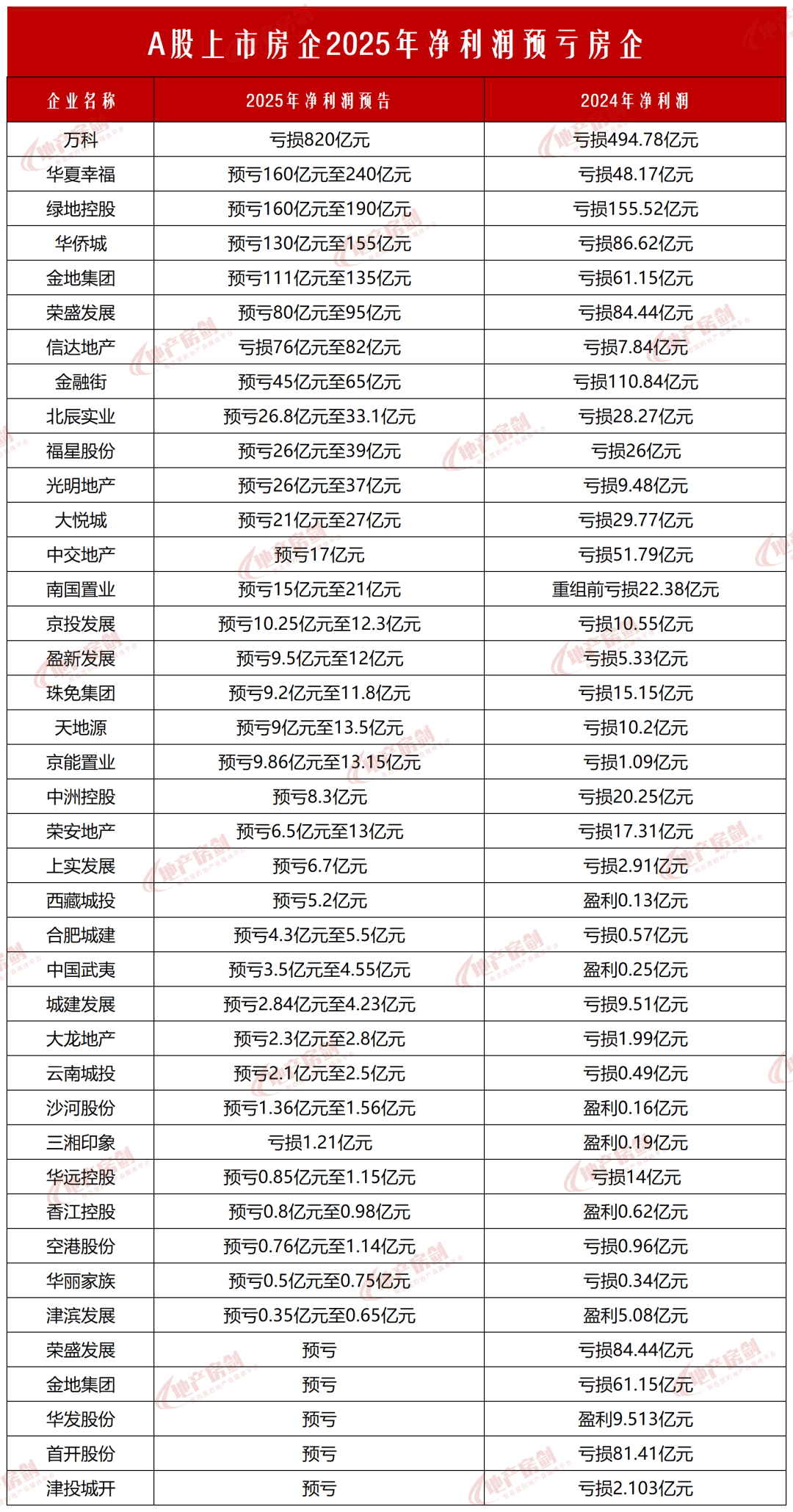
Core Viewpoint - The majority of A-share listed real estate companies are expected to report significant losses for the year 2025, indicating a challenging market environment for the industry [1][2]. Group 1: Loss Predictions - Out of 52 listed real estate companies, 40 are expected to report losses for 2025, which means over 80% of these companies are projected to be in the red [1]. - Five companies are expected to report losses exceeding 10 billion yuan, with Vanke leading at a projected loss of 820 billion yuan, followed by China Fortune Land Development, Greenland Holdings, Overseas Chinese Town, and Gemdale [2][3]. - Vanke's cumulative losses for 2024 and 2025 are projected to be nearly 1,315 billion yuan, surpassing the total profits from 2019 to 2023 [3]. Group 2: Reasons for Losses - The losses are attributed to declining property prices and significant impairment provisions that companies have had to make over the past two years [9][10]. - Many companies had previously anticipated a market recovery and began to recognize inventory impairments, but the continued market downturn has forced them to increase these provisions [10]. Group 3: Companies Reporting Profits - Twelve companies are expected to report profits, with Jinke Real Estate projected to achieve a net profit of 300 billion to 350 billion yuan, primarily due to successful restructuring [12][13]. - Poly Developments and China Merchants Shekou are also expected to report profits, albeit with significant declines compared to 2024, primarily due to impairment provisions [16][17]. Group 4: Market Dynamics - The list of loss-making companies includes a mix of private, state-owned, and central enterprises, indicating that the nature of the company does not correlate with the likelihood of losses [7]. - State-owned platform companies, which previously supported land acquisitions, are now facing increased pressure due to the ongoing market decline [8]. Group 5: Future Outlook - The upcoming annual report season in March and April 2025 will provide more detailed insights into the operational conditions of these companies [25].


首批商业不动产 REITs 申报:商业不动产 REITs,资产出表再添工具
GUOTAI HAITONG SECURITIES· 2026-01-31 12:53
Investment Rating - The report assigns an "Overweight" rating for the commercial real estate REITs sector [6]. Core Insights - The launch of commercial real estate REITs in China is expected to significantly improve corporate cash flow and performance, optimizing financial statements and guiding the industry towards a new model of development [2][6]. - The first batch of commercial real estate REITs has entered the application stage, accelerating the development process [6]. - The report highlights several recommended companies across different categories, including development, residential-commercial, property management, and cultural tourism [6]. Summary by Relevant Sections Investment Highlights - The first batch of commercial real estate REITs covers diverse asset types such as hotels, offices, and commercial complexes, enhancing the range of underlying assets [2]. - Specific REITs mentioned include: 1. Huazhong Jinjiang Closed-end Commercial Real Estate Securities Investment Fund, with a projected fundraising scale of 1.703 billion yuan and an annualized cash distribution rate forecast of 3.44% for 2025 [6]. 2. Huitianfu Shanghai Real Estate Closed-end Commercial Real Estate Securities Investment Fund, with a projected fundraising scale of 4.002 billion yuan and an annualized cash distribution rate forecast of 4.50% for 2026 [6]. 3. CICC Vipshop Closed-end Commercial Real Estate Securities Investment Fund, with a projected fundraising scale of 7.47 billion yuan and an annualized cash distribution rate forecast of 4.57% for 2026 [6]. Company Profitability Forecast - The report provides profitability forecasts for key companies, indicating expected earnings per share (EPS) and price-to-earnings (PE) ratios for 2024 to 2026, with all listed companies receiving an "Overweight" rating [8]. - Notable companies include: - Vanke A, with a projected EPS of -4.17 yuan for 2024 and a market cap of 54.22 [8]. - China Overseas Development, with a projected EPS of 1.43 yuan for 2024 and a market cap of 8.93 [8]. - Longfor Group, with a projected EPS of 1.58 yuan for 2024 and a market cap of 5.93 [8].

公募REITs周度跟踪(2026.01.26-2026.01.30):首批8单商业不动产REITs正式申报-20260131
Shenwan Hongyuan Securities· 2026-01-31 11:56
1. Report Industry Investment Rating - Not provided in the given content 2. Core Viewpoints of the Report - On January 29 - 30, 2026, 8 commercial real - estate REITs were successively declared on the Shanghai Stock Exchange, with a total planned fundraising scale of 31.48 billion yuan. The issuers are diverse, including 1 central enterprise, 2 Shanghai state - owned enterprises, 3 private enterprises, and 1 foreign - funded enterprise [4]. - As of January 30, 2026, 20 REITs have been successfully issued since 2025, with a total issuance scale of 40.3 billion yuan. This week, 10 first - issue public REITs made new progress, and the China Nuclear Clean Energy REIT will be listed on February 2, 2026 [4]. - This week, the CSI REITs Total Return Index closed at 1052.42 points, up 0.47%, outperforming the CSI 300 by 0.39 percentage points and underperforming the CSI Dividend by 1.11 percentage points. The CSI REITs Total Return Index has risen 4.22% since the beginning of the year, outperforming the CSI 300 by 2.57 percentage points and the CSI Dividend by 0.65 percentage points [4]. - In terms of liquidity, the average daily turnover rates of equity - type and franchise - type REITs this week were 0.58% and 0.44% respectively, down 14.01 and 2.61 basis points from last week. The trading volumes this week were 614 million and 146 million shares respectively, down 17.82% and 5.64% week - on - week [4]. - In terms of valuation, the yields of equity - type and franchise - type REITs according to ChinaBond valuation are 3.69% and 4.78% respectively. The transportation, warehousing and logistics, and park sectors rank among the top three [4]. 3. Summary According to the Table of Contents 3.1 Primary Market: 10 First - issue Public REITs Made New Progress - As of January 30, 2026, 79 REITs have been issued, with a total issuance scale of 203.5 billion yuan, a total market value of 228.7 billion yuan, and a circulating market value of 124.7 billion yuan. Among them, there are 56 equity - type REITs and 23 franchise - type REITs [14]. - This week, 10 first - issue REITs made new progress. 8 commercial real - estate REITs were declared to the CSRC and were accepted on the day of declaration. The China Aviation Beijing Changbao Rental Housing REIT and the CICC Torch Industrial Park REIT have been queried. There is no new progress in the expansion and fundraising this week [4][15][16]. 3.2 Secondary Market: Liquidity Declined This Week 3.2.1 Market Review: The CSI REITs Total Return Index Rose 0.47% - This week, the CSI REITs Total Return Index closed at 1052.42 points, up 0.47%, outperforming the CSI 300 by 0.39 percentage points and underperforming the CSI Dividend by 1.11 percentage points. The CSI REITs Total Return Index has risen 4.22% since the beginning of the year, outperforming the CSI 300 by 2.57 percentage points and the CSI Dividend by 0.65 percentage points [4]. - By project attribute, equity - type REITs rose 0.27% this week, and franchise - type REITs rose 0.69%. By asset type, the energy (+1.43%), environmental protection and water services (+0.87%), transportation (+0.45%), and park (+0.39%) sectors performed well [4]. 3.2.2 Liquidity: Both Turnover Rate and Trading Volume Declined - The average daily turnover rates of equity - type and franchise - type REITs this week were 0.58% and 0.44% respectively, down 14.01 and 2.61 basis points from last week. The trading volumes this week were 614 million and 146 million shares respectively, down 17.82% and 5.64% week - on - week. The data center sector was the most active [4]. 3.2.3 Valuation: The Valuation of the Affordable Housing Sector is Relatively High - According to ChinaBond valuation, the yields of equity - type and franchise - type REITs are 3.69% and 4.78% respectively. The transportation (5.92%), warehousing and logistics (5.29%), and park (4.39%) sectors rank among the top three [4]. 3.3 This Week's News and Important Announcements - This week, there were multiple important news and announcements, including Nanjing's plan to seize the opportunity of infrastructure REITs expansion, Poly Development's declaration of commercial real - estate REITs, Beijing's holding of the first provincial - level commercial real - estate REITs training session, and the declaration of the first batch of commercial real - estate REITs to the CSRC [33]. - There were also important announcements such as the listing of the China Nuclear Clean Energy REIT, the release of the operation data of the China Everbright Yuexiu Highway REIT, the change of the use of funds by the China Nanjing Transportation Highway REIT, and the expansion and fundraising plan of the Hua'an Waigaoqiao REIT [34].


多名地产大佬,转投物业公司!有专家称“如今物企偏爱地产背景或财务专长的管理者”
Mei Ri Jing Ji Xin Wen· 2026-01-30 16:47
每经记者|陈荣浩 每经编辑|段炼 陈梦妤 昔日地产板块的配套行业,正在成为房企核心人才的新赛场。 1月27日,保利物业的四条公告打破了物管行业的平静,这距离该公司上一次关键人事变动已过去三年。2023年1月,吴兰玉接任董事长,姚玉成空降出任 总经理。 而此次,因工作调整辞任总经理的姚玉成,其职位由47岁的王英男接棒,后者履历几乎贯穿地产开发全链条。 头部物企的人事变动并非行业孤例,随着地产行业的深度调整,拥有稳定现金流的物业板块反而成了"香饽饽",越来越多地产高管也开始转投物企。据 《每日经济新闻》记者(以下简称每经记者)统计,仅2026年以来,保利物业、建业新生活、弘阳服务已陆续迎来了地产背景高管。 图片来源:每经媒资库 地产大佬去物业 2026年开年,多位地产老将集体奔赴物管赛道。 1月27日,保利物业连发四条公告,官宣管理层换血,深耕地产领域15年的王英男接棒姚玉成出任总经理。 事实上,约半个月前,保利发展将运营管理中心与产品管理中心合并为不动产运营中心,集团架构调整的信号刚释放,王英男调任的消息便已传开。 中国企业资本联盟副理事长柏文喜向每经记者指出,保利发展这一架构调整,标志着集团层面已打破开发与运 ...
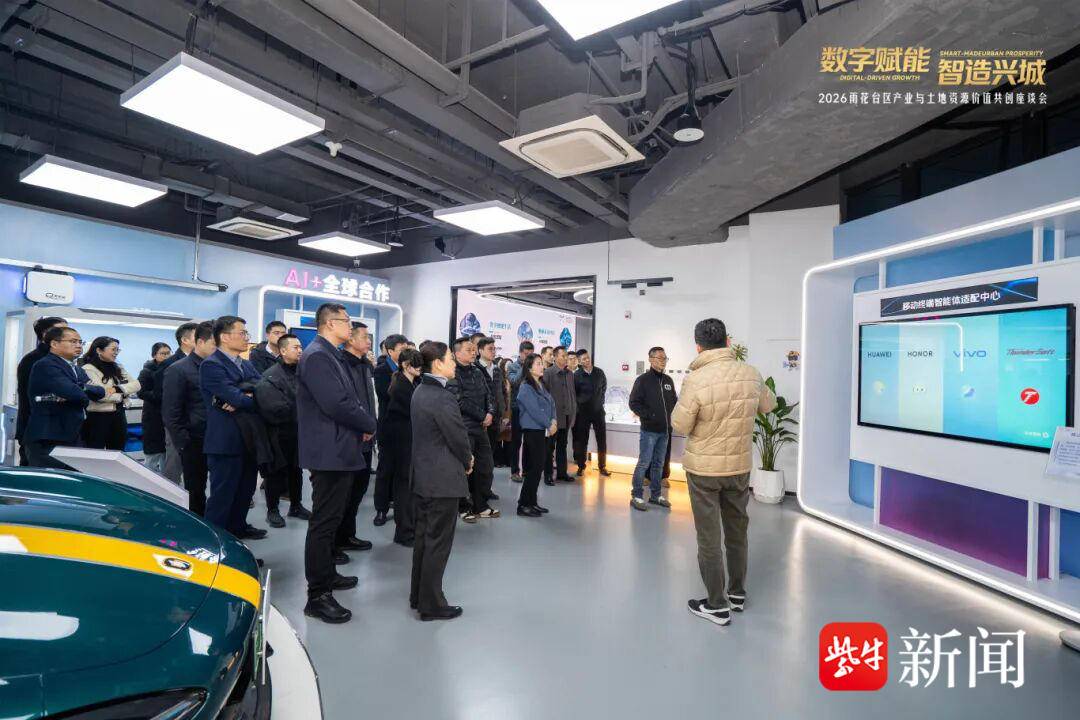
2026年南京首场土地招商推介活动在雨花台区进行
Yang Zi Wan Bao Wang· 2026-01-30 10:43
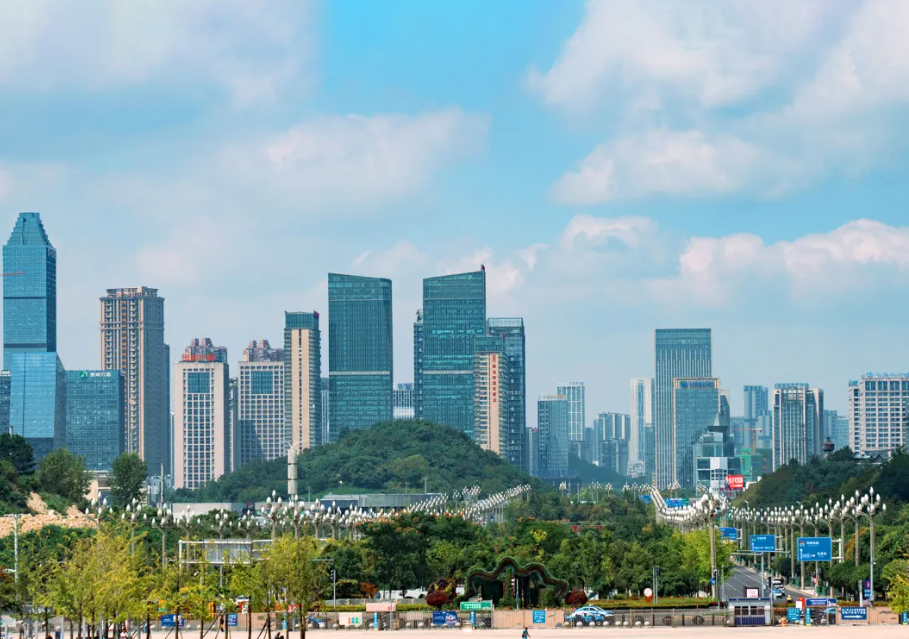
Group 1 - The event held on January 29 focused on promoting land investment opportunities in Nanjing's Yuhuatai District, emphasizing the theme "Digital Empowerment for Urban Manufacturing" [1] - Yuhuatai District aims to leverage its industrial development advantages and land resource value, showcasing multiple quality land plots and releasing a list of urban renewal opportunities [1][3] - The district has set a target for software business revenue to reach 350 billion yuan by 2025, accounting for approximately 35% of the city's total and 20% of the province's total [3] Group 2 - The event included participation from 15 major real estate companies and 10 urban renewal operators, who provided suggestions for regional development [3] - Yuhuatai District is focusing on urban development and improving living standards by offering various key land resources in priority functional areas, adhering to principles of "differentiated positioning and precise matching" [3] - The district introduced several projects for urban renewal, including the renovation of old residential areas and streets, aimed at enhancing the quality and efficiency of existing spaces [3][5] Group 3 - During the discussion, participating companies engaged in in-depth exchanges regarding land indicators, area construction, cooperation models, and approval services [5] - District leaders and relevant department heads assured that they would provide comprehensive service support and enhance the "Yuhuatai speed" for project approvals [5]