PDH(600048)

Search documents
保利、万科稳居营收千亿俱乐部,首开、滨江增速领跑
Xin Jing Bao· 2025-09-14 02:21
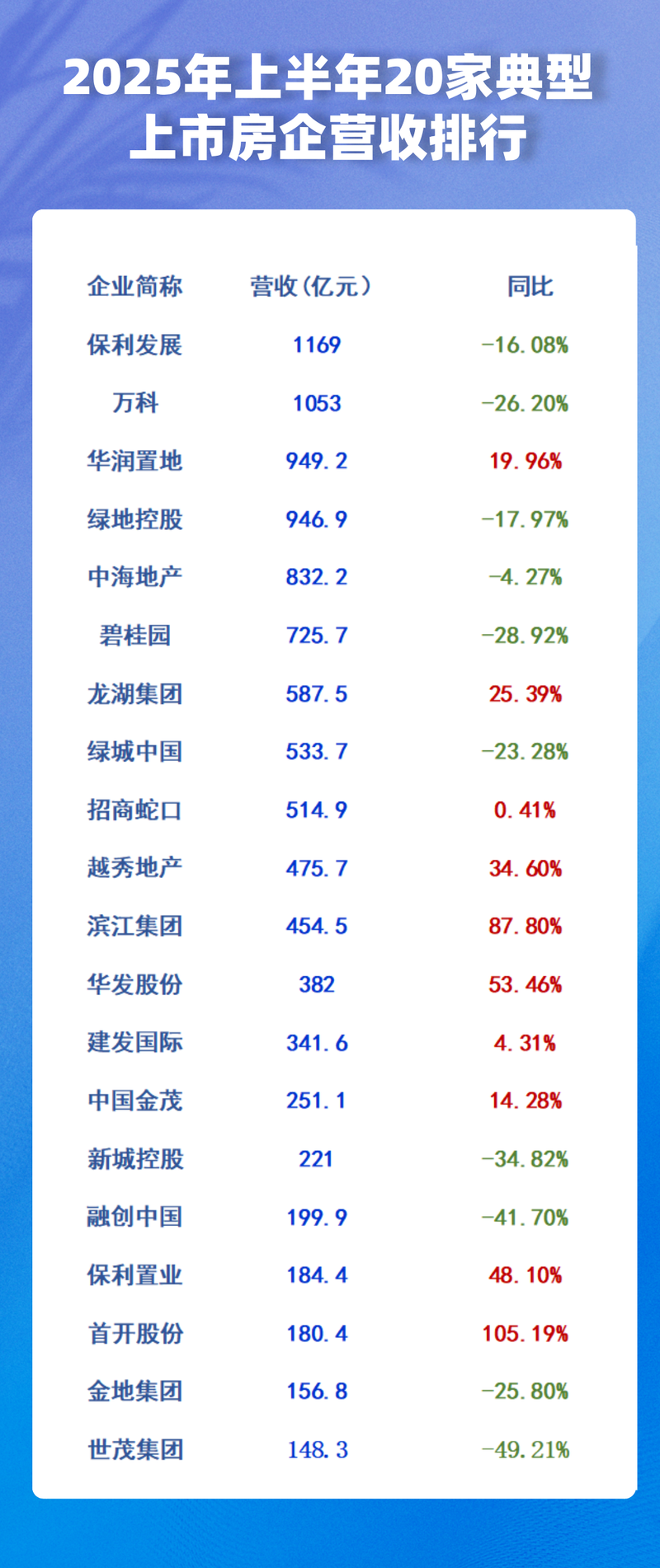
Core Viewpoint - The financial reports of listed real estate companies for the first half of 2025 reflect a significant industry transformation, moving from a "scale competition" phase to a "steady operation" phase, with ongoing deep adjustments and increasing differentiation among companies [1] Group 1: Revenue Performance - Only two companies, Poly Developments and Vanke, entered the "billion revenue club" with revenues of 116.9 billion and 105.3 billion respectively, while the average revenue growth rate for the 20 companies was only 7.72% [4][6] - Half of the listed real estate companies experienced revenue declines, with Shimao Group and Sunac China seeing declines close to 50% [1][6] - Notable revenue growth was observed in companies like Shoukai Co. and Binjiang Group, which reported growth rates exceeding 80% [1][6] Group 2: Revenue Breakdown - The first tier includes only Poly and Vanke, while the second tier consists of seven companies with revenues between 50 billion and 100 billion, including China Resources Land and Greenland Holdings [5] - The third tier includes 11 companies with revenues below 50 billion, featuring regional leaders and companies that have faced debt crises, such as Sunac China and Shimao Group [5] Group 3: Differentiation Among Companies - Significant differentiation in revenue growth rates is evident, with China Resources Land achieving nearly 20% positive growth, while Poly and Vanke saw declines of 16.08% and 26.2% respectively [6] - Companies like Binjiang Group and Yuexiu Property achieved growth rates of 87.8% and 34.6%, respectively, driven by strategic market positioning [6][7] Group 4: Challenges and Transformation - State-owned and central enterprises demonstrate stronger risk resistance, with stable revenues and lower financing costs, while private companies face significant pressures [7][8] - Many companies are shifting towards "second growth curves" through light asset transformation and non-development businesses, with China Resources Land's operational income contributing over 60% to its profits [8] - The industry is entering a new development phase characterized by declining scale and slower growth, necessitating improved financial management and debt restructuring among companies [8]





透视半年报|保利、万科稳居营收千亿俱乐部 首开、滨江增速领跑
Xin Jing Bao· 2025-09-14 01:42
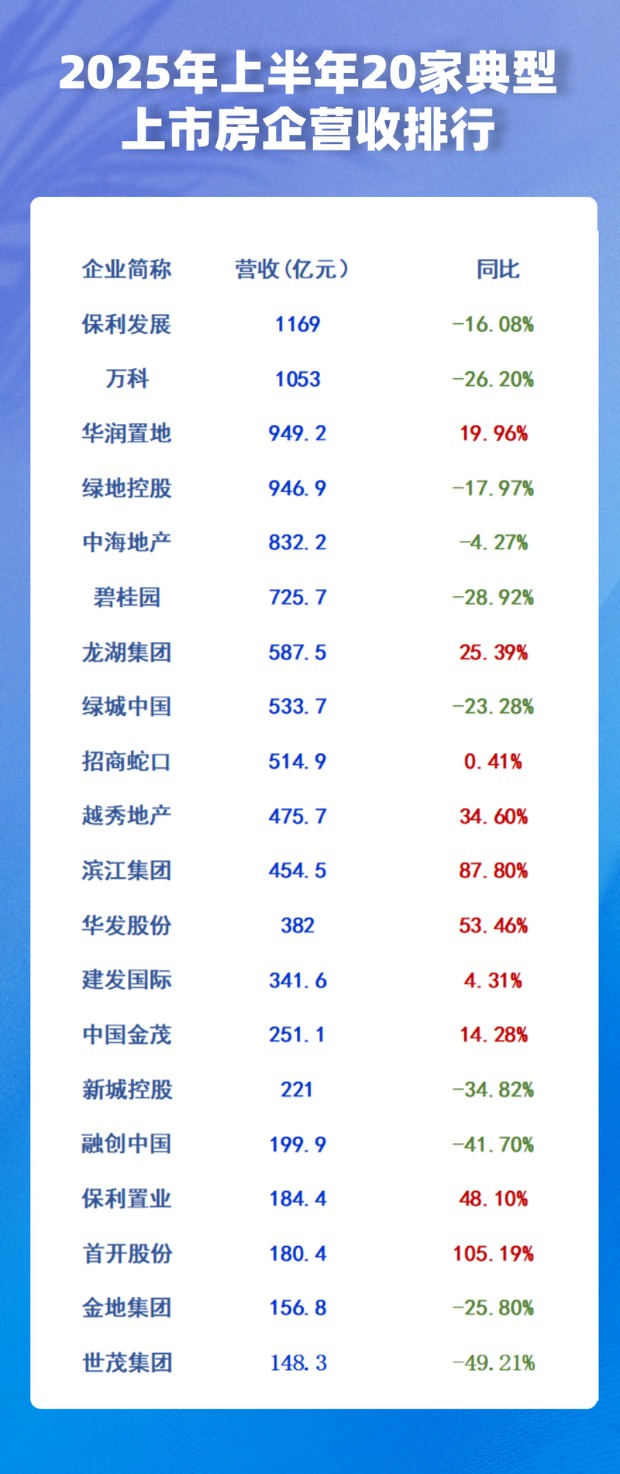
Core Viewpoint - The financial reports of listed real estate companies for the first half of 2025 reflect a significant industry transformation, moving from a "scale competition" phase to a "steady operation" phase, with ongoing deep adjustments and increasing differentiation among companies [1][7]. Group 1: Revenue Performance - Only two companies, Poly Developments and Vanke, entered the "billion revenue club" with revenues of 116.9 billion and 105.3 billion respectively, while the average revenue growth rate for the 20 companies was only 7.72% [4][6]. - Half of the listed real estate companies experienced revenue declines, with Shimao Group and Sunac China seeing declines close to 50% [1][6]. - Notable revenue growth was observed in companies like Shoukai Co. and Binjiang Group, with growth rates exceeding 80% and 87.8% respectively [1][6]. Group 2: Company Rankings - The first tier includes only two companies with revenues exceeding 100 billion, while the second tier consists of seven companies with revenues between 50 billion and 100 billion [4][5]. - The third tier includes 11 companies with revenues below 50 billion, many of which are regional leaders or have faced debt crises [5][6]. Group 3: Market Dynamics - State-owned and central enterprises demonstrated stronger risk resistance, with companies like Poly, China Resources Land, and China Overseas Land showing stable revenues and lower declines [7][8]. - Private companies, except for a few like Longfor Group and Binjiang Group, continue to face significant pressures, with many experiencing revenue declines of over 25% [7][8]. Group 4: Strategic Shifts - Many companies are focusing on "second growth curves" through light asset transformations and non-development businesses to drive revenue [8]. - China Resources Land's operational income from shopping centers, office buildings, and hotels contributed over 60% to its profits, helping it become the "profit king" [8].


透视半年报|保利、万科稳居营收千亿俱乐部,首开、滨江增速领跑
Bei Ke Cai Jing· 2025-09-14 01:39
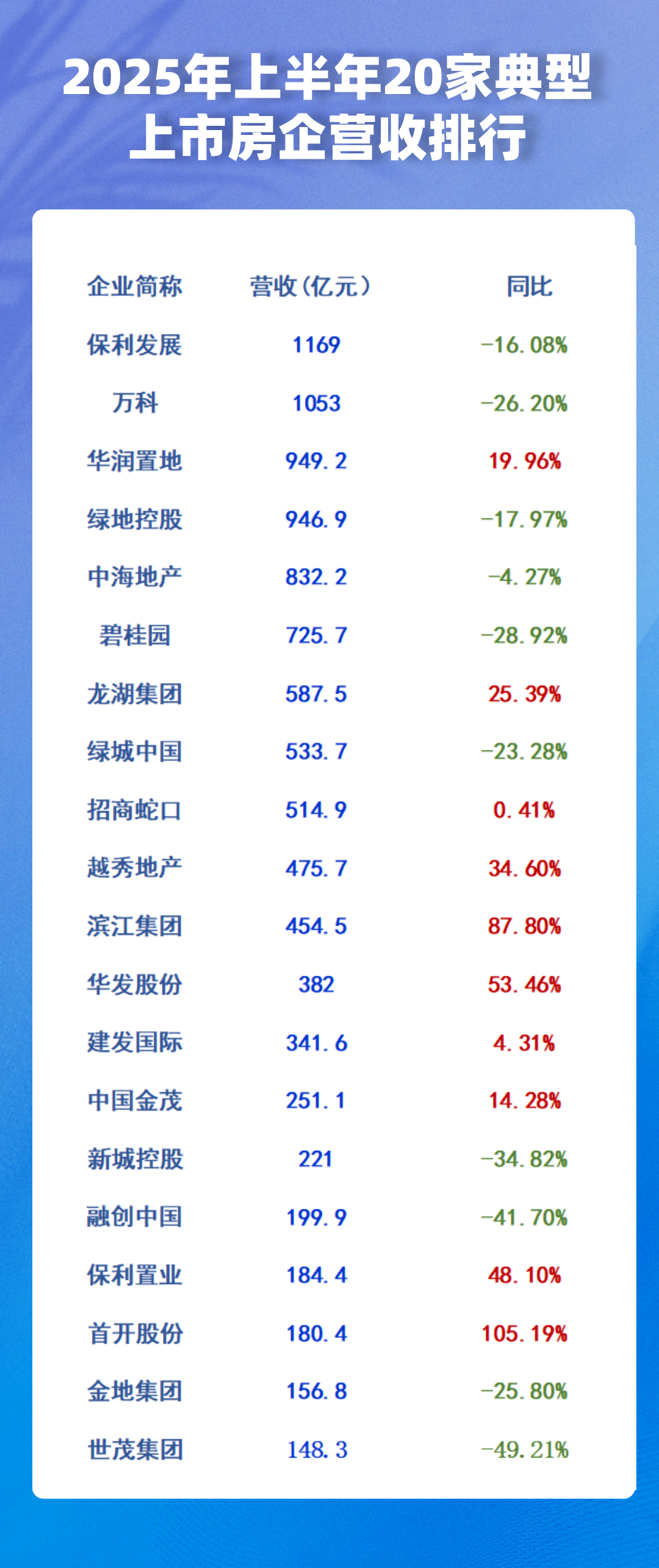
Core Viewpoint - The financial reports of listed real estate companies for the first half of 2025 reflect a new industry landscape, indicating a shift from "scale competition" to "steady operation" as the industry remains in a deep adjustment phase [1] Group 1: Revenue Performance - Only two companies, Poly Developments and Vanke, entered the "billion revenue club" with revenues of 116.9 billion and 105.3 billion respectively [4] - Half of the listed companies experienced revenue declines, with Shimao Group and Sunac China seeing declines close to 50% [1][11] - The average revenue growth rate for the 20 companies was only 7.72%, indicating weak growth overall [2][4] Group 2: Revenue Breakdown - The first tier includes only Poly and Vanke, while the second tier consists of seven companies with revenues between 50 billion and 100 billion, including China Resources Land and Greenland Holdings [5] - The third tier includes 11 companies with revenues below 50 billion, featuring regional leaders and companies that have faced debt crises, such as Sunac China and Shimao Group [6] Group 3: Divergence in Growth - Significant divergence in revenue growth is evident, with China Resources Land achieving nearly 20% growth while Poly and Vanke saw declines of 16.08% and 26.20% respectively [7] - Some mid-sized companies, like Binhai Group and Yuexiu Property, achieved growth rates exceeding 30%, with Binhai Group's growth at 87.8% and Shoukai's at 105.19% [8][10] Group 4: Challenges and Transformation - State-owned and central enterprises demonstrated stronger risk resistance, with stable revenues and lower declines compared to private companies [12][13] - Private companies, except for a few like Longfor Group and Binhai Group, continue to face significant pressures, with many experiencing revenue declines over 25% [14] - Companies are increasingly focusing on "second growth curves" through asset-light transformations and non-development businesses to drive revenue [14][16] Group 5: Future Outlook - The industry is entering a new development phase characterized by declining scale and slower speed, necessitating improved financial management and debt structure optimization [16] - The financial performance of these companies serves as a report card on their comprehensive risk resistance and future development potential, indicating a reshaped industry landscape [17]
房地产行业资金流入榜:华夏幸福、万科A等净流入资金居前
Zheng Quan Shi Bao Wang· 2025-09-12 13:05
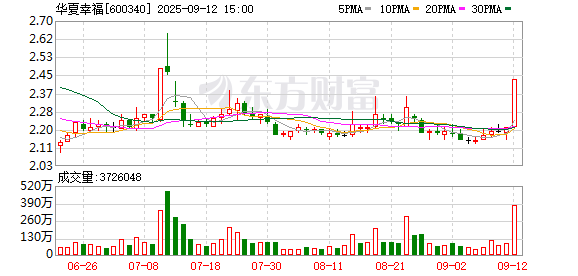
Market Overview - The Shanghai Composite Index fell by 0.12% on September 12, with 9 out of the 28 sectors rising, led by the non-ferrous metals and real estate sectors, which increased by 1.96% and 1.51% respectively [2] - The communication and comprehensive sectors experienced the largest declines, with drops of 2.13% and 1.95% respectively [2] Capital Flow Analysis - The net outflow of capital from the two markets reached 53.64 billion yuan, with 6 sectors seeing net inflows [2] - The non-ferrous metals sector had the highest net inflow of capital, totaling 2.168 billion yuan, while the construction and decoration sector saw a net inflow of 721 million yuan [2] Real Estate Sector Performance - The real estate sector rose by 1.51% with a net capital inflow of 204 million yuan, comprising 100 stocks, of which 89 rose and 11 fell [3] - Notable stocks with significant net inflows included China Fortune Land Development (3.25 billion yuan), Vanke A (2.61 billion yuan), and Shoukai Co. (1.63 billion yuan) [3] Top Gainers in Real Estate - The top gainers in the real estate sector included: - China Fortune Land Development: +9.95%, 9.57% turnover, 325.11 million yuan inflow - Vanke A: +1.61%, 3.31% turnover, 261.09 million yuan inflow - Shoukai Co.: +9.98%, 11.64% turnover, 162.70 million yuan inflow [4] Top Losers in Real Estate - The top losers in the real estate sector included: - Wantong Development: -5.95%, 20.71% turnover, -860.21 million yuan outflow - Wolong New Energy: -8.29%, 16.71% turnover, -89.14 million yuan outflow - Poly Development: -0.64%, 2.44% turnover, -80.62 million yuan outflow [5]


前8月长沙新房成交超344亿元
3 6 Ke· 2025-09-12 02:17
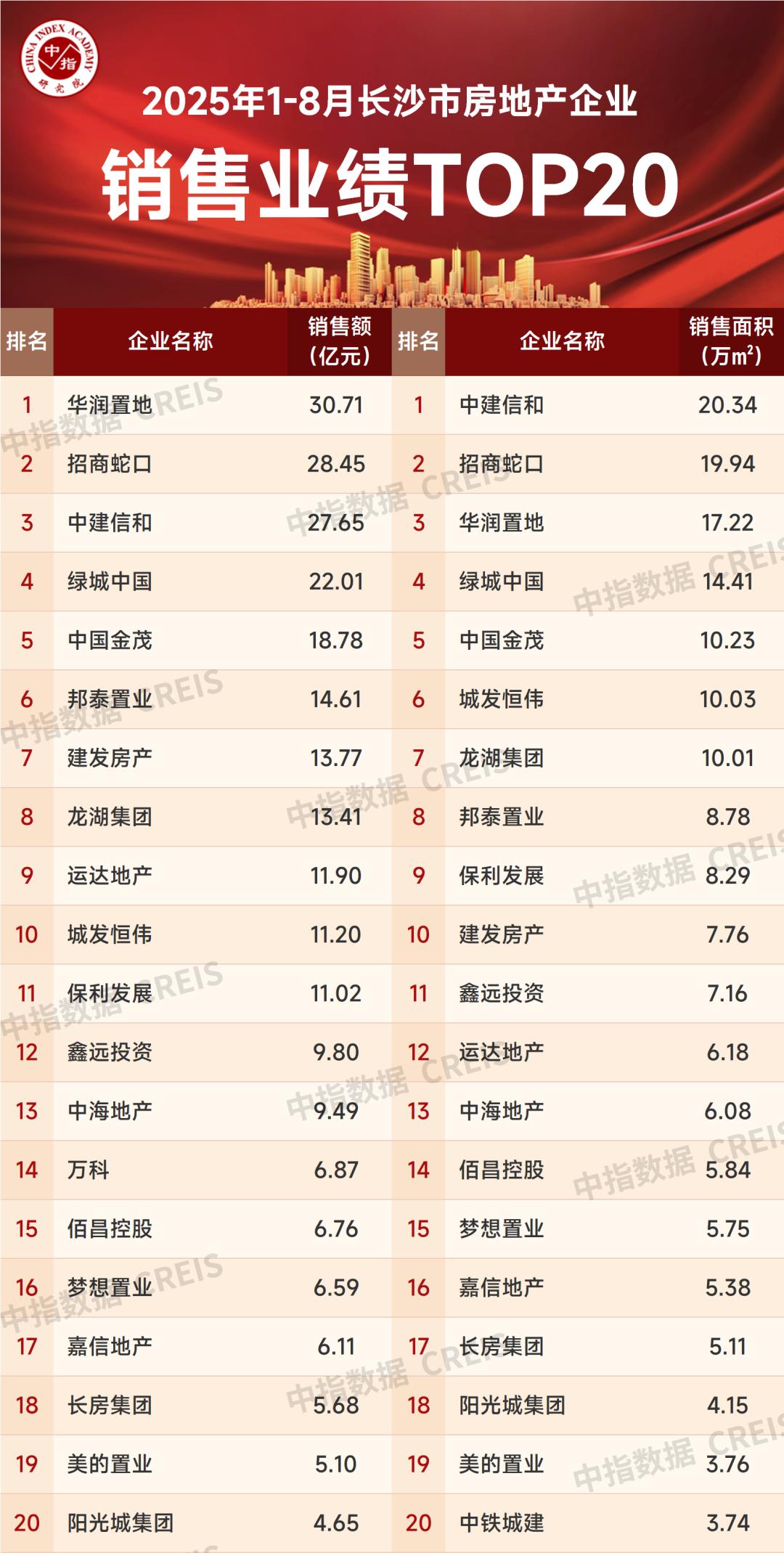
Sales Performance Overview - In the first eight months of 2025, the top 20 real estate companies in Changsha achieved a total sales revenue of 26.456 billion yuan, with a total sales area of 1.8016 million square meters [2][3] - The sales threshold for the top 10 companies was 1.12 billion yuan and 77,600 square meters, while for the top 20 it was 465 million yuan and 37,400 square meters [2] Top Companies by Sales Revenue - China Resources Land ranked first in sales revenue with 3.071 billion yuan, followed by China Merchants Shekou with 2.845 billion yuan, and China State Construction with 2.765 billion yuan [3][4] - In terms of sales area, China State Construction led with 203,400 square meters, followed by China Merchants Shekou with 199,400 square meters, and China Resources Land with 172,200 square meters [3] Project Sales Rankings - The top 10 projects in Changsha for sales revenue totaled 10.716 billion yuan, with the threshold for the top 10 set at 752 million yuan [6] - The project "Changsha Ruifu" topped the sales revenue chart with 1.943 billion yuan, followed by "Changsha Jianfa Guanyun" at 1.200 billion yuan, and "Yunda Conference Bay" at 1.077 billion yuan [6] - For sales area, "Changsha Ruifu" also led with 94,800 square meters, followed by "Zhongjian Taoli Jiu Zhang" with 79,500 square meters, and "Changsha Runfu" with 75,900 square meters [7]



房地产行业周报:深圳优化住房政策,多地公积金支持力度提升-20250911
Hua Yuan Zheng Quan· 2025-09-11 09:48
Investment Rating - The investment rating for the real estate industry is "Positive" (maintained) [5][6][57] Core Viewpoints - Since September 2024, the central government has emphasized "stabilizing the real estate market and stock market," which is crucial for boosting social expectations and facilitating domestic demand circulation [5][6] - The report suggests that high-quality residential properties may experience a development wave due to policy guidance and changes in supply-demand structure [5][6] Market Performance - The Shanghai Composite Index fell by 1.2%, the Shenzhen Component Index decreased by 0.8%, while the ChiNext Index rose by 2.4% during the week [9] - The real estate sector (Shenwan) declined by 1.5% [9] - Notable stock performances included Shoukai Co. (+32.0%) and Ningbo Fuda (+12.7%), while *ST Nanzhi fell by 22.6% [9] Data Tracking New Housing Transactions - In the week of August 30 to September 5, 2025, 42 key cities saw new housing transactions totaling 1.7 million square meters, a decrease of 15.3% week-on-week and 9.4% year-on-year [15] - For August 2025, the total new housing transactions in these cities reached 7.3 million square meters, down 4.1% month-on-month and 18.8% year-on-year [18] Second-Hand Housing Transactions - In the same week, 21 key cities recorded second-hand housing transactions of 171,000 square meters, a decrease of 9.1% week-on-week but an increase of 10.2% year-on-year [29] - For August 2025, total second-hand housing transactions in these cities were 793,000 square meters, down 7.2% month-on-month but up 0.9% year-on-year [34] Industry News - The Ministry of Housing and Urban-Rural Development held a meeting emphasizing high-level legislation to promote high-quality development in housing and urban construction [45] - Shanghai initiated a new round of adjustments to existing mortgage rates, allowing second-home buyers to apply for a rate reduction to the first-home level [45] - In Shenzhen, policies were optimized to lower purchasing thresholds and mortgage costs for residents and enterprises [45] Company Announcements - In August 2025, major real estate companies reported varying sales figures: China Overseas Development at 18.33 billion yuan (down 0.7% year-on-year), and Greentown China at 10.6 billion yuan (up 27.7% year-on-year) [48] - Poly Developments recently acquired two projects in Lanzhou and Sanya, with a total payment of 1.612 billion yuan [48]


保利发展在南京成立新公司 含房地产开发经营业务
Zheng Quan Shi Bao Wang· 2025-09-11 02:11
Core Viewpoint - A new company, Baosheng Enterprise Management (Nanjing) Co., Ltd., has been established with a registered capital of 50 million yuan, indicating expansion in the real estate and management sectors [1] Company Summary - The legal representative of the newly established company is Yan Zhiqiang [1] - The company is wholly owned by Poly Developments (600048) through indirect shareholding [1] - The business scope includes real estate development and management, non-residential real estate leasing, housing leasing, real estate consulting, catering management, and hotel management [1]
好房子专题报告系列之三:好房子的另类破局之道,引领核心城市五重共振
Shenwan Hongyuan Securities· 2025-09-10 15:20
Investment Rating - The report maintains a "Positive" rating for the real estate and property management sectors [4][5]. Core Insights - The report highlights that the broad housing demand in China has bottomed out, but the price and volume have not entered a positive cycle as expected. The real estate industry faces challenges from weakened household balance sheets and policy constraints requiring high-quality development without overall leverage [4][5][6]. - The "Good House" policy is seen as a potential breakthrough strategy that could lead to a fivefold positive resonance in core cities, gradually achieving a recovery driven by structural improvements [4][5][6]. Summary by Sections 1. Industry Status: Challenges in Real Estate Fundamentals and Policy Constraints - Broad housing demand is estimated to have bottomed out, with total transactions stabilizing around 1.4 billion square meters [15][22]. - New home sales have decreased from 1.57 billion square meters in 2021 to an estimated 0.81 billion square meters in 2024, a cumulative decline of 48%, while second-hand home sales have increased by 64% during the same period [15][22]. - The key issue in the real estate sector is not demand but purchasing power, with a trend of consumption downgrade evident in the market [22][31]. 2. Breakthrough Strategy: "Good House" Policy Leading to Fivefold Positive Resonance - The "Good House" policy aims to create new products and markets, enhancing the price system under conditions of supply scarcity and relatively abundant demand [4][6]. - The report identifies five positive resonances: policy strength of "Good House," urban renewal, housing consumption upgrade, wealth reallocation under capital controls, and stock market strength [4][6]. - Potential benefits include expected further reductions in mortgage rates and loosening of purchase restrictions, which could drive improvements in core cities [4][6]. 3. Core Cities: Hong Kong Has Reversed, Shanghai and Other Core Cities Nearing Bottom - Hong Kong's real estate market has experienced a turnaround due to four positive factors, including talent policies and stock market gains [4][6]. - Other core cities like Shanghai, Beijing, and Shenzhen are also showing signs of improvement, with Shanghai expected to be the next city to see a bottoming out [4][6]. 4. Investment Analysis Opinion: "Good House" as a Breakthrough Strategy - The report emphasizes that the "Good House" policy could lead to a structural recovery in the real estate market, benefiting quality real estate companies positioned in core cities [4][5][6]. - Recommended companies include those with strong product capabilities and undervalued recovery potential, as well as second-hand housing intermediaries and property management firms [4][5].

房地产开发板块9月10日涨0.44%,首开股份领涨,主力资金净流出12.13亿元
Zheng Xing Xing Ye Ri Bao· 2025-09-10 08:30
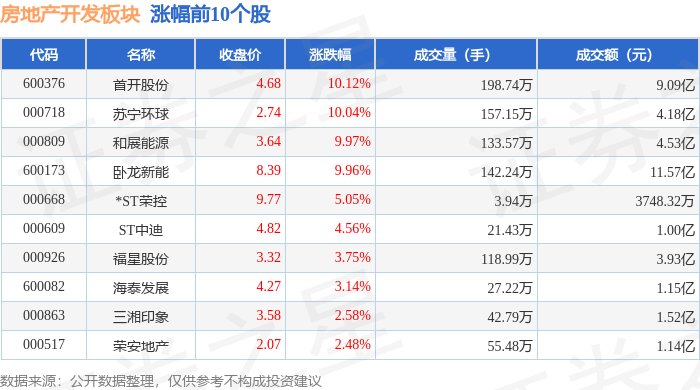
Market Performance - On September 10, the real estate development sector rose by 0.44% compared to the previous trading day, with Shouke Co. leading the gains [1] - The Shanghai Composite Index closed at 3812.22, up 0.13%, while the Shenzhen Component Index closed at 12557.68, up 0.38% [1] Top Gainers in Real Estate Sector - Shouke Co. (600376) closed at 4.68, with a gain of 10.12% and a trading volume of 1.9874 million shares, amounting to a transaction value of 909 million yuan [1] - Suning Universal (000718) closed at 2.74, up 10.04%, with a trading volume of 1.5715 million shares [1] - Hezhan Energy (000809) closed at 3.64, gaining 9.97%, with a trading volume of 1.3357 million shares [1] - Wolong New Energy (600173) closed at 8.39, up 9.96%, with a trading volume of 1.4224 million shares [1] Other Notable Stocks - ST Rongkong (000668) closed at 9.77, with a gain of 5.05% [1] - ST Zhongdi (000609) closed at 4.82, up 4.56% [1] - Fuxing Co. (000926) closed at 3.32, gaining 3.75% [1] Market Capital Flow - The real estate development sector experienced a net outflow of 1.213 billion yuan from major funds, while retail investors saw a net inflow of 1.149 billion yuan [2] - Speculative funds had a net inflow of 64.198 million yuan [2]


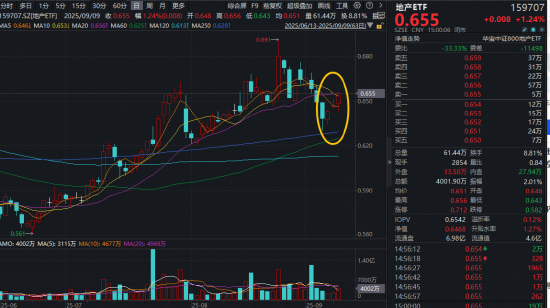
低位地产逆市补涨?全市场唯一地产ETF(159707)放量三连涨!政策暖风频吹,“金九银十”点火在即
Xin Lang Ji Jin· 2025-09-09 12:16
Group 1 - The A-share market experienced a volume contraction and a collective decline in the three major indices, while the real estate sector saw a rare surge, with the CSI 800 Real Estate Index rising over 1% against the market trend [1][3] - Major real estate stocks such as Binjiang Group and New Town Holdings saw significant gains, with Binjiang Group hitting the daily limit and New Town Holdings rising over 4% [1] - The only ETF tracking the CSI 800 Real Estate Index, ETF 159707, also rose by 1.24%, marking three consecutive days of gains, with a total trading volume of 40 million yuan and a net subscription of 8.5 million units in a single day [1][3] Group 2 - The strength of the real estate sector is attributed to recent policy adjustments in first-tier cities, including a combination of measures announced by the Shenzhen Housing and Urban-Rural Development Bureau and the People's Bank of China [3] - September is typically a period of intensive policy announcements for the real estate sector, and new supportive policies are expected to accelerate, coinciding with the traditional peak sales season of "Golden September and Silver October" [3] - Analysts predict a rebound in real estate transaction volumes in the fourth quarter, supported by the recent optimization of purchase restrictions in major cities, and suggest that the current low valuations in the real estate sector present a buying opportunity [3][5] Group 3 - The CSI 800 Real Estate Index currently has a price-to-book (PB) ratio of only 0.75, indicating a significant undervaluation at the 17th percentile over the past decade, suggesting substantial room for recovery [3][5] - Leading real estate companies, particularly state-owned enterprises and high-quality firms, are expected to demonstrate resilience due to their strong land reserves in core cities, which positions them for a quicker recovery in sales and profitability [5] - The ETF 159707, which tracks the CSI 800 Real Estate Index, includes 13 top-tier real estate companies, with over 90% of its weight concentrated in the top ten holdings, highlighting its focus on leading firms in the industry [5]