China Unicom(600050)

Search documents
通信服务板块9月15日跌1.16%,三维通信领跌,主力资金净流出9.87亿元
Zheng Xing Xing Ye Ri Bao· 2025-09-15 08:49
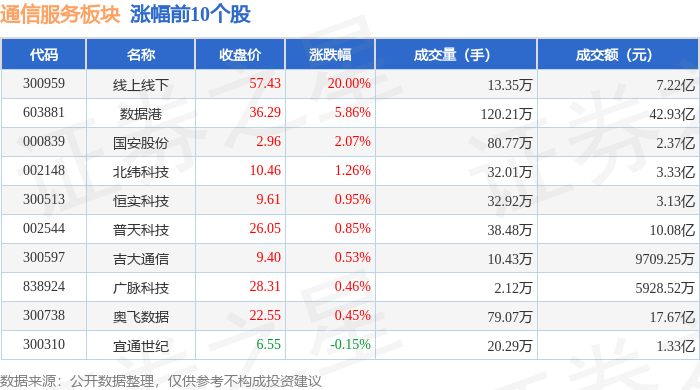
Market Overview - On September 15, the communication services sector declined by 1.16%, with Sanwei Communication leading the drop [1] - The Shanghai Composite Index closed at 3860.5, down 0.26%, while the Shenzhen Component Index closed at 13005.77, up 0.63% [1] Stock Performance - Notable gainers included: - Online Offline (300959) with a closing price of 57.43, up 20.00% [1] - Dataport (603881) with a closing price of 36.29, up 5.86% [1] - Significant decliners included: - Sanwei Communication (002115) with a closing price of 12.76, down 5.69% [2] - Yuandao Communication (301139) with a closing price of 22.28, down 5.15% [2] Trading Volume and Capital Flow - The communication services sector experienced a net outflow of 9.87 billion yuan from institutional investors, while retail investors saw a net inflow of 11.34 billion yuan [2][3] - The trading volume for Online Offline was 133,500 hands, with a transaction amount of 722 million yuan [1] Individual Stock Capital Flow - Dataport (603881) had a net inflow of 44.316 million yuan from institutional investors, while it faced a net outflow of 24.216 million yuan from speculative funds [3] - Online Offline (300959) saw a net inflow of 68.2855 million yuan from institutional investors, but a net outflow of 55.196 million yuan from speculative funds [3]


中国联通跌2.11%,成交额21.70亿元,主力资金净流出3.05亿元
Xin Lang Cai Jing· 2025-09-15 06:45
Core Viewpoint - China Unicom's stock price has experienced fluctuations, with a recent decline of 2.11% and a year-to-date increase of 5.95% [1] Financial Performance - For the first half of 2025, China Unicom reported revenue of 200.20 billion yuan, a year-on-year growth of 1.45%, and a net profit attributable to shareholders of 6.35 billion yuan, up 5.12% year-on-year [3] - The company has distributed a total of 35.54 billion yuan in dividends since its A-share listing, with 12.43 billion yuan distributed in the last three years [4] Stock Market Activity - As of September 15, China Unicom's stock was trading at 5.56 yuan per share, with a market capitalization of 173.83 billion yuan [1] - The stock saw a net outflow of 305 million yuan in principal funds, with significant selling pressure observed [1] Business Strategy - China Unicom has repositioned itself to focus on digital economy initiatives, emphasizing "big connectivity, big computing, big data, big applications, and big security" as its core responsibilities [2] - The company aims to enhance customer value and integrate into the new development landscape through a comprehensive transformation [2] Shareholder Information - As of June 30, 2025, China Unicom had 556,900 shareholders, with a decrease of 6.02% from the previous period [3] - Major shareholders include Hong Kong Central Clearing Limited and various ETFs, indicating a diversified institutional ownership [4]
Oracle云业务发展强劲,英伟达发布Rubin CPX GPU | 投研报告
Zhong Guo Neng Yuan Wang· 2025-09-15 02:06
Core Insights - Oracle reported strong performance in its cloud business with a backlog of $455 billion in remaining performance obligations (RPO), an increase of $317 billion from the end of last year, representing a year-over-year growth of 359% [2][4] - The growth in orders is primarily driven by data center-related orders from clients such as OpenAI, xAI, Meta, and NVIDIA [2][4] - For FY2026, Oracle's cloud infrastructure IaaS revenue is expected to grow by 77% to reach $18 billion, with projections for the following four years being $32 billion, $73 billion, $114 billion, and $144 billion respectively [2][4] Industry Developments - NVIDIA launched the Rubin CPX GPU, designed to enhance inference performance and efficiency for contexts exceeding 1 million tokens, featuring 128GB GDDR7 memory and AI computing power of 30 PFLOPS [3] - Lixun introduced Co-packaged Copper (CPC) technology at the 2025 Shenzhen Optical Expo, aimed at addressing high-performance, low-cost interconnect challenges in the AI and computing era [3] - Taiwanese AI server ODM manufacturers reported a monthly revenue of NT$121.39 billion in August, a year-over-year increase of 16.71%, with Wistron achieving a remarkable 198.14% increase [4] - China Unicom received a satellite communication business operating license, accelerating the development of satellite internet infrastructure in China [4] - The communication index rose by 3.00% this week, with the Shanghai and Shenzhen 300 index increasing by 1.38%, indicating a relative performance gain of 1.62% [4] Investment Recommendations - The global cloud service provider (CSP) AI arms race is accelerating, with new product launches from companies like Apple and Huawei, and events such as the Open Data Center Conference and META Developer Conference [5] - Continued focus on optical devices and modules, communication equipment, and liquid cooling technologies is recommended [5] - The three major telecom operators remain important assets for dividend allocation, with stable operations and increasing dividend payout ratios [5]






苹果iPhone Air掀手机“无卡化”浪潮? 业内人士:预计影响不大
Mei Ri Jing Ji Xin Wen· 2025-09-15 00:27
Core Viewpoint - Apple's launch of the iPhone Air, which only supports eSIM cards, is seen as a potential catalyst for the "cardless" mobile phone trend in China, although its impact may be limited due to market dynamics and competition from existing models [1][5][6]. Industry Summary - The three major telecom operators in China have indicated readiness to support eSIM technology but are awaiting regulatory approval to proceed with eSIM card services [1][4]. - The iPhone Air's introduction is viewed as a significant opportunity to promote eSIM adoption in China, despite the model's delayed release in the market [4]. - Industry analysts express skepticism about the iPhone Air's appeal, noting that it lacks certain features compared to other models in the iPhone series, which may limit its market success [5][6]. Company Summary - China Unicom, as the first operator to support eSIM for iPhones, has experienced a surge in interest, although the actual rollout of eSIM services is still pending regulatory confirmation [3][4]. - Other major smartphone manufacturers, including OPPO and vivo, are expected to release eSIM-compatible devices by the end of the year, indicating a gradual shift towards eSIM technology in the market [6][7]. - The introduction of eSIM technology may lead to increased competition among telecom operators, as it allows for easier switching between providers, although the current market dynamics suggest that factors like signal strength and pricing remain more influential in user decisions [8][9].

信达军工E周刊第196期:卫星通信乘风起,商业航天驭浪行
Xinda Securities· 2025-09-14 11:02
Investment Rating - The investment rating for the defense and military industry is "Positive" [2] Core Viewpoints - The report suggests that 2025 may be a significant year for the military industry, characterized by a "dual-cycle resonance, industry turning point, and a year of military investment" [5] - The satellite communication sector is becoming a key application area for commercial aerospace, driven by the issuance of satellite communication licenses and technological advancements [3][4] - The report highlights the acceleration of the commercial aerospace industry due to supportive policies and the upcoming IPOs of several key players [4][19] Summary by Sections Industry Performance - From September 8 to September 12, the defense and military index rose by 2.14%, outperforming the broader market by 0.62 percentage points [3][33] - Year-to-date, the defense and military index has increased by 16.90%, ranking 16th out of 29 sectors [34][38] Key Developments - China Unicom has received a satellite mobile communication business license, allowing it to provide satellite communication services in several provinces [10][13] - Huawei has announced satellite communication patents and is expected to begin testing low-orbit satellite internet systems in the second half of 2025 [14][15] - The report notes that there are currently 14 commercial reusable rockets under development in China, with several expected to conduct their maiden flights in 2025 [18][20] Investment Focus - The report emphasizes the importance of "new combat capabilities" and "value reassessment" in the military sector, suggesting a focus on companies involved in new generation combat systems, unmanned equipment, satellite internet, and missile production [5][58] - Key beneficiaries include companies like AVIC Shenyang Aircraft Corporation, Huazhong CNC, and Shaanxi Huada [5][58] Market Catalysts - The report identifies several catalysts for growth, including the acceleration of the 14th Five-Year Plan and the initiation of the 15th Five-Year Plan [5][59] - The ongoing geopolitical tensions and conflicts are expected to increase military spending and create new demands in the military industry [5][59]
通信行业周报2025年第37周:racle云业务发展强劲,英伟达发布RubinCPXGPU-20250914
Guoxin Securities· 2025-09-14 09:47
Investment Rating - The report maintains an "Outperform" rating for the communication industry [5] Core Insights - Oracle's cloud business shows strong growth with a remaining performance obligation (RPO) of $455 billion, a year-over-year increase of 359% [11][12] - The AI infrastructure sector is rapidly evolving, highlighted by NVIDIA's launch of the Rubin CPX GPU, which enhances performance for large context AI models [26][31] - Taiwanese AI server ODM manufacturers reported a monthly revenue of NT$121.39 billion in August, reflecting a year-over-year growth of 16.71% [34][41] Summary by Sections Industry News Tracking - Oracle's RPO reached $455 billion, up $317 billion from the previous quarter, driven by significant contracts with major clients like OpenAI and NVIDIA [11][12] - NVIDIA introduced the Rubin CPX GPU, designed for high-performance AI tasks, featuring 30 petaFLOPS of computing power and 128GB of GDDR7 memory [26][31] - Taiwanese ODM manufacturers, including Hon Hai and Quanta, reported strong revenue growth, with TSMC's August revenue increasing by 33.84% year-over-year [34][41] Investment Recommendations - Continuous focus on AI computing infrastructure development is advised, with recommendations for companies involved in optical devices and communication equipment [72] - The three major telecom operators are considered important assets for dividend allocation, with stable operations and increasing dividend payouts [72] - Key recommended stocks for the upcoming week include China Mobile, Zhongji Xuchuang, ZTE, and Yinvik [72]

iPhone Air在华发售延期,获批后将推动手机无卡化?业内人士:此机型略“鸡肋”,预计影响不大
Mei Ri Jing Ji Xin Wen· 2025-09-14 04:33
Core Viewpoint - Apple's launch of a new model that only supports eSIM cards is expected to drive the development of eSIM technology in China, despite existing regulatory and market challenges [1][7]. Group 1: eSIM Technology and Market Dynamics - The three major domestic telecom operators have indicated readiness to support eSIM technology but are awaiting regulatory approval to proceed [1][7]. - The introduction of eSIM technology is seen as a potential game-changer, allowing for thinner devices and improved waterproofing, but its adoption in China has been cautious due to regulatory concerns and operator interests [6][10]. - The iPhone Air, which exclusively supports eSIM, may not have strong market appeal compared to other models in the iPhone 17 series, which offer better specifications at lower prices [7][12]. Group 2: Consumer Behavior and Operator Strategies - User choice of telecom operators is primarily influenced by signal strength and the value of service plans, suggesting that eSIM technology may not significantly alter consumer behavior [3][10]. - Operators have strategies, such as contract phones, to maintain customer loyalty, which may mitigate the impact of eSIM on user retention [3][10]. - The potential for eSIM to facilitate easier switching between operators could intensify competition among telecom providers, although the current service ecosystem remains robust [10][12]. Group 3: Industry Responses and Future Outlook - Domestic manufacturers like OPPO and vivo are planning to release eSIM-compatible devices, with OPPO expecting to launch its first models by the end of the year [8]. - The overall market for eSIM technology in China is still developing, with low penetration rates and a lack of a comprehensive ecosystem compared to international markets [10][12]. - Analysts suggest that the future of eSIM technology may be more focused on mid-range devices, as manufacturers seek to balance features and affordability [12].

2025服贸会上,各类创新服务集中亮相
Da Zhong Ri Bao· 2025-09-13 01:26
Group 1 - The 2025 China International Service Trade Fair showcases various innovative services that are reshaping consumer experiences and lifestyles [2] - The aging population in China is driving demand for home care solutions, with companies like Shandong Xinyue Health Technology presenting products designed for elderly care [3][4] - Shandong Xinyue's home care solutions include a set of four products aimed at improving the living conditions of elderly individuals at home, emphasizing the need for a more suitable home environment [4] Group 2 - China Unicom introduced the Mifang card, which allows users to make digital payments and use public transportation, enhancing convenience for both locals and foreign visitors [5] - China Mobile's 5G new calling service offers real-time translation during calls, facilitating communication between speakers of different languages [6] - The digital consumption sector is rapidly evolving, with a focus on creating innovative consumption scenarios to drive market growth [6] Group 3 - The presence of intelligent robots at the fair highlights their growing role in various sectors, including banking and healthcare [8] - As of December 2024, there are 451,700 intelligent robot companies in China, with a registered capital of 64,445.57 billion yuan, indicating significant growth in the industry [8] - Companies are encouraged to develop specialized robots to capture niche markets, particularly in the manufacturing sector [8]

“联通IDC四期项目”签约,中国联通拟在成都加码投资5.36亿元
Sou Hu Cai Jing· 2025-09-12 12:39
Core Insights - China Unicom signed an investment cooperation agreement to build the Unicom Sichuan Tianfu Information Center Phase IV project, with an investment of 536 million yuan in Chengdu Shuangliu [1][3] - The project aims to enhance digital infrastructure and has released a procurement opportunity list exceeding 600 million yuan, covering key equipment for the digital industry [3] Investment Plans - China Unicom plans to invest 3 billion yuan from 2025 to 2030, with 1 billion yuan allocated for the Phase IV construction and 2 billion yuan for upgrades and technological iterations [4] - From 2031 to 2035, an additional investment of 2 billion yuan is planned to develop a new generation of intelligent data centers, enhancing its strategic position in the national computing network [4] Current and Future Developments - As of now, China Unicom has completed 5 billion yuan in investments for the first three phases of the project, establishing a high-performance data storage and computing platform [3] - The company aims to invest a total of 10 billion yuan to upgrade the Sichuan Tianfu Information Center towards a "green, large-scale, and intelligent" model, establishing a national-level green computing hub [4]

通信行业9月12日资金流向日报
Zheng Quan Shi Bao Wang· 2025-09-12 11:57
Market Overview - The Shanghai Composite Index fell by 0.12% on September 12, with 9 out of 28 sectors experiencing gains, led by non-ferrous metals and real estate, which rose by 1.96% and 1.51% respectively [1] - The communication sector had the largest decline, dropping by 2.13%, followed by the comprehensive sector with a decrease of 1.95% [1] Capital Flow Analysis - The net outflow of capital from the two markets reached 53.64 billion yuan, with 6 sectors seeing net inflows [1] - The non-ferrous metals sector led the net inflow with 2.168 billion yuan, while the construction and decoration sector followed with a net inflow of 721 million yuan [1] - The non-bank financial sector experienced the largest net outflow, totaling 8.138 billion yuan, followed by the electronics sector with a net outflow of 7.517 billion yuan [1] Communication Sector Performance - The communication sector saw a net outflow of 6.087 billion yuan, with 125 stocks in the sector; 50 stocks rose, including 4 that hit the daily limit, while 73 stocks fell, including 1 that hit the lower limit [2] - The top three stocks with the highest net inflow in the communication sector were Runjian Co., with 404 million yuan, followed by TeFa Information and Cambridge Technology, with 320 million yuan and 301 million yuan respectively [2] - The stocks with the largest net outflow included Xinyi Sheng, Tianfu Communication, and Changxin Bochuang, with outflows of 1.225 billion yuan, 599 million yuan, and 582 million yuan respectively [2][4]