CNRE(600111)

Search documents
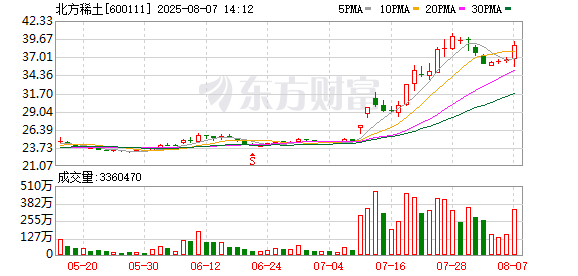
北方稀土成交额达100亿元,现涨超6%
Mei Ri Jing Ji Xin Wen· 2025-08-07 06:11
(文章来源:每日经济新闻) 每经AI快讯,8月7日,北方稀土成交额达100亿元,现涨超6%。 ...


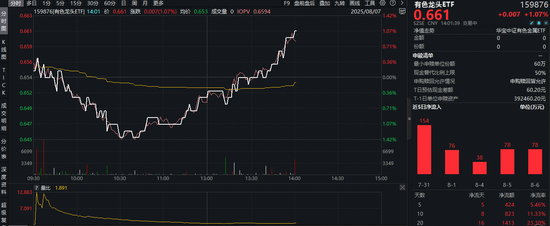
北方稀土登顶A股吸金榜!有色龙头ETF(159876)逆市涨逾1%冲击日线5连阳,机构建议把握四条主线
Xin Lang Ji Jin· 2025-08-07 06:10
Core Viewpoint - The non-ferrous metal sector is experiencing rapid rotation, with various metals like gold, copper, aluminum, rare earths, and lithium taking turns in performance, indicating strong market activity [1] Group 1: Market Performance - As of August 7, rare earth stocks are leading the non-ferrous metal sector, with major players like Northern Rare Earth and Shenghe Resources rising over 6% [1] - The non-ferrous metal sector has seen a cumulative increase of 24.91% year-to-date, making it the top-performing sector among 31 categories [6] - The non-ferrous metal ETF (159876) has recorded a 1.07% increase, achieving five consecutive days of gains, reflecting positive market sentiment [1][6] Group 2: Price Movements and Policies - Lithium carbonate futures have surged by 5% to 72,140 yuan/ton, benefiting lithium compound producers [3] - The "anti-involution" policy implemented in Jiangxi and Qinghai is expected to optimize the supply structure of the lithium industry, supporting long-term price stability [3][4] - The Ministry of Industry and Information Technology plans to introduce a growth stabilization plan for key industries, including non-ferrous metals, viewed as a continuation of the 2016 supply-side reform [5] Group 3: Investment Opportunities - Analysts suggest focusing on three major metals: gold, copper, and aluminum, while also considering strategic metals like rare earths due to their geopolitical significance [3][4] - The current low valuation of the non-ferrous metal sector, with a price-to-book ratio of 2.36, indicates potential for valuation recovery [6] - The sector is expected to benefit from increased demand in emerging industries and limited supply growth, leading to a balanced supply-demand situation [5]
主力个股资金流出前20:中国重工流出10.01亿元、中际旭创流出7.22亿元


Jin Rong Jie· 2025-08-07 04:14
Group 1 - The main focus of the article is on the significant outflow of capital from the top 20 stocks as of August 7, with notable amounts withdrawn from various companies [1][2] - China Shipbuilding Industry Corporation (中国重工) experienced the highest capital outflow at 1 billion yuan, followed by Zhongji Xuchuang (中际旭创) with 722 million yuan [1] - Other companies with substantial capital outflows include Xinyi Technology (新易盛) at 661 million yuan, China Shipbuilding (中国船舶) at 614 million yuan, and WuXi AppTec (药明康德) at 593 million yuan [1] Group 2 - The list of companies with the largest capital outflows also includes Changcheng Military Industry (长城军工) at 510 million yuan and Shenghong Technology (胜宏科技) at 506 million yuan [1] - Northern Rare Earth (北方稀土) saw an outflow of 476 million yuan, while Inner Mongolia First Machinery Group (内蒙一机) had 461 million yuan [1] - Other notable companies with significant outflows include Shanhe Intelligent (山河智能) at 441 million yuan and Dongfang Precision (东方精工) at 439 million yuan [1]
20股获融资客大手笔净买入
Zheng Quan Shi Bao Wang· 2025-08-07 03:14
截至8月6日,市场融资余额合计2.00万亿元,较前一交易日增加90.23亿元,这已经是融资余额连续3个 交易日持续增加,其中,沪市融资余额10132.10亿元,较前一交易日增加37.65亿元;深市融资余额 9757.48亿元,较前一交易日增加51.03亿元;北交所融资余额63.76亿元,较前一交易日增加1.55亿元。 证券时报·数据宝统计显示,具体到个股,8月6日共有2104只股获融资净买入,净买入金额在千万元以 上的有591只,其中20只融资净买入额超亿元。海光信息融资净买入额居首,当日净买入4.79亿元,其 次是博瑞医药、机器人,融资净买入金额分别为2.62亿元、2.48亿元,融资净买入金额居前的还有卧龙 电驱、双林股份、北方稀土等。 分行业统计,获融资客净买入超亿元个股中,汽车、国防军工、电子等行业最为集中,分别有4只、3 只、3只个股上榜。板块分布上,大手笔净买入个股中,主板有11只,创业板有7只,科创板有2只。 融资客大手笔净买入个股中,从最新融资余额占流通市值比例看,算术平均值为4.64%,融资余额占比 最高的是南都电源,该股最新融资余额12.54亿元,占流通市值的比例为8.85%,融资余额占比较 ...


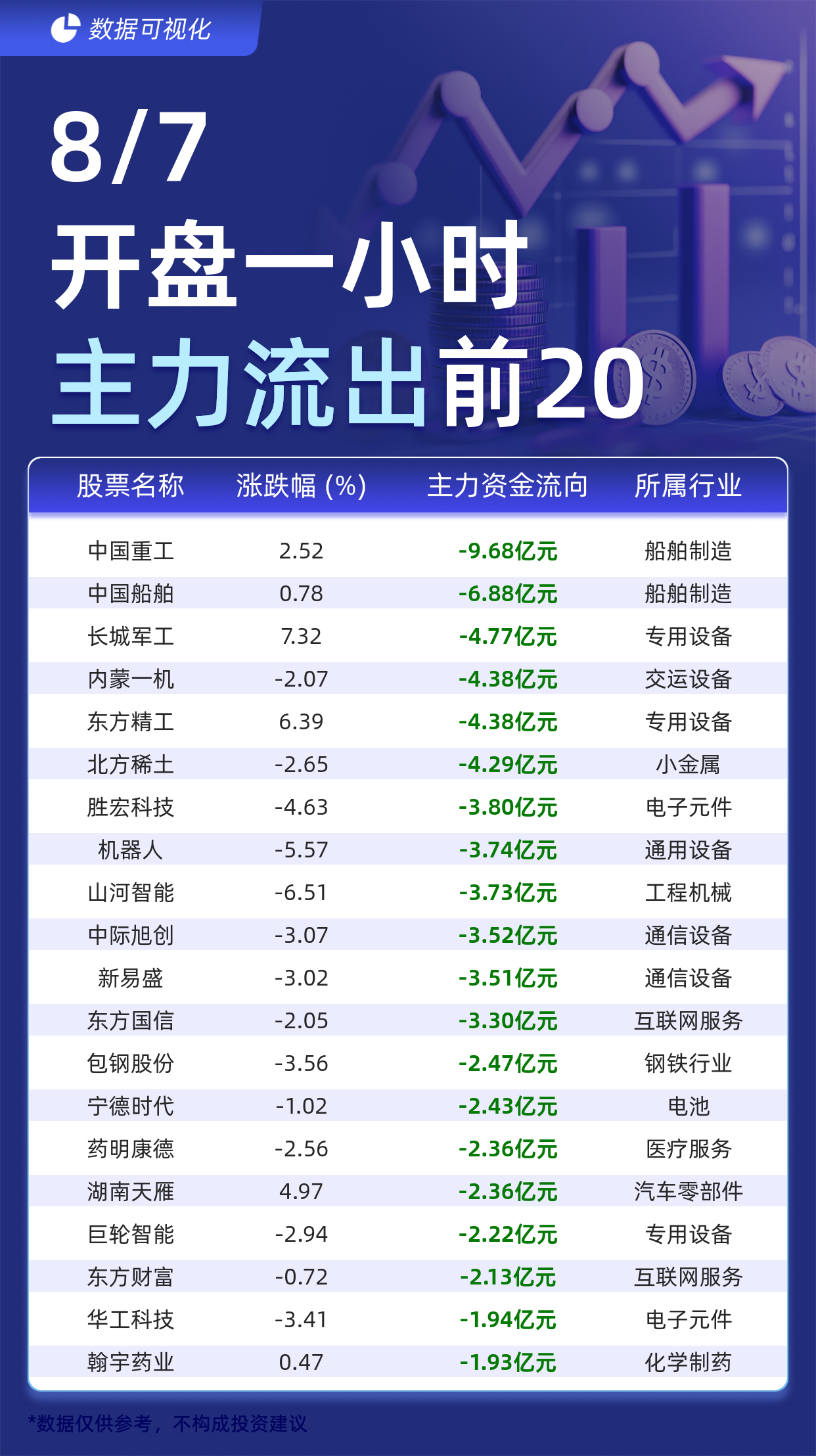
主力个股资金流出前20:中国重工流出9.68亿元、中国船舶流出6.88亿元
Jin Rong Jie· 2025-08-07 03:10
截至8月7日开盘一小时,主力资金流出前20的股票分别为:中国重工(-9.68亿元)、中国船舶(-6.88亿元)、长城军工(-4.77亿元)、内蒙一机(-4.38亿 元)、东方精工(-4.38亿元)、北方稀土(-4.29亿元)、胜宏科技(-3.80亿元)、机器人(-3.74亿元)、山河智能(-3.73亿元)、中际旭创(-3.52亿 元)、新易盛(-3.51亿元)、东方国信(-3.30亿元)、包钢股份(-2.47亿元)、宁德时代(-2.43亿元)、药明康德(-2.36亿元)、湖南天雁(-2.36亿 元)、巨轮智能(-2.22亿元)、东方财富(-2.13亿元)、华工科技(-1.94亿元)、翰宇药业(-1.93亿元)。 | 股票名称 | 涨跌幅 (%) | 主力资金流向 | 所属行) | | --- | --- | --- | --- | | 中国重工 | 2.52 | -9.68亿元 | 船舶制送 | | 中国船舶 | 0.78 | -6.88亿元 | 船舶制送 | | 长城军工 | 7.32 | -4.77亿元 | 专用设备 | | 内蒙一机 | -2.07 | -4.38亿元 | 交运设备 | | 东方精工 | ...




21个行业获融资净买入 20股获融资净买入额超1亿元
Zheng Quan Shi Bao Wang· 2025-08-07 02:05
Group 1 - On August 6, among the 31 first-level industries, 21 industries received net financing inflows, with the machinery equipment industry leading at a net inflow of 2.043 billion yuan [1] - Other industries with significant net financing inflows included electronics (1.395 billion yuan), defense and military industry (1.338 billion yuan), pharmaceutical and biological industry (1.234 billion yuan), automotive (1.224 billion yuan), electric equipment (0.926 billion yuan), and home appliances (0.327 billion yuan) [1] Group 2 - A total of 2,105 individual stocks received net financing inflows on August 6, with 201 stocks having net inflows exceeding 30 million yuan [1] - Among these, 20 stocks had net inflows over 100 million yuan, with Haiguang Information leading at 479 million yuan [1] - Other notable stocks with high net inflows included Borui Pharmaceutical (262 million yuan), Robot (248 million yuan), Wolong Electric Drive (226 million yuan), Shuanglin Co. (188 million yuan), Northern Rare Earth (162 million yuan), Nandu Power Supply (151 million yuan), Changying Precision (143 million yuan), and Tuo Wei Information (139 million yuan) [1]

中证诚通国企战略新兴产业指数上涨1.04%,前十大权重包含华虹公司等
Sou Hu Cai Jing· 2025-08-06 13:39
Core Points - The China Securities Index for State-Owned Enterprises in Strategic Emerging Industries has shown significant growth, with a 13.15% increase over the past month and a 21.86% increase over the past three months [1][2] - The index is designed by China Chengtong Holdings Group and includes 50 state-owned enterprises with high growth potential, reflecting the overall performance of representative state-owned companies in strategic emerging industries [1][2] Group 1: Index Performance - The index opened lower but closed higher, with a current value of 1634.48 points and a trading volume of 35.992 billion yuan [1] - Year-to-date, the index has increased by 15.73% [1] Group 2: Index Composition - The top ten holdings in the index include Northern Rare Earth (12.33%), BOE Technology Group (8.71%), and Shengyi Technology (6.52%) [1] - The index is primarily composed of companies listed on the Shanghai Stock Exchange (60.32%), followed by the Shenzhen Stock Exchange (39.53%) and a minimal presence on the Beijing Stock Exchange (0.15%) [1] Group 3: Sector Allocation - The sector allocation of the index shows that Information Technology comprises 39.21%, followed by Industrial (30.22%) and Materials (23.11%) [2] - Other sectors include Communication Services (3.27%), Healthcare (2.49%), Consumer Staples (1.37%), and Utilities (0.32%) [2] Group 4: Index Adjustment Mechanism - The index samples are adjusted biannually, with changes implemented on the next trading day after the second Friday of June and December [2] - In special circumstances, the index may undergo temporary adjustments, such as removing companies that are delisted or involved in mergers and acquisitions [2]



机构调研、股东增持与公司回购策略周报(20250728-20250801)-20250806
Yuan Da Xin Xi· 2025-08-06 11:13
Group 1 - The report identifies the top twenty companies with the highest institutional research activity over the past 30 days, including Ice Wheel Environment, Northern Rare Earth, and Weili Transmission, among others [2][11] - In the last five days, the most researched companies include InSai Group, Weili Transmission, and Tianlong Co., Ltd. [2][13] - Six companies among the top twenty in institutional research have ten or more rating agencies, with notable expected profit growth for Hu Dian Co., Yanjing Beer, and BOE Technology Group in 2024 compared to 2023 [2][11] Group 2 - From July 28 to August 1, 2025, two companies, Yuxin Electronics and Jiangnan Yifan, announced significant shareholder increases [3][14] - A total of 111 companies announced share repurchase progress during the same period, with six companies, including Jiufeng Energy and Midea Group, having repurchase amounts exceeding 1% of their market value [3][18] - From January 1 to August 3, 2025, 244 companies reported shareholder increases, with 19 companies having significant planned increase amounts relative to their market value [3][16] Group 3 - In 2025, from January 1 to August 3, 1,623 companies announced share repurchase progress, with 100 companies having repurchase amounts exceeding 1% of their market value [4][19] - Companies in the board proposal stage for repurchase include Jiayi Co., Haixing Power, and Sanhua Equipment [4][19]



A股收评:沪指低开高走涨0.45% 全市场近百股涨超9%
2 1 Shi Ji Jing Ji Bao Dao· 2025-08-06 07:23
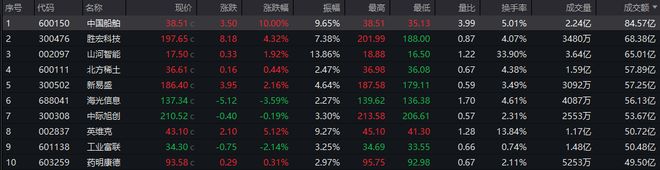
市场全天震荡走高,三大指数小幅上涨。截至收盘,沪指涨0.45%,深成指涨0.64%,创业板指涨 0.66%。 沪深两市全天成交额1.73万亿,较上个交易日放量1380亿。 盘面上,市场热点较为杂乱,个股涨多跌少,全市场超3300只个股上涨,近百股涨超9%。 从板块来看,PEEK材料概念股集体爆发,中欣氟材2连板。 军工股再度大涨,长城军工5天4板。 机器人概念股震荡走强,中大力德等多股涨停。 下跌方面,医药股展开调整,翰宇药业等多股跌超5%。 沪深两市成交额合计1.73万亿元,较上一交易日放量约1379.87亿元。其中,沪市成交额7072.21亿元, 深市成交额1.03万亿元。 中国船舶成交额居首,为84.57亿元。其后是胜宏科技、山河智能、北方稀土、新易盛,成交额分别为 68.38亿元、65.01亿元、57.89亿元、57.25亿元。 | 序号 | (488) | 名称 | 现价 | 涨跌 | 新筑候 | 提幅 | 看演 | 最低 | 量比 | 换手率 | 成交量 | 成交疑 ▼ | | --- | --- | --- | --- | --- | --- | --- | --- | --- | --- | ...