CNRE(600111)

Search documents
北方稀土:第三季度净利润6.1亿元 同比增长69.48%
Zheng Quan Shi Bao Wang· 2025-10-27 10:37
Core Viewpoint - Northern Rare Earth (600111) reported significant growth in both revenue and net profit for the third quarter and the first three quarters of 2025, driven by increased sales prices and volumes of its main products [1] Group 1: Financial Performance - Third quarter revenue reached 11.425 billion, representing a year-on-year increase of 33.32% [1] - Net profit for the third quarter was 610 million, showing a year-on-year growth of 69.48% [1] - Revenue for the first three quarters totaled 30.292 billion, with a year-on-year increase of 40.50% [1] - Net profit for the first three quarters was 1.541 billion, reflecting a substantial year-on-year growth of 280.27% [1] Group 2: Product Performance - The sales prices of the company's main products increased year-on-year [1] - The sales volume of the main products also saw a year-on-year increase [1] - Gross profit increased year-on-year during the reporting period [1]

北方稀土:第三季度净利润为6.1亿元,同比增长69.48%
Xin Lang Cai Jing· 2025-10-27 10:34
Core Insights - The company reported a third-quarter revenue of 11.425 billion, representing a year-on-year increase of 33.32% [1] - The net profit for the third quarter was 610 million, showing a year-on-year growth of 69.48% [1] - For the first three quarters, the total revenue reached 30.292 billion, reflecting a year-on-year increase of 40.50% [1] - The net profit for the first three quarters was 1.541 billion, which is a significant year-on-year increase of 280.27% [1]
有色金属ETF(512400.SH)涨2.82%,北方稀土涨4.30%
Sou Hu Cai Jing· 2025-10-27 09:37
Group 1 - A-share market experienced a broad increase, with rare earth and lithography machine sectors leading the gains, as evidenced by the 2.82% rise in the non-ferrous metal ETF (512400.SH) and a 4.30% increase in Northern Rare Earth [1] - The U.S. September CPI data came in below expectations, alongside tightening dollar liquidity and renewed regional banking risks, which strengthened market expectations for a Federal Reserve interest rate cut [1] - China's decision to postpone the implementation of rare earth export restrictions by one year signals a temporary easing, which is expected to stabilize global key mineral supply chain expectations and support the upward movement of industrial metal prices [1] Group 2 - Precious metals saw significant volatility this week, with spot gold experiencing its largest single-day drop in nearly a decade, primarily due to profit-taking and a temporary strengthening of the dollar [2] - Industrial metals are expected to maintain strong prices due to improved macro sentiment, frequent supply disruptions, and seasonal demand recovery [2] - The lithium battery supply chain is experiencing a tightening supply-demand balance, as indicated by the surge in hexafluorophosphate lithium prices and new highs in lithium carbonate futures, reflecting a continued recovery in the lithium battery industry [2] - Rare earth materials remain a core investment theme due to their long-term scarcity and strategic value in international competition, with leading companies accelerating integration and optimizing supply chains during the policy buffer period [2]


A股,冲刺!
Zhong Guo Ji Jin Bao· 2025-10-27 05:07
Market Overview - The A-share market opened positively on October 27, with major indices closing higher: Shanghai Composite Index up 1.04%, Shenzhen Component Index up 1.26%, and ChiNext Index up 1.54%, approaching the 4000-point mark [1][3] - The total market turnover reached 1.58 trillion yuan, showing a significant increase compared to the previous day, with over 3700 stocks rising [3] Sector Performance - Key sectors that performed well included telecommunications, steel, non-ferrous metals, and electronics, with notable gains in controllable nuclear fusion, Fujian local stocks, and storage chips [3][7] - The non-ferrous metals sector was particularly active, with stocks like Antai Technology and Xiamen Tungsten hitting the daily limit, while other companies like Dongfang Tantalum and Zhongtung High-tech also saw significant increases [10][12] Notable Stocks - In the Hong Kong market, Baidu Group led the gains with a rise of over 5%, contributing to a 1.02% increase in the Hang Seng Index [3][4] - Fujian local stocks saw a collective surge, with Haixia Innovation hitting the daily limit and other stocks like Fujian Cement and Zhangzhou Development also performing strongly [7][8] Upcoming Events - The 2025 Financial Street Forum is set to open in the afternoon of October 27, with key financial leaders expected to deliver speeches, which has generated market anticipation for potential policy announcements [5][6] Strategic Insights - Recent signals of easing tensions in US-China relations and the release of the "14th Five-Year Plan" are expected to enhance market risk appetite and provide a clearer growth path for A-shares through technological breakthroughs and industrial upgrades [4][6]



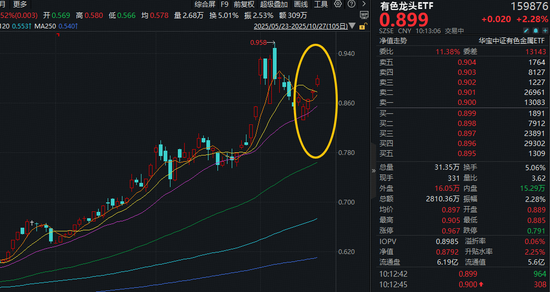
北方稀土拉升5%,跻身A股吸金榜TOP5!有色龙头ETF(159876)盘中涨近3%,日k线或已走出“上行台阶”
Xin Lang Cai Jing· 2025-10-27 04:01
Core Viewpoint - The non-ferrous metal sector is experiencing significant gains, driven by strong market performance and policy support, indicating a positive outlook for the industry [1][2]. Group 1: Market Performance - The non-ferrous metal sector ETF (159876) saw an intraday increase of 2.96%, currently up by 2.28%, with real-time transaction volume exceeding 280 million yuan [1]. - Major stocks in the sector, such as Xiamen Tungsten, Western Superconducting, Northern Rare Earth, and Jiangxi Copper, reported gains of over 5% [1]. - The sector attracted over 5.5 billion yuan in net inflows from main funds, ranking second among 31 primary industries [1]. Group 2: Technical Analysis - The 10-day moving average indicates that the market's average cost over the short term (approximately two weeks) has been recovered, suggesting that bullish forces are currently dominating the short-term trading landscape [1]. Group 3: Policy and Economic Context - The Ministry of Industry and Information Technology, along with eight other departments, has issued a "Work Plan for Stable Growth in the Non-Ferrous Metal Industry (2025-2026)," marking a new phase of institutional support and structural prosperity for the industry [1]. - The Federal Reserve's recent monetary policy changes are expected to reshape the pricing of non-ferrous metals, with a focus on supply constraints and released demand leading to a tight balance in supply and demand [1]. Group 4: Industry Outlook - The non-ferrous metal sector is positioned as a key player in the current commodity bull market, driven by long-term capital expenditure cycles and a shift in demand dynamics away from real estate and infrastructure [2]. - Different non-ferrous metals exhibit varying degrees of market performance and driving factors, suggesting a diversified investment approach may be beneficial for capturing overall sector trends [2].
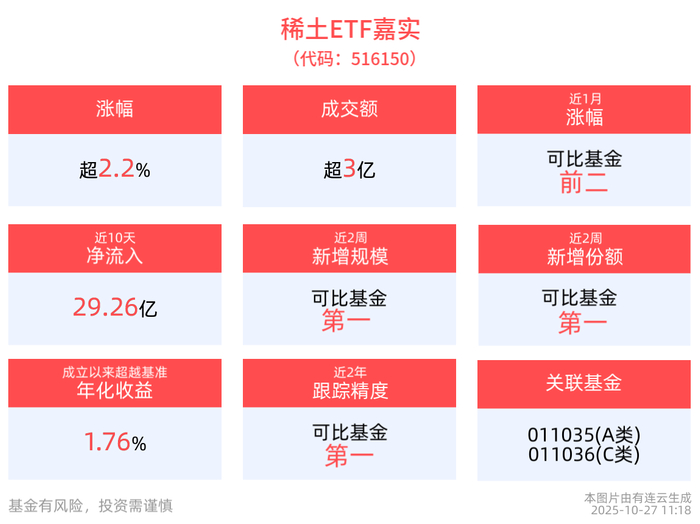
稀土板块长期估值中枢持续提升,稀土ETF嘉实(516150)上涨2.20%,成分股安泰科技、厦门钨业10cm涨停
Xin Lang Cai Jing· 2025-10-27 03:57
Core Insights - The rare earth industry index in China has seen a strong increase of 2.21%, with key stocks such as Antai Technology and Xiamen Tungsten hitting the daily limit up, indicating positive market sentiment and performance in the sector [1] - The recent export control measures by the Chinese government on rare earth materials and technologies have further solidified the strategic value of rare earths, leading to a reassessment of their long-term valuation in the international market [4][5] Market Performance - The rare earth ETF managed by Jiashi has experienced a turnover rate of 3.38% and a transaction volume of 365 million yuan, reflecting active trading [3] - Over the past two weeks, the Jiashi rare earth ETF has seen a significant growth in scale by 1.66 billion yuan, ranking first among comparable funds [3] - The ETF's net asset value has increased by 94.08% over the past two years, placing it in the top 4.31% of index equity funds [4] Stock Performance - The top ten weighted stocks in the China rare earth industry index account for 61.96% of the index, with North Rare Earth and Wolong Electric Drive being the most significant contributors [4] - Notable stock performances include North Rare Earth rising by 3.61% and Xiamen Tungsten by 10.00%, indicating strong investor interest [7] Supply and Demand Dynamics - The supply side is facing challenges with sluggish shipments from rare earth mines, increasing pressure on holders [4] - On the demand side, there is a weakening terminal demand and a cautious sentiment among large manufacturers, who are primarily restocking based on immediate needs [4] Investment Opportunities - The recent policy changes and market sentiment are positively impacting the rare earth sector, with expectations of continued global demand growth supporting the industry's outlook [5] - Investors can also consider the Jiashi rare earth ETF connection fund to capitalize on investment opportunities in the rare earth market [7]


稀土板块拉升,万朗磁塑、安泰科技涨停,厦门钨业等走高
Zheng Quan Shi Bao Wang· 2025-10-27 03:26
Core Viewpoint - The rare earth sector experienced a strong surge on the 27th, with significant stock price increases for companies like Wanlong Magnetic Plastic and Antai Technology, indicating a potential stabilization in rare earth prices as they approach the cost line for some enterprises [1] Group 1: Market Dynamics - Rare earth prices are expected to gradually stabilize as they approach the cost line for certain companies, limiting further declines [1] - Demand from downstream sectors, particularly in new energy vehicles, is showing marginal declines, while expectations for wind power installations are being released [1] - The overall trend in the industrial sector is improving, despite a slowdown in air conditioning production and a narrowing decline in elevator output [1] Group 2: Supply and Valuation - The industry landscape is becoming increasingly differentiated, with leading companies gaining a competitive advantage [1] - Current absolute and relative historical valuation levels are supported by loose liquidity and strategic industrial policies, maintaining high valuations for the rare earth sector [1] - New export restrictions on rare earths highlight their strategic value, but uncertainties from US-China tensions and export control policies may exert pressure on short-term demand and valuation adjustments [1] Group 3: Future Outlook - Continuous performance improvement is necessary to absorb valuation pressures, with a focus on the sustainability of rare earth magnetic material prices and industry profitability [1] - Changes in demand and shifts in policy expectations need to be closely monitored to assess their impact on the sector [1]

北方稀土拉升5%,跻身A股吸金榜TOP5!有色龙头ETF(159876)盘中涨近3%,日k线或已走出 “上行台阶”
Xin Lang Ji Jin· 2025-10-27 02:33
Core Viewpoint - The non-ferrous metal sector is experiencing significant gains, with the non-ferrous metal leader ETF (159876) showing a rise of 2.28% and a trading volume exceeding 280 million yuan, indicating a potential increase in market activity [1][3] Market Performance - The non-ferrous metal sector has seen a net inflow of over 5.5 billion yuan from major funds, ranking second among 31 primary industries [3] - Key stocks such as Xiamen Tungsten, Northern Rare Earth, and Jiangxi Copper have shown substantial gains, with Xiamen Tungsten hitting the daily limit and others rising over 5% [1][3] Technical Analysis - The recovery of the 10-day moving average suggests that short-term bullish forces are strong enough to push prices above this key level, indicating a favorable short-term market sentiment [1] - A significant volume increase accompanying the recovery of the 10-day moving average would enhance the reliability of this bullish signal [1] Policy and Economic Environment - The Ministry of Industry and Information Technology and seven other departments have issued a "Work Plan for Stable Growth in the Non-Ferrous Metal Industry (2025-2026)," marking a new phase of institutional support and structural prosperity for the industry [3] - The Federal Reserve has initiated a new round of interest rate cuts, which may improve global liquidity conditions, creating new opportunities for the non-ferrous metal sector [3] Supply and Demand Dynamics - The supply of non-ferrous metals is limited while demand is expected to increase, leading to a tight balance between supply and demand [4] - The shift in demand drivers from real estate and infrastructure to the new energy sector has significantly altered the demand structure for copper and aluminum, with new energy now accounting for over 15% and 20% of copper and aluminum demand, respectively [4] Future Outlook - Non-ferrous metals are positioned as key commodities in the current bull market, driven by long-term capital expenditure cycles and increasing global manufacturing investment [4] - The combination of domestic macroeconomic recovery expectations and strategic resource reserve demands under globalization trends further strengthens the outlook for non-ferrous metals [4] Investment Strategy - A diversified investment approach through the non-ferrous metal leader ETF (159876) and its associated funds is recommended to capture the sector's beta performance while mitigating risks [6] - The ETF tracks the CSI Non-Ferrous Metal Index, which includes significant weights in copper (27.6%), gold (14.5%), aluminum (13.1%), rare earths (10.4%), and lithium (8.4%) [6]
战略小金属价值重估进行时,推荐关注稀土及钴等战略金属
HUAXI Securities· 2025-10-26 05:55
Investment Rating - Industry rating: Recommended [3] Core Insights - The report emphasizes the strategic revaluation of key metals, particularly focusing on rare earths and cobalt [24] - Nickel prices are expected to be supported due to tightened supply expectations following Indonesia's new regulation reducing the approval cycle for mining plans from three years to one year [26][27] - Cobalt prices have continued to rise, with expectations of increasing supply tightness further driving prices up [30][33] - Antimony supply is expected to remain tight, providing a bottom support for antimony prices [34] - Lithium carbonate prices are projected to remain strong due to ongoing demand and inventory depletion [16] - China's dominance in rare earth supply is reinforced by stricter export controls, which are expected to support rare earth prices [18] - Tin supply remains uncertain due to ongoing challenges in overseas supply, which is expected to support tin prices [19] - Tungsten prices are supported by a tightening supply situation, with production rates slowing down [20] - Uranium supply tightness is anticipated to continue, supporting uranium prices [21] Summary by Sections Nickel and Cobalt Industry Update - Indonesia's new regulation on mining approvals is expected to tighten future ore supply, supporting nickel prices [26] - As of October 24, LME nickel price was $15,085 per ton, up 1.04% from October 17 [26] - Cobalt prices have risen significantly, with electrolytic cobalt reaching 408,500 CNY per ton, a 6.94% increase [30] Antimony Industry Update - Domestic antimony prices have decreased, but long-term supply tightness is expected to support prices [34] - China's antimony production is projected to dominate global supply, accounting for 60% of the total [34] Lithium Industry Update - Lithium carbonate prices have increased, with a market average of 73,700 CNY per ton as of October 24 [16] - Demand from the battery sector continues to drive price support [16] Rare Earth Industry Update - China's strict export controls on rare earths are expected to tighten supply and support prices [18] - The report highlights the importance of China's role in the global rare earth supply chain [18] Tin Industry Update - Tin prices are supported by supply uncertainties, particularly from Myanmar and Indonesia [19] - As of October 24, LME tin price was $35,925 per ton, up 2.42% from October 17 [19] Tungsten Industry Update - The tungsten supply situation is tightening, with production rates slowing down [20] - Prices for tungsten concentrate have increased, reflecting supply constraints [20] Uranium Industry Update - The report indicates a continued tight supply situation for uranium, supporting price stability [21] - Recent production guidance reductions from major suppliers are expected to impact future supply [21]


小金属板块10月24日涨2.32%,厦门钨业领涨,主力资金净流入5.35亿元
Zheng Xing Xing Ye Ri Bao· 2025-10-24 08:21
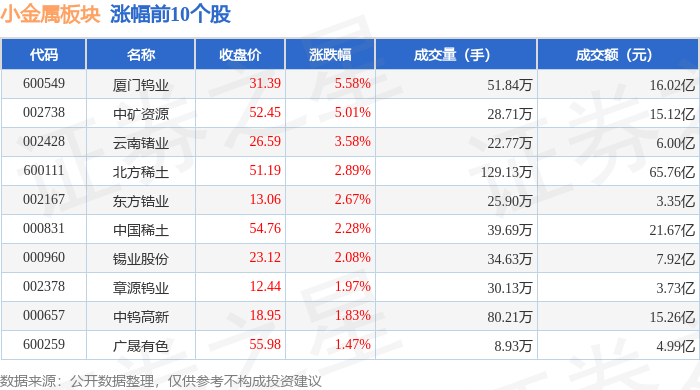
Core Insights - The small metals sector experienced a rise of 2.32% on October 24, with Xiamen Tungsten leading the gains [1] - The Shanghai Composite Index closed at 3950.31, up 0.71%, while the Shenzhen Component Index closed at 13289.18, up 2.02% [1] Small Metals Sector Performance - Xiamen Tungsten (600549) closed at 31.39, up 5.58%, with a trading volume of 518,400 shares and a transaction value of 1.602 billion [1] - Zhongkuang Resources (002738) closed at 52.45, up 5.01%, with a transaction value of 1.512 billion [1] - Yunnan Tin (002428) closed at 26.59, up 3.58%, with a transaction value of 600 million [1] - Northern Rare Earth (600111) closed at 51.19, up 2.89%, with a transaction value of 6.576 billion [1] - Other notable performers include China Rare Earth (000831) and Xiyang Co. (600259), with increases of 2.28% and 1.47% respectively [1] Capital Flow Analysis - The small metals sector saw a net inflow of 535 million from main funds, while retail funds experienced a net outflow of 216 million [2] - Main funds showed significant net inflows in Northern Rare Earth (2.68 million) and Xiamen Tungsten (1.35 million) [3] - Retail funds had notable outflows in Xiamen Tungsten and China Rare Earth, indicating a shift in investor sentiment [3]