NARI-TECH(600406)

Search documents
国电南瑞(600406):收入利润稳健增长,海外与网外业务持续突破
Guoxin Securities· 2025-09-08 12:22
Investment Rating - The investment rating for the company is "Outperform the Market" [6][24]. Core Views - The company has shown steady revenue and profit growth, with a significant increase in overseas and external network business [1][2]. - The company achieved a revenue of 24.243 billion yuan in the first half of 2025, representing a year-on-year increase of 19.54%, and a net profit of 2.952 billion yuan, up 8.82% year-on-year [1][8]. - The company is experiencing rapid growth in smart grid and low-carbon energy businesses, with smart grid revenue reaching 12.225 billion yuan, up 28.37% year-on-year [2][22]. - The company has signed new contracts worth 35.432 billion yuan, a year-on-year increase of 23.46%, with over 50% of contracts coming from outside the State Grid [2][23]. Summary by Sections Financial Performance - In the second quarter of 2025, the company reported a revenue of 15.348 billion yuan, a year-on-year increase of 22.50%, and a net profit of 2.272 billion yuan, up 7.33% year-on-year [1][22]. - The gross margin for the first half of 2025 was 26.45%, down 2.58 percentage points year-on-year, while the net margin was 12.89%, down 1.38 percentage points year-on-year [1][8]. Business Segments - The company’s smart grid revenue was 12.225 billion yuan, with a gross margin of 30.34%, while low-carbon energy revenue reached 6.541 billion yuan, with a gross margin of 21.59% [2][22]. - The overseas revenue saw a remarkable increase of 139% year-on-year, contributing to 46% of the total revenue from external networks [2][23]. Future Outlook - The company plans to distribute a mid-term dividend of 0.147 yuan per share, totaling 1.175 billion yuan, which accounts for 45.72% of the net profit for the first half of the year [2][23]. - The profit forecast for 2025-2027 has been adjusted to 8.369 billion yuan, 9.462 billion yuan, and 10.716 billion yuan respectively, with the current stock price corresponding to PE ratios of 21, 19, and 17 times [24][26].

2025年中国高压直流输电系统行业产业链全景、行业发展现状及未来趋势研判:HVDC技术赋能多元场景,数据中心800V HVDC市场成为行业重点发展方向[图]
Chan Ye Xin Xi Wang· 2025-09-08 00:52
Core Viewpoint - China's High Voltage Direct Current Transmission System (HVDCS) has become a core technology for building a new energy system, leveraging its advantages in long-distance and high-power transmission. The market for HVDC is projected to reach 89.2 billion yuan in 2024 and exceed 300 billion yuan by 2028, driven by the expansion of wind and solar power installations and the explosive demand for AI computing power [1][7]. Industry Overview - HVDCS utilizes direct current for high-power, long-distance electricity transmission, converting three-phase alternating current to direct current and back again, enabling efficient and stable energy transfer [2]. - The industry has developed a complete upstream and downstream industrial system, focusing on raw materials, equipment manufacturing, and system integration, with major investments from state-owned enterprises [4]. Market Size and Growth - The HVDC market in China reached 89.2 billion yuan in 2024, a 42.3% increase year-on-year, and is expected to surpass 300 billion yuan by 2028 [7]. - The demand for 800V HVDC technology is anticipated to surge, particularly in the context of AI data centers, with the market projected to grow from 2 billion yuan in 2028 to 6.4 billion yuan by 2030, reflecting a compound annual growth rate of 47% [1][8]. Industry Chain - The HVDCS industry chain includes upstream raw materials, midstream equipment manufacturing, and downstream operation by major power grid companies, facilitating large-scale applications in long-distance transmission and renewable energy integration [4]. Competitive Landscape - The industry is characterized by a concentration of market share among state-owned enterprises like China Xidian and TBEA, while private companies and foreign firms compete in niche areas [10]. - China Hengtian Electric holds a 28% market share, benefiting from partnerships with leading internet companies in the AI data center sector [10]. Development Trends - The industry is expected to see technological advancements, with a shift towards 800V high-voltage platforms and silicon carbide devices, enhancing system efficiency and reliability [11]. - The application scenarios for HVDC are diversifying, including cross-border energy interconnections and industrial microgrids, creating a multi-billion market for related services [12]. - Chinese HVDC companies are transitioning to a global operational model, focusing on technology, standards, and capital, with exports expected to rise to 40% by 2030 [13][14].


高位加仓?富时中国A50指数九月调仓名单一览
天天基金网· 2025-09-05 11:11
Core Viewpoint - The article discusses the quarterly review changes of the FTSE China A50 index announced by FTSE Russell, highlighting the inclusion and exclusion of specific stocks and the implications for investment funds tracking the index [5][6]. Group 1: Index Changes - Four stocks, including BeiGene, NewEase, WuXi AppTec, and Zhongji Xuchuang, will be added to the FTSE China A50 index, while China Nuclear Power, China Unicom, Guodian NARI, and Wanhua Chemical will be removed [5]. - The newly added stocks belong to the innovative drug and CPO sectors, while the removed stocks are from traditional industries such as utilities and telecommunications [5]. - The newly included stocks have shown significant price increases this year, with NewEase and Zhongji Xuchuang rising over 200%, and BeiGene and WuXi AppTec around 90% [5]. Group 2: Market Impact - The estimated size of passive funds tracking the FTSE China A50 index exceeds $10 billion, indicating that changes in constituent stocks can lead to substantial capital flows, potentially in the hundreds of millions to billions [5]. - Investors have raised concerns about the inclusion of stocks perceived as overvalued and whether this adjustment is a strategy for foreign capital to take over high-priced stocks [6]. - The adjustment is based on market capitalization and liquidity criteria, with the review conducted quarterly, using data from the third Friday of February, May, August, and November [6].





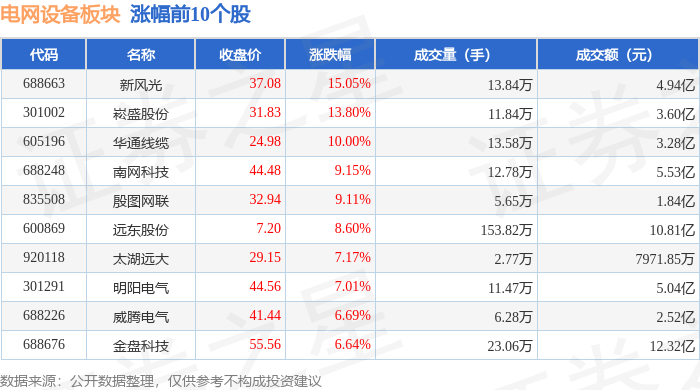
电网设备板块9月5日涨3.01%,新风光领涨,主力资金净流入10.73亿元
Zheng Xing Xing Ye Ri Bao· 2025-09-05 09:07
Market Performance - The grid equipment sector increased by 3.01% compared to the previous trading day, with Xin Fengguang leading the gains [1] - The Shanghai Composite Index closed at 3812.51, up 1.24%, while the Shenzhen Component Index closed at 12590.56, up 3.89% [1] Individual Stock Performance - Xin Fengguang (688663) closed at 37.08, up 15.05% with a trading volume of 138,400 shares and a transaction value of 494 million [1] - Songsheng Co., Ltd. (301002) closed at 31.83, up 13.80% with a trading volume of 118,400 shares and a transaction value of 360 million [1] - Other notable performers include: - Buyao Maintenance (605196) at 24.98, up 10.00% [1] - Southern Power Technology (688248) at 44.48, up 9.15% [1] - Yantu Network (835508) at 32.94, up 9.11% [1] Capital Flow Analysis - The grid equipment sector saw a net inflow of 1.073 billion in main funds, while retail funds experienced a net outflow of 552 million [2][3] - The main funds' net inflow for notable stocks includes: - TBEA (600089) with a net inflow of 411 million [3] - Far East Holdings (600869) with a net inflow of 128 million [3] - Guodian NARI (600406) with a net inflow of 82 million [3]


A股上市宁企“半年报”全部发布
Nan Jing Ri Bao· 2025-09-05 03:27
Core Viewpoint - The financial performance of A-share listed companies in Nanjing for the first half of the year shows strong growth, particularly in the banking and securities sectors, driven by their focus on serving the real economy and innovation in technology [1][2][3]. Financial Performance - Nanjing's A-share listed companies have a total market capitalization of approximately 1.81 trillion yuan, with Jiangsu Bank, Nanjing Bank, and Huatai Securities leading in net profits of 20.24 billion yuan, 12.62 billion yuan, and 7.55 billion yuan respectively [1][2]. - Jiangsu Bank reported a revenue of 44.86 billion yuan, an increase of 7.78% year-on-year, and a net profit growth of 8.05% [2]. - Nanjing Bank achieved a revenue of 28.48 billion yuan, with a year-on-year growth of 8.64%, and a net profit increase of 8.84% [2]. - Huatai Securities saw a revenue of 16.22 billion yuan, with a significant year-on-year increase of 31.01%, and a net profit growth of 42.16% [2]. Service to Real Economy - Jiangsu Bank's focus on supporting manufacturing and infrastructure projects led to a manufacturing loan balance of 360.6 billion yuan, growing by 18.90% year-on-year, and infrastructure loans reaching 691.2 billion yuan, up by 31% [3]. - Nanjing Bank emphasized service to key industries, with green finance, inclusive small and micro finance, and technology finance loans growing by 27.79%, 12.51%, and 12.42% respectively [3]. - Huatai Securities maintained a strong development trend by innovating its business and service models [3]. Innovation and Technology - Nanjing Steel's half-year report highlighted a net profit of 1.46 billion yuan, with advanced steel material sales contributing significantly to profits [4][5]. - Nanjing Steel's innovation strategy included breakthroughs in advanced steel materials and participation in national key research projects [5]. - Guodian NARI's report showcased its technological advancements, achieving a revenue of 24.24 billion yuan, up by 19.54% year-on-year, and a net profit of 2.95 billion yuan, growing by 8.82% [6]. Globalization Strategy - Companies like Maolai Optical and Nanwei Medical are leveraging globalization for growth, with Maolai Optical reporting a revenue of 319 million yuan, up by 32.26%, and a net profit increase of 110.36% [7][8]. - Nanwei Medical achieved a revenue of 1.565 billion yuan, with overseas revenue accounting for 58% of total income, reflecting its global expansion efforts [9].




全省9家市值超千亿元企业,南京占4席
Nan Jing Ri Bao· 2025-09-05 00:13
Core Viewpoint - Nanjing has four companies among the nine listed in Jiangsu with a market capitalization exceeding 100 billion yuan, highlighting the city's strong financial performance and contribution to the regional economy [1]. Financial Performance of Nanjing Companies - Nanjing's A-share listed companies reported a total market capitalization of approximately 1.81 trillion yuan, with Jiangsu Bank, Nanjing Bank, and Huatai Securities leading in net profits of 202.38 billion yuan, 126.19 billion yuan, and 75.49 billion yuan respectively [1][2]. - Jiangsu Bank achieved a revenue of 448.64 billion yuan, an increase of 7.78% year-on-year, and a net profit growth of 8.05% [3]. - Nanjing Bank reported a revenue of 284.8 billion yuan, up 8.64%, and a net profit of 126.19 billion yuan, reflecting an 8.84% increase [2]. - Huatai Securities recorded a revenue of 162.19 billion yuan, with a year-on-year increase of 31.01%, and a net profit of 75.49 billion yuan, up 42.16% [2]. Focus on Serving the Real Economy - Jiangsu Bank's focus on supporting the manufacturing sector led to a manufacturing loan balance of 360.6 billion yuan, growing 18.90% year-on-year, and infrastructure loans increased by 31% to 691.2 billion yuan [3]. - Nanjing Bank emphasized service to key industries, with significant growth in green finance, inclusive small and micro finance, and technology finance [3]. - Huatai Securities maintained a strong development trajectory by innovating its business and service models [3]. Innovation and Technology Leadership - Nanjing Steel's report highlighted a 18.63% increase in net profit, driven by advanced steel material sales contributing significantly to profits [4]. - Nanjing Steel's R&D investments focused on overcoming technological bottlenecks in advanced materials, leading to notable achievements in product development [4]. - Guodian Nari's innovations included the development of a domestic complete set of equipment for speed regulation and energy management systems, resulting in a revenue increase of 19.54% [5]. Globalization Strategy - Companies like Maolai Optical have successfully implemented globalization strategies, achieving a revenue of 3.19 billion yuan, a 32.26% increase, and a net profit growth of 110.36% [6][7]. - Nanwei Medical's overseas revenue now accounts for 58% of total income, reflecting its commitment to global expansion [8][9].
电力设备:国内外需求共振,筑中期成长空间
2025-09-04 14:36
Summary of Conference Call Records Industry Overview: Power Equipment Key Points on Domestic and International Demand - The acceleration of ultra-high voltage (UHV) project approvals is expected, with multiple AC lines approved in the second half of the year, significantly higher than the first half. The total investment for the Shaanxi to Henan and Nanjing to Sichuan projects exceeds 30 billion yuan [1] - The investment budget for distribution networks is projected to grow by approximately 5% in 2025, focusing on smart technology, replacement of old equipment, and energy-saving renovations. Investment in grid intelligence is expected to increase by 60% year-on-year [1][5] - The European power market is seeing substantial investment in grid upgrades, with the EU planning to invest 584 billion euros by 2030, with one-third for transmission and two-thirds for distribution [1][7] Core Insights and Arguments - The approval of UHV projects is expected to increase from 2-3 AC lines in 2024 to 4-5 in 2025, indicating a significant growth trajectory [4] - The regional joint procurement in the distribution network sector has pressured the gross margins of leading companies by about 10 percentage points, but it has also increased market share for companies like XJ Electric, Samsung Medical, and Oriental Electronics [5] - The demand for low-voltage transformers and UHV equipment in Europe is rising, with Chinese manufacturers having advantages in conversion efficiency and power density [8] Company-Specific Developments - **Pinggao Electric**: New order growth of approximately 15% in the first half of 2025, with a significant increase in UHV GIS delivery expected from 2026 [11] - **China XD Electric**: Improved gross margins through cost management, with a projected delivery of 30-40 billion yuan in UHV projects for the year [12] - **XJ Electric**: Anticipates a significant increase in delivery volume for UHV products in 2026, with current orders exceeding 3 billion yuan [13] - **Siyuan Electric**: Actively expanding in the North American data center market, with a projected net profit growth of about 30% for 2025 [15] - **Samsung Medical**: Achieved a 124% year-on-year increase in overseas distribution network orders, with a projected net profit growth of 10-15% [16] - **Huaming Equipment**: European market contributes 50% of overseas revenue, with a projected net profit growth of about 15% [17] - **Guodian NARI**: Strong performance in the low-carbon energy sector, with expected revenue growth of 14-15% [18] - **Sifang Co.**: Domestic business exceeded expectations, with a 15% growth in main network orders [19] Other Important Insights - The focus on smart grid investments is expected to reshape the competitive landscape in the distribution network sector, benefiting leading companies in the medium term [5] - The North American market is experiencing tight supply for transformers and switches, creating significant opportunities for domestic companies [9] - The overall trend in the power equipment industry indicates a shift towards intelligent and sustainable solutions, aligning with global energy transition goals [10]


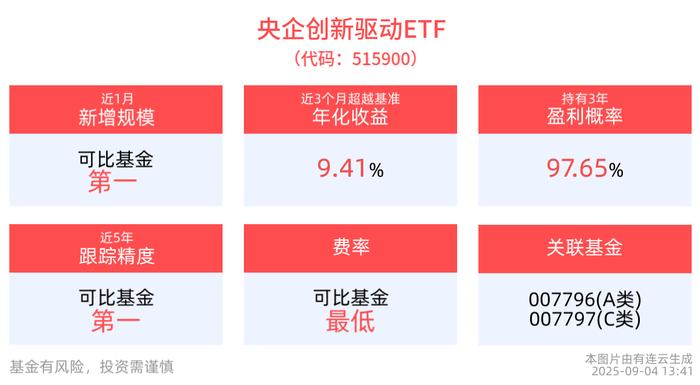
电网智能、能源低碳板块收入快速增长,央企创新驱动ETF(515900)近1月新增规模居可比基金首位
Xin Lang Cai Jing· 2025-09-04 06:33
Group 1 - The China Central Enterprises Innovation-Driven Index decreased by 1.64% as of September 4, 2025, with mixed performance among constituent stocks [3] - Nanjing South Network Technology led the gains with an increase of 3.18%, while Changfei Optical Fiber experienced the largest decline at 10.00% [3] - The Central Enterprises Innovation-Driven ETF (515900) fell by 1.42%, with the latest price at 1.52 yuan, but showed a 2.18% increase over the past month [3] Group 2 - The Central Enterprises Innovation-Driven ETF saw a significant scale increase of 42.68 million yuan over the past month, ranking in the top quarter among comparable funds [4] - The index tracks 100 representative listed companies from state-owned enterprises, reflecting the overall performance of innovative and profitable central enterprises [4] - As of August 29, 2025, the top ten weighted stocks in the index accounted for 33.39% of the total, including Hikvision, Guodian NARI, and Chang'an Automobile [4] Group 3 - Guodian NARI reported a revenue of 24.243 billion yuan for the first half of 2025, marking a year-on-year growth of 19.54%, with significant contributions from its smart grid and low-carbon energy segments [3] - The company's overseas revenue surged by 139.18% to 1.987 billion yuan, indicating strong international performance [3] - Guotai Junan Securities highlighted the company's strengthening position in the industry and robust growth potential driven by the construction of new power systems and energy frameworks [3]
A50,重大调整!这几只“翻倍股”被纳入
天天基金网· 2025-09-04 05:09
Core Viewpoint - FTSE Russell announced quarterly review changes for multiple indices, effective after the close on September 19, 2025, with significant implications for the FTSE China A50 Index [2][5]. Group 1: Index Changes - The FTSE China A50 Index will include stocks such as BeiGene-U, NewEase, WuXi AppTec, and Zhongji Xuchuang, which are primarily from the pharmaceutical and AI computing sectors [3][6]. - Stocks removed from the FTSE China A50 Index include China Nuclear Power, China Unicom, Guodian Nari, and Wanhua Chemical [6][7]. - The FTSE China A50 Index consists of the 50 largest stocks listed on the Shanghai and Shenzhen exchanges, reviewed quarterly [7]. Group 2: Stock Performance - BeiGene-U has doubled in value this year, with a growth rate of 102.51%, and a market capitalization of approximately 466.4 billion [7]. - WuXi AppTec also experienced a doubling in its stock price, while NewEase surged over three times, and Zhongji Xuchuang increased by over 240%, with a market cap exceeding 470 billion [7]. Group 3: Market Trends - The inclusion of stocks in the FTSE Russell indices often leads to significant buying pressure from index-tracking funds, particularly around the effective date of the changes [8]. - The AI computing sector is expected to see explosive growth in demand as it plays a crucial role in the AI industry, impacting various segments of the supply chain [11]. - The pharmaceutical sector is experiencing a shift towards innovation-driven growth, with a focus on value creation through new drug models, which is anticipated to result in greater market capitalization increases compared to previous cycles [11].



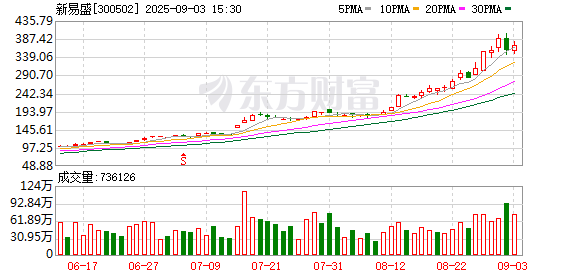
新易盛、中际旭创等 纳入富时中国A50指数
Zhong Guo Zheng Quan Bao· 2025-09-03 15:50
Group 1 - FTSE Russell announced changes to the FTSE China 50 Index, FTSE China A50 Index, FTSE China A150 Index, FTSE China A200 Index, and FTSE China A400 Index, with the most notable inclusion being BeiGene, NewEase, WuXi AppTec, and Zhongji Innolight, while excluding China National Nuclear Power, China United Network Communications, NARI Technology Development, and Wanhua Chemical Group [2][4] - The changes will take effect after the market closes on September 19, 2023, and will officially be implemented on September 22, 2023 [2] - Zhongji Innolight's stock price surged approximately 11% on September 3, reaching a historical high with a market capitalization exceeding 470 billion yuan, ranking second on the ChiNext board [7] Group 2 - The newly included companies in the FTSE China A50 Index are primarily from the innovative drug and optical module sectors, which have shown significant stock price increases this year [4] - The FTSE China A50 Index's reserve list includes Minsheng Bank, CMOC Group, Hithink RoyalFlush Information Network, SAIC Motor, and Seres Group, which may be activated if any of the current constituents are removed before the next quarterly review [7][8]