
TONGWEI CO.,LTD(600438)

Search documents
去年中国GDP增长5%,多家手机厂商下调出货预期 | 财经日日评
吴晓波频道· 2026-01-20 00:30
Economic Overview - In 2025, China's GDP reached 1401879 billion yuan, growing by 5% year-on-year, with quarterly growth rates of 5.4%, 5.2%, 4.8%, and 4.5% respectively [2] - The industrial added value increased by 5.9%, while the service sector grew by 5.4%. Retail sales totaled 501202 billion yuan, up by 3.7% [2] - Fixed asset investment decreased by 3.8%, with a notable decline in real estate investment [3] Trade and Investment - Canada has reduced the import tax on Chinese electric vehicles to 6.1%, allowing an annual quota of 49,000 vehicles, which is a significant policy shift aimed at filling market gaps [4][5] - The adjustment in tariffs is expected to enhance the competitiveness of Chinese electric vehicles in the Canadian market, which has seen a decline in sales due to high costs and tariffs [5] Real Estate Market - In December 2025, new home prices in first-tier cities fell by 0.3%, with a notable increase in Shanghai, while overall new home sales area decreased by 8.7% year-on-year [6] - The real estate market is still in a bottoming phase, with a significant reduction in new supply and ongoing inventory pressure [7] Mobile Phone Industry - Several smartphone manufacturers, including Xiaomi and OPPO, have lowered their annual shipment forecasts due to rising storage costs, with reductions exceeding 20% for some brands [8] - The impact of rising storage prices is uneven across manufacturers, with larger firms like Apple and Samsung less affected [9] Solar Industry - Nine leading solar companies, including LONGi Green Energy and Tongwei Co., have announced expected losses for 2025, with Tongwei projecting a loss of 90 to 100 billion yuan [10] - The solar industry is facing significant challenges, including high inventory levels and price competition, leading to a prolonged period of losses [11] Wealth Disparity - The global wealth of billionaires reached a record 18.3 trillion USD in 2025, with a 16% increase in total wealth, highlighting a growing wealth gap amid stagnant poverty reduction efforts [12][13] - The AI sector's growth has significantly contributed to the increase in billionaire wealth, while ordinary residents face declining purchasing power due to inflation [13] Space Tourism - A startup has announced the opening of reservations for the world's first lunar hotel, aiming to begin operations by 2032, although the feasibility of such a project remains uncertain [14][15]





白银价格再创新高 光伏行业成本攀升
Xin Lang Cai Jing· 2026-01-19 18:12
Core Viewpoint - The surge in silver prices is significantly impacting the photovoltaic (PV) industry, leading to increased operational pressures and projected losses for major companies in the sector [1][2]. Group 1: Silver Price Impact - International silver prices have recently surpassed $94 per ounce, contributing to heightened costs for PV companies already facing two years of losses [1]. - The cost of silver has increased over threefold in the past year, now accounting for 29% of the total cost of solar panels, compared to 3.4% in 2023 and 14% last year [2]. Group 2: Company Performance Forecasts - Tongwei Co. anticipates a net loss of approximately 9 billion to 10 billion yuan for 2025, citing rising silver prices and declining product prices as key factors [1]. - TCL Zhonghuan, a leading PV silicon wafer manufacturer, expects a net loss between 8.2 billion to 9.6 billion yuan, attributing this to ongoing supply-demand imbalances despite growth in new installations [2]. - Longi Green Energy forecasts a net loss of 6 billion to 6.5 billion yuan for 2025, with significant cost increases in silver paste and silicon materials further straining operations [2]. Group 3: Industry Response - Some component manufacturers have raised prices to reflect the increased costs of silver, while the industry is also exploring technological adjustments to mitigate these pressures [2]. - Longi Green Energy has completed pilot tests for replacing silver paste with cheaper materials and is beginning large-scale production of these alternatives [2].
喜娜AI速递:今日财经热点要闻回顾|2026年1月19日
Xin Lang Cai Jing· 2026-01-19 12:00
Group 1 - Trump's threat to impose tariffs on Denmark and other European countries has led to significant market volatility, with European stock markets declining and a surge in demand for safe-haven assets like gold and silver [2][7] - The China Securities Regulatory Commission (CSRC) has outlined key tasks for 2026, focusing on market stability, regulatory enforcement, and promoting the development of listed companies [2][7] - Five leading solar companies, including Tongwei Co. and Longi Green Energy, have announced a combined expected loss exceeding 28.9 billion yuan due to industry challenges such as supply-demand imbalances and rising raw material costs [2][7] Group 2 - Tesla's CEO Elon Musk has announced the restart of the Dojo 3 project, with the new AI5 chip expected to have five times the computing power of the current HW4 chip, impacting the rollout of full self-driving capabilities [3][8] - Rare earth prices have been rising, with a projected supply-demand gap of 140,000 tons by 2030, driven by strong demand from the global electric vehicle sector [3][8] - Several small and medium-sized banks have raised deposit rates as part of a strategy to attract deposits amid low net interest margins, although future rates may stabilize or slightly decrease [3][9] Group 3 - Rongbai Technology is under investigation by the CSRC for misleading statements regarding a significant contract, raising concerns about its ability to fulfill orders due to production capacity issues [4][9] - The minimum margin requirement for financing purchases on the Shanghai and Shenzhen stock exchanges has been increased from 80% to 100% for new contracts, aimed at controlling market leverage risks [4][9] - The 2025 Hurun Report has ranked Cambrian as the top AI company in China, valued at 630 billion yuan, with an increasing number of AI chip companies listed, reflecting a shift towards domestic computing power independence [5][10]


超300份预告折射产业冷暖,业绩驱动取代概念博弈成市场主线
第一财经网· 2026-01-19 10:13
Core Viewpoint - The A-share market is experiencing a clear divergence in industry performance as over 350 companies have released their 2025 earnings forecasts, highlighting strong growth in the semiconductor and non-ferrous metals sectors, while the photovoltaic industry faces significant losses due to overcapacity and price competition [1] Semiconductor Industry - The semiconductor sector is benefiting from the global AI infrastructure wave and rising storage chip prices, with leading companies like 澜起科技 (Lianqi Technology) forecasting a net profit of 2.15 billion to 2.35 billion yuan for 2025, representing a year-on-year growth of 52.29% to 66.46% [2] - 佰维存储 (Baiwei Storage) expects to achieve record revenue of 10 billion to 12 billion yuan, with a net profit forecast of 850 million to 1 billion yuan, reflecting a staggering year-on-year growth of 427.19% to 520.22% [2] Photovoltaic Industry - The photovoltaic sector is struggling with overcapacity, low prices, and rising raw material costs, leading to significant losses among leading companies. 通威股份 (Tongwei Co.) anticipates a net loss of 9 billion to 10 billion yuan, while TCL中环 (TCL Zhonghuan) expects a loss of 8.2 billion to 9.6 billion yuan [3] - The total projected losses for major photovoltaic companies have exceeded 32 billion yuan, with several firms reporting substantial deficits [3] Real Estate Industry - The real estate sector is also under pressure, with companies like 华夏幸福 (China Fortune Land Development) forecasting a net loss of 16 billion to 24 billion yuan, attributed to insufficient market demand and weak social expectations [4] Non-Ferrous Metals Industry - The non-ferrous metals sector has seen significant price increases, benefiting from global monetary easing and fiscal expansion, with companies reporting strong earnings growth. For instance, 紫金矿业 (Zijin Mining) expects a net profit of 51 billion to 52 billion yuan, a year-on-year increase of 59% to 62% [5][6] - The performance of the rare earth sector is also notable, with 北方稀土 (Northern Rare Earth) projecting a net profit of 2.176 billion to 2.356 billion yuan, reflecting a year-on-year growth of 116.67% to 134.60% [7] Concept Stocks and Emerging Industries - Emerging sectors like commercial aerospace and AI applications are facing challenges, with many companies reporting losses despite previous market enthusiasm. For example, 上海瀚讯 (Shanghai Hanxun) and 三维通信 (Sanwei Communication) are expected to incur losses in 2025 [8][9] - 中文在线 (Zhongwen Online) anticipates a net loss of 580 million to 700 million yuan, driven by high promotional costs in its overseas short drama business [9]

超3300只个股上涨
第一财经· 2026-01-19 03:53
Market Overview - The Shanghai Composite Index rose by 0.13% at midday, while the Shenzhen Component Index fell by 0.01%, the ChiNext Index dropped by 0.64%, and the Sci-Tech Innovation Index decreased by 0.19% [3]. - The total trading volume in the Shanghai and Shenzhen markets reached 1.79 trillion yuan, a decrease of 198.5 billion yuan compared to the previous trading day, with over 3,300 stocks rising [6]. Sector Performance - The ultra-high voltage concept stocks surged, with companies like China Xidian hitting the daily limit, and several other stocks in the electric grid equipment sector also saw significant gains [5][6]. - The retail and tourism sectors experienced a rally, with Xinhua Department Store hitting the daily limit and Guangbai Co. rising over 7% [6]. - The AI application sector showed signs of recovery, with Tianqi Co. reaching the daily limit and other companies like Giant Network and Shiji Information also performing well [7]. Notable Stocks - Cambridge Technology hit the daily limit down, despite forecasting a 51%-67% year-on-year increase in net profit for 2025, as Q4 performance fell short of expectations [7]. - Yongjiang Co. reached the daily limit after announcing plans to acquire 98.54% of Yongqiang Technology [11]. - Tongwei Co. opened down over 5%, with an expected net loss of approximately 9 to 10 billion yuan for 2025 [12]. Economic Indicators - The People's Bank of China conducted a 7-day reverse repurchase operation of 158.3 billion yuan at an interest rate of 1.40%, with 86.1 billion yuan of reverse repos maturing today [12].


钧达股份3000万元投资抢滩太空光伏! 特变电工涨超7%,光伏龙头ETF(516290)爆量涨超1%冲击四连阳!2026年最强电新主线确定了?
Xin Lang Cai Jing· 2026-01-19 03:01
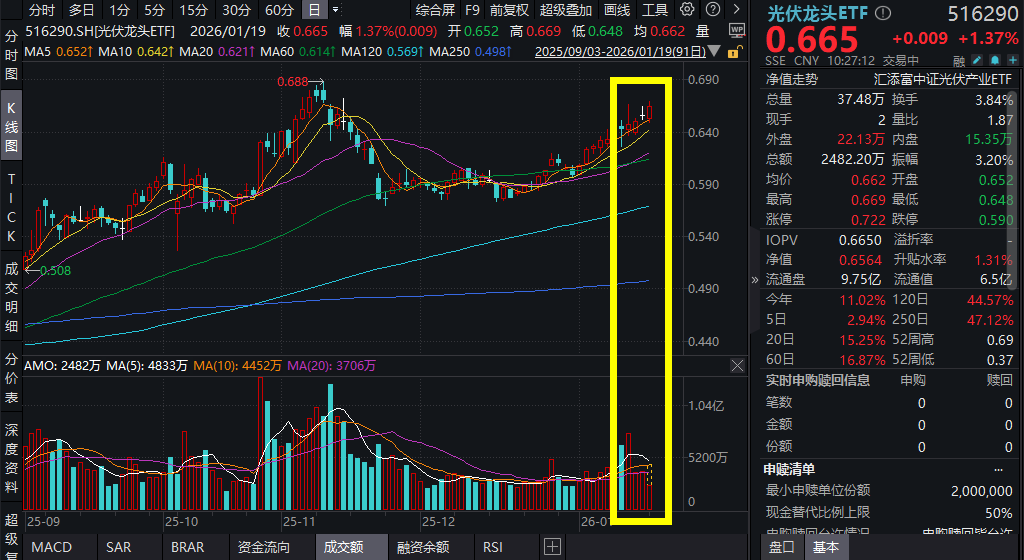
Core Viewpoint - The A-share market experienced fluctuations with the photovoltaic leader ETF (516290) seeing a significant increase of 1.37%, with a trading volume exceeding 30 million yuan, marking a four-day consecutive rise in daily performance [1]. Group 1: Market Performance - The photovoltaic leader ETF (516290) showed mixed performance among its constituent stocks, with TBEA rising over 7%, Maiwei Co. and Chint Electric increasing over 5%, while Longi Green Energy and Jiejia Weichuang experienced pullbacks [3]. - The top ten constituent stocks of the photovoltaic leader ETF include TBEA, which rose by 7.07%, and TCL Technology, which increased by 2.90%, while Longi Green Energy fell by 2.24% [4]. Group 2: Industry Developments - Junda Co. announced a 30 million yuan investment in Shanghai Xingyi Chip Energy Technology Co., aiming to leverage opportunities in the low-orbit satellite networking and space computing industry, enhancing capabilities in photovoltaic industrialization and perovskite technology [5]. - Space photovoltaic energy is highlighted as a strategic solution for commercial space and high-end applications, with the potential to supply energy to satellites and space stations, marking a pivotal moment for the industry [5]. Group 3: Future Outlook - Huaxi Securities emphasizes that photovoltaic technology is the only viable energy solution in space, with advantages over traditional fossil fuels and nuclear energy, making it suitable for extreme environments [5]. - According to CITIC Securities, the space photovoltaic market is expected to reach a trillion yuan scale, with satellite launches projected to increase from 5,000 to 50,000 between 2025 and 2040, driving demand for photovoltaic batteries from 0.024 GW to 1.8 GW [5]. - Guojin Securities expresses strong confidence in "space photovoltaic" becoming a dominant theme in the energy sector through 2026, driven by surging demand and the urgency for resource competition [6].




两大光伏龙头去年预亏超150亿,“亏损王”开盘大跌
Di Yi Cai Jing Zi Xun· 2026-01-19 02:48
Core Viewpoint - Two major photovoltaic companies, Tongwei Co., Ltd. and Longi Green Energy, are expected to report significant net losses for the year 2025, with Tongwei projected to lose between 9 billion to 10 billion yuan and Longi between 6 billion to 6.5 billion yuan, totaling a maximum of 16.5 billion yuan in losses for both companies [2][3]. Company Performance - Tongwei Co., Ltd. anticipates a net loss due to a combination of factors including a slowdown in new installations, an industry-wide supply surplus, and rising costs of core raw materials [3][4]. - Longi Green Energy cites ongoing supply-demand mismatches, low operating rates, and increased costs of silver paste and silicon materials as key reasons for its expected losses [2][3]. - TCL Zhonghuan also reported a projected loss of 8.2 billion to 9.6 billion yuan, attributing it to insufficient market demand and price declines [3]. Industry Trends - The photovoltaic industry is experiencing a prolonged period of losses, with many leading companies reporting negative earnings for nine consecutive quarters [4]. - The average market transaction price for photovoltaic modules is expected to remain low, around 0.6 yuan per watt by mid-2025, due to intense competition and insufficient end-user demand [2]. - The industry is witnessing a significant decline in production volumes, with polysilicon output down by 29.6% and silicon wafer production down by 6.7% year-on-year [5]. Financial Implications - Tongwei Co., Ltd. has reported asset impairment provisions of approximately 1.5 billion to 2 billion yuan, primarily due to technological changes and market demand fluctuations [3][4]. - Companies like Yijing Photovoltaic have warned that their net assets may turn negative, which could lead to delisting risks if confirmed [4].

两大光伏巨头预亏 银价成关键词
Xin Hua Wang· 2026-01-19 02:21
Core Viewpoint - Both Tongwei Co. and Longi Green Energy forecast significant losses for 2025, driven by rising raw material costs and declining product prices, leading to increased operational pressure in the photovoltaic industry [1][2][4]. Group 1: Tongwei Co. - Tongwei Co. expects a net loss of approximately 9 billion to 10 billion yuan for 2025, which is an increase from a net loss of 7.039 billion yuan in 2024 [2]. - The company anticipates that the growth in new photovoltaic installations will slow down significantly in the second half of 2025, exacerbating the industry's supply surplus and operational challenges [2]. - Tongwei's losses are attributed to various factors, including a decline in the operating rates across the industry, rising prices of key raw materials like silver, and a continued drop in product prices [2][3]. Group 2: Longi Green Energy - Longi Green Energy projects a net loss of 6 billion to 6.5 billion yuan for 2025, which is a reduction from a net loss of approximately 8.592 billion yuan in 2024 [4]. - The company cites ongoing supply-demand mismatches and intense price competition in the photovoltaic sector, alongside rising costs for silver paste and silicon materials, as key challenges for its operations [4][5]. - Longi is focusing on differentiating its products through high-value solutions and has begun scaling up production of its silver paste alternative technology, which is expected to enhance its competitive edge [5]. Group 3: Industry Overview - The photovoltaic industry is facing significant operational pressures due to structural overcapacity, with companies like Aiko Solar also predicting losses for 2025, estimating a net loss of 1.2 billion to 1.9 billion yuan [5][6]. - The overall market is characterized by low product prices and rising raw material costs, which are impacting profitability across the sector [6].
两大光伏龙头25年合计预亏超150亿,“亏损王”通威股份开盘跌超5%
Di Yi Cai Jing Zi Xun· 2026-01-19 02:08
Core Viewpoint - Major photovoltaic companies Tongwei Co., Ltd. and Longi Green Energy are expected to report significant net losses for the year 2025, with Tongwei projected to lose between 9 billion to 10 billion yuan and Longi between 6 billion to 6.5 billion yuan, totaling a maximum of 16.5 billion yuan in losses for both companies [1] Group 1: Company Performance - Tongwei Co., Ltd. is identified as the "loss leader" among disclosed photovoltaic companies, with a projected loss of 9 billion to 10 billion yuan for 2025 [1] - Longi Green Energy anticipates a loss of 6 billion to 6.5 billion yuan for the same period, citing ongoing supply-demand mismatches and low-price competition as key factors [1] - TCL Zhonghuan also expects a loss of 8.2 billion to 9.6 billion yuan, attributing it to insufficient market demand and price declines [2] Group 2: Industry Challenges - The photovoltaic industry is facing a supply-demand mismatch, leading to prolonged low prices for photovoltaic components, with market transaction prices around 0.6 yuan per watt expected by mid-2025 [1] - Rising costs of key raw materials, such as silver paste and silicon materials, have further pressured the profitability of companies like Longi Green Energy [1] - The overall production growth in the photovoltaic manufacturing sector has slowed, with significant declines in the output of polysilicon and silicon wafers, marking the first year-on-year decrease in years [4] Group 3: Financial Adjustments - Tongwei Co., Ltd. has reported a significant increase in asset impairment provisions, estimating between 1.5 billion to 2 billion yuan due to market demand changes and technological iterations [2] - The company has also indicated that it will write down approximately 1 billion yuan related to certain photovoltaic power station businesses [2] Group 4: Market Trends - The photovoltaic industry has experienced nine consecutive quarters of losses since the fourth quarter of 2023, with many leading companies continuing to report negative earnings [3] - As of November 2025, prices across various segments of the photovoltaic supply chain have increased compared to the beginning of the year, although silicon material prices have seen a significant decline of 38.9% from the start of the year [3]
通威股份:2025年年度业绩预告
Zheng Quan Ri Bao Wang· 2026-01-19 01:49
证券日报网讯1月18日,通威股份(600438)发布公告称,公司预计2025年年度实现归属于母公司所有 者的净利润约为-90亿元至-100亿元,扣除非经常性损益后净利润同为-90亿元至-100亿元。 ...