Tsingtao Brewery(600600)

Search documents
青岛啤酒要卖黄酒了
Sou Hu Cai Jing· 2025-05-10 11:42
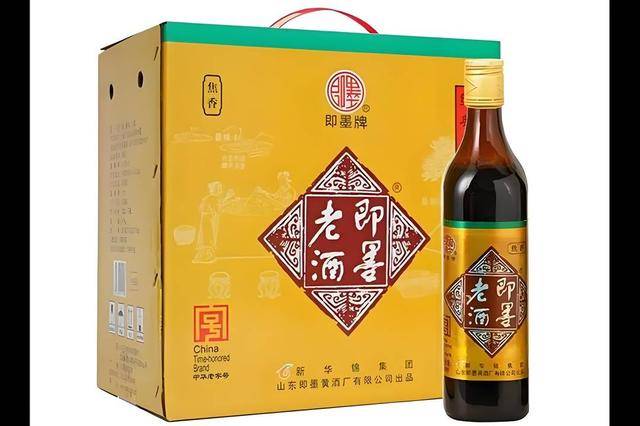
Core Viewpoint - Qingdao Beer plans to acquire 100% equity of Jimo Huangjiu Factory for 665 million yuan, aiming to enhance industry synergy and competitiveness in the beverage market [2][4][9]. Group 1: Acquisition Details - The acquisition involves Qingdao Beer purchasing the entire stake from Xinhua Jin Group and Shandong Lujin Import and Export Group, with a total consideration of 665 million yuan plus any profit or loss adjustments during the price adjustment period [2][4]. - Jimo Huangjiu, established in 1949, is a well-known brand in the Chinese Huangjiu market, recognized for its unique flavor profile [4][8]. - In 2024, Jimo Huangjiu reported a revenue of 166 million yuan, a year-on-year increase of 13.5%, and a net profit of 30.47 million yuan, up 38% [4]. Group 2: Market Context - The beer industry is facing intensified competition, with major players like Qingdao Beer experiencing revenue declines; in 2024, Qingdao Beer reported a revenue of 32.138 billion yuan, down 5.3% from the previous year [9][11]. - The overall beer market in China saw a slight decline in production, with a total output of 35.213 million kiloliters in 2024, down 0.6% year-on-year [11]. - As part of a broader trend, beer giants are diversifying their portfolios; for instance, China Resources Beer has entered the white liquor market, while Qingdao Beer is expanding into Huangjiu [11][12]. Group 3: Strategic Implications - The acquisition is expected to broaden Qingdao Beer's product line and market channels, providing consumers with more diverse options and enhancing market influence [8][9]. - The integration of Jimo Huangjiu is anticipated to create complementary sales effects between beer and Huangjiu products, potentially opening new growth avenues for Qingdao Beer [8][9]. - The Huangjiu market, while smaller than beer, is characterized by regional strengths and specific consumer preferences, with Jimo Huangjiu representing the northern style of Huangjiu [13][14].


青岛啤酒6.65亿并购黄酒厂,能否打造业绩增长新引擎?
Sou Hu Cai Jing· 2025-05-09 15:25
Core Viewpoint - Qingdao Beer has announced a significant acquisition of Shandong Jimo Yellow Wine Factory for 665 million yuan, marking a strategic move to diversify its business beyond beer and tap into the yellow wine market [1][3]. Group 1: Acquisition Details - The acquisition involves Qingdao Beer fully acquiring Jimo Yellow Wine, a company with over 70 years of history known for its "Jimo Old Wine" and a diverse product line including yellow wine, sparkling wine, and white liquor [1]. - The investment of 665 million yuan aims to integrate Jimo Yellow Wine as a wholly-owned subsidiary, enhancing Qingdao Beer's product offerings and market reach [1]. Group 2: Industry Context - The beer industry is facing growth challenges, with domestic market saturation leading to declining sales and revenue, prompting companies like Qingdao Beer to seek new growth avenues [3]. - The seasonal sales complementarity between beer and yellow wine is seen as a potential solution to Qingdao Beer's fourth-quarter losses, as beer sales peak in summer while yellow wine performs better in spring and winter [3]. Group 3: Diversification Strategy - Qingdao Beer is accelerating its diversification efforts, as indicated by its strategic restructuring with Qingdao Beverage Group, which includes brands in various alcoholic beverage categories [4]. - The challenges of diversification are highlighted by the example of China Resources Beer, which faced difficulties in its foray into the white liquor market despite significant investment [4]. - The success of Qingdao Beer's expansion into the yellow wine sector remains uncertain, as the overall yellow wine market is experiencing a decline [3][4].
啤酒行业步入瓶颈,青岛啤酒斥资6.65亿向黄酒寻增量
Guan Cha Zhe Wang· 2025-05-09 13:55
Core Viewpoint - Qingdao Beer is expanding into the yellow wine sector by acquiring 100% of Jimo Yellow Wine for 665 million yuan, marking a strategic diversification effort [1][2]. Group 1: Acquisition Details - The acquisition involves a total payment of 6.65 billion yuan plus adjustments for profit and loss during the price adjustment period [1]. - Jimo Yellow Wine, established in 1949, has a registered capital of 55 million yuan and is a significant player in the yellow wine industry [2]. - In 2024, Jimo Yellow Wine reported a revenue of 166 million yuan, a year-on-year increase of 13.5%, and a net profit of 30.47 million yuan, up 38.0% [2]. Group 2: Strategic Rationale - The acquisition is part of Qingdao Beer's strategy to diversify its business beyond beer, aiming to create new growth opportunities [2][3]. - The complementary seasonal sales patterns of beer and yellow wine are expected to enhance overall sales stability, with beer sales peaking in summer and yellow wine in autumn and winter [2]. Group 3: Industry Context - The beer industry is experiencing a contraction, with Qingdao Beer reporting a revenue decline of 5.3% to 32.138 billion yuan in 2024, while net profit increased by 1.81% to 4.345 billion yuan [3]. - The yellow wine sector is facing challenges, with significant performance disparities among leading companies, as evidenced by the sharp profit drop of the industry leader, Guyue Longshan, which saw a 48.17% decline in net profit [5]. Group 4: Market Implications - The acquisition signals a shift in the Chinese liquor industry from single-category competition to an ecosystem-based approach, with Qingdao Beer leveraging its extensive distribution network to support Jimo Yellow Wine's market expansion [5][6]. - The market reacted positively to the acquisition, with stock prices of major yellow wine companies rising following the announcement [7].
融中回顾 | 老铺黄金再募资27亿港元 青岛啤酒拟收购即墨黄酒
Sou Hu Cai Jing· 2025-05-09 11:24
Group 1: Mubadala Investment Fund - Mubadala, the second-largest sovereign fund in the UAE, reported an asset management scale of approximately 2.4 trillion RMB, reflecting a year-on-year growth of 9.1% [2] - The fund achieved a five-year annualized return rate of 10.1% [2] - Mubadala has invested nearly 17 billion USD (approximately 123 billion RMB) in China over the past decade, covering over 100 projects across various sectors including consumer, healthcare, and industrial services [2] - The fund is focusing on late-stage merger and acquisition investment opportunities in the Chinese market [2] Group 2: Open Source China - Open Source China, founded by Ma Yue, has undergone multiple transformations, evolving from a community to a code hosting platform [3] - The platform has become the second-largest code hosting platform globally, with over 18 million developers [3] - Open Source China's DevOps toolchain has achieved an 80% market penetration in critical sectors such as finance and military [3] Group 3: Aoshark Intelligent - Aoshark Intelligent, a high-tech company, has completed two rounds of strategic financing, led by Binfu Capital [4] - The company aims to expand its "thousand-yuan exoskeleton" product line and enhance core technology through this financing [4] - Aoshark Intelligent is positioning itself to tap into the consumer market while solidifying its industrial application base [4] Group 4: Qingdao Beer - Qingdao Beer announced plans to acquire 100% equity of Jimo Yellow Wine for 665 million RMB [6] - The acquisition will make Jimo Yellow Wine a wholly-owned subsidiary of Qingdao Beer [6] Group 5: PMI Capital - PMI Capital is reportedly undergoing a significant strategic adjustment, planning to close its offices in Hong Kong and Shanghai within the next 18 months [5] - The firm intends to increase its focus on Indian companies moving forward [5]
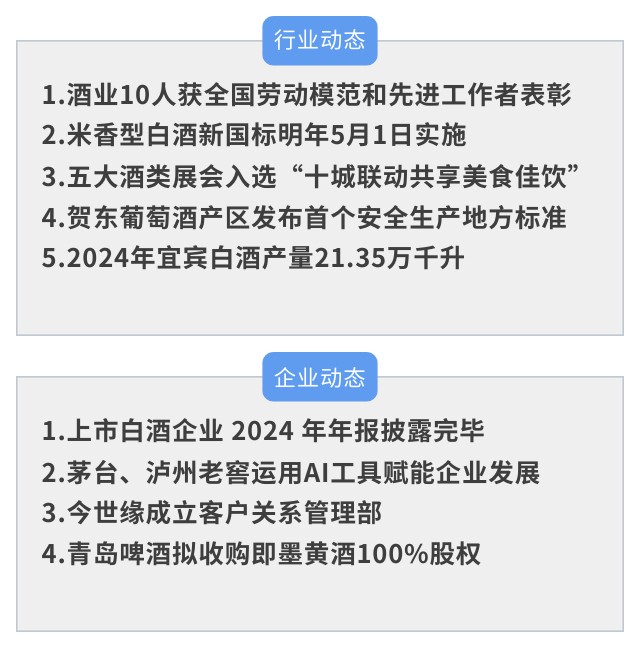
中经酒业周报∣酒业10人获全国劳动模范和先进工作者表彰,米香型白酒新国标明年5月1日实施
Xin Hua Cai Jing· 2025-05-09 10:05
Industry Dynamics - Ten individuals from the liquor industry were recognized as national labor models and advanced workers at a ceremony celebrating the 100th anniversary of the All-China Federation of Trade Unions [3] - A new national standard for rice-flavored liquor will be implemented on May 1, 2026, focusing on sensory quality and production process control, which aims to enhance consumer perception and trust in the product [5] - Five major liquor exhibitions have been included in the "Ten Cities Linkage Sharing Food and Drink" initiative for 2025, organized by various government departments [6] - The first local safety production standard for the Helan Mountain East Ridge wine region will take effect on June 3, 2025, providing guidelines for safety hazard inspections in wine production [7] - Yibin's projected liquor production for 2024 is 213,500 kiloliters, reflecting a year-on-year decrease of 3.6% [7] Company Dynamics - As of April 30, 2024, 21 listed liquor companies reported a total revenue of 443.96 billion yuan, a year-on-year increase of 7.63%, and a net profit of 167.72 billion yuan, up 6.79% [8] - In Q1 2025, 19 listed liquor companies achieved a revenue of 149.32 billion yuan, growing by 2.20%, and a net profit of 63.11 billion yuan, increasing by 2.26% [10] - Major companies like Kweichow Moutai and Luzhou Laojiao are leveraging AI tools to enhance brand influence and operational efficiency [11] - Jiangsu Jinshiyuan has established a Customer Relationship Management Department to improve internal management and resource allocation [11] - Qingdao Beer plans to acquire 100% equity of Shandong Jimo Yellow Wine Factory for 665 million yuan [12]






青岛啤酒 6.65 亿元跨界黄酒:主业承压下的多元化突围与协同效应考验
Xin Lang Zheng Quan· 2025-05-09 09:22
Core Viewpoint - Qingdao Beer is strategically shifting towards diversification by acquiring 100% equity of Shandong Jimo Yellow Wine Factory for 665 million yuan, in response to stagnating growth in its core beer business [1][2] Group 1: Beer Business Challenges - Qingdao Beer has faced significant growth pressure, with 2024 revenue declining by 5.3% to 32.138 billion yuan, ending three consecutive years of growth [2] - Net profit for 2024 was 4.345 billion yuan, showing only a 1.81% increase, a sharp decline from the previous year's 17.59% growth [2] - Beer sales volume dropped by 5.9% to 7.54 million tons, marking two consecutive years of negative growth, with mid-to-high-end product sales also declining for the first time [2] Group 2: Yellow Wine Acquisition - The acquisition of Jimo Yellow Wine is seen as a strategic move to enhance Qingdao Beer's product portfolio, with Jimo Yellow Wine achieving 2024 revenue of 166 million yuan and a net profit of 30.47 million yuan, both showing significant growth [3] - The complementary nature of beer and yellow wine consumption patterns is highlighted, as beer sales peak in summer while yellow wine is favored in autumn and winter [3] - However, the yellow wine industry faces regional limitations, with leading companies like Kuaijishan and Guyue Longshan deriving over 50% of their revenue from specific regions, indicating slow national expansion [3] Group 3: Synergy and Challenges - Qingdao Beer aims to leverage its extensive distribution network of 11,600 dealers covering over 90% of county-level markets to support Jimo Yellow Wine's growth [4] - The integration of Jimo Yellow Wine into Qingdao Beer's existing beverage portfolio poses challenges, including consumer perception differences and potential brand conflicts [4] - The competitive landscape is intense, with established yellow wine brands having a significant head start in national markets, raising questions about Jimo Yellow Wine's ability to differentiate itself [4] Group 4: Industry Trends - The acquisition reflects a broader trend in the beer industry, where major players are diversifying to create multi-category portfolios amid intense competition [5] - Financially, Jimo Yellow Wine's contribution to Qingdao Beer's profits is minimal, accounting for only 0.7% of total net profit, indicating that the strategic value may outweigh immediate financial benefits [5] - The move is part of a larger strategy to mitigate risks associated with the cyclical nature of the beer business and tap into the health and wellness market through yellow wine's perceived benefits [5] Group 5: Future Outlook - The acquisition signifies a shift from single-category competition to a multi-faceted ecosystem in the Chinese alcohol industry, driven by consumer trends and market dynamics [6] - The success of this transition will depend on the ability to reconstruct consumption scenarios, iterate product logic, and enhance organizational capabilities [6] - The potential for Jimo Yellow Wine to become a significant growth driver for Qingdao Beer remains uncertain, as the company navigates the complexities of this new venture [6]
超级品牌概念涨0.19%,主力资金净流入这些股
Zheng Quan Shi Bao Wang· 2025-05-09 09:07
Core Viewpoint - The Super Brand concept index experienced a slight increase of 0.19%, ranking 7th among concept sectors, with 21 stocks rising and notable performances from companies like Dengkang Dental and others [1][2]. Group 1: Stock Performance - Dengkang Dental achieved a maximum increase of 10.00%, while Xiaoshangpin, Yangyuan Beverage, and Op Lighting saw increases of 3.03%, 2.32%, and 1.83% respectively [1][5]. - The stocks with the largest declines included Lianhua Holdings, Zhonggong Education, and Zhu Laoliu, which fell by 2.98%, 2.85%, and 1.90% respectively [1][5]. Group 2: Capital Flow - The Super Brand concept sector saw a net inflow of 194 million yuan, with 17 stocks receiving net inflows, and 5 stocks exceeding 10 million yuan in net inflow [2][3]. - BYD led the net inflow with 621.17 million yuan, followed by Midea Group, Qingdao Beer, and TCL Technology with net inflows of 149.18 million yuan, 33.77 million yuan, and 25.20 million yuan respectively [2][3]. Group 3: Capital Inflow Ratios - The top net inflow ratios were recorded for BYD at 11.90%, Qingdao Beer at 10.63%, and Midea Group at 8.01% [3][4]. - Other notable companies with positive inflow ratios included Yunnan Baiyao and Qingdao Double Star, with ratios of 3.84% and 7.31% respectively [3][4].



食饮吾见 | 一周消费大事件(5.2-5.9)
Cai Jing Wang· 2025-05-09 08:46
Group 1: Guizhou Moutai - Guizhou Moutai announced that Zhang Yixing has become the brand ambassador for its cultural tourism [1] Group 2: Qingdao Beer - Qingdao Beer plans to acquire 100% equity of Shandong Jimo Yellow Wine Factory for a total consideration of RMB 66.5 million [2] - The acquisition aims to enhance industry synergy and competitiveness, expanding the company's non-beer business and product line [2] - The integration of Jimo Yellow Wine is expected to create complementary sales effects between seasonal products, enhancing market competitiveness [2] Group 3: Jin Zai Food - Jin Zai Food has launched its soft-boiled quail eggs in select stores of Pang Dong Lai, with no current plans to invest in snack chain stores [3] Group 4: Jiahe Food - Jiahe Food's coffee business focuses more on online branding, with significant investment in brand promotion [4] - The company plans to control overall expense ratios to mitigate impacts on profits while expanding its C-end business through online platforms [4] Group 5: Uni-President China - Uni-President China reported an unaudited net profit of RMB 602 million for the first quarter ending March 31, 2025 [5] Group 6: Anjiexin Food - Anjiexin Food is adjusting its 2025 new product strategy, differentiating between B-end and C-end approaches [6] - The company will focus on product innovation and competitive pricing, with plans to launch various new products in the frozen food category [6] Group 7: Market Regulation - The State Administration for Market Regulation has initiated a special action to address the production and sale of counterfeit and substandard meat products from April to December 2025 [7][8] Group 8: Food Additives - The State Council's Food Safety Office and other departments have launched a comprehensive governance plan to address the abuse of food additives, focusing on illegal practices and enhancing regulatory measures [9] Group 9: Naixue Tea - Naixue Tea has rebranded with a new logo "Naisnow" and is set to open its first store in the U.S. in Flushing, New York [10] Group 10: Cha Baidao - Cha Baidao's flagship store in Chengdu has begun trial operations, featuring a menu that includes ice cream and special tea cocktails with premium spirits [11] Group 11: Xiaobuxiang - Xiaobuxiang reported an 18.85% increase in revenue during the May Day holiday, with plans to open 80 new stores this year [12] Group 12: Estee Lauder - Estee Lauder reported a 9.8% decline in sales to $3.55 billion for Q3, with organic sales in China showing double-digit growth for specific brands [14][15] Group 13: Pang Dong Lai - Pang Dong Lai has implemented a return policy for jade and jadeite purchases, allowing customers to return items without incurring fees [16] Group 14: ST Renle - ST Renle received a notice from the Shenzhen Stock Exchange regarding the potential termination of its stock listing [17] Group 15: Yonghui Supermarket - Yonghui Supermarket issued a public letter supporting ethical business practices and committed to upholding integrity in the retail industry [18]



青岛啤酒主业进入瓶颈期,黄酒和饮料能拉动它的业绩吗?
Xin Lang Cai Jing· 2025-05-08 13:24
Core Viewpoint - Qingdao Beer announced the acquisition of 100% equity in Shandong Jimo Huangjiu Brewery for 665 million yuan, marking its first entry into the Huangjiu sector, aimed at diversifying its business and creating new growth points amid declining beer sales [1][2] Group 1: Acquisition Details - The acquisition price includes 6.65 billion yuan and the amount of profit and loss during the price adjustment period [1] - Jimo Huangjiu has a registered capital of 55 million yuan, with total assets of 908 million yuan and net assets of 203 million yuan as of the end of 2024 [1][3] - The acquisition is expected to complement Qingdao Beer's seasonal sales fluctuations, enhancing product diversity and market channels [3] Group 2: Financial Performance - Qingdao Beer reported a 5.30% decline in revenue in 2024, while net profit grew by 1.81%, indicating a slowdown in growth [1][2] - Jimo Huangjiu achieved revenue of 166 million yuan in 2024, a year-on-year increase of 13.5%, with net profit of 30.47 million yuan, up 38% [3] Group 3: Market Context - The beer industry is facing a shift towards stock competition, with major players seeking new growth drivers due to declining sales [1][4] - The Huangjiu market is characterized by strong regional branding but has not seen significant growth compared to beer and other spirits [6][7] - The beverage industry is also experiencing intense competition, with packaging drinking water's market share dropping below 50% [7] Group 4: Strategic Implications - The acquisition reflects a broader trend among beverage giants exploring diversification in response to market saturation [4][5] - Qingdao Beer aims to leverage its extensive distribution network of 11,622 dealers to enhance the market presence of Jimo Huangjiu and other regional brands [3] - The effectiveness of this diversification strategy remains uncertain, as the integration of different alcoholic beverages poses management challenges [4][5]
青岛啤酒增长乏力,并购黄酒来提升业绩丨封面观酒
Sou Hu Cai Jing· 2025-05-08 13:00
Core Viewpoint - Qingdao Beer is taking a significant step in its diversification process by acquiring 100% equity of Shandong Jimo Yellow Wine Factory for 665 million RMB [1][3]. Group 1: Acquisition Details - On May 7, the company signed a share transfer agreement with Xinhua Jin Group and Shandong Lujin Import and Export Group to acquire the entire equity of Jimo Yellow Wine [3]. - The acquisition price is 665 million RMB, which includes the amount of profit and loss adjustments during the price adjustment period [3]. - After the completion of the transaction, Jimo Yellow Wine will become a wholly-owned subsidiary of Qingdao Beer and will be included in the company's consolidated financial statements [3]. Group 2: Company Background - Jimo Yellow Wine, established in 1949, is a significant representative of traditional Chinese yellow wine, known for its unique flavor and rich cultural heritage [3]. - The brand "Jimo" was awarded the title of "Chinese Time-Honored Brand" by the Ministry of Commerce in 2006, and its traditional brewing technique is recognized as a provincial intangible cultural heritage [3]. Group 3: Financial Performance - In 2024, Jimo Yellow Wine achieved a main business income of 166.41 million RMB, representing a year-on-year growth of 13.5% [4]. - The net profit for the same year was 30.47 million RMB, showing a year-on-year increase of 38.0% [4]. - As of December 31, 2024, Jimo Yellow Wine had total assets of 908 million RMB and a net asset value of 203 million RMB [4]. Group 4: Strategic Rationale - The acquisition aligns with Qingdao Beer's strategy to drive high-quality development through innovation and expand its non-beer business for diversified growth [5]. - The complementary sales effect between "Jimo Yellow Wine" and Qingdao Beer products is expected to enhance market competitiveness and open new growth avenues [6]. - The overall performance of the yellow wine market has been stable, contrasting with the declining growth in the beer sector, where Qingdao Beer reported a revenue decrease of 5.3% in 2024 [6].