GDPD(600795)

Search documents
行业投资长夜将明,光伏板块拐点已现 | 每日研选
Shang Hai Zheng Quan Bao· 2025-11-06 01:20
Core Viewpoint - The renewable energy sector in China is poised for significant growth, with projections indicating that renewable energy generation could double in the next five years, potentially replacing fossil fuels in the energy supply [2] Group 1: Industry Trends - The electricity sector is experiencing a transformation, with power operators gaining renewed vitality and intrinsic value being reassessed due to ongoing reforms [3] - The demand for electricity is robust, driven by the urgent need for smart grid upgrades and infrastructure improvements, leading to a high growth cycle in grid investment [5] - The photovoltaic (PV) industry is witnessing a trend of reducing losses, with the third quarter showing signs of recovery and a potential for performance improvement [5][6] Group 2: Investment Recommendations - Investors are encouraged to focus on high-quality thermal power operators such as Huaneng International and Datang Power, as well as major hydropower companies like Yangtze Power and Guotou Power [3] - The electricity sector's basic fundamentals are solidifying, with recommendations to pay attention to long-cycle growth areas such as ultra-high voltage and smart grid technologies [4] - The PV industry is expected to benefit from a dual boost of performance improvement and structural changes, suggesting a favorable environment for investment in this sector [5][6]




天风证券晨会集萃-20251105
Tianfeng Securities· 2025-11-04 23:41
Group 1 - The report highlights the overall stability of the A-share market in October, with the Shanghai Composite Index slightly increasing by 1.85%, while the ChiNext Index decreased by 1.56% [3] - In the fixed income market, the central bank maintained a tight balance in October, with a net withdrawal of funds amounting to 25.3 billion yuan, and liquidity remained stable towards the end of the month [3] - Commodity prices showed a rebound in October, with non-ferrous metals and precious metals increasing, while pork prices continued to decline [3] - The report anticipates a continuation of stable and flexible policies in the second half of the year, focusing on economic construction and addressing potential geopolitical risks [3][30] Group 2 - The bond market showed signs of recovery in October, with improved trading sentiment and a noticeable decrease in interest rate fluctuations compared to September [5] - Large banks increased their net purchases of short-term bonds, while insurance companies and rural commercial banks shifted their selling focus towards shorter-term bonds [5][31] - The report suggests that the year-end "rush for allocation" may not occur this year due to the volatile bond market and accumulated losses for some institutional investors [5][34] Group 3 - The report emphasizes the importance of understanding the lifecycle of new materials for investment, indicating that many new materials are in the development or introduction phase [6][8] - It suggests that short-term excess returns in new materials investment are closely tied to market trends, and emotional factors play a significant role in theme-based investments [8] - The report recommends focusing on solid-state batteries and electronic fabrics as key investment areas within the new materials sector [8] Group 4 - Haier Smart Home reported a revenue of 234.05 billion yuan for the first three quarters of 2025, reflecting a year-on-year growth of 10%, with a net profit of 17.37 billion yuan, up 14.7% [10] - The company’s domestic air conditioning segment drove growth, while overseas markets showed resilience, particularly in North America and Europe [10] - Midea Group achieved a revenue of 1119.3 billion yuan in Q3 2025, with a net profit of 11.87 billion yuan, indicating strong performance in domestic sales [11][17] Group 5 - The report on environmental utilities indicates that ChuanTou Energy's Q3 revenue was 429 million yuan, down 11.3% year-on-year, with a net profit of 176 million yuan, down 16.96% [18] - The report notes that the company is developing multiple renewable energy projects to enhance future profitability [18] - Guotou Power's Q3 revenue was 14.88 billion yuan, down 14% year-on-year, but the overall performance remained stable due to the coal price decline [19]




国电电力(600795):装机规模持续扩张,三季度盈利能力同比显著改善
Tianfeng Securities· 2025-11-04 08:42
Investment Rating - The investment rating for the company is "Buy" with a maintained rating for the next six months [6]. Core Views - The company has shown significant improvement in profitability in Q3, with a year-on-year increase in net profit of 24.87% [4]. - The installed capacity continues to expand, with a total of 12,324.14 MW as of September 30, 2025, including 7,929.3 MW from thermal power and 1,856.93 MW from solar power [2][3]. - The company plans to increase its thermal power capacity by 7.64 million kW and renewable energy capacity by 6.42 million kW in 2025 [2]. Financial Performance - In the first three quarters of 2025, the company achieved revenue of 125.205 billion yuan, a decrease of 6.47% year-on-year, while the net profit attributable to the parent company was 6.777 billion yuan, down 26.27% [1]. - In Q3 alone, the company reported revenue of 47.551 billion yuan, a slight decline of 1.01% year-on-year, but net profit increased by 24.87% to 3.09 billion yuan [1][4]. - The average on-grid electricity price in Q3 was 376.36 yuan per thousand kWh, down 8.31% year-on-year [3]. Installed Capacity and Generation - The company added 2.7 GW of thermal power capacity in Q3, with a total of 12,324.14 MW of installed capacity, including 7,929.3 MW of thermal, 1,495.06 MW of hydro, 1,042.85 MW of wind, and 1,856.93 MW of solar [2]. - The total power generation in Q3 was 143.215 billion kWh, an increase of 7.57% year-on-year, with on-grid electricity increasing by 7.58% [3]. Cost Management and Profitability - The operating cost in Q3 was 39.212 billion yuan, a decrease of 3.88% year-on-year, attributed to lower coal prices and improved cost management [4]. - The company’s expense control improved, with a period expense ratio of 4.24%, down 0.37 percentage points year-on-year [4]. Future Earnings Forecast - The earnings forecast for the company has been raised, with expected net profits of 7.5 billion yuan, 7.8 billion yuan, and 8.2 billion yuan for 2025, 2026, and 2027 respectively [5].
首张非生物来源可再生燃料氨证书颁发
Zhong Guo Hua Gong Bao· 2025-11-04 07:14
Core Insights - The Jilin Daan Wind-Solar Green Hydrogen Ammonia Integrated Demonstration Project (Phase I) by State Power Investment Corporation has received the world's first certification for "non-biological renewable fuel ammonia" from the International Sustainability and Carbon Certification (ISCC EU) [1][2] Group 1: Project Overview - The project produces "green ammonia" entirely from renewable energy sources such as wind and solar power, distinguishing it from traditional ammonia production methods that utilize biomass [1] - The Daan project has an annual capacity of 180,000 tons of ammonia and is the largest single-unit green ammonia project globally [1][2] - The project employs innovative "electric-hydrogen-ammonia" flexible control technology to address the challenges of renewable energy volatility and chemical production stability [1] Group 2: Industry Impact - The project is recognized as a significant achievement for China's entire green hydrogen industry chain, establishing a traceable and verifiable system from "green electricity" to "green hydrogen" and then to "green ammonia" [2] - It is part of China's clean low-carbon hydrogen demonstration project and one of the top 100 strategic emerging industry projects, with a total installed capacity of 800 megawatts (700 MW wind and 100 MW solar) [2] - The project has signed intention procurement agreements with multiple energy companies in Europe, Japan, and South Korea, indicating its potential for international collaboration and market expansion [2]
公用事业行业专题报告:板块持仓历史新低,配置性价比凸显
Changjiang Securities· 2025-11-03 23:30
Investment Rating - The investment rating for the utility sector is "Positive" and maintained [12] Core Insights - The heavy stockholding ratio of public funds in the utility sector reached a historical low of 0.31% in Q3 2025, down 0.78 percentage points from the previous quarter, indicating a decline in sector allocation [2][6][18] - The electricity holding ratio is 0.29%, also down 0.78 percentage points from the previous quarter, with the sector's allocation ranking dropping significantly [19] - The sub-sectors of electricity holdings include thermal power (45.77%), hydropower (27.23%), nuclear power (2.72%), and renewable energy (24.15%), with varying changes in their respective ratios [19] Summary by Relevant Sections Thermal Power - The thermal power sector saw a decline in holdings due to increased market risk appetite and profit-taking after mid-year performance [7][27] - Despite the overall decline, some companies like Baoneng New Energy and Guangzhou Development received institutional increases, highlighting their dividend attractiveness [27][28] - The long-term outlook for thermal power remains positive with expected price increases starting in 2026 [28] Hydropower - Hydropower holdings decreased significantly due to weak market sentiment and reduced water inflow in major rivers [8][38] - Despite short-term performance fluctuations, the long-term value of hydropower assets is still considered strong, with attractive valuations [38] - As of October 31, the expected dividend yield of Changjiang Electric reached the 93.5th percentile compared to ten-year government bonds, indicating strong dividend value [38] Renewable Energy Operations - The renewable energy sector experienced a notable decline in holdings, primarily due to weak pricing mechanisms and short-term performance pressures [9][44] - However, quality operators like Zhongmin Energy and Longyuan Power received market increases, reflecting a preference for undervalued, high-alpha stocks [44] - The sector is entering a new phase of high-quality development, and long-term investment value remains promising [44] Nuclear Power - Nuclear power holdings fell to 2.72%, influenced by market risk appetite and weaker mid-year performance [10] - The expected strengthening of thermal power pricing is seen as a stabilizing factor for nuclear power's long-term value [10]

申万公用环保周报(25/10/26~25/11/2):绿证价格大涨 9 月天然气消费增速回调-20251103
Shenwan Hongyuan Securities· 2025-11-03 11:15
Investment Rating - The report provides a positive investment outlook for the electricity and natural gas sectors, highlighting potential growth opportunities in renewable energy and natural gas consumption [4][8]. Core Insights - The green certificate market is experiencing a significant increase in both volume and price, with a 210% rise in average trading prices in Q3 compared to Q1. The total issuance of green power certificates reached 2.29 billion in September 2025, with 1.58 billion being tradable [7][8]. - Global natural gas prices are fluctuating, with the U.S. Henry Hub spot price reaching a six-month high of $3.57/mmBtu, while European prices are showing mixed trends [9][11]. - The report anticipates an increase in natural gas consumption in Q4 2025 due to low base effects and expected higher heating demand from a potential La Niña phenomenon [30][31]. Summary by Sections Electricity - The average trading price of green certificates increased by 210% in Q3 compared to Q1. The issuance of green certificates reached 2.29 billion in September 2025, with 1.58 billion being tradable, indicating a robust market growth [7][8]. - The report emphasizes the need for further development of the green certificate market and the introduction of regulations to enhance renewable energy consumption [4][7]. Natural Gas - As of October 31, 2025, the U.S. Henry Hub spot price was $3.57/mmBtu, marking an 11.16% increase week-on-week. In contrast, European gas prices showed a decline, with the TTF spot price at €30.35/MWh, down 5.42% [9][10]. - The report notes a decrease in China's apparent natural gas consumption in September 2025, but anticipates a rebound in Q4 2025 due to low base effects and increased heating demand [30][31]. - The LNG national ex-factory price in China rose to 4407 yuan/ton, reflecting a 3.11% increase week-on-week, driven by rising demand ahead of the heating season [28][30]. Investment Recommendations - The report recommends several companies based on their performance and market conditions: - Hydropower: Focus on Guotou Power, Chuan Investment Energy, and Yangtze Power due to favorable hydrological conditions [8]. - Green Power: Attention to New Energy, Funiu Co., Longyuan Power, and China Resources Power for their stable returns [8]. - Nuclear Power: Recommendations for China Nuclear Power and China General Nuclear Power due to ongoing approvals for new units [8]. - Thermal Power: Companies like Guodian Power and Huadian International are highlighted for improved profitability due to falling coal prices [8]. - Gas Power: Recommendations for Guangzhou Development and Shenzhen Energy based on expected stability in profitability [8].


申万公用环保周报:绿证价格大涨9月天然气消费增速回调-20251103
Shenwan Hongyuan Securities· 2025-11-03 07:46
Investment Rating - The report maintains a "Buy" rating for various sectors including hydropower, green electricity, nuclear power, thermal power, and gas power [4][9][44]. Core Insights - The green certificate market is experiencing a significant increase in both volume and price, with a 210% rise in average trading price in Q3 compared to Q1 [8]. - Global natural gas prices are fluctuating, with the US Henry Hub spot price reaching a near six-month high of $3.57/mmBtu, while European prices are showing mixed trends [11][12]. - The report anticipates a potential increase in gas consumption growth in Q4 2025 due to low base effects and high demand expectations, despite a 1.6% year-on-year decline in September gas consumption [32][33]. Summary by Sections 1. Electricity - In September 2025, 229 million green electricity certificates were issued, with 68.86% being tradable [4][8]. - The report highlights the improvement in market mechanisms and the growing demand for renewable energy consumption [8]. 2. Natural Gas - As of October 31, 2025, the US Henry Hub spot price increased by 11.16% week-on-week, while European prices showed a decline [11][12]. - The report notes a 1.6% year-on-year decrease in national gas consumption in September, with expectations for growth in Q4 2025 due to favorable weather conditions [32][33]. 3. Investment Recommendations - Recommendations include hydropower companies such as Guotou Power and Chuanwei Energy, green electricity firms like Xintian Green Energy and Longyuan Power, and gas companies including Kunlun Energy and New Hope Energy [9][44]. - The report emphasizes the potential for improved profitability in the gas sector due to declining costs and rising demand [33][44].


汇金、证金持仓动向揭秘
财联社· 2025-11-02 02:19
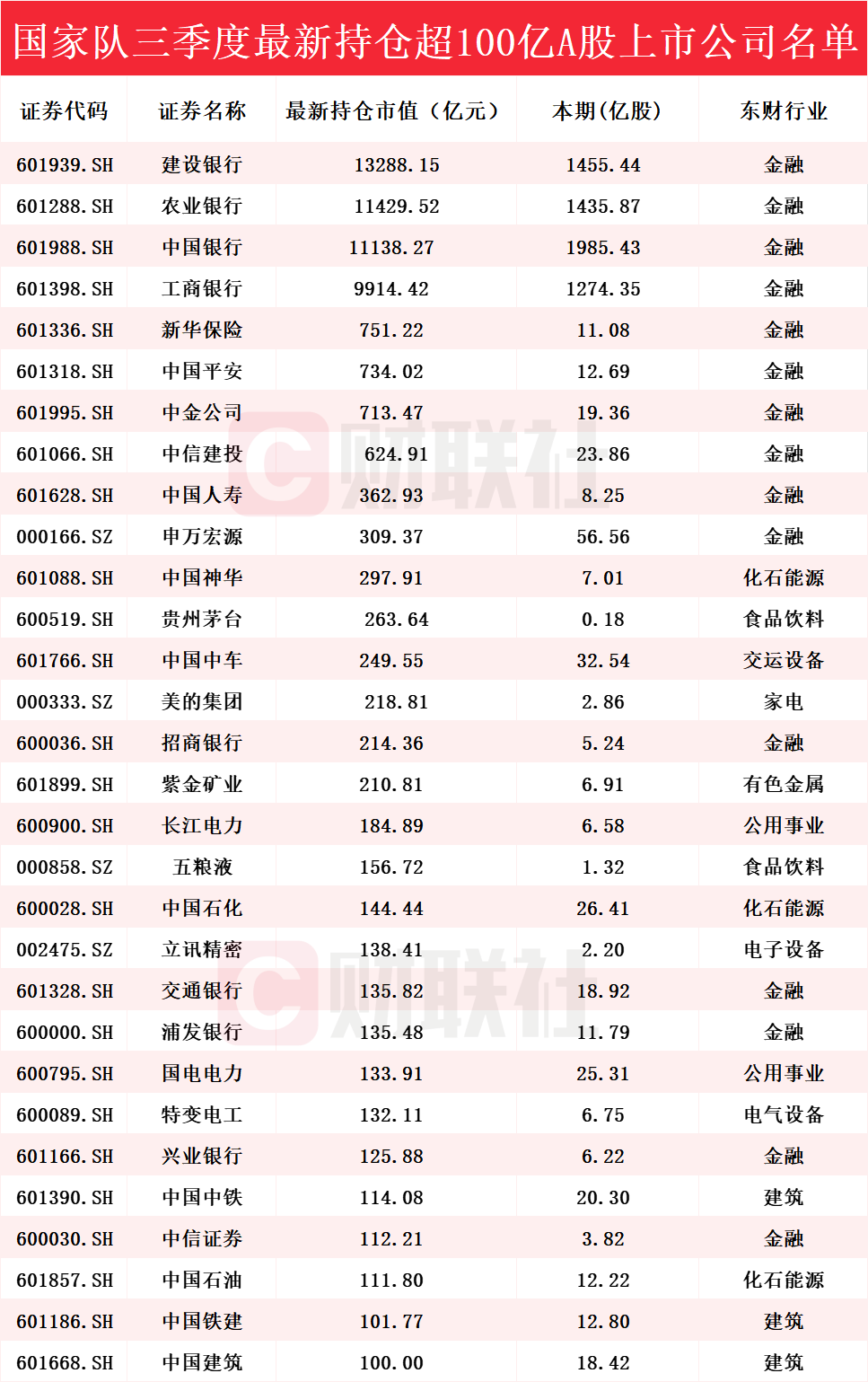
Core Viewpoint - The latest holdings of the "national team" in A-share listed companies have been revealed, with significant investments in major financial institutions and other sectors, indicating a strategic focus on stability and growth in the market [1][2]. Group 1: National Team Holdings - A total of 233 A-share listed companies have the "national team" (China Securities Finance Corporation and Central Huijin) among their top ten shareholders [1]. - There are 30 stocks with a holding value exceeding 10 billion yuan, including major banks like China Construction Bank, Agricultural Bank of China, and Bank of China, with holdings valued at 1.3288 trillion yuan, 1.1429 trillion yuan, and 1.1138 trillion yuan respectively [1][2]. - The top holdings also include companies from various sectors such as insurance, food and beverage, and energy, showcasing a diversified investment strategy [1][2]. Group 2: New Additions and Performance - Farah Electronics has been newly added to the "national team" holdings, with a market value of 158 million yuan [3]. - For the third quarter, Farah Electronics reported a revenue of 3.944 billion yuan, a year-on-year increase of 14.69%, and a net profit of 888 million yuan, also up by 14.58% [3]. - The company’s capacitor products are utilized in ultra-high voltage transmission applications, indicating a focus on high-demand technology sectors [3].






“国家队”持仓动向揭秘!Q3持仓超100亿A股上市公司名单一览
Xin Lang Cai Jing· 2025-11-02 00:45
Core Insights - The latest holdings of the "national team" in A-share listed companies have been revealed, with 233 companies having the "national team" as one of their top ten shareholders [1][2] - In the third quarter, the "national team" held over 10 billion yuan in market value in 30 stocks, including major banks and insurance companies [1] Group 1: Major Holdings - The top three holdings by market value are: - China Construction Bank: 13,288.15 billion yuan - Agricultural Bank of China: 11,429.52 billion yuan - Bank of China: 11,138.27 billion yuan [1] - Other significant holdings include: - Industrial and Commercial Bank of China: 9,914.42 billion yuan - New China Life Insurance: 751.22 billion yuan - Ping An Insurance: 734.02 billion yuan [1][2] Group 2: New Additions - Farah Electronics is a new addition to the "national team" holdings, with a market value of 1.58 billion yuan [2] - The company reported a revenue of 3.944 billion yuan for the first three quarters, a year-on-year increase of 14.69%, and a net profit of 888 million yuan, also up 14.58% [2] - In the third quarter alone, Farah Electronics achieved a revenue of 1.445 billion yuan, reflecting a year-on-year growth of 9.31% [2]
公用事业行业央企ESG评价体系:绿色安全+能源转型是核心社会责任担当是基石:公用事业行业央企ESG评价体系
Shenwan Hongyuan Securities· 2025-10-30 11:23
Investment Rating - The report assigns a "Buy" rating for several key companies in the public utility sector, including China Resources Power, Guodian Power, and Inner Mongolia Huadian [28]. Core Insights - The public utility sector is crucial for achieving national "dual carbon" goals, with a strong emphasis on environmental and social issues in the ESG evaluation framework [5][4]. - The ESG evaluation system for public utilities includes four categories of positive indicators and one category of negative indicators, focusing on objective assessment metrics [8][23]. - Recent policies from various government departments emphasize the need for green transformation, pollution prevention, and social welfare in the public utility sector [5][4]. Summary by Sections 1. ESG Policy in Public Utilities - The public utility sector is a major contributor to energy consumption and carbon emissions, making its green transformation essential for national goals [5]. - Key policies include the "14th Five-Year" energy conservation and emission reduction plan, which outlines specific requirements for green transformation and public service stability [5][4]. 2. ESG Evaluation System Construction - The ESG evaluation system consists of four positive categories: General Indicators, Environmental Indicators, Social Indicators, and Governance Indicators, with a total of 18 primary indicators and 35 secondary indicators [8][23]. - The negative category focuses on violations and penalties, with specific metrics for environmental, social, and governance aspects [23]. 3. General Indicators - General indicators assess the authenticity and standardization of ESG reports, including the basis for report preparation, third-party verification, and the publication of ESG-specific reports [10][9]. 4. Environmental Indicators - Environmental indicators are based on energy conservation, low carbon, and circular economy principles, with a total of four primary indicators focusing on emissions management, ecological compliance, resource utilization, and climate strategy [11][12]. 5. Social Indicators - Social indicators highlight the public utility sector's role in community development and social stability, with six primary indicators covering community contributions, employee development, innovation, supply chain responsibility, product safety, and core operational responsibilities [15][16][17]. 6. Governance Indicators - Governance indicators aim to enhance corporate governance and decision-making, with five primary indicators focusing on party leadership, industry reform, compliance risk management, governance structure, and information transparency [19][20][21]. 7. Negative Indicators - The negative indicators focus on compliance issues, with penalties for violations in environmental, social, and governance areas, deducting points for each violation [23][25].