Shanxi Xinghuacun Fen Wine Factory (600809)

Search documents
19只白酒股上涨 贵州茅台1470.38元/股收盘
Bei Jing Shang Bao· 2025-11-13 08:04
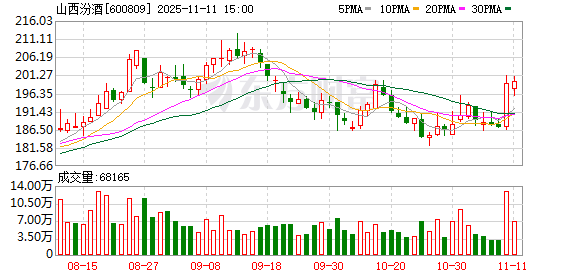
从个股来看,贵州茅台收盘价达1470.38元/股,上涨0.36%;五粮液收盘价达121.20元/股,上涨0.68%; 山西汾酒收盘价达201.00元/股,上涨1.25%;泸州老窖收盘价143.32元/股,上涨1.02%;洋河股份收盘 价达70.39元/股,上涨0.13%。 申万宏源发布研报称,Q3白酒板块加速出清,预计26Q3迎来基本面拐点从报表端看,自24Q4部分企业 开始下滑,但由于25Q1动销仍然有韧性,头部品牌仍然实现了增长。25Q2自外部需求结构显著扰动以 来,行业需求环境明显承压,消费场景大量缺失,头部品牌报表端开始出清,25Q3报表端进一步加速 出清,开始触底。 北京商报讯(记者 刘一博 冯若男)11月13日尾盘,三大指数集体上涨,沪指4029.50点上涨0.73%。白 酒板块2372.47点收盘上涨0.61%,其中19只白酒股上涨。 ...





山西汾酒涨2.00%,成交额7.53亿元,主力资金净流入3199.92万元
Xin Lang Cai Jing· 2025-11-13 06:33
Core Viewpoint - Shanxi Fenjiu's stock price has shown a positive trend, with a year-to-date increase of 13.67% and a recent 5-day increase of 7.72% [1] Financial Performance - For the period from January to September 2025, Shanxi Fenjiu achieved a revenue of 32.924 billion yuan, representing a year-on-year growth of 5.00% [2] - The net profit attributable to shareholders for the same period was 11.405 billion yuan, reflecting a year-on-year increase of 0.48% [2] Shareholder Information - As of September 30, 2025, the number of shareholders for Shanxi Fenjiu was 80,000, a decrease of 23.37% from the previous period [2] - The average number of circulating shares per shareholder increased by 30.50% to 15,252 shares [2] Dividend Distribution - Since its A-share listing, Shanxi Fenjiu has distributed a total of 24.325 billion yuan in dividends, with 16.775 billion yuan distributed over the past three years [3] Institutional Holdings - As of September 30, 2025, the top circulating shareholder was the China Securities White Wine Index A, holding 38.6514 million shares, an increase of 4.5109 million shares from the previous period [3] - Hong Kong Central Clearing Limited was the fourth largest shareholder, holding 27.1639 million shares, a decrease of 21.8352 million shares [3] - The ETF for liquor (512690) entered the top ten circulating shareholders, holding 13.1023 million shares [3]
第四届中国酒业活态文化·国际化大会在太原举行
Zhong Guo Xin Wen Wang· 2025-11-13 06:25
会议同期启动"中国酒业口述史团体标准"起草工作,并成立"中国酒业口述史研究中心"。该中心作为活 态文化传承重要平台,将通过口述史方式系统记录酿酒业"心口相传"的技艺、记忆与经验,实现活态记 忆的规范化记录与传承,有效保存濒临失传的口头技艺和行业故事,为酒业活态文化发展提供有力支 撑。 中国酒业协会理事长宋书玉以《民族的就是世界的》为题发表主旨演讲,开篇即精准点明活态是中国酒 业新文化的本质特征。他指出,中国美酒的活态魅力,根植于千年传承却生生不息的酿造技艺,流淌于 社交场景的民俗礼仪,彰显于持续迭代的生活美学,承载着文化、文明、酿造、生活四重自信,推动国 际化已成为全行业的自觉行动。针对酒业出海的痛点难点,他明确五大"认知破壁"关键方向:打破"中 国白酒难出海"的思维定势、完成"中国美酒"到"世界名酒"的文化跨越、适配"中西合璧"的多元消费场 景、重塑"稀缺珍贵"的价值标签、升级"全球产业"的发展格局;同时给出四大实践路径:推动产业抱团 出海形成协同合力、实现从产品出口到产能输出的进阶升级、推进中国酒业"世界双遗"申报、聚焦香型 特色开展精准国际传播,为行业国际化发展指明方向。 帝亚吉欧大中华区公共事务与传播 ...
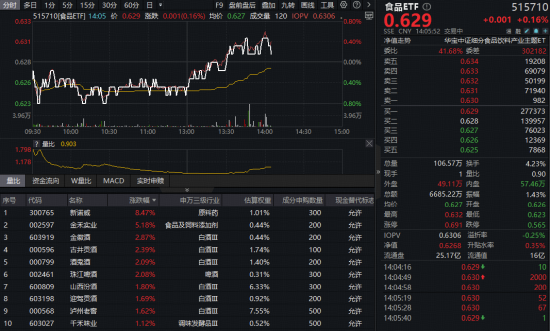
吃喝板块午后惊现逆转!白酒股集体躁动,食品ETF(515710)拉升翻红!估值洼地能否上车?
Xin Lang Ji Jin· 2025-11-13 06:13
Core Insights - The food and beverage sector experienced a reversal on November 13, with the Food ETF (515710) showing a slight increase of 0.16% after a period of low volatility [1][2] - Major liquor stocks, including Jinhuijiu, Gujinggongjiu, and Jiugui Jiu, saw significant gains, with increases exceeding 2% [1] - The China Alcohol Industry Association released a new cultural development outline for the industry, emphasizing the importance of cultural initiatives in addressing current challenges and enhancing international competitiveness [3] Industry Analysis - The newly released outline is seen as an upgrade from the previous five-year plan, targeting industry transformation by focusing on cultural aspects to resolve short-term sales issues and enhance long-term value recognition [3] - The food and beverage sector is currently at a historical low in terms of valuation, with the Food ETF's underlying index PE ratio at 21.24 times, indicating a favorable entry point for long-term investments [3] - The liquor sector has undergone five years of adjustment, with the average PE ratio of major liquor companies now below 20 times and an average dividend yield of approximately 3.5%, suggesting that the sector is entering a value zone [4] Investment Opportunities - The Food ETF (515710) is recommended for investors looking to gain exposure to core assets in the food and beverage sector, with a significant portion of its holdings in leading high-end liquor stocks [5] - The ETF tracks the China Securities Index's food and beverage theme index, with around 60% of its portfolio allocated to high-end liquor leaders and 40% to other segments like beverages and condiments [5]


年轻人不买账,白酒这次真要凉?
3 6 Ke· 2025-11-13 03:02
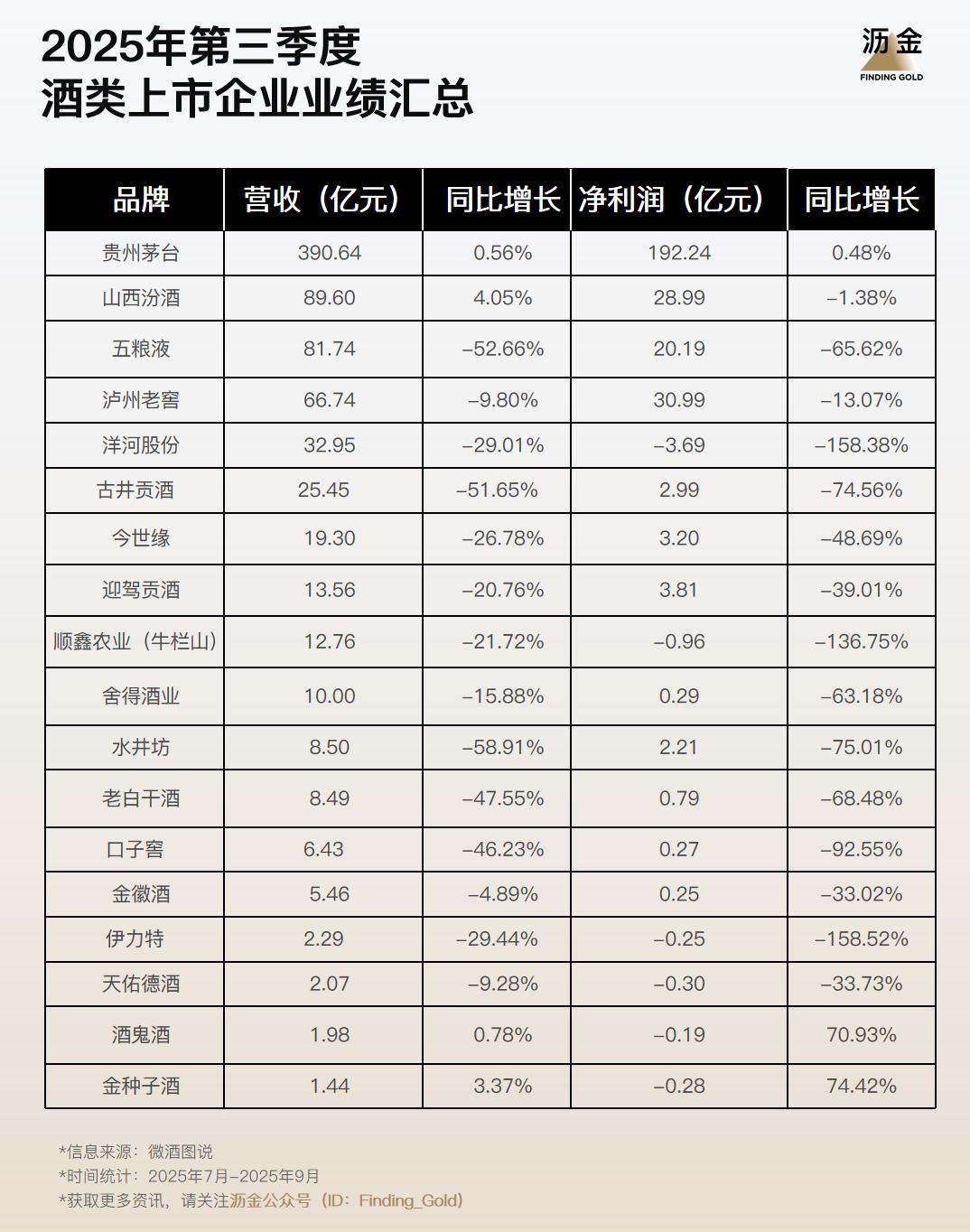
Core Viewpoint - The Chinese liquor industry, particularly the baijiu sector, is experiencing significant revenue and profit declines, with most companies facing challenges except for a few leading brands [1][4]. Financial Performance - Major brands like Kweichow Moutai reported a revenue of 39.064 billion yuan with a slight growth of 0.56%, while others like Wuliangye saw a drastic revenue drop of 52.66% to 8.174 billion yuan [2]. - The net profit for Kweichow Moutai was 19.224 billion yuan, reflecting a growth of 0.48%, whereas Wuliangye's net profit plummeted by 65.62% to 2.019 billion yuan [2]. - Other brands such as Yanghe and Gujing Gongjiu also reported significant declines in both revenue and net profit, indicating a broader industry downturn [2]. Market Sentiment and Public Perception - The introduction of the "ban on alcohol" in June is viewed as a catalyst for the current downturn, leading to reduced consumption in both public and business settings [1][4]. - Social media discussions have intensified around the notion that "baijiu is failing," with extreme expressions of pessimism emerging [3][4]. - The price of Kweichow Moutai's scattered bottles fell below 1,500 yuan, reflecting market panic and a loss of confidence [4]. Historical Context and Cycles - The baijiu industry has undergone four significant downturns since the establishment of New China, with each cycle characterized by structural adjustments and eventual recovery [6][11]. - The current downturn is seen as a continuation of a long-term structural adjustment rather than a sudden collapse, with historical patterns suggesting potential for recovery [8][11]. Cultural and Generational Shifts - The narrative surrounding baijiu has shifted, with younger generations perceiving it as a symbol of social pressure rather than a status symbol, leading to a disconnect in cultural significance [20][21]. - The traditional values associated with baijiu are being challenged by changing social dynamics, where younger consumers prioritize personal identity over societal expectations [22][23]. Future Outlook - The baijiu industry faces the challenge of redefining its narrative to resonate with contemporary consumers, particularly the younger demographic that shapes public discourse [25][27]. - Recovery will depend not only on price stabilization but also on rebuilding cultural relevance and consumer trust in the brand [28].
酒价内参11.13价格发布 飞天茅台终端价再小涨
Xin Lang Cai Jing· 2025-11-13 00:08
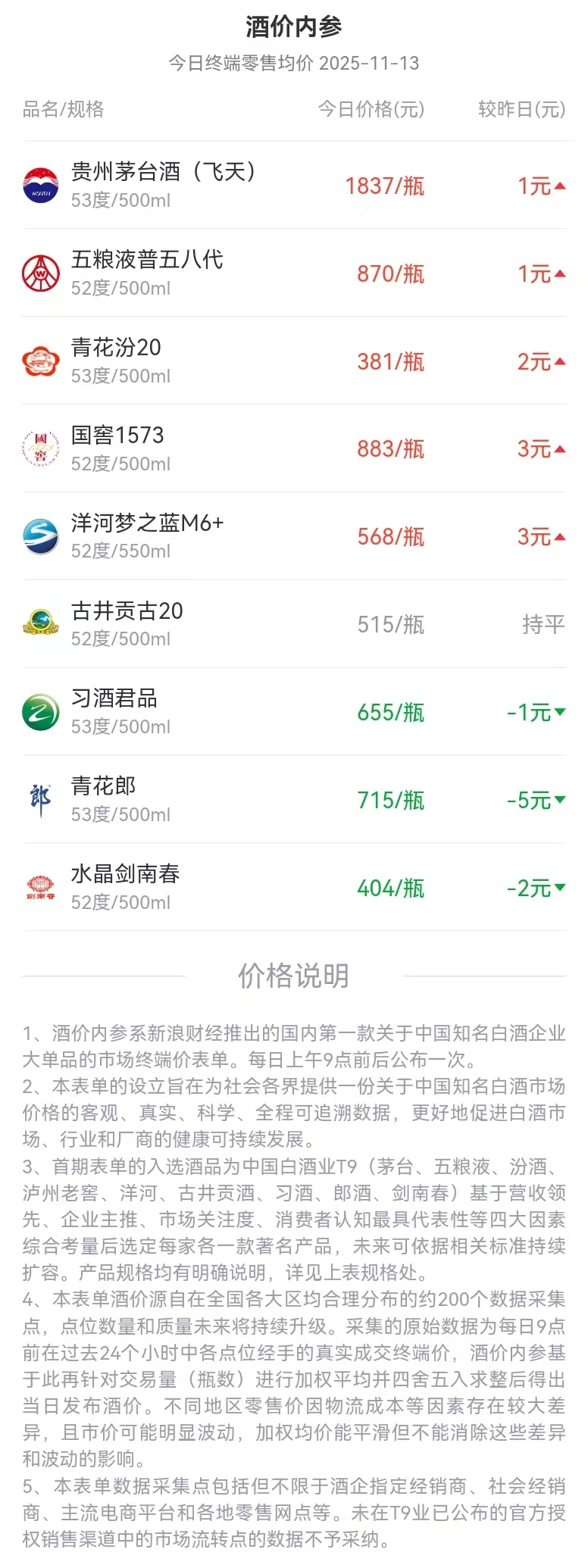
Core Insights - The average retail price of major Chinese liquor brands has shown a slight increase following the Double Eleven shopping festival, indicating a stable market trend for the industry [1] Price Trends - Moutai's Feitian liquor saw a price increase of 1 yuan per bottle, reaching 1837 yuan [3] - Other notable brands such as Guojiao 1573 and Yanghe Dream Blue M6+ both increased by 3 yuan per bottle, indicating a leading price rise among major products [1][3] - Wuliangye's Pu Wuhai edition increased by 1 yuan, showing signs of price stabilization [1] - Qinghua Fen 20 also experienced a price rise of 2 yuan, while Guqingong Gu 20 remained stable [1] - On the downside, Qinghua Lang saw a significant drop of 5 yuan per bottle, while Xijiu Junpin and Shuijing Jianan Chun decreased by 1-2 yuan, which is considered normal market fluctuation [1] Data Collection and Reporting - The price data is collected from approximately 200 points across major regions, including authorized distributors and retail outlets, ensuring a comprehensive representation of the market [6][7] - The data is published daily by Sina Finance, aiming to provide an objective and traceable overview of the Chinese liquor market [6]
17只白酒股下跌贵州茅台1465.15元/股收盘
Xin Lang Cai Jing· 2025-11-12 10:32
Core Viewpoint - The article discusses the recent performance of the liquor market, particularly focusing on the white liquor sector, highlighting a collective decline in major indices and specific stock movements within the industry [1]. Industry Summary - On November 12, the three major indices collectively fell, with the Shanghai Composite Index closing at 4000.14 points, down 0.07% [1]. - The white liquor sector closed at 2358.04 points, experiencing a slight decline of 0.04%, with 17 out of 20 white liquor stocks reporting losses [1]. Company Summary - Individual stock performances included: - Kweichow Moutai closed at 1465.15 CNY per share, up 0.42% [1]. - Wuliangye closed at 120.38 CNY per share, down 0.33% [1]. - Shanxi Fenjiu closed at 198.52 CNY per share, down 0.52% [1]. - Luzhou Laojiao closed at 141.87 CNY per share, unchanged [1]. - According to a report by Shenwan Hongyuan, the financial results of leading brands began to clear in Q2, with further acceleration in Q3, indicating a potential bottoming out [1]. - The report anticipates a year-on-year decline in overall industry sales volume of 20%-30% in Q3, driven by a low base in Q2 2024 [1].
17只白酒股下跌 贵州茅台1465.15元/股收盘
Bei Jing Shang Bao· 2025-11-12 09:25
Core Viewpoint - The overall market experienced a decline, with the Shanghai Composite Index dropping to 4000.14 points, down 0.07%, and the liquor sector also saw a slight decrease, indicating ongoing challenges in the industry [1]. Industry Summary - The liquor sector closed at 2358.04 points, with a minor decline of 0.04%, and 17 liquor stocks reported losses [1]. - In Q3, the industry is expected to see a year-on-year decline in sales volume of 20%-30%, driven by a low base in Q2 2024, as the market seeks to balance volume and price [1]. - Looking ahead, the industry may face double-digit sales volume decline pressure in Q1 2026, with continued pressure on financial reports, but stabilization is anticipated in Q2 2026, and a potential turning point in fundamentals could occur in Q3 2026 [1]. Company Summary - Kweichow Moutai's stock closed at 1465.15 CNY per share, up 0.42%, while Wuliangye's stock closed at 120.38 CNY per share, down 0.33% [1]. - Shanxi Fenjiu's stock closed at 198.52 CNY per share, down 0.52%, and Luzhou Laojiao's stock closed at 141.87 CNY per share, up 0.16% [1]. - Yanghe's stock closed at 70.30 CNY per share, down 0.71% [1].
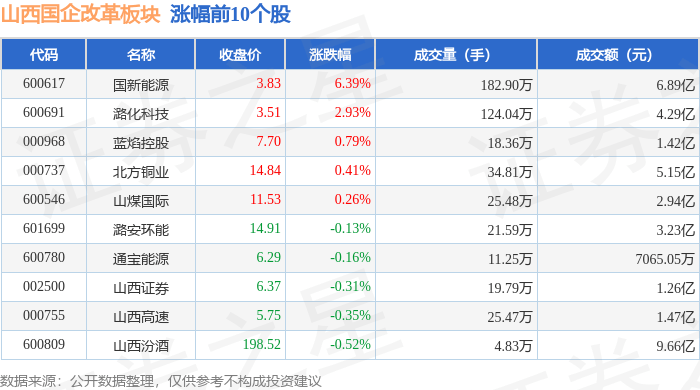
山西国企改革板块11月12日跌0.37%,华阳新材领跌,主力资金净流出1057.42万元
Sou Hu Cai Jing· 2025-11-12 08:56
Market Overview - The Shanxi state-owned enterprise reform sector experienced a decline of 0.37% on November 12, with Huayang New Materials leading the drop [1] - The Shanghai Composite Index closed at 4000.14, down 0.07%, while the Shenzhen Component Index closed at 13240.62, down 0.36% [1] Stock Performance - Notable gainers included: - Guo New Energy (600617) with a closing price of 3.83, up 6.39% and a trading volume of 1.829 million shares, totaling 689 million yuan [1] - Luohua Technology (600691) closed at 3.51, up 2.93% with a trading volume of 1.2404 million shares, totaling 429 million yuan [1] - Significant decliners included: - Huayang New Materials (600281) closed at 6.26, down 2.03% with a trading volume of 77,300 shares, totaling 48.545 million yuan [2] - Shanxi Coking (600740) closed at 4.37, down 2.02% with a trading volume of 389,800 shares, totaling 171 million yuan [2] Capital Flow - The Shanxi state-owned enterprise reform sector saw a net outflow of 10.5742 million yuan from institutional investors, while retail investors experienced a net outflow of 35.7534 million yuan [2] - Conversely, speculative funds recorded a net inflow of 46.3276 million yuan [2] Individual Stock Capital Flow - Guo New Energy (600617) had a net inflow from institutional investors of 66.6112 million yuan, while retail investors saw a net outflow of 70.3735 million yuan [3] - Luohua Technology (600691) experienced a net inflow of 34.6259 million yuan from institutional investors, but a net outflow of 28.8624 million yuan from retail investors [3] - Shanxi Fenjiu (600809) had a net inflow of 10.4316 million yuan from institutional investors, while retail investors saw a net outflow of 28.8380 million yuan [3]


山西汾酒现7笔大宗交易 均为折价成交
Zheng Quan Shi Bao Wang· 2025-11-11 11:50
Core Viewpoint - Shanxi Fenjiu conducted a total of 7 block trades on November 11, with a total trading volume of 760,000 shares and a transaction amount of 143 million yuan, reflecting a discount of 6% compared to the closing price of 199.56 yuan on the same day [2][3]. Trading Activity - The block trades on November 11 involved a total transaction amount of 143 million yuan, with an average transaction price of 187.59 yuan per share, which is 6% lower than the closing price [2][4]. - Over the past three months, Shanxi Fenjiu has seen 79 block trades, accumulating a total transaction amount of 1.255 billion yuan [3]. - The stock's daily turnover rate was 0.56%, with a total trading volume of 1.354 billion yuan on the same day, and a net inflow of main funds amounting to 78.53 million yuan [3]. Institutional Activity - Institutional specialized seats participated in 2 of the block trades, with a total transaction amount of 84.42 million yuan, indicating a net purchase of the same amount [2][4]. - The latest margin financing balance for the stock is 935 million yuan, which has increased by 79.1 million yuan over the past five days, reflecting a growth rate of 9.24% [4]. - Three institutions have provided ratings for the stock in the past five days, with the highest target price set at 232.10 yuan by Southwest Securities [4].