
AECC AP(600893)

Search documents
航天卫星概念爆发,航空航天ETF天弘(159241)开盘大涨1.51%,一键配置航天、国产大飞机、低空经济概念股
Xin Lang Cai Jing· 2025-05-29 03:21
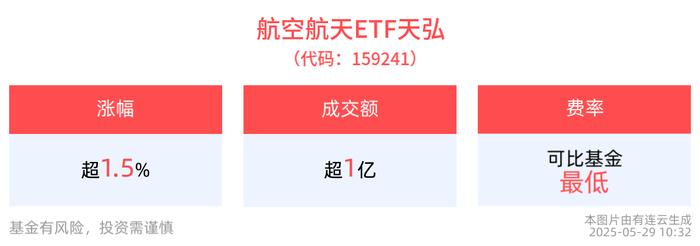
Core Viewpoint - The aerospace sector is experiencing a significant surge, with key stocks and ETFs showing strong performance, driven by recent successful satellite launches and a positive outlook for the industry [1][2]. Group 1: Market Performance - As of May 29, 2025, the CN5082 aerospace industry index rose by 1.71%, with notable stock increases including Guangqi Technology (7.39%) and Shanghai Hanyun (5.39%) [1]. - The Aerospace ETF Tianhong (159241) increased by 1.51%, leading its category, with a trading volume of 100 million yuan and a turnover rate of 29.06% [1][2]. Group 2: Fee Structure - The management fee for the Aerospace ETF Tianhong is 0.50%, and the custody fee is 0.10%, making it the lowest among comparable funds [2]. Group 3: Recent Launches - In May 2025, several successful satellite launches occurred, including: - Long March 6 rocket launched the Remote Sensing Satellite 40 on May 11 [2]. - Long March 3B rocket successfully launched Communication Technology Test Satellite 19 on May 13 [2]. - Long March 2D rocket launched a constellation of twelve satellites on May 14 [2]. - Blue Arrow Aerospace's Zhuque-2 rocket successfully launched six satellites on May 17 [2]. Group 4: Industry Outlook - According to a report by CICC, the aerospace technology sector is gradually bottoming out due to demand, with strong demand rigidity and long-term certainty expected to drive recovery in the industry [2]. - The sector is anticipated to experience compensatory growth in 2025, supported by a low base and the easing of industry disruptions [2]. Group 5: Index Composition - As of April 30, 2025, the top ten weighted stocks in the CN5082 aerospace industry index accounted for 52.89% of the index, including Guangqi Technology and AVIC Shenyang Aircraft [3].




一战成名,积极出海,坐拥大飞机、低空经济两大主题,这个行业或已进入击球点
市值风云· 2025-05-28 10:03
Core Viewpoint - The article emphasizes the increasing military expenditure and geopolitical tensions globally, particularly highlighting the growth in China's military trade and the potential investment opportunities in the aerospace and defense sectors due to these dynamics [2][3][4]. Group 1: Military Expenditure and Geopolitical Tensions - The U.S. has raised its defense spending to over $1 trillion, a year-on-year increase of approximately 13% [2]. - The global arms race is expected to escalate as countries respond to geopolitical conflicts, with China showcasing its military capabilities during recent conflicts [3][4]. Group 2: Growth in Military Trade - China's military trade exports from 2015 to 2024 reached $17.254 billion TIV, a 56.48% increase compared to the previous decade [4]. - Over 60% of China's military exports are directed towards South Asia and Southeast Asia, particularly Pakistan [5]. Group 3: Domestic Military Demand - The upcoming years are expected to see a surge in domestic military equipment orders, driven by the "14th Five-Year Plan" and the centenary of the military [11]. - Major military groups in China are prioritizing military trade as a core business, indicating a strategic shift towards international market competition [8]. Group 4: Aerospace Industry Growth - The C919 aircraft symbolizes China's advancements in the aerospace sector, with nearly 1,500 orders received as of February 2025 [12]. - The market for large aircraft is projected to be valued at approximately $1.4 trillion over the next 20 years, with significant growth expected in satellite internet and low-altitude economy sectors [12]. Group 5: Market Dynamics and Valuation - The aerospace and defense sector is characterized by a focus on mergers and acquisitions, with notable recent transactions aimed at resource integration [14][15]. - The National Aerospace and Aviation Index has shown a strong performance, with a 19.74% annualized return since its inception, indicating robust long-term growth potential [26]. Group 6: Investment Strategies - The aerospace and defense sector is currently at a relatively low valuation, with the latest price-to-book ratio around 3.2, suggesting potential for investment [28]. - Investors are encouraged to consider strategies such as dollar-cost averaging to navigate market volatility while aiming for satisfactory returns [31].


中证军工指数下跌0.73%,前十大权重包含中航西飞等
Jin Rong Jie· 2025-05-28 09:44
Group 1 - The core viewpoint of the news is the performance of the China Securities Military Industry Index, which has shown a slight decline recently despite a modest increase over the past month [1] - The China Securities Military Industry Index has decreased by 0.73% to 10,524.13 points, with a trading volume of 25.619 billion yuan [1] - Over the past month, the index has increased by 3.75%, while it has only risen by 0.07% over the last three months and has decreased by 0.46% year-to-date [1] Group 2 - The index comprises ten major military groups and other representative listed companies related to the military industry, reflecting the overall performance of military industry companies [1] - The top ten weighted companies in the index include China Shipbuilding (5.72%), Guangqi Technology (5.28%), AVIC Shenyang Aircraft (4.35%), China Heavy Industry (4.15%), and others [1] - The market share of the index's holdings is 55.25% from the Shanghai Stock Exchange and 44.75% from the Shenzhen Stock Exchange [1] Group 3 - The index's holdings are primarily in the industrial sector (73.17%), followed by information technology (9.43%), materials (9.40%), telecommunications services (6.32%), and consumer discretionary (1.68%) [1] - The index samples are adjusted every six months, with adjustments typically not exceeding 10% of the sample [2] - Special circumstances may lead to temporary adjustments of the index, such as delisting of samples or corporate actions like mergers and acquisitions [2]


中证国新央企科技引领指数下跌0.83%,前十大权重包含上海贝岭等
Jin Rong Jie· 2025-05-27 14:34
Group 1 - The core index, the China Securities National New Central Enterprise Technology Index, experienced a decline of 0.83%, closing at 1177.14 points with a trading volume of 14.126 billion yuan [1] - Over the past month, the index has increased by 0.94%, but it has decreased by 9.04% over the last three months and by 6.20% year-to-date [1] - The index is customized by Guoxin Investment Co., Ltd., selecting 50 listed companies from industries such as aerospace, defense, computer, electronics, semiconductors, and communication equipment to reflect the overall performance of central enterprise technology theme listed companies [1] Group 2 - The top ten weighted stocks in the index include Hikvision (9.63%), AVIC Shenyang Aircraft (7.43%), AVIC Optoelectronics (6.74%), Aero Engine Corporation of China (5.91%), Shenzhen South Circuit (4.35%), Shanghai Beiling (4.22%), AVIC Aircraft (4.12%), Baoxin Software (3.6%), AVIC High-Tech (3.2%), and Guangxun Technology (3.12%) [1] - The market segments of the index holdings show that the Shanghai Stock Exchange accounts for 52.18% and the Shenzhen Stock Exchange accounts for 47.82% [1] Group 3 - The industry composition of the index holdings indicates that industrial companies make up 46.32%, information technology companies account for 42.73%, and communication services represent 10.95% [2] - The index samples are adjusted biannually, with adjustments implemented on the next trading day following the second Friday of June and December each year [2] - Public funds tracking the central enterprise technology index include various funds from E Fund, Yinhua, and Southern Asset Management [2]



中证高端装备细分50指数上涨1.01%,前十大权重包含中国长城等
Jin Rong Jie· 2025-05-26 14:50
Group 1 - The core index, the CSI High-end Equipment Sub-index 50, reflects the performance of 50 representative listed companies in the aerospace and high-end equipment sectors, with a base date of December 31, 2012, set at 1000.0 points [1] - The CSI High-end Equipment Sub-index 50 has seen a 2.48% increase over the past month, a 1.82% decrease over the past three months, and a 0.96% decline year-to-date [1] - The top ten weighted companies in the index include AVIC Shenyang Aircraft Corporation (7.3%), AVIC Optoelectronics (6.9%), Aero Engine Corporation of China (6.21%), and others, indicating a concentration in key players within the industry [1] Group 2 - The index's holdings are primarily in the industrial sector, accounting for 74.18%, followed by materials at 10.73%, information technology at 7.60%, and communication services at 7.49% [2] - The index samples are adjusted biannually, with changes implemented on the next trading day following the second Friday of June and December, ensuring the index remains reflective of the current market [2] - Public funds tracking the CSI High-end Equipment Sub-index 50 include the Harvest CSI High-end Equipment Sub-index 50 Link A, Harvest CSI High-end Equipment Sub-index 50 Link C, and Harvest CSI High-end Equipment Sub-index 50 ETF [2]


2025年中国航空发动机行业发展概述 产品领域多,发展前景好【组图】
Qian Zhan Wang· 2025-05-23 06:58
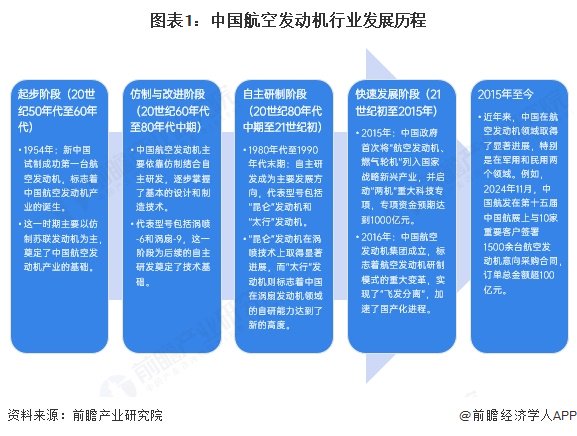
Core Viewpoint - The Chinese aviation engine industry has transitioned from imitation to independent research and development, demonstrating strong self-innovation capabilities and moving towards high-quality development supported by national policies [1]. Industry Overview - The aviation engine industry is a crucial segment of the national economy and security, with its comprehensive level reflecting a country's overall strength. Aviation engines can be categorized into various types based on thrust generation principles, oxidizer sources, and the presence of compressors [3]. Technical and Financial Barriers - The aviation engine industry is characterized by high technical and financial barriers, requiring expertise across multiple modern technology fields. The demanding operational conditions necessitate significant foundational research, engineering technology accumulation, and financial investment, making it challenging for new entrants to compete [5]. Engine Types and Applications - Different types of aviation engines serve distinct applications, with the turbofan engine being the most widely used due to its efficiency and low fuel consumption. A summary of various engine types and their applications includes: - Piston engines: Low cost and high fuel efficiency, primarily used in small low-speed aircraft and drones [9]. - Ramjet engines: Simple structure and high thrust, used in supersonic missiles and targets [9]. - Turbojet engines: High thrust but high fuel consumption, used in older fighter jets and ballistic missiles [9]. - Turbofan engines: High efficiency and low fuel consumption, used in modern military and civilian aircraft [9]. - Turboprop engines: High fuel economy at medium to low speeds, used in small transport and general aviation aircraft [9]. - Turboshaft engines: The only power source for helicopters [9]. - Propfan engines: Complex structure and high noise, with limited application [9]. Future Development Directions - The Chinese aviation engine manufacturing industry is expected to focus on independent innovation, improving quality and reliability, international cooperation, R&D investment, and sustainable development, positioning itself as a significant player in the global aviation sector [11].


5月22日交银国企改革灵活配置混合A净值下跌0.57%,近1个月累计上涨0.79%
Sou Hu Cai Jing· 2025-05-22 11:33
Group 1 - The core point of the article is the performance and holdings of the Jiao Yin State-Owned Enterprise Reform Flexible Allocation Mixed A Fund, which has a recent net value of 1.7633 yuan and a decline of 0.57% [1] - The fund's performance over the past month shows a return of 0.79%, ranking 89 out of 119 in its category; over the past six months, it has returned 3.61%, ranking 29 out of 117; and since the beginning of the year, it has returned 3.46%, ranking 24 out of 117 [1] - The fund's top ten stock holdings account for a total of 50.78%, with significant positions in companies such as SF Holding (9.90%), China Chemical (6.04%), and ShouLve Hotel (5.44%) [1] Group 2 - The Jiao Yin State-Owned Enterprise Reform Flexible Allocation Mixed A Fund was established on June 10, 2015, and as of March 31, 2025, it has a total scale of 1.802 billion yuan [1] - The fund manager, Shen Nan, has been in the role since the fund's inception and has a background in finance, holding a master's degree from Fudan University [2]



“十四五”收官年,中长期逻辑不改,关注军工核心主线
Mei Ri Jing Ji Xin Wen· 2025-05-21 03:07
Group 1 - The A-share market indices are rising, with a slight pullback in the military industry sector, particularly the aerospace ETF (159227) which is down by 0.50% as of 10:55 AM, while key holdings like Hongdu Aviation (600316) and others are increasing [1] - The military industry is heavily influenced by five-year plans, which significantly impact operational and market expectations, making it a primary driver of military market trends [1] - The year 2025 marks the end of the "14th Five-Year Plan," and the execution of military construction plans is entering a critical phase, with expected acceleration in order demand [1] - The importance of air power in modern warfare is increasing, making aerospace equipment a focal point for military development, characterized by high technical barriers and significant value within the military supply chain [1] - According to Huafu Securities, the military sector has strong domestic trade attributes, with substantial growth expected from 2025 to 2027 due to multiple catalysts, including the "14th Five-Year Plan" tasks and the centenary goals of the military [1] Group 2 - The aerospace ETF (159227) tracks the Guozheng Aerospace Index, which has a high concentration of core companies in China's military industry, covering sectors like large aircraft and low-altitude economy [2] - The military industry accounts for 99.2% of the index's composition, indicating a higher concentration compared to other indices like the Zhongzheng Military and Zhongzheng Defense indices [2] - The weight of aerospace equipment in the Guozheng Aerospace Index is as high as 73%, significantly surpassing the 40% and 53% weights in the Zhongzheng Military and Zhongzheng Defense indices, respectively [2]
交银国企改革灵活配置混合A连续5个交易日下跌,区间累计跌幅1.08%
Sou Hu Cai Jing· 2025-05-19 16:01
Group 1 - The core viewpoint of the news is the performance and structure of the fund "交银国企改革灵活配置混合A," which has experienced a decline in recent trading days and has a significant portion of its holdings in institutional and individual investors [1][2][3] - As of May 19, the fund's latest net value is 1.76 yuan, with a cumulative decline of 1.08% over the last five trading days [1] - The fund was established in June 2015, with a total size of 1.802 billion yuan and a cumulative return of 104.86% since inception [1] Group 2 - By March 31, 2025, the top ten holdings of the fund accounted for a total of 50.78%, with significant positions in companies such as 顺丰控股 (9.90%), 中国化学 (6.04%), and 首旅酒店 (5.44%) [2] - The current fund manager, 沈楠, has a background in finance and has been managing the fund since June 2015, bringing extensive experience from previous roles in analysis and fund management [1]
国防军工行业2024年报及2025一季报综述:板块业绩结构性特征明显,关注订单基本面复苏机遇
China Securities· 2025-05-18 16:10
Investment Rating - The report indicates a positive outlook for the military industry, suggesting that the industry is nearing a bottom and is expected to recover in 2025 [1][2]. Core Insights - The military sector reported a total revenue of 764.903 billion yuan in 2024, reflecting a year-on-year increase of 1.16%. Key segments such as shipbuilding, aerospace engines, and aviation maintained positive revenue growth [1][2][11]. - The net profit attributable to shareholders in the military sector decreased to 26.655 billion yuan in 2024, a decline of 38.01% year-on-year, primarily due to lower downstream demand and price reductions for certain products [11][12]. - In Q1 2025, the military sector's revenue reached 153.894 billion yuan, up 2.35% year-on-year, with segments like ground equipment and aerospace showing signs of recovery [28][31]. Summary by Sections 1. 2024 Annual Report and 2025 Q1 Review - The military sector's revenue structure shows significant characteristics, with a focus on the recovery of order fundamentals. The shipbuilding sector saw a revenue increase of 10.87%, while ground equipment and aerospace segments are expected to stabilize [11][28]. - The military sector's net profit for 2024 was 26.655 billion yuan, down 38.01% year-on-year, with only the shipbuilding sector showing positive growth [11][12]. 2. Key Target Profit Forecasts and Valuations - Investment strategies suggest focusing on traditional military sectors with expected order recovery, including aerospace engines, shipbuilding, and aviation [3]. - New domains and new qualities are recommended, emphasizing low-cost, intelligent, and systematic characteristics in industries like precision-guided munitions and unmanned systems [3]. 3. Investment Strategy - The report recommends three main investment lines: traditional military sectors, new domains with significant growth potential, and companies with expected asset integration and competitive military trade markets [3]. - Specific recommended stocks include aerospace engine manufacturers, shipbuilding companies, and firms involved in commercial aerospace and low-altitude economies [3]. 4. Market Performance - The military sector's performance is closely monitored, with various companies announcing contracts and showing signs of recovery in the fundamentals of the military sector [46][47].


