
Bank Of Jiangsu(600919)

Search documents
银行业2025年三季报综述:业绩稳健性凸显,引领银行价值回归
Shenwan Hongyuan Securities· 2025-11-04 14:41
Investment Rating - The report maintains a positive outlook on the banking sector, indicating a potential return to a valuation of 1 times net asset value [4][7]. Core Insights - The banking sector has demonstrated steady performance, with a year-to-date revenue growth of 0.8% and a net profit growth of 1.5% for the first nine months of 2025, reflecting a stable regulatory environment supporting bank profitability [10][14]. - The report highlights a shift in focus from scale to balance in credit growth, with banks increasingly pursuing a "quantity-price balance" strategy [4][7]. - The cost of liabilities has improved more significantly than the decline in asset pricing, leading to a stabilization of net interest margins, which is expected to continue into the next year [4][7]. - Asset quality remains stable but shows signs of divergence, particularly with rising risks in small and micro businesses [4][7]. - The report suggests that the current dividend yield of the banking sector has returned to an attractive range, indicating a significant disconnect between stable earnings and stock holdings, which could lead to a value recovery [4][7]. Summary by Sections Performance Overview - The banking sector's performance has been characterized by a steady increase in revenue and profit, with state-owned banks showing better-than-expected stability and regional banks leading in performance [11][12][15]. - The report notes that the revenue growth of state-owned banks has turned positive, with non-interest income contributing significantly to this growth [12][15]. Credit Growth and Strategy - The report indicates a gradual abandonment of scale-driven growth, with banks focusing on achieving a balance between volume and pricing in their lending practices [4][7]. - The credit growth rate for listed banks decreased by 0.3 percentage points to 7.7% in Q3 2025, with state-owned banks maintaining a growth rate of approximately 8.5% [4][7]. Profitability and Asset Quality - The net interest margin for listed banks remained stable at 1.5%, with a slight quarter-on-quarter increase of 3 basis points in Q3 2025 [4][7]. - The overall non-performing loan ratio remained stable at 1.22%, indicating manageable risk levels across the sector [4][7]. Investment Recommendations - The report recommends focusing on leading banks and undervalued regional banks as key investment opportunities, suggesting that the recovery in valuations is supported by stable earnings and attractive dividend yields [4][7].



长三角城商行扩表进行时:对公信贷狂飙,财富业务回暖
2 1 Shi Ji Jing Ji Bao Dao· 2025-11-04 11:57
Core Insights - The banking sector in the Yangtze River Delta is experiencing a different trend compared to the overall slowdown in loan growth, with several city commercial banks showing double-digit asset growth [1][3] Group 1: Loan Growth - As of the end of Q3, several city commercial banks in the Yangtze River Delta reported significant asset growth: Jiangsu Bank at 4.93 trillion yuan (up 24.68%), Ningbo Bank at 3.58 trillion yuan (up 14.50%), and Nanjing Bank at 2.96 trillion yuan (up 14.31%) [1] - The overall loan growth for all A-share listed banks was 7.70% year-on-year, with city commercial banks leading at 12.86% [1][2] - Specific banks like Jiangsu Bank and Ningbo Bank reported loan growth rates exceeding 17% in Q3, driven primarily by corporate loans [3][5] Group 2: Corporate Loans - Corporate loans have significantly increased, with Ningbo Bank's corporate loan growth reaching 32.10% in Q3, the highest among peers [5] - The proportion of corporate loans in total loans has risen for many banks, with Jiangsu Bank's corporate loans making up 67.38% and Nanjing Bank's at 76.03% [4][5] - The focus on corporate loans, particularly in technology sectors, has been emphasized by several banks, with notable increases in technology-related loan disbursements [6][8] Group 3: Revenue and Profitability - The total revenue for six city commercial banks in the Yangtze River Delta reached 243.6 billion yuan in Q3, a year-on-year increase of 6.41%, while net profit grew by 8.36% to 111.2 billion yuan [7] - Jiangsu Bank reported a revenue of 67.18 billion yuan and a net profit of 30.58 billion yuan, both showing positive growth [7] - Wealth management and retail banking segments are showing signs of recovery, contributing to the overall revenue growth [8] Group 4: Investment Income - Investment income has been under pressure due to rising interest rates and market volatility, with the fair value changes of financial assets showing negative results [9][10] - Shanghai Bank reported the highest investment income at 16.77 billion yuan, but also faced significant losses in fair value changes [11]





城商行板块11月4日涨1.62%,厦门银行领涨,主力资金净流入2.8亿元
Zheng Xing Xing Ye Ri Bao· 2025-11-04 08:48
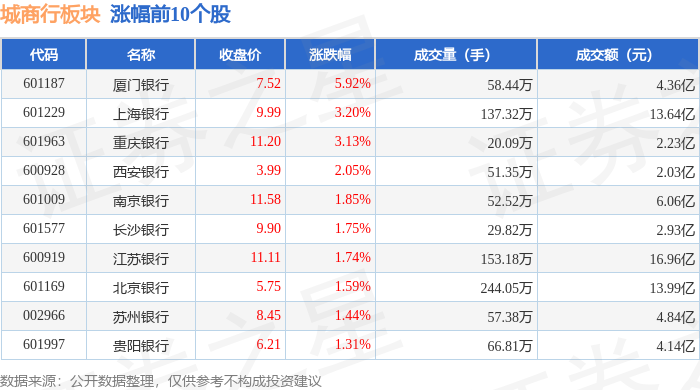
Market Performance - The city commercial bank sector increased by 1.62% on November 4, with Xiamen Bank leading the gains [1] - The Shanghai Composite Index closed at 3960.19, down 0.41%, while the Shenzhen Component Index closed at 13175.22, down 1.71% [1] Individual Bank Performance - Xiamen Bank's closing price was 7.52, up 5.92% with a trading volume of 584,400 shares and a transaction value of 4.36 billion [1] - Shanghai Bank closed at 66.6, up 3.20%, with a trading volume of 1,373,200 shares and a transaction value of 1.364 billion [1] - Chongqing Bank closed at 11.20, up 3.13%, with a trading volume of 200,900 shares and a transaction value of 223 million [1] - Other notable banks include Xi'an Bank, Nanjing Bank, and Changsha Bank, with respective increases of 2.05%, 1.85%, and 1.75% [1] Fund Flow Analysis - The city commercial bank sector saw a net inflow of 280 million from main funds, while retail funds experienced a net outflow of 89.43 million [1] - Beijing Bank had a main fund net inflow of 1.47 billion, but retail funds saw a net outflow of 55.81 million [2] - Xiamen Bank recorded a main fund net inflow of 49.44 million, with retail funds experiencing a net outflow of 54.06 million [2]

江苏银行股价连续4天上涨累计涨幅5.51%,金信基金旗下1只基金持169.69万股,浮盈赚取98.42万元
Xin Lang Cai Jing· 2025-11-04 07:34
Core Viewpoint - Jiangsu Bank's stock has seen a continuous increase over the past four days, with a cumulative rise of 5.51% and a current price of 11.10 CNY per share, reflecting strong market performance and investor interest [1]. Company Overview - Jiangsu Bank, established on January 22, 2007, and listed on August 2, 2016, is headquartered in Nanjing, Jiangsu Province. The bank's main business activities include accepting public deposits, issuing loans of various terms, handling domestic and international settlements, and engaging in various financial services [1]. - The revenue composition of Jiangsu Bank is as follows: financial business accounts for 45.56%, personal financial business for 32.74%, funding business for 20.93%, and other business for 0.77% [1]. Fund Holdings - Jin Xin Fund has a significant holding in Jiangsu Bank through its Jin Xin Intelligent Mixed A Fund (002849), which held 1.6969 million shares, representing 3.02% of the fund's net value. The fund has realized a floating profit of approximately 305,400 CNY today and 984,200 CNY during the four-day increase [2]. - The Jin Xin Intelligent Mixed A Fund was established on July 1, 2016, with a current size of 527 million CNY. Year-to-date returns are 15.45%, with a one-year return of 22.57% and a cumulative return since inception of 186.36% [2]. Fund Manager Performance - The fund managers of Jin Xin Intelligent Mixed A are Yang Chao and Tan Jiajun. Yang Chao has been in position for 4 years and 179 days, managing assets totaling 2.168 billion CNY, with the best return during his tenure being 78.88% and the worst being -22.52% [3]. - Tan Jiajun has been managing the fund for 1 year and 17 days, with assets of 609 million CNY, achieving a best return of 33.46% and a worst return of 9.31% during his tenure [3].
上市公司三季报的几点债市信号:A股上市公司三季报分析
Hua Yuan Zheng Quan· 2025-11-04 05:17
Report Industry Investment Rating - The report is bullish on the bond market, predicting that the yield of the 10Y Treasury bond will return to around 1.65% this year, the 30Y Treasury bond to 1.9%, and the 5Y Tier 2 capital bonds of large banks to 1.9% (for bonds without VAT) [74]. Core Viewpoints - The revenue growth rate of the entire A-share market and the net profit growth rate of the parent company are at a low level, indicating that the economic growth rate may have stabilized at a low level but still faces downward pressure. The yield of the 10-year Treasury bond is more closely related to the revenue growth rate of the entire A-share market than the nominal GDP growth rate [1][4]. - The loan growth rate has been declining, and the proportion of loans in the bank's asset side is decreasing. The demand for personal and corporate loans may be weak in the long term, while the scale of government bonds may significantly expand. The asset structure of the banking system may face long-term changes, with the proportion of loans likely to decline significantly [21][24]. - Since the beginning of 2023, the proportion of financial investments of large banks has rebounded, and the growth rate of bond investments has increased. The cost rate of interest-bearing liabilities of listed banks has been decreasing quarter by quarter, and it is expected to further decline in the future [1][49]. - The decline in bank liability costs will support the downward oscillation of bond yields. Given the current economic situation, the rapid decline in bank liability costs, and the loose capital situation, the report is bullish on the bond market [70][74]. Summary by Directory 1. Analyzing Economic and Bank Operating Pressures from the Q3 Reports of the Entire A-share Market - **Economic Insights from the Entire A-share Performance**: The revenue growth rate of the entire A-share market can reflect the nominal GDP growth rate to some extent. The revenue growth rate of the entire A-share market and the 10-year Treasury bond yield have a similar trend. The performance growth rate of the entire A-share market is still under pressure, and the growth rate of the real economy also faces significant pressure [5][6][9]. - **Economic Insights from the Bank Sector Performance**: The performance of the banking sector is closely related to the economy. In recent years, the performance growth of the banking sector has been under significant pressure, and the net interest margin of commercial banks has been continuously declining [11][12][15]. - **Financing Demand from the Entire A-share Liabilities**: Since Q1 2024, the long-term borrowing growth of the entire A-share market (excluding finance, petroleum, and petrochemicals) has almost stagnated, reflecting the weak financing demand of market-oriented enterprises. The social financing growth rate generally leads the nominal GDP growth rate by 1 - 2 quarters, but its guiding role may decline in the future [18][20]. 2. Changes in Bank Asset and Liability Situations - **Declining Loan Growth Rates of Large and Small Banks**: The loan growth rate has significantly declined. The growth of personal housing loans is facing negative growth pressure, which significantly drags down the growth rate of personal loans. The loan growth rates of both large and small banks have declined, and the proportion of loans is also decreasing. In the long term, the asset structure of the banking system may change, with the proportion of loans likely to decline and the proportion of bond investments likely to increase [21][25][36]. - **Decreasing Deposit Proportion on the Liability Side of Large Banks and Stable Deposit Proportion of Small Banks**: The growth of corporate deposits of large banks has slowed down. In recent years, the proportion of deposits on the liability side of large banks has decreased, while the average deposit proportion of listed joint-stock banks has increased [37][48]. 3. Banks with Significant Financial Investment Growth in Q3 2025 - Since the beginning of 2023, the proportion of financial investments of large banks has rebounded. In Q3 2025, the financial investments of some banks, such as ICBC and CCB, increased significantly, while those of a few banks decreased. The financial investment increments of large banks, joint-stock banks, and city and rural commercial banks were all significant, and the bond investment growth rates of the Big Four banks and small and medium-sized banks were also relatively high [49][56][59]. 4. Decrease in Bank Interest-Bearing Liability Costs - In 2025, the decline of the current deposit proportion slowed down. Since the beginning of 2024, the deposit interest payment rate has significantly decreased, and the interest-bearing liability cost rate has been decreasing quarter by quarter. It is expected to further decline in the future [60][63][66]. 5. Investment Recommendations - The decline in bank liability costs will support the downward oscillation of bond yields. In the future, the liability costs of commercial banks are expected to decline year by year, which will drive the yield of the 10-year Treasury bond to decline. Given the current economic situation and the value of government bond allocation, it is recommended that commercial bank self-operated departments increase the allocation of government bonds. The report is bullish on the bond market [70][73][74].



银行ETF指数(512730)涨超1%,上市银行营收开始企稳
Xin Lang Cai Jing· 2025-11-04 02:28
Core Insights - The banking sector in China shows signs of stabilization in operating income after two years of decline, with a slight increase of 0.9% year-on-year in the first three quarters of 2023, totaling 4.32 trillion yuan [1] - Net profit for the 42 listed banks in China reached 1.68 trillion yuan in the same period, reflecting a growth of 1.5% compared to the previous year, outpacing revenue growth by 0.6 percentage points [1] - The current low valuation of the banking sector, combined with attractive dividend yields compared to bonds and wealth management products, suggests potential for increased investment in the sector [1] Banking Index Performance - The China Securities Banking Index (399986) rose by 1.14%, with significant gains from constituent stocks such as Shanghai Bank (up 2.48%) and CITIC Bank (up 1.91%) [1] - The Banking ETF Index (512730) also increased by 1.01%, closing at 1.7 yuan [1] Dividend and Market Sentiment - The concentrated dividend distribution period for banks has largely concluded since July, leading to a shift in market sentiment and increased risk appetite among investors [1] - The ongoing dividend distribution from banks remains robust, enhancing the attractiveness of bank stocks as a viable investment option [1] Index Composition - As of October 31, 2025, the top ten weighted stocks in the China Securities Banking Index account for 64.87% of the index, with major players including China Merchants Bank and Industrial and Commercial Bank of China [2]



银行股全线上涨
第一财经· 2025-11-04 02:16
Core Viewpoint - The banking sector continues to show positive momentum, with several banks experiencing significant stock price increases on November 4th, indicating a bullish trend in the market [1]. Group 1: Stock Performance - Shanghai Bank, CITIC Bank, Industrial Bank, China Merchants Bank, Xiamen Bank, and Postal Savings Bank all saw stock price increases of over 2% [1]. - Specific stock performance data includes: - CITIC Bank: +2.29%, current price 8.04 [2] - Industrial Bank: +2.24%, current price 21.02 [2] - Shanghai Bank: +2.27%, current price 9.90 [2] - China Merchants Bank: +2.23%, current price 42.72 [2] - Xiamen Bank: +2.11%, current price 7.25 [2] - Postal Savings Bank: +2.08%, current price 5.90 [2] - Other banks also showed positive performance, with Agricultural Bank up by 1.87% and Industrial and Commercial Bank up by 1.65% [2].


晨会纪要:2025年第187期-20251104
Guohai Securities· 2025-11-04 01:33
Group 1: China Petroleum - In Q3 2025, the company reported a 14% increase in net profit attributable to shareholders, demonstrating resilience in the oil and gas sector [4][5] - The company achieved a total revenue of 21,693 billion yuan in the first three quarters of 2025, a year-on-year decrease of 3.9%, with a net profit of 1,263 billion yuan, down 4.9% year-on-year [4][5] - Capital expenditures for 2025 are budgeted at 262.2 billion yuan, focusing on exploration and development in key basins and upgrading refining and chemical projects [6][7] Group 2: Shanghai Film - The company reported a revenue of 361 million yuan in Q3 2025, a year-on-year increase of 101.6%, with a net profit of 86 million yuan, up 123.51% year-on-year [10][11] - The success of the film "Wang Wang Mountain Little Monster" significantly contributed to the revenue growth, with a box office exceeding 1.7 billion yuan [11][13] - The company is actively developing its IP business, with multiple upcoming projects expected to enhance future growth [11][13] Group 3: Foton Motor - Foton Motor's revenue for the first three quarters of 2025 reached 45.45 billion yuan, a year-on-year increase of 27.1%, with a net profit of 1.11 billion yuan, up 157.5% year-on-year [15][16] - The company achieved a market share of 12.6% in heavy truck wholesale, the highest in 10 years, with significant growth in both domestic and export sales [16][17] - The annualized ROE improved to the highest level since 2013, reflecting enhanced profitability and cash flow quality [18][19] Group 4: Bojun Technology - Bojun Technology reported a revenue of 4.075 billion yuan in the first three quarters of 2025, a year-on-year increase of 42.36%, with a net profit of 627 million yuan, up 70.47% year-on-year [20][21] - The company is expanding its production capacity and has established multiple subsidiaries across key regions, enhancing its operational efficiency [22][23] - The human-robot business is steadily advancing, with ongoing collaborations in intelligent robotics [22][23] Group 5: Dingyang Technology - Dingyang Technology achieved a revenue of 431 million yuan in the first three quarters of 2025, a year-on-year increase of 21.67%, with a net profit of 111 million yuan, up 21.49% year-on-year [24][25] - The company is focusing on high-end product development, with significant growth in high-end product sales [25][26] - The overall gross margin remains high at 61.13%, reflecting effective cost management and product pricing strategies [26] Group 6: KEBODA - KEBODA reported a revenue of approximately 17.33 billion yuan in Q3 2025, a year-on-year increase of 11.76%, with a net profit of about 2.18 billion yuan [27][28] - The company is expanding its global presence, with overseas revenue growth outpacing domestic markets [28][29] - KEBODA's acquisition of intelligent technology is expected to enhance its product offerings and market competitiveness [29][30] Group 7: Desay SV - Desay SV reported a revenue of approximately 76.92 billion yuan in Q3 2025, a year-on-year increase of 5.63%, with a net profit of about 5.65 billion yuan [31][32] - The company is focusing on expanding its product structure and optimizing customer relationships to mitigate short-term performance pressures [32][33] - Desay SV is actively exploring new business areas, including smart transportation and autonomous delivery [33][34] Group 8: Aishide - Aishide reported a revenue of 393.75 billion yuan in the first three quarters of 2025, a year-on-year decrease of 31.47%, with a net profit of 33.7 million yuan [35][36] - The company is undergoing a strategic adjustment to focus on high-margin core businesses, showing signs of operational improvement [36][37] - Aishide is establishing an industry fund to invest in emerging technologies, enhancing its growth potential [38][39]




前三季度42家上市银行非利息收入同比增长5%
Zheng Quan Ri Bao· 2025-11-03 15:48
Core Insights - Non-interest income is a crucial component of banks' revenue structure, especially under pressure on net interest income, reflecting operational resilience [1] - In the first three quarters of this year, 42 listed banks in A-shares reported a total non-interest income of 1.22 trillion yuan, an increase of 58.3 billion yuan, or 5% year-on-year [1] - The growth in non-interest income is driven by the performance of wealth management businesses and the overall market activity, although investment income has been affected by fluctuations in the bond market [1][6] Non-Interest Income Growth - Among the 42 listed banks, 18 reported a year-on-year increase in non-interest income, with 16 banks seeing an increase in the proportion of non-interest income in total revenue [1][2] - Notably, Zijin Bank, Changshu Bank, and Zhangjiagang Bank, all from Jiangsu, showed remarkable growth rates of 54%, 35%, and 22% respectively, contributing significantly to their total revenues [2] - State-owned banks demonstrated strong growth in non-interest income, with Agricultural Bank, Postal Savings Bank, Bank of China, China Construction Bank, and Industrial and Commercial Bank reporting double-digit growth rates [2][3] Fee and Commission Income - The total fee and commission income for the 42 listed banks reached 578.2 billion yuan, a year-on-year increase of 4.6%, with over 60% of banks reporting growth [4][5] - Notable increases in fee and commission income were observed in Changshu Bank and Ruifeng Bank, with growth rates exceeding 364% and 162% respectively [4] - State-owned banks also reported growth in fee and commission income, with major banks like China Merchants Bank seeing a 0.9% increase, driven by significant growth in various subcategories of income [5] Investment Income Trends - The investment net income for the 42 listed banks totaled 477 billion yuan, reflecting a year-on-year growth of 21%, although this growth rate has slowed compared to the previous year [6] - The fluctuations in the bond market have particularly impacted the investment income of smaller banks, such as city commercial banks and rural commercial banks [6] - Analysts suggest that differences in client bases and operational strategies between state-owned and smaller banks are influencing their respective non-interest income growth [3][6]
江苏银行(600919):业绩增长强劲,利息中收双轮驱动:——江苏银行(600919):2025年三季报点评
Guohai Securities· 2025-11-03 13:35
Investment Rating - The investment rating for the company is "Buy" (maintained) [1] Core Views - The company has shown strong performance with revenue and net profit attributable to shareholders growing by 7.83% and 8.32% year-on-year respectively for the first three quarters of 2025. In Q3 alone, revenue and net profit increased by 7.93% and 8.84% year-on-year, indicating robust growth momentum [5] - The growth in performance is driven by dual optimization of scale and revenue structure, with net interest income in Q3 increasing by 20.60% year-on-year, and non-interest income (fees and commissions) rising by 24.45% year-on-year, significantly higher than the first half of the year [5] - As of the end of Q3, total assets grew by 24.68% compared to the beginning of the year, with deposits and loans also showing strong growth of 20.22% and 17.87% respectively [5] Summary by Sections Performance Overview - For the first three quarters of 2025, the company achieved revenue and net profit growth of 7.83% and 8.32% year-on-year. In Q3, the growth rates were 7.93% and 8.84% respectively [5] - The company’s revenue structure improved significantly, with Q3 net interest income growth accelerating by 4.25 percentage points compared to H1 [5] Asset and Liability Management - Total assets increased by 24.68% year-to-date, with deposits and loans growing by 20.22% and 17.87% respectively [5] - The non-performing loan ratio remained stable at 0.84%, with a slight increase in the proportion of loans under special attention to 1.28% [5] Earnings Forecast - The company forecasts revenue for 2025-2027 to be 877.07 billion, 960.49 billion, and 1,022.63 billion respectively, with year-on-year growth rates of 8.53%, 9.51%, and 6.47% [6] - Net profit attributable to shareholders is projected to be 343.49 billion, 367.27 billion, and 388.51 billion for the same period, with growth rates of 7.87%, 6.92%, and 5.78% [6]