
Bank Of Jiangsu(600919)

Search documents
华宝国际(00336)进一步认购江苏银行集团金融产品
智通财经网· 2025-09-15 09:59
智通财经APP讯,华宝国际(00336)发布公告,于2025年9月15日,集团成员公司已向江苏银行集团认购 金融产品。截至本公告日期,集团成员公司向江苏银行集团认购的该等金融产品仍未到期合计投资总额 为人民币12.1亿元。 ...

华宝国际(00336.HK)认购12.1亿元金融产品
Ge Long Hui· 2025-09-15 09:57
格隆汇9月15日丨华宝国际(00336.HK)公告,于2025年9月15日,集团成员公司已向江苏银行集团认购金 融产品。截至本公告日期,集团成员公司向江苏银行集团认购的该等金融产品仍未到期合计投资总额为 人民币12.1亿元。 ...
江苏银行VS南京银行:江苏两家头部城商行对决
数说者· 2025-09-14 23:31
Core Viewpoint - The article provides a comparative analysis of Jiangsu Bank and Nanjing Bank, highlighting their strengths, market positions, and financial performance, indicating that Jiangsu Bank has outperformed Nanjing Bank in several key financial metrics and is positioned as the largest city commercial bank in China as of mid-2025 [2][45]. Group 1: Background and Structure - Jiangsu Bank was established in January 2007 through the merger of city commercial banks in ten cities in Jiangsu Province, excluding Nanjing [3]. - Nanjing Bank was founded in 1996, evolving from 39 city credit cooperatives and has undergone several name changes and ownership changes, including foreign investments [4][6]. Group 2: Shareholding Structure - Jiangsu Bank's top shareholders include Jiangsu International Trust Co., Ltd. (6.98%) and Jiangsu Phoenix Publishing & Media Group Co., Ltd. (6.93%), both state-owned enterprises [4]. - Nanjing Bank's major shareholders include BNP Paribas (12.93%) and Nanjing Zijin Investment Group Co., Ltd. (10.92%), with significant foreign investment [6]. Group 3: Capital Market - Both banks are listed on the Shanghai Stock Exchange, with Jiangsu Bank listed since August 2016 and Nanjing Bank since 2007 [7][8][9]. Group 4: Operational Coverage - Both banks have achieved full coverage across 13 cities in Jiangsu Province, with Jiangsu Bank having 17 branches and 522 sub-branches, while Nanjing Bank has 16 branches and 289 outlets [11]. Group 5: Subsidiaries - Jiangsu Bank has four subsidiaries, including Su Yin Financial Leasing Co., Ltd. and Su Yin Wealth Management Co., Ltd. [12]. - Nanjing Bank has three subsidiaries and also holds stakes in three other companies, indicating a broader business scope [13]. Group 6: Employee Situation - As of the end of 2024, Jiangsu Bank had 20,780 employees, with 20.70% holding master's degrees, while Nanjing Bank had 18,045 employees, with 30.13% holding master's degrees [14]. Group 7: Financial Performance - In 2024, Jiangsu Bank's total assets reached 395.20 billion, with a net profit of 318.43 billion, while Nanjing Bank's total assets were 259.14 billion, with a net profit of 201.77 billion [15]. - By mid-2025, Jiangsu Bank's total assets increased to 478.85 billion, while Nanjing Bank's reached 290.14 billion, indicating Jiangsu Bank's growth trajectory [15]. Group 8: Long-term Trends - Over the past decade, Jiangsu Bank's total assets have consistently been about 1.5 times larger than those of Nanjing Bank, with both banks showing growth [19]. - Jiangsu Bank's operating income has also consistently exceeded that of Nanjing Bank, with a growing margin from 1.18 times in 2016 to 1.61 times in 2024 [21]. Group 9: Asset Quality - Both banks maintain strong asset quality, with non-performing loan ratios below 0.9% and high provision coverage ratios exceeding 300% [18][34]. - Jiangsu Bank's provision coverage ratio has improved significantly from 192.06% to over 350% [35]. Group 10: Compensation and Benefits - Jiangsu Bank's employee costs have consistently been higher than those of Nanjing Bank, with average salaries of approximately 560,000 and 530,000 respectively [42][43].


2025年8月金融数据点评:政府债支撑减弱,存款搬家延续
Yin He Zheng Quan· 2025-09-14 14:03
Investment Rating - The report maintains a "Recommended" rating for the banking sector [1]. Core Insights - The support from government bonds for social financing has weakened, with August's new social financing at 2.57 trillion yuan, a year-on-year decrease of 463 billion yuan, and a stock growth rate of 8.81%, down 0.17 percentage points month-on-month [3]. - The demand for credit from households and enterprises remains weak, with August's new RMB loans increasing by 623.3 billion yuan, a year-on-year decrease of 417.8 billion yuan [3]. - The phenomenon of "deposit migration" continues, with M1 and M2 showing year-on-year changes of +6% and +8.8%, respectively [3]. Summary by Sections Social Financing - The issuance of government bonds decreased significantly, with August's issuance at 1.37 trillion yuan, down 2.52 trillion yuan year-on-year [3]. - Non-financial corporate domestic stock financing increased by 45.7 billion yuan, a year-on-year increase of 32.5 billion yuan [3]. Credit Demand - As of the end of August, the balance of RMB loans from financial institutions grew by 6.8% year-on-year, a decrease of 0.1 percentage points from the previous month [3]. - The household sector's loans increased by 30.3 billion yuan, a year-on-year decrease of 159.7 billion yuan, indicating weak consumer demand [3]. Deposit Trends - Financial institutions' RMB deposits increased by 2.06 trillion yuan in August, a year-on-year decrease of 160 billion yuan [3]. - Non-bank deposits increased by 1.18 trillion yuan, a year-on-year increase of 550 billion yuan, attributed mainly to the ongoing deposit migration [3]. Investment Recommendations - The report suggests that the banking sector's fundamentals are accumulating positive factors, with a potential for marginal improvement in mid-term performance [3]. - Specific stock recommendations include Industrial and Commercial Bank of China, Agricultural Bank of China, Postal Savings Bank of China, Jiangsu Bank, Hangzhou Bank, and China Merchants Bank [3].





8月金融数据点评:存款非银化延续,贷款投放或“价在量先”
KAIYUAN SECURITIES· 2025-09-14 08:06
Investment Rating - The industry investment rating is "Overweight" (maintained) [1] Core Viewpoints - The report indicates that the financial management scale is expected to benefit, and there may be changes in investment fund preferences due to new regulations on fund sales [3] - The trend of deposit non-bankization continues, with loan issuance potentially prioritizing price over volume [4] - The report highlights a decrease in both corporate and personal loans in August, with a notable decline in short-term and medium-to-long-term loans [5][6] Summary by Sections Financial Data - In August, M1 and M2 year-on-year growth rates were 6.00% (up 0.4 percentage points month-on-month) and 8.80% (unchanged month-on-month), respectively [4] - The total social financing (社融) increased by 2.57 trillion yuan in August, a year-on-year decrease of 463 billion yuan, with a stock growth rate of 8.8% (down 0.2 percentage points month-on-month) [4] - The new RMB loans amounted to 590 billion yuan in August, a year-on-year decrease of 310 billion yuan [5] Loan Analysis - Corporate loans showed a decline, with medium-to-long-term loans decreasing by 20 billion yuan year-on-year, while short-term loans increased by 70 billion yuan, marking the first positive growth in five years for corporate short-term loans [6] - Residential loans also decreased, with medium-to-long-term loans adding only 20 billion yuan, a year-on-year decrease of 100 billion yuan [6] Investment Recommendations - The report anticipates a recovery in credit rhythm in September, with potential short-term loan growth for enterprises [7] - Recommended bank stocks include Agricultural Bank of China, China Merchants Bank, CITIC Bank, Industrial Bank, Beijing Bank, Jiangsu Bank, Hangzhou Bank, Chengdu Bank, and Chongqing Rural Commercial Bank [7]

上市城商行新格局:“规模之王”易主、前三甲洗牌
Jing Ji Guan Cha Bao· 2025-09-13 09:19
Core Insights - The rise of Jiangsu Bank and Ningbo Bank reflects not only their governance and transformation capabilities but also the high-quality development of the regional economy [2][12] - The new banking landscape is expected to reinforce the trend of "the strong getting stronger" [2][12] Group 1: Jiangsu Bank's Performance - As of June 2025, Jiangsu Bank's total assets grew by 21.16% year-on-year to 4.79 trillion yuan, surpassing Beijing Bank [2][3] - Jiangsu Bank's operating income in the first half of 2025 was 448.64 billion yuan, a year-on-year increase of 7.78%, while net profit rose by 8.05% to 202.38 billion yuan [4] - The bank's total assets have consistently shown double-digit growth over the past five years, expanding from 2.34 trillion yuan to 3.95 trillion yuan [3] Group 2: Ningbo Bank's Growth - Ningbo Bank's total assets reached 3.47 trillion yuan as of June 2025, marking an 11.04% increase and surpassing Shanghai Bank [6][8] - In the same period, Ningbo Bank's operating income was 371.60 billion yuan, up 7.91%, and net profit increased by 8.23% to 147.72 billion yuan [7][8] - The bank's governance effectiveness and focus on small and medium-sized enterprises have contributed to its competitive edge [8][9] Group 3: Regional Economic Factors - The strong regional economic dynamics in the Yangtze River Delta, characterized by vibrant private enterprises and a complete industrial chain, support the growth of Jiangsu and Ningbo Banks [12][13] - The banks have effectively capitalized on the demand for corporate loans, with Jiangsu Bank's corporate loan growth reaching 23.30% [4][9] - The asset quality of both banks remains strong, with low non-performing loan ratios, enhancing their profitability [9][12] Group 4: Competitive Landscape - The competitive landscape among city commercial banks has shifted, with Jiangsu Bank and Ningbo Bank now leading in key financial metrics [2][10] - Other banks like Nanjing Bank also show robust growth, with total assets nearing 3 trillion yuan [10] - The trend of "stronger banks becoming stronger" is evident, as 14 out of 17 listed city commercial banks reported growth in both revenue and net profit in the first half of 2025 [13]

上市城商行新格局:“规模之王”易主、前三甲洗牌
经济观察报· 2025-09-13 08:55
Core Viewpoint - The rise of Jiangsu Bank and Ningbo Bank reflects not only their governance and transformation capabilities but also the high-quality development of the regional economy, supported by vibrant private enterprises, quality enterprise clusters, and innovative ecosystems, which provide solid backing for business growth, risk control, and profitability. This new pattern is expected to continue reinforcing the trend of "the strong getting stronger" [2][11][16]. Summary by Sections Jiangsu Bank's Growth - As of June 2025, Jiangsu Bank's total assets grew significantly by 21.16% year-on-year, reaching 4.79 trillion yuan, surpassing Beijing Bank's 4.75 trillion yuan, making it the new leader among city commercial banks [2][4]. - Jiangsu Bank's operating income and net profit exceeded those of Beijing Bank in 2022, with figures of 70.57 billion yuan and 25.39 billion yuan respectively, while Beijing Bank reported 66.28 billion yuan in revenue and 24.76 billion yuan in net profit [4][5]. - The bank's loan and advance balance increased by 16.38% year-on-year, with corporate loans growing by 23.30% [5]. Ningbo Bank's Performance - Ningbo Bank's total assets reached 3.47 trillion yuan as of June 2025, surpassing Shanghai Bank, which had total assets of 3.29 trillion yuan [8][9]. - In the same period, Ningbo Bank's operating income was 37.16 billion yuan, a year-on-year increase of 7.91%, and its net profit was 14.77 billion yuan, up 8.23% [9][10]. Comparison with Other Banks - The competitive landscape has shifted, with Jiangsu Bank and Ningbo Bank overtaking Shanghai Bank, which has fallen from second to fourth place in terms of asset size [9][14]. - The top five city commercial banks by operating income in the first half of 2025 were Jiangsu Bank (44.86 billion yuan), Ningbo Bank (37.16 billion yuan), Beijing Bank (36.22 billion yuan), Nanjing Bank (28.48 billion yuan), and Shanghai Bank (27.34 billion yuan) [10]. Regional Economic Factors - The robust regional economic development, particularly in the Yangtze River Delta, has been a crucial factor supporting the rapid growth of Jiangsu and Ningbo Banks, providing diverse customer bases and business opportunities [15][16]. - The banks' focus on corporate business has been a significant driver of growth, with both banks maintaining low non-performing loan ratios compared to their peers, enhancing their profitability [11][15]. Capital Adequacy - Despite rapid expansion, Jiangsu Bank's capital adequacy ratio faced pressure, standing at 12.36% as of June 2025, with declines in its tier one and core tier one capital ratios [6].

服贸会秀“绿”绩
2 1 Shi Ji Jing Ji Bao Dao· 2025-09-12 23:06
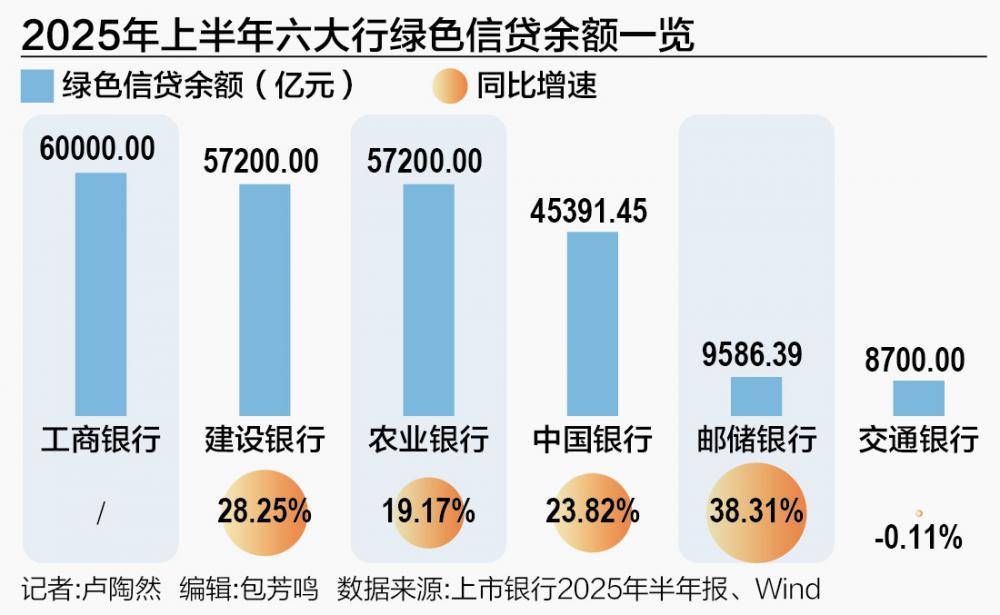
Core Insights - As of the end of Q2 2025, China's green loan balance reached approximately 42.4 trillion yuan, and the green bond balance exceeded 2.2 trillion yuan, positioning China among the top globally [1] - The carbon reduction support tool has guided financial institutions to issue carbon reduction loans exceeding 1.38 trillion yuan [1] - A total of 37 listed banks reported a combined green loan balance of 29.22 trillion yuan, with an average balance exceeding 800 billion yuan, reflecting a year-on-year growth of 41.79% [1][5] Green Loan Growth - The green loan balance of the banking system in China is leading globally, with state-owned banks playing a significant role [4] - Among the six major state-owned banks, the Industrial and Commercial Bank of China (ICBC) leads with a green loan balance of 6 trillion yuan, followed by China Construction Bank and Agricultural Bank of China, each with 5.72 trillion yuan [5] - Postal Savings Bank of China showed a remarkable year-on-year growth rate of 38.31%, nearing the 1 trillion yuan mark [5] Innovation in Green Financial Products - Banks are actively expanding and innovating specialized green financial products and service models, covering areas such as clean energy and environmental remediation [2] - The green financial product system is becoming increasingly diverse, showcasing various practical paths and innovative outcomes [2] Carbon Reduction Support Tool - The carbon reduction support tool is becoming a key indicator of banks' green financial capabilities, effectively directing financial resources towards green and low-carbon sectors [9] - In Q2 2025, 16 banks reported carbon reduction loans that facilitated a carbon reduction equivalent of over 7 million tons, with a total loan amount of nearly 24 billion yuan [9] - Major banks like ICBC and China Construction Bank have over 100 projects funded through carbon reduction loans, leading in both project numbers and loan amounts [9] Performance of Smaller Banks - Smaller banks, including city commercial banks and rural commercial banks, are showing significant growth in green loan balances, with some achieving substantial year-on-year increases [8] - Zhangjiagang Rural Commercial Bank led the rural commercial banks with a growth rate of 30.25% in green loan balances [7] - Smaller banks are encouraged to leverage local advantages and develop differentiated paths to support local green projects [8]



央行:调整后的一级交易商考评办法将从2025年启用,考评期内行为不当的一级交易商将被暂停参与公开市场操作
Sou Hu Cai Jing· 2025-09-12 10:45
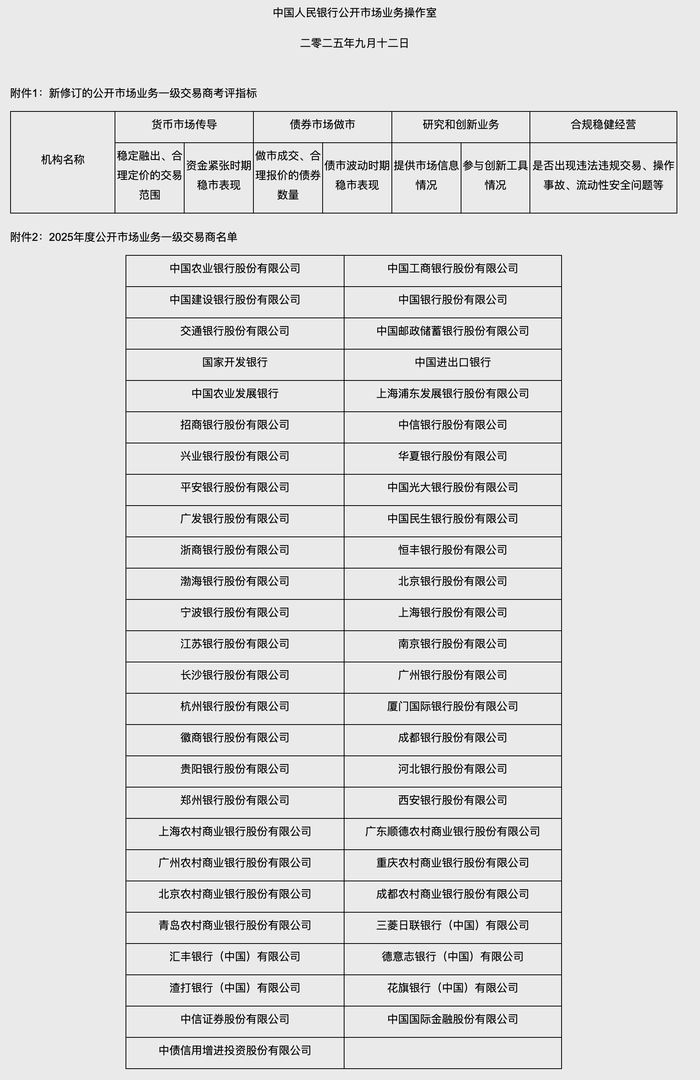
Core Viewpoint - The People's Bank of China (PBOC) has established a new evaluation mechanism for primary dealers in the open market, which will be implemented in 2025, aiming to enhance the transmission of monetary policy and adapt to the evolving financial market [1]. Group 1: Evaluation Mechanism - The PBOC's evaluation mechanism for primary dealers was first established in 2004 and adjusted in 2018 to support smooth open market operations [1]. - The new evaluation method will focus on optimizing and simplifying assessment indicators, categorizing institutions for evaluation, and strengthening the linkage with bond market makers [1]. - The list of primary dealers for the year 2025 will remain unchanged, and any dealer exhibiting inappropriate behavior during the evaluation period may be suspended from participating in open market operations [1]. Group 2: Institutions Involved - A comprehensive list of institutions that will be evaluated includes major banks such as Agricultural Bank of China, Industrial and Commercial Bank of China, China Construction Bank, and Bank of China, among others [3][4]. - The evaluation will consider factors such as stable lending, reasonable pricing, market performance during tight funding periods, and compliance with operational standards [3].





江苏银行跌2.04%,成交额15.07亿元,主力资金净流出1.42亿元
Xin Lang Zheng Quan· 2025-09-12 06:30
Core Viewpoint - Jiangsu Bank's stock price has experienced fluctuations, with a recent decline despite an overall increase in the year-to-date performance. The bank's financial metrics indicate a stable growth in net profit and a significant history of dividend payouts. Group 1: Stock Performance - As of September 12, Jiangsu Bank's stock price decreased by 2.04%, trading at 10.54 CNY per share, with a total market capitalization of 193.42 billion CNY [1] - Year-to-date, the stock price has increased by 13.35%, but it has seen a decline of 1.13% over the last five trading days, 4.01% over the last 20 days, and 9.65% over the last 60 days [2] Group 2: Financial Overview - For the first half of 2025, Jiangsu Bank reported a net profit of 20.24 billion CNY, reflecting an 8.05% year-on-year growth [2] - The bank's main business segments include financial services (46.93%), personal financial services (30.84%), and funding services (21.44%) [2] Group 3: Shareholder and Dividend Information - Since its A-share listing, Jiangsu Bank has distributed a total of 47.64 billion CNY in dividends, with 25.79 billion CNY paid out in the last three years [3] - As of June 30, 2025, the number of shareholders increased by 5.29% to 138,800, while the average number of circulating shares per person decreased by 5.02% [2][3]