
CMS(600999)

Search documents
视频|中信证券、银河证券、中信建投、招商、光大、国联民生等顶级券商掌舵人齐聚可持续全球领导者大会
Xin Lang Zheng Quan· 2025-10-23 09:27
Group 1 - The 2025 Sustainable Global Leaders Conference will be held from October 16 to 18 in Shanghai, focusing on building a new ecosystem for sustainable development in the securities industry through five key financial initiatives [1][2] - Key leaders from top Chinese securities firms, including China Galaxy Securities and CITIC Securities, will discuss the implementation of these five initiatives to support high-quality economic development in China [1] - The conference is co-hosted by the World Green Design Organization and Sina Group, with support from the Shanghai Huangpu District Government, aiming to explore new paths for sustainable development and inject "Chinese momentum" into global governance [1] Group 2 - The conference has upgraded from the previous four "ESG Global Leaders Conferences," inviting around 500 prominent guests, including approximately 100 international attendees, such as former political leaders, representatives from international organizations, Nobel Prize winners, and leaders from Fortune 500 companies [2]



打造现代投行发展新模式,招商证券力推三大转型
Zhong Guo Zheng Quan Bao· 2025-10-23 08:28
Core Viewpoint - The Central Financial Work Conference emphasizes the cultivation of first-class investment banks and institutions, providing a vision for the high-quality development of securities companies, with a focus on quality and technological finance as a leading force for transformation [1] Group 1: Modern Investment Banking Transformation - The difference in investment banking capabilities lies in organizational and business models, transitioning from a "hunting model" to a "farming model" that emphasizes platform management and professional integration [2] - Since 2018, the company has initiated a transformation towards modern investment banking in response to the registration system reform, restructuring its organization, processes, and culture to enhance service quality [2][3] - The company has implemented a "three investments linkage" model, integrating investment banking, investment, and research departments to proactively acquire clients and provide comprehensive financial services [3] Group 2: Technological Empowerment and Standardization - The company is enhancing its investment banking operations through a standardized project management system and intelligent platforms, improving efficiency and quality in project execution [4][9] - A comprehensive digital support platform has been developed to facilitate all aspects of investment banking, utilizing big data and AI to enhance management capabilities and operational efficiency [9][10] - The company has established a performance evaluation system that links results to accountability, ensuring compliance and quality in investment banking practices [8] Group 3: Focus on Technology Finance and Industry Services - The company is committed to developing technology finance, green finance, and inclusive finance, aligning with national strategies to provide quality financial services [11][12] - The "Leap Plan" has been launched to support early-stage technology companies, with over 600 enterprises engaged and investments exceeding 2.6 billion [12] - The company has focused on three key technology sectors: digital technology, life sciences, and green technology, facilitating significant financing for technology enterprises [13][14] Group 4: Quality Control and Risk Management - The company emphasizes quality as the lifeline of investment banking, establishing a robust internal control system to manage risks and ensure compliance [6][7] - A three-line defense mechanism has been implemented to uphold ethical standards, professional norms, and quality control in all investment banking activities [6][7] - The company maintains strict project management and risk assessment protocols to ensure high-quality service delivery and compliance with regulatory standards [8]
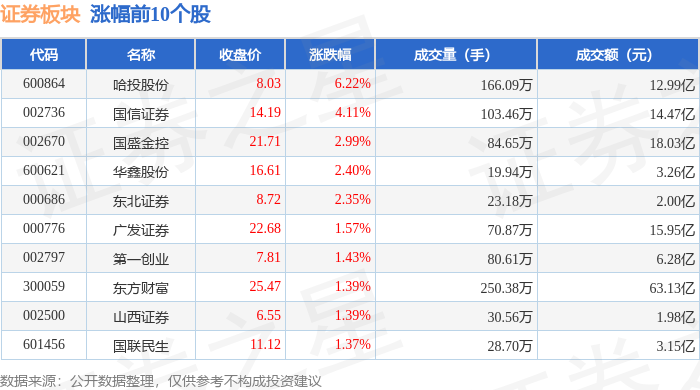
证券板块10月23日涨1.06%,哈投股份领涨,主力资金净流入3.58亿元
Zheng Xing Xing Ye Ri Bao· 2025-10-23 08:20
Market Overview - On October 23, the securities sector rose by 1.06%, with Haotou Co., Ltd. leading the gains [1] - The Shanghai Composite Index closed at 3922.41, up 0.22%, while the Shenzhen Component Index closed at 13025.45, also up 0.22% [1] Individual Stock Performance - Haotou Co., Ltd. (600864) closed at 8.03, up 6.22% with a trading volume of 1.66 million shares and a transaction value of 1.299 billion [1] - Other notable performers included: - Tuxin Securities (002736) at 14.19, up 4.11% [1] - Guosheng Financial Holdings (002670) at 21.71, up 2.99% [1] - Huaxin Co., Ltd. (600621) at 16.61, up 2.40% [1] Capital Flow Analysis - The securities sector saw a net inflow of 358 million in institutional funds, while retail investors experienced a net outflow of 618 million [2] - Major stocks with significant capital inflows included: - Dongfang Fortune (300059) with a net inflow of 325 million [3] - Haotou Co., Ltd. (600864) with a net inflow of 16.6 million [3] - CITIC Securities (600030) with a net inflow of 13.8 million [3] Summary of Trading Data - The trading data for various securities showed mixed results, with some stocks experiencing gains while others faced declines [2][3] - The overall trading environment indicates a cautious sentiment among retail investors, contrasting with institutional buying activity [2][3]





乖宝宠物跌14.42% 招商证券今刚维持强烈推荐评级就跌
Zhong Guo Jing Ji Wang· 2025-10-23 07:40
Group 1 - The core viewpoint of the article highlights that Guibao Pet (301498.SZ) experienced a significant stock decline of 14.42%, closing at 73.25 yuan, amid competitive pressures and export challenges impacting profitability [1] - According to the research report by CITIC Securities, Guibao Pet's Q3 revenue increased by 21.9% year-on-year, while the net profit attributable to shareholders decreased by 16.6% due to export pressures and rising costs [1] - The domestic brands, such as Freycat and Maifudi, continued to show growth, but the OEM segment faced tariff impacts, which affected overall profitability [1] Group 2 - The company is expected to see gradual improvement in profitability, with projected net profits for 2025, 2026, and 2027 being 690 million, 870 million, and 1.11 billion yuan, respectively [1] - Earnings per share (EPS) forecasts for 2025, 2026, and 2027 are 1.73, 2.18, and 2.77 yuan, respectively, with a corresponding 39x PE valuation for 2026 [1] - The research maintains a "strong buy" rating for Guibao Pet, indicating confidence in the company's future performance despite current challenges [1]
大行评级丨招商证券国际:维持泡泡玛特“增持”评级 上调销售额和净利润预测
Ge Long Hui· 2025-10-23 05:28
Core Viewpoint - The report from China Merchants Securities International highlights that Pop Mart's third-quarter financial performance is impressive, with overall revenue surging by 245% year-on-year to 250 million, driven by strong domestic and international market performance [1] Group 1: Financial Performance - Pop Mart's revenue growth is attributed to the effective execution of its localization growth strategy and international expansion [1] - The company has successfully implemented a multi-channel approach, including online, offline, and collaboration with Books-A-Million, which has become a key catalyst for growth [1] Group 2: Investment Outlook - China Merchants Securities International maintains Pop Mart as a preferred industry stock, reiterating an "overweight" rating [1] - Sales and net profit forecasts for 2025 have been raised by 16% and 13%, respectively, reflecting the strong performance in the third quarter [1] - After adjusting profit forecasts, a target price of 380 HKD is derived based on a 21 times price-to-earnings ratio for the end of 2026, which is still one standard deviation above the average valuation since 2025 [1]

东信和平科技股份有限公司 关于变更持续督导保荐代表人的公告

Zhong Guo Zheng Quan Bao - Zhong Zheng Wang· 2025-10-23 00:52
登录新浪财经APP 搜索【信披】查看更多考评等级 本公司及董事会全体成员保证信息披露的内容真实、准确、完整,没有虚假记载、误导性陈述或重大遗 漏。 东信和平科技股份有限公司(以下简称"公司")于近日收到招商证券股份有限公司(以下简称"招商证 券")出具的《关于更换公司配股项目持续督导保荐代表人的函》,现将相关情况公告如下: 一、基本情况 招商证券作为公司2019年度配股公开发行股票的保荐机构,项目法定持续督导期至2020年12月31日止。 鉴于公司募集资金尚未使用完毕,招商证券将继续履行募集资金相关的持续督导职责。 招商证券原指派李莎女士、刘海燕女士为该项目的保荐代表人。现刘海燕女士因工作变动原因,无法继 续担任该项目的保荐代表人,为保证持续督导工作的有序开展,招商证券现委派张阳先生(简历附后) 接替刘海燕女士继续担任公司该项目的保荐代表人,继续履行持续督导职责。 本次变更后,公司配股项目的持续督导保荐代表人为李莎女士、张阳先生。 公司董事会对刘海燕女士在持续督导期间所做的工作表示衷心感谢。 二、备查文件 1、招商证券出具的《关于更换公司配股项目持续督导保荐代表人的函》。 特此公告。 东信和平科技股份有限公司 ...
招商证券公告称,“25中铁十一MTN003(科创债)”申购结束前一小时内出现投资人撤标
Xin Hua Cai Jing· 2025-10-22 15:26
招商证券 公告称,"25中铁十一MTN003( 科创债 )"申购结束前一小时内出现投资人撤标, 申万宏源 证 券撤标规模4000万元,申购价位2.39%,撤标时间17:58:38。 ...

创业板ETF(159915)标的指数震荡回调,机构认为可关注前期调整充分的科技成长赛道
Sou Hu Cai Jing· 2025-10-22 11:52
Group 1 - The ChiNext index closed down by 0.8%, the ChiNext Growth Index down by 0.6%, and the ChiNext Mid 200 Index down by 0.5% [1] - Short-term market risk appetite may recover, with a focus on technology growth sectors that have undergone sufficient adjustments, particularly in areas related to the "14th Five-Year Plan" such as domestic computing power, semiconductor self-sufficiency, controllable nuclear fusion, military industry, and commercial aerospace [1] Group 2 - The ChiNext ETF tracks the ChiNext Index, which consists of 100 stocks with large market capitalization and good liquidity, with nearly 60% of the index composed of emerging industries such as power equipment, communication, and electronics [3] - The ChiNext 200 ETF tracks the ChiNext Mid 200 Index, which includes 200 stocks with medium market capitalization and good liquidity, reflecting the overall performance of mid-cap companies in the ChiNext market, with over 40% of the index in the information technology sector [3] - The ChiNext Growth ETF tracks the ChiNext Growth Index, composed of 50 stocks with strong growth characteristics and good liquidity, with nearly 80% of the index in the communication, power equipment, electronics, non-bank financials, and pharmaceutical industries [3]

招商证券:首予曹操出行“增持”评级 Robotaxi拓展成长空间
Zhi Tong Cai Jing· 2025-10-22 08:22
Core Viewpoint - Caocao Travel (02643) is a ride-hailing platform empowered by Geely Group, maintaining a strong second position in market share, with a projected CAGR of 39% from 2022 to 2024, and plans for a successful listing on the Hong Kong Stock Exchange in 2025, marking a new phase of expansion and technological upgrades [1] Group 1: Business Model and Competitive Advantage - Caocao Travel operates the largest customized ride-hailing fleet in China, leveraging Geely Group's manufacturing and service support to build differentiated competitive advantages, significantly reducing supply-side costs and increasing driver income [2] - The company attracts quality drivers through stable order volumes and a standardized management system, while its brand recognition and differentiated service experiences enhance user loyalty [2] Group 2: Future Growth Potential - The company is accelerating penetration into lower-tier markets, planning to enter 27 new cities by mid-2025 through sales of customized vehicles to local partners, with further expansion into high-tier markets expected to increase market share [3] - Profitability is anticipated to improve as the cost of customized vehicles is optimized, with potential for increased commission rates and better user subsidy efficiency, positioning Caocao Travel favorably against industry leaders like Didi [3] Group 3: Autonomous Driving - In February 2025, Caocao Travel will launch its autonomous driving platform, integrating Geely Group's "Qianli Haohan" Robotaxi solution, transitioning from technology validation to scenario-based operations [4] - The core advantage of the autonomous driving business lies in its unique "smart manufacturing + smart driving + smart operation" model, with plans to initiate commercial operations for unmanned driving by 2027, indicating strong potential in the Robotaxi sector [4]
招商证券:首予曹操出行(02643)“增持”评级 Robotaxi拓展成长空间
智通财经网· 2025-10-22 08:21
Core Viewpoint - Caocao Travel, backed by Geely Group, is positioned as a leading ride-hailing platform with a stable market share, expected to maintain growth above industry average due to its cost advantages and differentiated services [1] Group 1: Company Overview - Caocao Travel is a ride-hailing platform empowered by Geely Group, with Geely's chairman holding a 77% stake, ensuring strong backing [1] - The company holds the second-largest market share in China, with a revenue CAGR of 39% projected from 2022 to 2024 [1] - The company plans to go public on the Hong Kong Stock Exchange in 2025, marking a new phase of expansion and technological upgrades [1] Group 2: Business Model and Competitive Advantage - Caocao Travel operates the largest customized ride-hailing fleet in China, leveraging Geely's manufacturing and service capabilities to create a differentiated competitive edge [2] - The customized vehicle ecosystem significantly reduces supply-side costs, leading to higher driver incomes, while a stable order volume attracts quality drivers [2] - The company primarily sources orders through a platform aggregation model, enhancing brand recognition and user loyalty through superior service [2] Group 3: Future Growth Potential - The company is accelerating penetration into lower-tier markets, planning to enter 27 new cities by mid-2025 through partnerships for customized vehicle sales [3] - There is significant potential for market share growth as the company deepens its presence in high-tier markets and expands into new lower-tier cities [3] - Profitability is expected to improve through further optimization of customized vehicle costs, enhanced user subsidy efficiency, and scale effects, positioning Caocao Travel favorably against industry leaders like Didi [3] Group 4: Autonomous Driving Initiatives - In February 2025, Caocao Travel will launch its autonomous driving platform, integrating Geely's Robotaxi solutions, transitioning from technology validation to operational scenarios [4] - The core advantage of the autonomous driving business lies in its unique "smart manufacturing + smart driving + smart operation" model [4] - The company aims to initiate commercial operations for unmanned driving by 2027, indicating strong potential in the Robotaxi sector [4]