CMS(600999)

Search documents
易方达基金增持招商证券161.78万股 每股作价约18.08港元
Zhi Tong Cai Jing· 2025-09-01 12:47
香港联交所最新资料显示,8月26日,易方达基金管理有限公司增持招商证券(600999)(06099)161.78 万股,每股作价18.0842港元,总金额约为2925.66万港元。增持后最新持股数目约为1.02亿股,最新持 股比例为8.02%。 ...

易方达基金增持招商证券(06099)161.78万股 每股作价约18.08港元
智通财经网· 2025-09-01 11:29
智通财经APP获悉,香港联交所最新资料显示,8月26日,易方达基金管理有限公司增持招商证券 (06099)161.78万股,每股作价18.0842港元,总金额约为2925.66万港元。增持后最新持股数目约为1.02 亿股,最新持股比例为8.02%。 ...
招商证券国际:降理想汽车-W(02015)目标价至115港元 新车真空期拖累业绩
智通财经网· 2025-09-01 09:33
Core Viewpoint - Li Auto's Q2 performance fell short of expectations, with weak sales growth during the new model gap, but profitability is steadily improving [1] Group 1: Financial Performance - Li Auto's new electric model i8 has seen smooth deliveries, with management projecting cumulative deliveries to reach between 8,000 to 10,000 units by the end of September [1] - The company has a strong cash position exceeding 100 billion, providing sufficient resources to navigate short-term headwinds [1] - The forecast for net profit (non-GAAP) for Li Auto has been revised downwards by 48%, 28%, and 25% for the years 2025 to 2027, reflecting pressure on profitability during the new model gap [1] Group 2: Market Outlook - The market is overly pessimistic about the company's product cycle, overlooking its management efficiency, channel expansion potential, and overseas growth opportunities [1] - The third quarter is expected to be the low point for delivery volumes, with the launch of the i6 model anticipated to reverse market pessimism [1] Group 3: Investment Recommendations - The recommendation is to buy on dips, maintaining a "buy" rating, while lowering the target price for Hong Kong shares to 115 HKD and for US shares to 30 USD, which corresponds to a 19 times price-to-earnings ratio for the fiscal year 2026, representing a 27% discount to the company's historical average valuation [1]

招商证券国际:降理想汽车-W目标价至115港元 新车真空期拖累业绩
Zhi Tong Cai Jing· 2025-09-01 09:33
招商证券国际表示,当前市场对公司产品周期过度悲观,忽略公司精细管理提效能力,渠道下沉拓展空 间以及海外拓展空间。公司有超过千亿现金,有足够源应对短期逆风。预计三季度是交付量低点,i6上 市后将扭转市场悲观预期。该行分别下调理想汽车2025至2027年净利润预测(非GAAP)48%、28%、 25%,反映新品断档期盈利承压。 招商证券国际发布研报称,理想汽车-W(02015,LI.US)今年次季度业绩低于预期,新车空窗期销量增长 乏力,但盈利能力稳中有升,纯电新品i8交付顺利,管理层预计截至9月底累计交付目标为8,000至 10,000台,产能与供应链稳定性良好,i8市场接受度好于预期。建议逢低吸纳,维持"增持"评级,下调 港股目标价至115港元、美股目标价至30美元,相当于2026财年19倍市盈率,相对公司历史平均估值折 让27%。 ...
招商证券(600999):业绩符合预期,自营收益率环比提升
Huachuang Securities· 2025-09-01 09:03
Investment Rating - The report maintains a "Recommend" rating for the company, with a target price of 22.37 CNY, compared to the current price of 18.98 CNY [4][10]. Core Views - The company's return on equity (ROE) for the reporting period is 3.9%, with a year-on-year increase of 0.1 percentage points. The quarterly ROE is 2.2%, showing a quarter-on-quarter increase of 0.4 percentage points and a year-on-year increase of 0.1 percentage points [2]. - The total revenue for the reporting period, excluding other business income, is 10.4 billion CNY, representing a year-on-year growth of 9%. The quarterly revenue is 5.8 billion CNY, with a quarter-on-quarter increase of 11.5% [7]. - The net profit attributable to the parent company is 5.19 billion CNY, reflecting a year-on-year increase of 9.2% and a quarterly increase of 5.7% [7]. Financial Performance - The company's self-operated business income amounts to 4.12 billion CNY, with a quarterly income of 2.61 billion CNY, showing a quarter-on-quarter increase of 1.1 billion CNY [3]. - Interest income from credit business is 4.53 billion CNY, with a quarterly income of 2.22 billion CNY, showing a quarter-on-quarter decrease of 0.95 million CNY [3]. - The company's asset turnover rate is 2.1%, with a quarterly rate of 1.2%, both showing year-on-year increases of 0.1 percentage points [2]. Market Position - The company's market share in margin financing is 5.15%, with a year-on-year decrease of 0.13 percentage points [3]. - The average yield of actively managed equity funds in the same quarter is +1.41%, showing a quarter-on-quarter decrease of 1.87 percentage points and a year-on-year increase of 4.02 percentage points [3]. Future Earnings Forecast - The expected earnings per share (EPS) for 2025, 2026, and 2027 are projected to be 1.45 CNY, 1.56 CNY, and 1.67 CNY respectively, with corresponding book values per share (BPS) of 13.98 CNY, 15.02 CNY, and 16.06 CNY [10][11].
金麒麟最佳投顾评选基金组8月月榜:国元证券吴达耀收益超31%居首位 方正证券洪晓伟、广发证券张坤居第2、3位
Xin Lang Zheng Quan· 2025-09-01 08:36
Group 1 - The "Second Golden Unicorn Best Investment Advisor Selection" event is currently ongoing, organized by Sina Finance in collaboration with Yinhua Fund, aiming to identify outstanding investment advisors and enhance the investment advisory IP construction [1] - The monthly ranking data for August shows that the top investment advisor in the public fund simulation configuration group is Wu Dayao from Guoyuan Securities, achieving a monthly return of 31.32% [1][2] - The second and third positions are held by Hong Xiaowei from Founder Securities with a return of 26.25% and Zhang Kun from GF Securities with a return of 23.07% respectively [1][2] Group 2 - The top 100 rankings for the public fund simulation configuration group for August include notable advisors such as Zhang Yefeng from Guotai Junan Securities with a return of 22.88% and Liu Jiafeng from Guoxin Securities with a return of 21.04% [2][3] - The performance of the top advisors indicates a competitive environment in the investment advisory sector, with several advisors achieving returns above 20% [2][3] - The rankings reflect the effectiveness of different investment strategies employed by various advisors across multiple securities firms [1][2]






机构:中线拿稳、短线勿追!“慢牛”心态,结构更重要
天天基金网· 2025-09-01 05:46
Group 1 - The potential for the Federal Reserve to lower interest rates may strengthen a weak dollar environment, catalyzing a new round of growth in resource commodities, particularly precious metals and copper, which could accelerate the performance of the non-ferrous sector [2] - The upcoming product launches from Apple and META in September, focusing on edge AI and AR glasses, may lead to a sustainable trend in edge devices and AI ecosystems, making the consumer electronics sector, especially the Apple supply chain, worth watching [2] - The "anti-involution" trend is expected to reveal three clues: industries with high capital expenditure intensity and signs of marginal reduction, industries showing self-discipline or policy implementation, and industries relying on quotas to continuously improve profit margins [2] Group 2 - The number of innovative drug catalysts is expected to increase significantly in September, and recent technology shifts have cleared out short-term speculative funds, suggesting that innovative drugs may continue to rise after this adjustment [2] - The market is likely to maintain a volatile upward trend, driven by the accumulation of profit-making effects and continuous inflows of incremental capital, with a focus on sectors like AI computing power, semiconductor autonomy, solid-state batteries, commercial aerospace, controllable nuclear fusion, and innovative drugs [4][5] - The market is expected to remain in a high center of gravity, with structural rotation among sectors, supported by active trading and favorable policy expectations, particularly in growth sectors that have shown high prosperity in the first half of the year [5] Group 3 - The current market sentiment is high, with significant inflows of incremental capital, particularly from financing funds, leading to a further acceleration of market growth [6] - The market is experiencing structural differentiation, with volatility increasing, and a need for sectors to alternate and rise for a more stable and sustainable market [7] - Long-term capital, particularly from insurance funds, is increasing its presence in the A-share market, contributing to the stability of the current "slow bull" market [8] Group 4 - The market is expected to exhibit a primary trend of oscillation, with limited space for strong continuation, and a focus on defensive dividend sectors as their value is increasing [9] - The current bull market is supported by long-term factors such as the economic cycle nearing a bottom, supportive funding conditions, and positive signals from the industry [12] - The index center of gravity is expected to rise further, with a continuation of the growth trend in total market capitalization [12]



招商证券:银行板块超额收益窗口或会再开启 建议坚持长期主义和均衡配置
智通财经网· 2025-09-01 03:10
Core Viewpoint - The report from China Merchants Securities indicates that the banking sector is expected to see a reopening of excess return windows as macro liquidity approaches its peak, despite ongoing pressures from insurance non-standard maturities and a mid-term market outlook that remains positive for banks [1][2]. Group 1: Market Performance and Trends - From mid-July to mid-August, market trading volume increased and indices reached new highs, leading to a reduction in bank focus [1]. - As of August 29, 42 A-share banks reported a year-on-year revenue growth of 1.03%, PPOP growth of 1.13%, and net profit growth of 0.77% for the first half of 2025, showing improvements compared to the first quarter [2]. Group 2: Banking Sector Dynamics - The banking sector's profit improvement in Q2 was attributed to a reduction in bond market pressures and a decline in deposit rates, which provided confidence in bank interest margins [3]. - The report highlights that if the asset side of banks does not align with the reduction in deposit costs, the benefits may be negated by continued credit demand pressures [3]. Group 3: Policy and Structural Changes - The need for banks to focus on serving the real economy and high-quality development is emphasized, with a warning against low interest rates leading to misallocation of resources and increased non-performing loans [4]. - Macro policy design is crucial for guiding banks to prioritize genuine credit demand and avoid internal competition, especially during economic downturns [5]. - Positive changes are noted in policy measures aimed at improving the banking sector's asset side pressures, with expectations for a shift towards supporting the real economy and enhancing overall economic well-being [5].
上市券商上半年经纪业务收入同比增超43%
Zheng Quan Ri Bao· 2025-08-31 17:42
Core Viewpoint - The brokerage business is a fundamental aspect of securities firms' operations and a crucial starting point for their wealth management transformation, showing significant growth in net income and performance in the first half of 2025 [1][2]. Group 1: Market Performance - The brokerage business net income for listed securities firms exceeded 63 billion yuan, marking a year-on-year increase of over 43% due to a notable recovery in market trading activity [1][2]. - The average daily trading volume for stock funds reached 1.61 trillion yuan, a year-on-year increase of 63.87%, with new account openings totaling 12.6 million [2]. - The overall net income from securities trading for 150 firms in the industry was 688.42 billion yuan, reflecting a substantial year-on-year growth of 48.22% [2]. Group 2: Brokerage Income Growth - All 42 listed securities firms reported a year-on-year increase in brokerage fee net income, with a total of 634.54 billion yuan, representing a growth of 43.98% [2][3]. - Major firms like CITIC Securities, Guotai Junan, and GF Securities achieved significant brokerage income, with CITIC Securities leading at 64.02 billion yuan, a 31.2% increase [3]. Group 3: Structural Changes and Growth Drivers - The top-tier firms maintained their leading positions, while smaller firms achieved rapid growth through differentiated advantages [3]. - Mergers and acquisitions contributed to the growth of brokerage income, with firms like Guolian Minsheng seeing a staggering 223.77% year-on-year increase [3]. Group 4: Wealth Management Transformation - The wealth management transformation of securities firms is progressing from quantitative to qualitative changes, driven by regulatory guidance and a focus on customer-centric services [4]. - CITIC Securities reported over 16.5 million wealth management clients and a total managed asset scale exceeding 12 trillion yuan, with significant growth in various financial products [4]. - CICC innovated its product service model, achieving record highs in wealth management business, with managed assets totaling approximately 3.4 trillion yuan [5]. Group 5: Future Growth Potential - The brokerage business has solidified its foundational role, while the wealth management transformation is expected to become a core growth engine for the industry in the next phase [6].

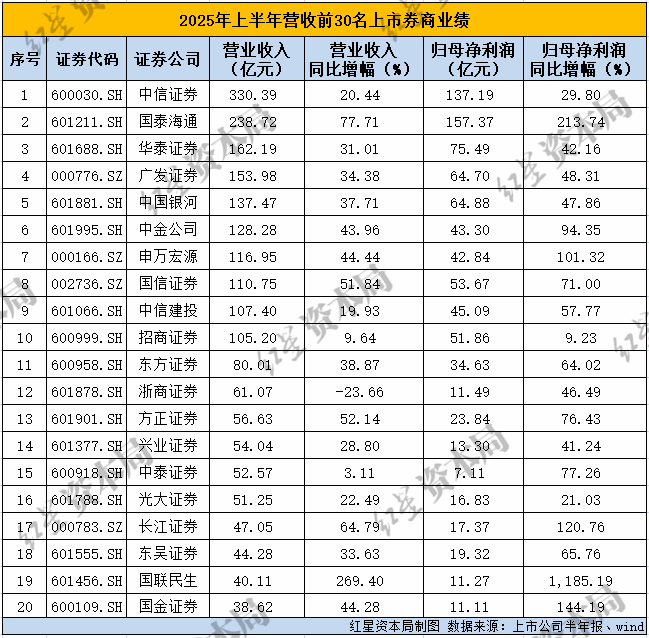
A股牛市助力!42家上市券商半年报亮眼,十家净利大增,员工薪酬水涨船高
Sou Hu Cai Jing· 2025-08-31 16:02
Core Insights - The A-share market's robust growth in the first half of 2025 has led to significant performance improvements in the brokerage industry, with 42 listed brokerages achieving a total revenue of 251.87 billion yuan, a year-on-year increase of 30.8%, and a net profit of 104.02 billion yuan, reflecting a substantial growth of 65.08% [1] Group 1: Performance Overview - Among large brokerages, CITIC Securities topped the industry with a revenue of 33.04 billion yuan, followed by Guotai Junan with 23.87 billion yuan [1] - Ten brokerages, including Huatai Securities and GF Securities, reported revenues exceeding 10 billion yuan [1] - Guotai Junan achieved the highest net profit in the first half, totaling 15.74 billion yuan [1] Group 2: Business Segments - The thriving A-share market has been the primary driver of the brokerages' performance, with core segments such as brokerage, proprietary trading, and wealth management showing strong results [1][4] - The gradual recovery of the IPO market has also contributed to the growth of investment banking services among several brokerages [1][4] Group 3: Employee Compensation - The average employee compensation in the brokerage sector has seen a significant increase, with nearly 90% of the 38 listed brokerages reporting a year-on-year rise, many exceeding 30% [5] - CITIC Securities leads with an average employee compensation of 420,800 yuan, followed by CICC and Guotai Junan at 380,300 yuan and 348,200 yuan, respectively [5] Group 4: Notable Growth Rates - Over 80% of listed brokerages reported double-digit growth in both revenue and net profit, with Huaxi Securities and Guolian Minsheng showing remarkable net profit growth of 1195% and 1185%, respectively [2] - Northeast Securities and Guotai Junan also experienced over twofold growth in net profit, while Tianfeng Securities successfully turned a profit [2] Group 5: Investment Banking Revenue - Several brokerages reported significant increases in investment banking revenue, with CITIC Securities achieving 2.10 billion yuan in the first half of 2025, a 20.91% increase year-on-year [6] - CICC and Guotai Junan also saw substantial growth in their investment banking revenues, with increases of 30.20% and 19.37%, respectively [6]