CMS(600999)

Search documents
港股券商股延续涨势 招商证券涨近15%
news flash· 2025-07-15 01:29
港股券商股延续涨势 招商证券涨近15% 智通财经7月15日电,截至发稿,招商证券(06099.HK)涨14.98%、中信建投证券(2.39.HK)涨2.39%、东 方证券(03958.HK)涨1.58%、国泰海通(01456.HK)涨0.66%。消息方面,招银国际于7月14日正式获得香 港证券及期货事务监察委员会批准,成为香港首家取得虚拟资产交易服务等相关牌照的中资银行系券 商。 ...

稳定币:数字化新势力与传统金融的最大公约数
HUAXI Securities· 2025-07-14 02:49
Investment Rating - Industry Rating: Recommended [6] Core Insights - The passing of the US "GENIUS Act" and Hong Kong's "Stablecoin Ordinance" marks a significant milestone in the recognition of stablecoins, potentially transforming virtual assets into key components of financial infrastructure [2][19] - Stablecoins are expected to bridge the gap between digital finance and traditional finance, enhancing their acceptance by regulatory bodies due to their stable value and payment attributes [2][12] - The total market capitalization of stablecoins exceeded $269 billion as of July 12, 2025, with over 90% being USD-pegged stablecoins [17] Regulatory Framework - The US "GENIUS Act" requires stablecoin issuers to hold 1:1 cash or treasury reserves and grants the Federal Reserve emergency stop authority to prevent systemic risks [20] - Hong Kong's "Stablecoin Ordinance" establishes a licensing system for stablecoin issuers, mandating sufficient reserves and compliance with anti-money laundering regulations [22][23] - The European Union's MiCA regulation, effective from December 30, 2024, also aims to regulate stablecoins, focusing on consumer protection and market integrity [19][21] Stablecoin Characteristics - Stablecoins are pegged to fiat currencies, balancing openness and stability, unlike Bitcoin which is highly volatile [3][12] - They are designed to function as a payment tool, with lower transaction costs and faster settlement times compared to traditional payment systems [17][23] - The stablecoin ecosystem includes issuers, exchanges, and application scenarios, supported by reserve banks and compliance service providers [25][26] Market Opportunities - The implementation of the "Stablecoin Ordinance" is expected to boost the development of stablecoin issuance, trading, and cross-border payments in Hong Kong, positioning it as a global virtual asset hub [8][23] - Companies like ZA Bank are poised to benefit from the stablecoin ecosystem by providing reserve banking services [26][28] - The regulatory environment in Hong Kong is conducive for local securities firms to expand their services into the virtual asset space, creating new growth opportunities [31][32]





政策红利不断释放,资金坚定布局,保险证券ETF(515630)近一年份额增长超8000万份
Xin Lang Cai Jing· 2025-07-14 02:28
Core Insights - The non-bank sector is experiencing a transformation driven by policy initiatives, which are expected to enhance revenue growth in the securities and insurance industries [2]. Group 1: Securities Industry - The implementation of the "Implementation Opinions on Strengthening Self-Regulation to Promote High-Quality Development of the Securities Industry" is likely to expand wealth management, investment banking, and asset management businesses, benefiting overall industry revenue growth [2]. - As of July 14, the CSI 800 Securities and Insurance Index component stocks showed mixed performance, with Guolian Minsheng leading with a 6.70% increase [1]. Group 2: Insurance Industry - The notification on guiding insurance funds for long-term stable investments is expected to increase the allocation of high-dividend stocks and long-term government bonds, enhancing the investment returns of insurance companies and improving industry valuations [2]. - The CSI 800 Securities and Insurance ETF has seen a significant increase in net value, rising by 49.53% over the past year, indicating strong investor interest [1]. Group 3: Market Performance - As of June 30, the top ten weighted stocks in the CSI 800 Securities and Insurance Index accounted for 63.35% of the index, highlighting the concentration of investment in these key players [3]. - The CSI 800 Securities and Insurance ETF has experienced a growth of 81 million shares over the past year, reflecting robust demand in the non-bank sector [1].



沪指放量上攻突破关键点位机构:投资者交易策略或应转向
Shang Hai Zheng Quan Bao· 2025-07-13 19:46
Group 1 - The A-share market has shown strong upward momentum, with the Shanghai Composite Index breaking through the 3500-point mark and trading volume exceeding 1.7 trillion yuan [2] - The financial sector has led the market rally, supported by a surge in short-term capital chasing high-performing stocks as semi-annual earnings forecasts are released [2] - Institutions suggest that investors should shift from a trading strategy to a holding strategy in light of the market's transition from a stock-based to an incremental market [4][5] Group 2 - Positive factors for the A-share market continue to accumulate, with strong risk appetite reflected in trading behavior and capital flows [3] - The market is increasingly focusing on fundamental factors rather than external disturbances, indicating a shift in pricing dynamics [3] - The strong upward trend in the A-share market is expected to continue, with significant conditions for a major rally accumulating [3] Group 3 - The market has seen a shift from net outflows to net inflows in actively managed public funds since June, marking a reversal in the trend of capital withdrawal [4] - Different sectors, including non-ferrous metals, telecommunications, and gaming, have shown synchronized upward movement, indicating the presence of incremental capital across various funding entities [5] Group 4 - The performance of semi-annual earnings is crucial for trading strategies, with sectors like TMT (Technology, Media, and Telecommunications) expected to perform well [6] - High-growth industries such as automotive parts, automation equipment, and consumer goods are recommended for investment, alongside sectors with improving performance like precious metals and pharmaceuticals [6] - Predictions indicate that industries such as light industry, non-ferrous metals, and non-bank financials may experience high growth rates in their semi-annual earnings [6]




招商证券:建议关注高景气TMT领域、具有全球竞争力的中游制造、内需领域和其他业绩预喜板块
news flash· 2025-07-13 11:46
Core Viewpoint - The report from China Merchants Securities suggests focusing on high-growth TMT sectors, globally competitive midstream manufacturing, domestic demand sectors, and other segments with positive earnings forecasts as A-shares continue to reach new highs this year [1] Group 1: Market Performance - The A-share market has been consistently setting new highs this year, indicating a strong market performance [1] - The upcoming earnings season is seen as a favorable opportunity for investment, particularly in companies that are expected to exceed earnings forecasts [1] Group 2: Earnings Outlook - The overall earnings improvement rate for A-shares is higher than the same period last year, although the extent of profit improvement may be limited [1] - Structural opportunities remain worth exploring, particularly in sectors with high growth potential [1] Group 3: Sector Focus - Recommended sectors for investment include high-growth TMT (Technology, Media, and Telecommunications), globally competitive midstream manufacturing, and domestic demand sectors [1] - Attention should also be given to other sectors that are expected to report positive earnings [1] Group 4: Policy Considerations - Future policies aimed at addressing structural contradictions within industries should be monitored, particularly in relation to the concept of "anti-involution" [1]
优化发审效率同时如何衔接好现行机制?预先审阅规则发布!
Zhong Guo Jing Ying Bao· 2025-07-13 11:13
Core Viewpoint - The Shanghai Stock Exchange (SSE) has officially released the "Guidelines for Pre-Review of IPO Applications" to enhance the quality of IPO application documents and improve review efficiency, particularly for high-quality technology enterprises [1][2][3]. Group 1: Pre-Review Mechanism - The pre-review mechanism aims to optimize the allocation of review resources and strengthen risk prevention, reflecting a balance between supporting "hard technology" and protecting investors [3]. - The SSE has established a pre-review system for IPO applications, which allows eligible technology enterprises to apply for pre-review before formally submitting their IPO applications [2][4]. Group 2: Implementation and Quality Improvement - The SSE emphasizes the importance of accurately identifying the applicable scenarios for pre-review, particularly for technology enterprises facing potential negative impacts from early disclosure of business information [4][5]. - Issuers are required to prepare high-quality pre-review application documents that are true, accurate, and complete, in accordance with relevant regulations [5]. Group 3: Review Process and Disclosure Management - The SSE will conduct the pre-review process in accordance with formal review procedures, providing feedback to issuers and sponsors, but the review opinions do not constitute a pre-confirmation of compliance with listing conditions [5]. - During the pre-review period, related application documents and processes will not be disclosed to the public, but issuers must disclose relevant inquiries and responses on the SSE website upon formal application submission [5].
“1+6”配套规则正式发布,32家企业进入科创成长层
2 1 Shi Ji Jing Ji Bao Dao· 2025-07-13 09:38
Core Points - The China Securities Regulatory Commission (CSRC) is focusing on enhancing the inclusiveness and adaptability of the system, aiming to deepen reforms in the Sci-Tech Innovation Board and the Growth Enterprise Market [1] - The CSRC has issued guidelines for establishing a Sci-Tech Growth Tier to better support high-quality, unprofitable technology companies, allowing 32 existing unprofitable firms to enter this tier [1][2] - The reform does not impose additional listing thresholds for unprofitable companies, facilitating their access to capital markets [1][2] Group 1 - The Sci-Tech Growth Tier aims to support technology companies at different development stages, providing them with early access to capital markets [3] - The pre-review mechanism is a significant innovation, allowing companies to apply for pre-review under specific conditions to protect sensitive business information [3][4] - The Shanghai Stock Exchange (SSE) will conduct reviews based on formal procedures, ensuring transparency and market supervision during the pre-review phase [4] Group 2 - The SSE has established guidelines for identifying qualified institutional investors, encouraging companies to disclose information about these investors voluntarily [5] - The criteria for recognizing qualified institutional investors have been refined, focusing on their governance structure, asset management scale, and investment experience [5][6] - The introduction of qualified institutional investors is expected to create a binding effect, helping regulators and the market identify genuinely high-potential companies [6]

A股趋势与风格定量观察20250713:情绪和流动性向好,短期继续看多
CMS· 2025-07-13 05:13
Quantitative Models and Construction Methods - **Model Name**: Short-term Quantitative Timing Model **Model Construction Idea**: The model integrates macroeconomic fundamentals, valuation metrics, sentiment indicators, and liquidity metrics to generate short-term timing signals for A-share market trends [17][18]. **Model Construction Process**: 1. **Macroeconomic Fundamentals**: - Manufacturing PMI: Latest value is 49.70, corresponding to the 44.92% percentile over the past 5 years. Neutral signal. - RMB medium-to-long-term loan growth rate: Latest value is 6.78%, corresponding to the 0.00% percentile over the past 5 years. Cautious signal. - M1 growth rate (HP filter detrended): Latest value is 0.00%, corresponding to the 77.97% percentile over the past 5 years. Optimistic signal [17]. 2. **Valuation Metrics**: - PE Median: Latest value is 41.03, corresponding to the 94.79% percentile over the past 5 years. Neutral signal. - PB Median: Latest value is 2.73, corresponding to the 76.34% percentile over the past 5 years. Neutral signal [17]. 3. **Sentiment Indicators**: - Beta Dispersion: Latest value is -0.59%, corresponding to the 40.68% percentile over the past 5 years. Neutral signal. - Volume Sentiment Score: Latest value is 0.59, corresponding to the 90.82% percentile over the past 5 years. Optimistic signal. - Volatility: Latest value is 10.41% (annualized), corresponding to the 4.55% percentile over the past 5 years. Neutral signal [18]. 4. **Liquidity Metrics**: - Monetary Rate Indicator: Latest value is -0.10, corresponding to the 33.90% percentile over the past 5 years. Optimistic signal. - Exchange Rate Expectation Indicator: Latest value is -0.09%, corresponding to the 40.68% percentile over the past 5 years. Neutral signal. - 5-day average net financing: Latest value is 25.53 billion RMB, corresponding to the 84.20% percentile over the past 5 years. Neutral signal [18]. **Model Evaluation**: The model effectively captures short-term market trends and provides actionable signals for timing decisions [17][18]. - **Model Name**: Growth-Value Style Rotation Model **Model Construction Idea**: The model uses a quantitative economic mid-cycle analysis framework to determine the relative attractiveness of growth versus value styles based on profitability, interest rate, and credit cycles [28][29]. **Model Construction Process**: 1. **Macroeconomic Fundamentals**: - Profitability Cycle Slope: Current level is high, favoring growth. - Interest Rate Cycle Level: Current level is high, favoring value. - Credit Cycle Trend: Current trend is weakening, favoring value [28]. 2. **Valuation Metrics**: - PE Spread Percentile: Current value is 14.87%, indicating mean reversion upward, favoring growth. - PB Spread Percentile: Current value is 34.18%, indicating mean reversion upward, favoring growth [28]. 3. **Sentiment Indicators**: - Turnover Spread Percentile: Current value is 21.09%, indicating low turnover spread, favoring value. - Volatility Spread Percentile: Current value is 22.55%, indicating low volatility spread, favoring balanced allocation [29]. **Model Evaluation**: The model provides a systematic approach to style rotation, enhancing returns compared to equal-weighted style allocation [28][29]. - **Model Name**: Small-Cap vs. Large-Cap Style Rotation Model **Model Construction Idea**: The model evaluates the relative attractiveness of small-cap versus large-cap styles based on profitability, interest rate, and credit cycles, as well as valuation and sentiment metrics [33][34]. **Model Construction Process**: 1. **Macroeconomic Fundamentals**: - Profitability Cycle Slope: Current level is high, favoring small-cap. - Interest Rate Cycle Level: Current level is high, favoring large-cap. - Credit Cycle Trend: Current trend is weakening, favoring large-cap [33]. 2. **Valuation Metrics**: - PE Spread Percentile: Current value is 80.35%, indicating mean reversion downward, favoring large-cap. - PB Spread Percentile: Current value is 96.77%, indicating mean reversion downward, favoring large-cap [34]. 3. **Sentiment Indicators**: - Turnover Spread Percentile: Current value is 64.93%, indicating high turnover spread, favoring small-cap. - Volatility Spread Percentile: Current value is 65.44%, indicating mean reversion downward, favoring large-cap [34]. **Model Evaluation**: The model balances small-cap and large-cap allocations effectively, providing consistent returns over time [33][34]. - **Model Name**: Four-Style Rotation Model **Model Construction Idea**: The model combines insights from growth-value and small-cap-large-cap rotation models to allocate across four styles: small-cap growth, small-cap value, large-cap growth, and large-cap value [36][37]. **Model Construction Process**: - Allocation Recommendation: Small-cap growth 12.5%, small-cap value 37.5%, large-cap growth 12.5%, large-cap value 37.5% [36]. **Model Evaluation**: The model achieves superior returns compared to equal-weighted allocation across four styles, with consistent performance over time [36][37]. Model Backtesting Results - **Short-term Quantitative Timing Model**: - Annualized Return: 16.71% - Annualized Volatility: 14.56% - Maximum Drawdown: 27.70% - Sharpe Ratio: 0.9969 - Monthly Win Rate: 69.74% - Quarterly Win Rate: 69.23% [19][22][25] - **Growth-Value Style Rotation Model**: - Annualized Return: 11.73% - Annualized Volatility: 20.82% - Maximum Drawdown: 43.07% - Sharpe Ratio: 0.5416 - Monthly Win Rate: 58.28% - Quarterly Win Rate: 60.78% [29][32] - **Small-Cap vs. Large-Cap Style Rotation Model**: - Annualized Return: 12.21% - Annualized Volatility: 22.73% - Maximum Drawdown: 50.65% - Sharpe Ratio: 0.5336 - Monthly Win Rate: 60.93% - Quarterly Win Rate: 58.82% [34][35] - **Four-Style Rotation Model**: - Annualized Return: 13.25% - Annualized Volatility: 21.56% - Maximum Drawdown: 47.91% - Sharpe Ratio: 0.5931 - Monthly Win Rate: 59.60% - Quarterly Win Rate: 62.75% [36][37]
每周股票复盘:招商证券(600999)每股派发现金红利0.377元
Sou Hu Cai Jing· 2025-07-12 17:48
截至2025年7月11日收盘,招商证券(600999)报收于17.75元,较上周的17.42元上涨1.89%。本周,招 商证券7月11日盘中最高价报18.17元。7月7日盘中最低价报17.3元。招商证券当前最新总市值1543.63亿 元,在证券板块市值排名8/49,在两市A股市值排名86/5149。 交易信息汇总:7月10日招商证券发生1笔大宗交易,成交金额245.84万元 公司公告汇总:招商证券2024年年度权益分派实施,A股每股现金红利0.377元 本周关注点 交易信息汇总 7月10日招商证券发生1笔大宗交易,成交金额245.84万元。 公司公告汇总 招商证券股份有限公司提交了截至2025年6月30日的证券变动月报表给香港交易及结算所有限公司,呈 交日期为2025年7月7日。公司注册于中华人民共和国,注册股本总额为人民币8,696,526,806元。截至月 底,招商证券的A股在上海证券交易所上市,证券代码600999,注册股本为7,422,005,272股;H股在香 港联交所上市,证券代码06099,注册股本为1,274,521,534股。已发行股份方面,A股和H股的已发行股 份数目与上月底结存相同,分别 ...
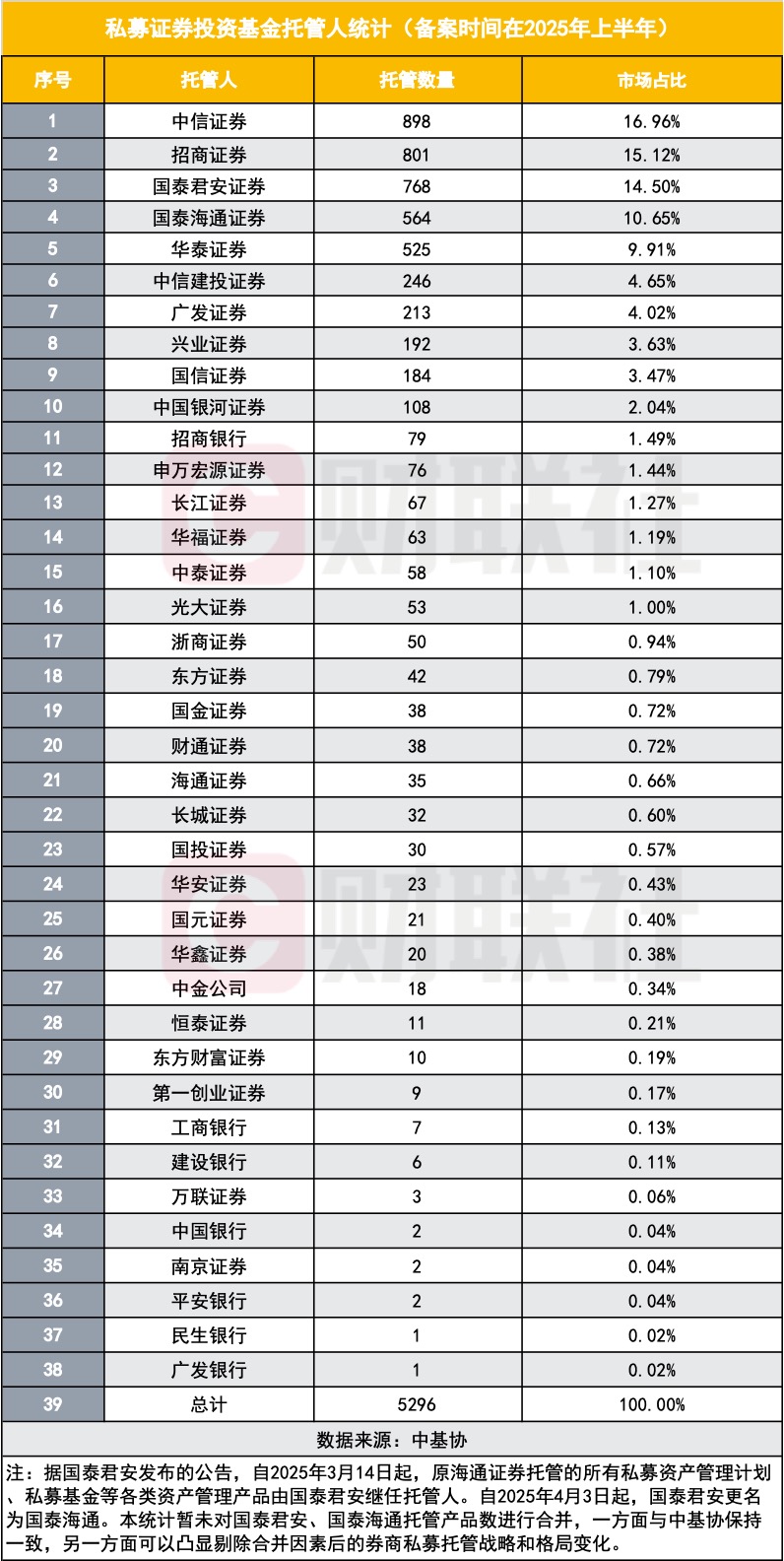
券商私募托管龙虎榜出炉!新增托管杀出新霸主
Xin Lang Cai Jing· 2025-07-11 10:18
Core Viewpoint - The private securities investment fund custody landscape is showing increasing concentration among leading brokerages, with the top three firms capturing nearly half of the market share in the first half of 2025 [1][4]. Group 1: Market Overview - A total of 5,296 new private fund products were registered in the market during the first half of 2025, with CITIC Securities leading with 898 products, accounting for 16.96% of the market [1][3]. - The combined market share of the top three brokerages—CITIC Securities, China Merchants Securities, and Guotai Junan—reached 46.58%, indicating strong competitive power in the private fund custody sector [4][5]. - Guotai Junan, after taking over the custody products from Haitong Securities, achieved a market share of 26.30% when combining the new products from Guotai Haitong and Haitong Securities, ranking first in the industry [1][3]. Group 2: Cumulative Custody Data - As of the end of 2024, China Merchants Securities led with a cumulative custody of 29,683 products, holding a market share of 21.35% [8][12]. - Guotai Junan and CITIC Securities followed with 23,691 and 19,459 products, respectively, showcasing significant scale advantages among the top firms [7][8]. - The cumulative custody volume of the top three brokerages reached 72,833 products, far exceeding other institutions [7]. Group 3: Strategic Importance of Custody Business - The private fund custody business is seen as a critical component of brokerages' asset management systems, providing a stable income source through custody fees, which typically range from 0.02% to 0.2% of fund size [15]. - Brokerages view custody services as an entry point for deeper collaboration with private fund managers, allowing them to expand their service offerings and enhance client retention [16]. - The custody business also enables brokerages to accumulate valuable data and experience, which can improve their overall service capabilities and support other asset management operations [16].