
NJBK(601009)

Search documents
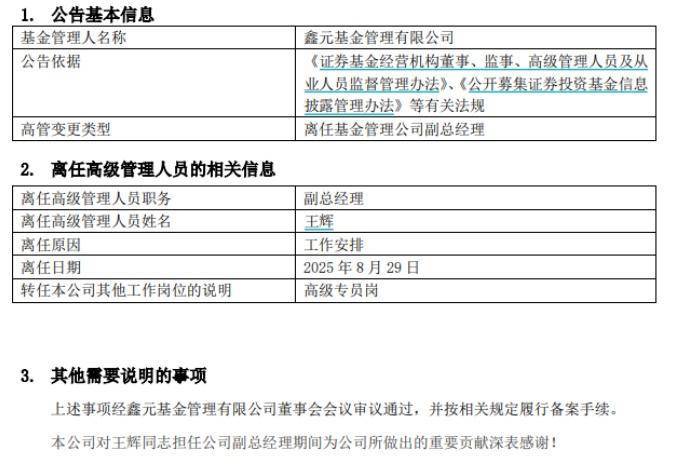
这家公募基金副总,为何转任高级专员?知情人士:因临近退休
Sou Hu Cai Jing· 2025-09-03 12:28
Core Viewpoint - The recent announcement from Xinyuan Fund Management regarding the resignation of Vice President Wang Hui has attracted significant market attention, indicating potential shifts in the company's management and strategy [1][5]. Company Overview - Xinyuan Fund Management is a bank-affiliated public fund company, with Nanjing Bank holding an 80% stake and Nanjing Gaoke holding 20% [5]. - The company currently manages 89 public fund products with a total management scale of 213.56 billion yuan, ranking 36th in the market [5]. Management Changes - Wang Hui, who joined Xinyuan Fund in August 2013 and has served as Vice President since 2016, will transition to a senior specialist role due to nearing retirement [3][4]. - The executive team will consist of six members post-adjustment, with three having backgrounds in Nanjing Bank and the other three possessing extensive experience in banking, public funds, and accounting firms [4]. Financial Performance - In the first half of 2025, Xinyuan Fund reported revenue of 356 million yuan, a year-on-year increase of 17.47%, and a net profit of 107 million yuan, up 18.99%, placing these figures in the top 25 among public funds [5]. - The fund's asset allocation is heavily weighted towards money market and bond funds, which together account for 97% of its total scale, amounting to 208.5 billion yuan [5]. Market Position and Strategy - Xinyuan Fund's strategy involves enhancing its equity product offerings, as the current market trend shows a lower proportion of equity products compared to competitors [6][7]. - The company aims to optimize its investment research team and improve asset allocation capabilities, focusing on aligning with national strategies and customer needs [6][7]. Product Development - Xinyuan Fund has seen significant growth in several actively managed equity funds, with some achieving returns exceeding 20% year-to-date [7]. - The company is also expanding its index product line, which includes various types of funds, and is preparing to launch its first ETF product [7].



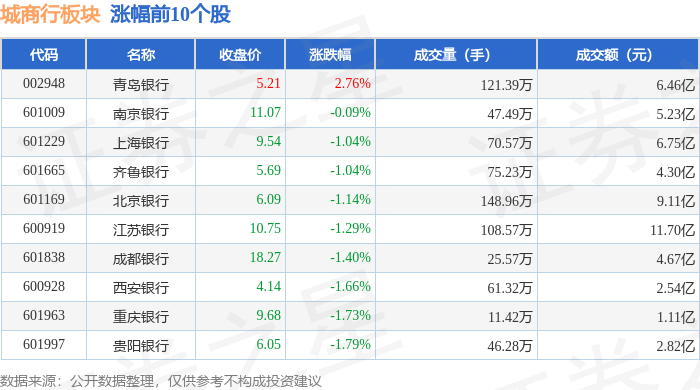
城商行板块9月3日跌1.43%,宁波银行领跌,主力资金净流出1.17亿元
Zheng Xing Xing Ye Ri Bao· 2025-09-03 08:44
Market Overview - On September 3, the city commercial bank sector declined by 1.43%, with Ningbo Bank leading the drop [1] - The Shanghai Composite Index closed at 3813.56, down 1.16%, while the Shenzhen Component Index closed at 12472.0, down 0.65% [1] Individual Stock Performance - Qingdao Bank saw an increase of 2.76%, closing at 5.21, with a trading volume of 1.2139 million shares and a transaction value of 646 million yuan [1] - Ningbo Bank decreased by 2.69%, closing at 28.20, with a trading volume of 298,100 shares and a transaction value of 849 million yuan [2] - Other notable declines include Xiamen Bank down 2.40% to 6.51, and Zhengzhou Bank down 2.39% to 2.04 [2] Capital Flow Analysis - The city commercial bank sector experienced a net outflow of 117 million yuan from institutional investors, while retail investors saw a net outflow of 13.7037 million yuan [2] - Conversely, speculative funds recorded a net inflow of 130 million yuan [2] Detailed Capital Flow by Bank - Shanghai Bank had a net outflow of 54.9962 million yuan from institutional investors, with a retail net outflow of 36.3451 million yuan [3] - Nanjing Bank recorded a net inflow of 32.8769 million yuan from institutional investors, but a net outflow of 52.7283 million yuan from retail investors [3] - Beijing Bank had a net inflow of 19.6264 million yuan from institutional investors, while retail investors experienced a net outflow of 43.6984 million yuan [3]



年内9家银行股东宣布增持
21世纪经济报道· 2025-09-03 07:32
Core Viewpoint - The article highlights a trend of bank shareholders and executives increasing their stakes in their respective banks, indicating confidence in the long-term value and growth potential of these institutions [1][3][6]. Group 1: Shareholder Actions - Qingdao Bank announced that its shareholder Guoxin Chanquan Holdings plans to increase its stake to between 19.00% and 19.99%, with a minimum of 233 million shares and a maximum of 291 million shares to be acquired within six months [1]. - Nanjing Bank's major shareholder, Nanjing Gaoke, increased its stake from 8.94% to 9.00% by acquiring 7.5077 million shares, reflecting confidence in the bank's future [3]. - Shanghai Bank reported that ten executives purchased a total of 440,000 shares at prices ranging from 10.46 to 10.70 yuan per share, committing to lock these shares for two years [5]. Group 2: Broader Market Trends - A total of nine banks have disclosed shareholder or executive buyback plans this year, indicating a broader trend in the banking sector [2]. - Other banks, including Jiangsu Bank and Suzhou Bank, have also reported significant share buybacks, with Jiangsu Bank's buyback amounting to 21.648 million shares valued at approximately 24.2782 million yuan [6]. - The article notes that many buyback plans are announced when bank stock valuations are at historical lows, suggesting a strategic move to signal confidence in long-term value [6]. Group 3: Adjustments to Buyback Plans - Chengdu Bank adjusted its buyback plan due to its stock price exceeding the original upper limit, proposing a new range of 700 million to 1.4 billion yuan without a price cap [7]. - Huaxia Bank announced a plan for executives to voluntarily increase their holdings by at least 30 million yuan, although the implementation has been delayed due to market conditions [9]. Group 4: Market Outlook - Analysts suggest that the banking sector is showing signs of recovery, with improved profitability and stable asset quality, indicating potential for upward earnings growth [9]. - The article emphasizes that the current environment presents a significant opportunity for long-term investment in bank stocks, given their defensive attributes and relatively high dividend yields [6][9].
股东拟增持青岛银行2.33亿股 年内已有9家银行发布增持报告
2 1 Shi Ji Jing Ji Bao Dao· 2025-09-03 05:39
Group 1 - Qingdao Bank announced that its shareholder Guoxin Chanquan Holdings plans to increase its stake through secondary market transactions, aiming for a total holding of 19.00% to 19.99% after the increase, with a minimum of 233 million shares and a maximum of 291 million shares to be acquired within six months [1] - Nanjing Bank's major shareholder, Nanjing Gaoke, increased its stake by 7.51 million shares, raising its holding from 8.94% to 9.00%, reflecting confidence in the bank's future development [2] - Shanghai Bank reported that ten directors and senior management purchased a total of 440,000 shares, with a total investment estimated between 4.60 million to 4.70 million yuan, indicating strong internal confidence in the bank's value [3] Group 2 - Suzhou Bank's major shareholder, Guofazhong Group, completed its share increase plan, acquiring 118 million shares for a total investment of 856 million yuan, based on confidence in the bank's long-term value [4] - Chengdu Bank adjusted its share increase plan due to rising stock prices, with a new plan to invest between 700 million to 1.4 billion yuan without a price cap, reflecting ongoing confidence in the bank's future [5] - Huaxia Bank announced a plan for its directors and senior management to voluntarily increase their holdings by at least 30 million yuan, demonstrating confidence in the bank's long-term investment value [6] Group 3 - The trend of share increases among banks is concentrated when valuations are at historical lows, indicating a strong internal belief in long-term value [4] - Analysts noted that the banking sector's profitability is stabilizing, with expectations for continued growth in earnings, suggesting a favorable investment environment for bank stocks [6]


区域龙头韧性彰显,南京银行上半年交出高质量答卷
Huan Qiu Lao Hu Cai Jing· 2025-09-03 03:36
Core Viewpoint - Nanjing Bank's 2025 semi-annual report demonstrates robust growth across multiple operational metrics, indicating strong profitability and resilience in a complex environment [1][6]. Financial Performance - As of the end of the reporting period, Nanjing Bank's total assets exceeded 2.9 trillion yuan, marking a nearly 12% increase from the previous year [1][7]. - The bank's deposits reached 1.64 trillion yuan, and loans amounted to 1.38 trillion yuan, with respective growth rates of 9.98% and 10.41% compared to the previous year [1][7]. - In the first half of 2025, Nanjing Bank achieved operating income of 28.48 billion yuan, an increase of 8.64% year-on-year, and a net profit attributable to shareholders of 12.62 billion yuan, up 8.84% year-on-year [6][7]. Capital Strength - The recent successful conversion of "Nanjing Bank Convertible Bonds" at nearly 100% conversion rate, totaling 19.996 billion yuan, set a record for city commercial banks [5][7]. - This conversion significantly enhances the bank's capital strength, providing a solid foundation for future high-quality development [5][7]. Business Segments - Nanjing Bank's corporate banking segment reported a loan balance of 1.06 trillion yuan, increasing by 119.02 billion yuan, or 12.71%, from the beginning of the year [8][11]. - Retail banking revenue reached 7.644 billion yuan, growing 21.40% year-on-year, with personal loans increasing to 331.949 billion yuan, a growth of 3.67% [9][11]. - The financial market segment maintained a steady upward trend, with subsidiaries contributing significantly to overall profitability [10]. Strategic Development - The bank's new five-year strategic plan focuses on developing corporate finance, retail finance, and financial markets, enhancing its comprehensive financial service capabilities [8][12]. - Nanjing Bank is actively optimizing its credit structure, particularly in key sectors such as advanced manufacturing, technology innovation, and green finance, with notable growth in these areas [11][12]. Regional Economic Integration - The bank emphasizes its role in supporting regional economic transformation, with significant increases in loans for green finance, inclusive small and micro enterprises, and technology finance [11][12]. - Nanjing Bank is also enhancing its cross-border financial services, supporting foreign trade small and micro enterprises [11][12]. Unique Business Identity - The bank is developing five distinctive business identities: Science and Technology Bank, Investment Bank, Wealth Bank, Transaction Bank, and Digital Bank, aiming to create a competitive edge [12][13]. - The focus on technology finance has led to a 12% increase in technology finance balance, reaching 166.8 billion yuan [12][13].

南京银行将在9月5日至9月6日对部分系统进行升级
Jin Tou Wang· 2025-09-03 03:14
Core Points - Nanjing Bank announced a system upgrade scheduled from September 5, 2025, 18:30 to September 6, 2025, 20:00, during which certain services will be suspended to enhance financial service quality and efficiency [1] Summary by Categories Service Suspension Details - From September 5, 18:30 to September 5, 21:30, mobile banking, Xinwei Hall, and WeChat official account services for appointment and information will be suspended [1] - From September 5, 19:00 to September 5, 23:00, corporate online banking and related services will not be available [1] - From September 5, 20:00 to September 6, 20:00, various channels for bill-related services will be suspended [1] - From September 5, 21:00 to September 6, 01:00, all services of Xin Cloud Finance, including payment, wealth management, and bills, will be unavailable [1] - From September 6, 01:00 to September 6, 04:00, electronic account services and personal information updates via the official WeChat account will be suspended [1] Customer Communication - The bank expressed gratitude for customer support and understanding regarding the inconvenience caused by the upgrade [2]
外资持仓超千亿!185家公司被扎堆!这两家公司被中东土豪重仓
Sou Hu Cai Jing· 2025-09-03 03:12
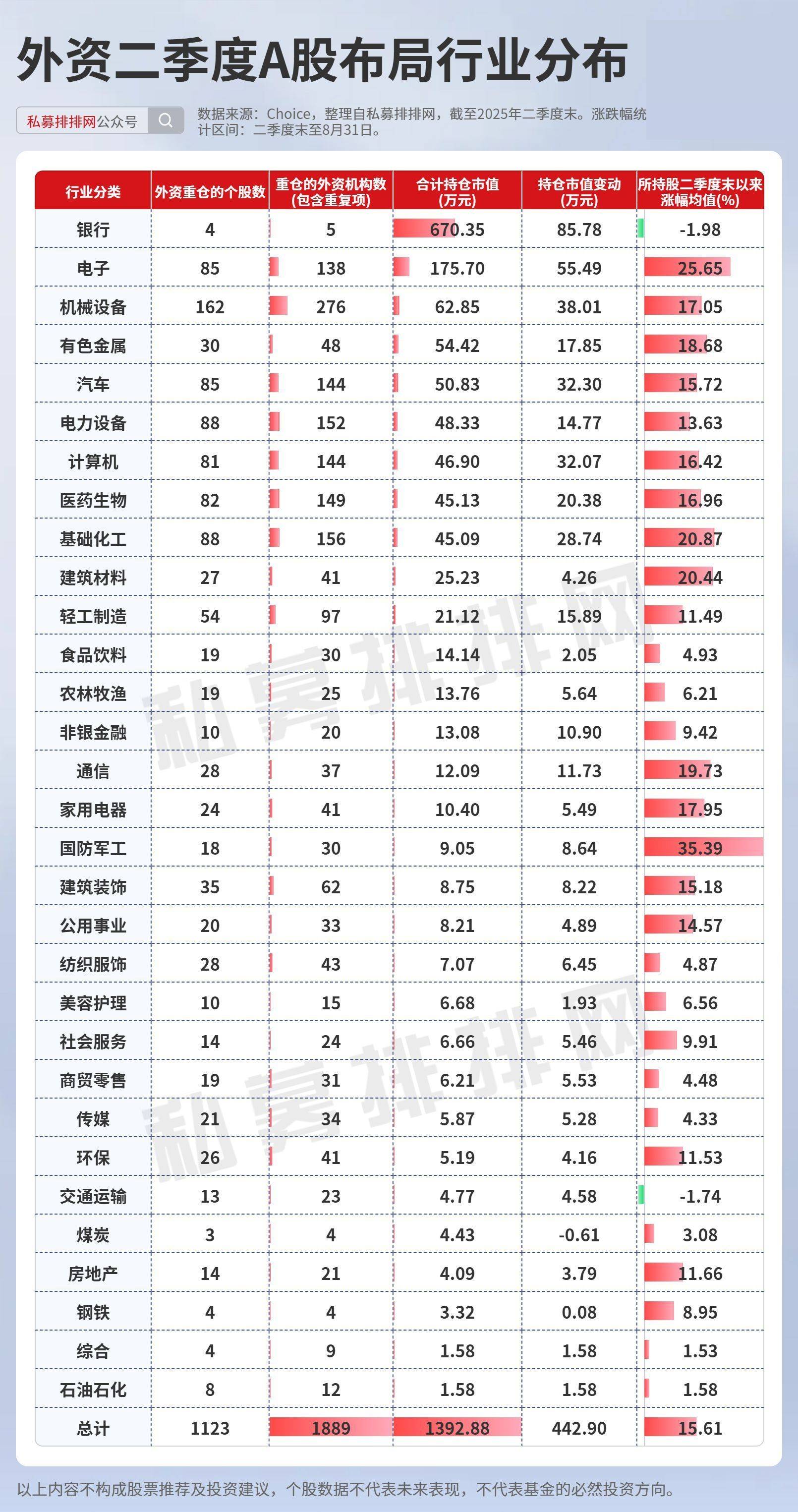
Core Insights - A-shares have entered a slow bull market since April 27, with increasing market activity from foreign capital, particularly evident in the second quarter's disclosures [1] - Foreign capital has heavily invested in 1,123 companies, with a total market value of 139.29 billion yuan, an increase of over 40 billion yuan from the previous quarter [1] - The electronics sector has become the preferred investment area for foreign capital, with a total holding value of 17.57 billion yuan, reflecting a rise of 5.55 billion yuan [1] Industry Summary - **Banking**: 4 companies, 5 foreign institutions, total holding value of 6.70 billion yuan [2] - **Electronics**: 85 companies, 138 foreign institutions, total holding value of 17.57 billion yuan [2] - **Machinery Equipment**: 162 companies, 276 foreign institutions, total holding value of 6.29 billion yuan [2] - **Non-ferrous Metals**: 30 companies, 48 foreign institutions, total holding value of 5.44 billion yuan [2] - **Automobile**: 85 companies, 144 foreign institutions, total holding value of 5.08 billion yuan [2] - **Power Equipment**: 88 companies, 152 foreign institutions, total holding value of 4.83 billion yuan [2] - **Computers**: 81 companies, 144 foreign institutions, total holding value of 4.69 billion yuan [2] - **Pharmaceuticals and Biology**: 82 companies, 149 foreign institutions, total holding value of 4.51 billion yuan [2] - **Basic Chemicals**: 88 companies, 156 foreign institutions, total holding value of 4.51 billion yuan [2] - **Building Materials**: 27 companies, 41 foreign institutions, total holding value of 2.52 billion yuan [2] - **Light Industry Manufacturing**: 54 companies, 97 foreign institutions, total holding value of 2.11 billion yuan [2] - **Food and Beverage**: 19 companies, 30 foreign institutions, total holding value of 1.41 billion yuan [2] - **Agriculture, Forestry, Animal Husbandry, and Fishery**: 19 companies, 25 foreign institutions, total holding value of 1.38 billion yuan [2] Notable Companies - 126 companies have a foreign holding value exceeding 100 million yuan, with significant investments in Ningbo Bank and Nanjing Bank [4] - The average increase in stock prices for these 126 foreign-heavy stocks since the end of Q2 is 19.05%, with 15 companies seeing increases over 50% [4] - Noteworthy is Shengyi Technology, with a foreign holding value of 9.55 billion yuan and a stock price increase of 76.62% since the end of Q2 [4] - The company reported a total revenue of 12.68 billion yuan for the first half of the year, a year-on-year increase of 31.68%, and a net profit of 1.43 billion yuan, up 52.98% [4] Foreign Investment Trends - 185 companies have been heavily invested in by multiple foreign institutions, with 21 companies having investments from more than five foreign entities [12] - Companies like Huafang Co. and Anji Food have seen significant foreign interest, with the former being held by six foreign institutions [12][13] - The top three stocks with the highest price increases since the end of Q2 are Kosen Technology, Deepwater Planning Institute, and Innovative Medical, with increases of 90.05%, 84.10%, and 76.83% respectively [12]



你追我赶!长三角头部城商行业绩背后:新排序靠什么?
Nan Fang Du Shi Bao· 2025-09-02 12:59
Core Viewpoint - The performance of the five leading city commercial banks in the Yangtze River Delta region listed on A-shares showed growth in revenue and net profit for the first half of 2025, but the growth rate has generally slowed compared to the previous year, with significant differentiation among them [2][3]. Group 1: Financial Performance - Jiangsu Bank led with a revenue of 44.86 billion yuan and a net profit of 21.06 billion yuan, maintaining its top position [3][4]. - Nanjing Bank surpassed Shanghai Bank in revenue, dropping Shanghai Bank to fourth place, while net profit rankings remained consistent [2][3]. - All five banks reported year-on-year growth in net profit, with Hangzhou Bank achieving the highest growth rate of 16.7% due to a reduction in credit impairment losses [5][12]. Group 2: Revenue and Profit Growth Rates - Revenue growth rates for the five banks showed a decline compared to last year, with Hangzhou Bank experiencing the largest drop from 9.6% to 3.9% [4][5]. - Jiangsu Bank and Ningbo Bank had revenue growth rates around 8%, while Shanghai Bank and Hangzhou Bank lagged behind with growth rates around 4% [4][5]. Group 3: Interest Income and Non-Interest Income - All five banks saw an increase in net interest income, with Nanjing Bank achieving the highest growth rate of 22.13% [5][6]. - Non-interest income showed mixed results, with four banks reporting growth while Shanghai Bank experienced a decline of 6% [7][11]. Group 4: Asset Quality and Capital Adequacy - The non-performing loan (NPL) ratios remained low, with only Shanghai Bank exceeding 1% at 1.18% [12][13]. - Jiangsu Bank's core Tier 1 capital adequacy ratio fell below 9%, the lowest among the five banks, while Shanghai Bank led with a ratio of 10.78% [14]. Group 5: Financial Investment and Loan Composition - Financial investment assets accounted for a significant portion of total assets, with Hangzhou Bank having the highest ratio at 46.8% [8][9]. - Jiangsu Bank's financial investment assets grew at a rate nearly double that of its loan assets, indicating a shift in asset allocation strategy [10][11].


南京银行“绿色金融债”精准赋能可持续发展
Hua Xia Shi Bao· 2025-09-02 11:50
Group 1 - Nanjing Bank successfully issued the first domestic green financial bond compliant with the Multilateral Common Green Taxonomy (MCGT), raising 10 billion yuan for key areas such as renewable energy development and clean energy system construction [1][2] - As of the end of July, Nanjing Bank has connected with 27 green projects, utilizing over 2 billion yuan of the bond funds, demonstrating commitment to the concept of "green mountains and clear waters are as valuable as mountains of gold and silver" [1][3] - The MCGT, officially released in November 2024, includes 110 climate change mitigation activities recognized by China, the EU, and Singapore, marking a milestone in the convergence of global sustainable finance standards [1] Group 2 - Nanjing Bank adheres to green bond fund management requirements, ensuring funds are directed towards MCGT-compliant green industry projects and low-carbon development initiatives [2][3] - The practical effects of fund utilization are already evident in projects, such as a technology company using funds for a green intelligent casting project for wind power core components, significantly reducing costs for downstream wind power manufacturers [2] - The bank's funding supports local low-carbon transformation projects, such as a zero-carbon demonstration park in Yancheng, optimizing local energy structure and achieving intelligent energy management [2][3] Group 3 - Nanjing Bank's green financial bond funding effectively promotes the conversion of ecological value into economic value, with supported projects achieving significant reductions in greenhouse gas emissions and improving regional environmental quality [3][4] - The bank actively utilizes the MCGT directory to support high-quality projects that excel in climate change mitigation and adaptation, enhancing the international recognition and transparency of fund allocation [3] - Nanjing Bank is committed to aligning local industrial projects with international standards in environmental impact assessment and information disclosure, boosting China's green competitiveness in new industrialization [3][4] Group 4 - The rapid and precise allocation of green financial bond funds reflects Nanjing Bank's commitment to green finance and support for the transformation of the real economy [4] - With accelerated fund deployment and the initiation of more green projects, the benefits of Nanjing Bank's green financial bonds are expected to further materialize [4] - The bank will continue to track the effectiveness of fund usage, aiming to achieve a balance between high-quality economic development and high-level ecological protection [4]
江苏银行晋升城商行“一哥” 长三角四小龙携手迈向3万亿
2 1 Shi Ji Jing Ji Bao Dao· 2025-09-02 11:01
Core Viewpoint - The major city commercial banks in the Yangtze River Delta region have reported strong performance in the first half of the year, achieving growth in both revenue and net profit despite challenges such as narrowing interest margins and weakened credit demand [1][2]. Group 1: Financial Performance - Jiangsu Bank has the highest total assets among city commercial banks, reaching 4.79 trillion yuan, with a year-on-year growth of 26.99% [2][6]. - Ningbo Bank and Shanghai Bank also reported total assets exceeding 3 trillion yuan, with figures of 3.47 trillion yuan and 3.29 trillion yuan respectively [2]. - The net profit growth for Jiangsu Bank was 7.78%, while Ningbo Bank, Nanjing Bank, and Shanghai Bank reported growth rates of 7.91%, 8.64%, and 4.18% respectively [2][4]. Group 2: Asset Quality - The non-performing loan (NPL) ratios for these banks are below 1%, with Ningbo Bank having the lowest at 0.76%, followed by Jiangsu and Nanjing Banks at 0.84%, and Shanghai Bank at 1.18% [3][2]. Group 3: Loan Growth - Jiangsu Bank's loan and advance scale reached 2.37 trillion yuan, with a year-on-year growth of 18.79% [6][7]. - Ningbo Bank's loans and advances totaled 1.67 trillion yuan, with a growth of 13.36% [8]. - Nanjing Bank's total loans reached 1.39 trillion yuan, with a growth of 10.41% [6]. Group 4: Market Performance - The stock prices of these banks have shown an upward trend in the first half of the year, with Ningbo Bank experiencing the highest increase of 23.18% [5]. Group 5: Retail Business Challenges - Retail banking performance has lagged behind corporate banking, with Jiangsu Bank's retail loan growth at only 3.07% compared to 23.30% for corporate loans [11][12]. - Nanjing Bank's personal loan balance increased by 3.67%, while Shanghai Bank's personal loan balance decreased by 4.86% [13][12]. Group 6: Capital Adequacy Concerns - Concerns regarding capital adequacy have arisen due to rapid asset expansion, prompting banks to focus on optimizing asset structures and maintaining stable profit accumulation [9][10].
