
NJBK(601009)

Search documents
A股上市宁企“半年报”全部发布
Nan Jing Ri Bao· 2025-09-05 03:27
Core Viewpoint - The financial performance of A-share listed companies in Nanjing for the first half of the year shows strong growth, particularly in the banking and securities sectors, driven by their focus on serving the real economy and innovation in technology [1][2][3]. Financial Performance - Nanjing's A-share listed companies have a total market capitalization of approximately 1.81 trillion yuan, with Jiangsu Bank, Nanjing Bank, and Huatai Securities leading in net profits of 20.24 billion yuan, 12.62 billion yuan, and 7.55 billion yuan respectively [1][2]. - Jiangsu Bank reported a revenue of 44.86 billion yuan, an increase of 7.78% year-on-year, and a net profit growth of 8.05% [2]. - Nanjing Bank achieved a revenue of 28.48 billion yuan, with a year-on-year growth of 8.64%, and a net profit increase of 8.84% [2]. - Huatai Securities saw a revenue of 16.22 billion yuan, with a significant year-on-year increase of 31.01%, and a net profit growth of 42.16% [2]. Service to Real Economy - Jiangsu Bank's focus on supporting manufacturing and infrastructure projects led to a manufacturing loan balance of 360.6 billion yuan, growing by 18.90% year-on-year, and infrastructure loans reaching 691.2 billion yuan, up by 31% [3]. - Nanjing Bank emphasized service to key industries, with green finance, inclusive small and micro finance, and technology finance loans growing by 27.79%, 12.51%, and 12.42% respectively [3]. - Huatai Securities maintained a strong development trend by innovating its business and service models [3]. Innovation and Technology - Nanjing Steel's half-year report highlighted a net profit of 1.46 billion yuan, with advanced steel material sales contributing significantly to profits [4][5]. - Nanjing Steel's innovation strategy included breakthroughs in advanced steel materials and participation in national key research projects [5]. - Guodian NARI's report showcased its technological advancements, achieving a revenue of 24.24 billion yuan, up by 19.54% year-on-year, and a net profit of 2.95 billion yuan, growing by 8.82% [6]. Globalization Strategy - Companies like Maolai Optical and Nanwei Medical are leveraging globalization for growth, with Maolai Optical reporting a revenue of 319 million yuan, up by 32.26%, and a net profit increase of 110.36% [7][8]. - Nanwei Medical achieved a revenue of 1.565 billion yuan, with overseas revenue accounting for 58% of total income, reflecting its global expansion efforts [9].





全省9家市值超千亿元企业,南京占4席
Nan Jing Ri Bao· 2025-09-05 00:13
Core Viewpoint - Nanjing has four companies among the nine listed in Jiangsu with a market capitalization exceeding 100 billion yuan, highlighting the city's strong financial performance and contribution to the regional economy [1]. Financial Performance of Nanjing Companies - Nanjing's A-share listed companies reported a total market capitalization of approximately 1.81 trillion yuan, with Jiangsu Bank, Nanjing Bank, and Huatai Securities leading in net profits of 202.38 billion yuan, 126.19 billion yuan, and 75.49 billion yuan respectively [1][2]. - Jiangsu Bank achieved a revenue of 448.64 billion yuan, an increase of 7.78% year-on-year, and a net profit growth of 8.05% [3]. - Nanjing Bank reported a revenue of 284.8 billion yuan, up 8.64%, and a net profit of 126.19 billion yuan, reflecting an 8.84% increase [2]. - Huatai Securities recorded a revenue of 162.19 billion yuan, with a year-on-year increase of 31.01%, and a net profit of 75.49 billion yuan, up 42.16% [2]. Focus on Serving the Real Economy - Jiangsu Bank's focus on supporting the manufacturing sector led to a manufacturing loan balance of 360.6 billion yuan, growing 18.90% year-on-year, and infrastructure loans increased by 31% to 691.2 billion yuan [3]. - Nanjing Bank emphasized service to key industries, with significant growth in green finance, inclusive small and micro finance, and technology finance [3]. - Huatai Securities maintained a strong development trajectory by innovating its business and service models [3]. Innovation and Technology Leadership - Nanjing Steel's report highlighted a 18.63% increase in net profit, driven by advanced steel material sales contributing significantly to profits [4]. - Nanjing Steel's R&D investments focused on overcoming technological bottlenecks in advanced materials, leading to notable achievements in product development [4]. - Guodian Nari's innovations included the development of a domestic complete set of equipment for speed regulation and energy management systems, resulting in a revenue increase of 19.54% [5]. Globalization Strategy - Companies like Maolai Optical have successfully implemented globalization strategies, achieving a revenue of 3.19 billion yuan, a 32.26% increase, and a net profit growth of 110.36% [6][7]. - Nanwei Medical's overseas revenue now accounts for 58% of total income, reflecting its commitment to global expansion [8][9].
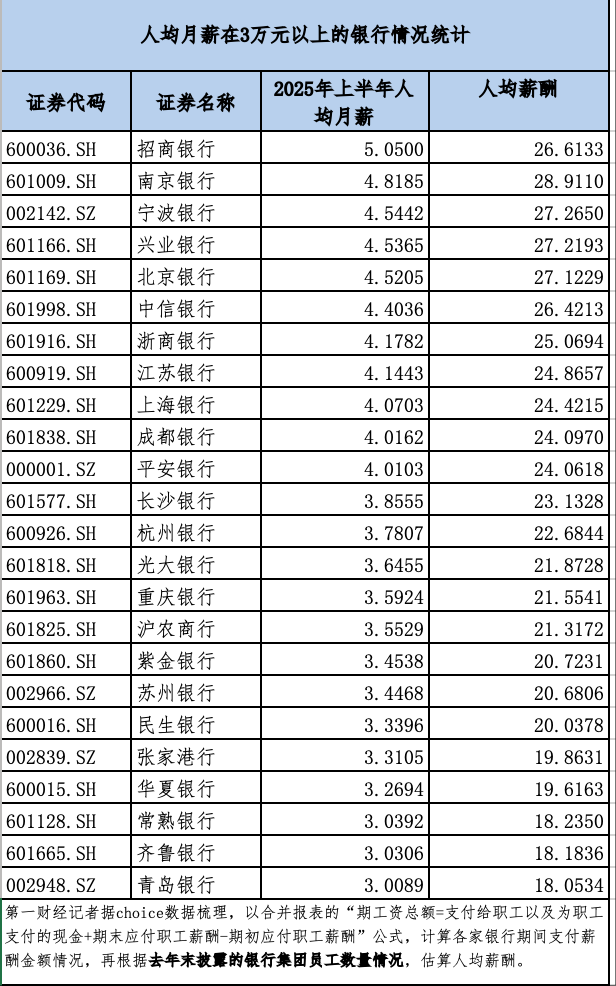
揭秘银行薪酬:24家银行上半年人均月薪超3万,高管降薪成趋势
Di Yi Cai Jing· 2025-09-04 22:49
Core Viewpoint - The banking sector in A-shares has regained its position as the largest sector with a market value of 11.31 trillion yuan, surpassing the electronics sector, while the salary situation of banking employees has also drawn attention [1] Salary Overview - The average monthly salary in the banking industry for the first half of 2025 is 30,200 yuan, a slight increase of 1,300 yuan year-on-year, reversing a trend of a 5,300 yuan decrease in the same period last year [2][4] - The top tier of banks, including joint-stock banks and strong city commercial banks in eastern regions, have an average monthly salary exceeding 45,000 yuan, with specific banks like China Merchants Bank and Nanjing Bank reporting 50,500 yuan and 48,185 yuan respectively [2][3] Salary Distribution - The second tier consists of state-owned banks with average monthly salaries ranging from 25,000 to 30,000 yuan, with Bank of China at 28,200 yuan and China Construction Bank at 26,200 yuan [3] - The third tier includes some rural and city commercial banks in remote areas, with average salaries below 25,000 yuan, such as Zhengzhou Bank and Xi'an Bank at 24,700 yuan and 22,800 yuan respectively [4] Management Salary Trends - A significant trend in the banking industry is the reduction of executive salaries, with 33 out of 42 A-share listed banks reporting a decrease in management compensation, with the highest drop reaching 82.4% [5][6] - For instance, Zhengzhou Bank's key management compensation fell from 103.88 million yuan to 59.57 million yuan year-on-year [5] Salary Reform and Mechanisms - Many banks are emphasizing salary structure reforms, focusing on value creation and incentivizing younger employees to work in grassroots positions [6][7] - The implementation of a reverse salary mechanism is becoming more common, allowing banks to reclaim performance-related pay in cases of misconduct or excessive risk exposure [7] Industry Context - It is important to note that the salary levels of listed banks do not represent the overall banking industry, as many smaller banks and rural credit cooperatives have significantly lower average salaries due to various factors affecting their profitability [8]





上市银行掀起“增持潮”
Shen Zhen Shang Bao· 2025-09-04 16:54
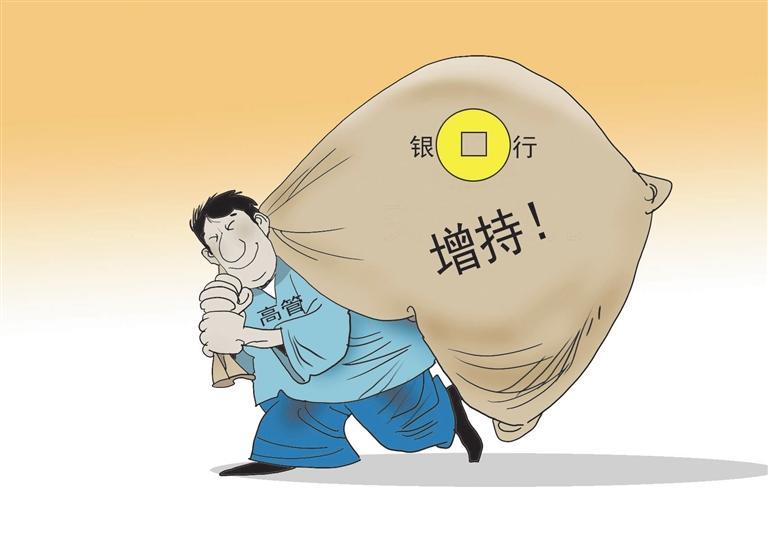
Group 1 - Qingdao Bank's major shareholder, Qingdao Guoxin Financial Holdings, plans to increase its stake by up to 5% within six months, reflecting a trend of local state-owned enterprises strengthening control over regional financial institutions [2][3] - As of the announcement date, Guoxin Financial Holdings and its concerted parties hold a total of 872 million shares, accounting for 14.99% of Qingdao Bank's total shares [2] - In 2023, 23 A-share listed banks have seen shareholders or executives increase their holdings, indicating a broader trend of confidence in the banking sector [2][3] Group 2 - The increase in shareholding is seen as a recognition of the long-term investment value of banks and aims to enhance the ability to serve the real economy through financial resource integration [3] - Analysts suggest that the trend of shareholding increases signals a recovery in bank valuations and positive performance growth expectations supported by policies [3] - Such actions are believed to stabilize market confidence and demonstrate shareholders' willingness to invest in the long-term development of banks, especially in the context of economic stabilization and improved asset quality [3]
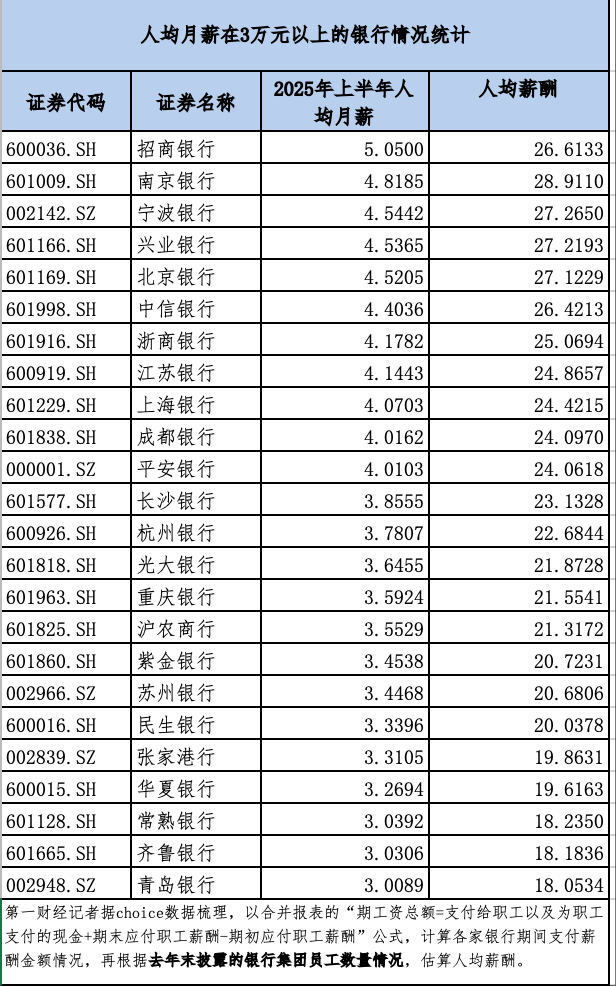
揭秘银行薪酬:24家银行上半年人均月薪超3万元,高管降薪成趋势
Di Yi Cai Jing· 2025-09-04 13:04
Core Insights - The banking sector's compensation reform has shifted from "controlling high" to a dual focus on "lowering" and "risk constraints" [1] - The average monthly salary for bank employees in the first half of 2025 was 30,200 yuan, a slight increase of 1,300 yuan year-on-year [2][5] - A total of 42 banks reported a decline in management salaries, with the highest drop reaching 82.4% [6][8] Salary Structure - The banking industry has formed a salary tier system, with leading joint-stock banks and strong city commercial banks in the first tier, averaging over 45,000 yuan per month [2][4] - Major state-owned banks fall into the second tier, with average monthly salaries ranging from 25,000 to 30,000 yuan [4][5] - Some rural and city commercial banks in remote areas are in the third tier, with average salaries below 25,000 yuan [5] Management Salary Trends - Key management salaries have seen significant reductions, with 33 out of 42 listed banks reporting a decrease in total management compensation [6][8] - For example, Zhengzhou Bank's management compensation dropped from 10,388 million yuan to 5,957 million yuan year-on-year [6] - The trend of management salary cuts is becoming a new norm in the industry, with banks emphasizing value creation and risk management in their compensation structures [7][8] Compensation Reform Mechanisms - Many banks are implementing reverse salary recovery mechanisms to enhance performance accountability [8] - For instance, Zhengzhou Bank has established a mechanism for deferred payment and performance salary recovery to mitigate operational risks [8] - The overall direction of salary distribution is shifting towards grassroots employees, reducing the previous "averaging" phenomenon [8][9] Industry Context - The salary levels of listed banks do not represent the overall banking industry's compensation situation, as many smaller banks have significantly lower average salaries [9] - The banking sector consists of over 4,000 financial institutions, with listed banks being a small fraction of the total [9]
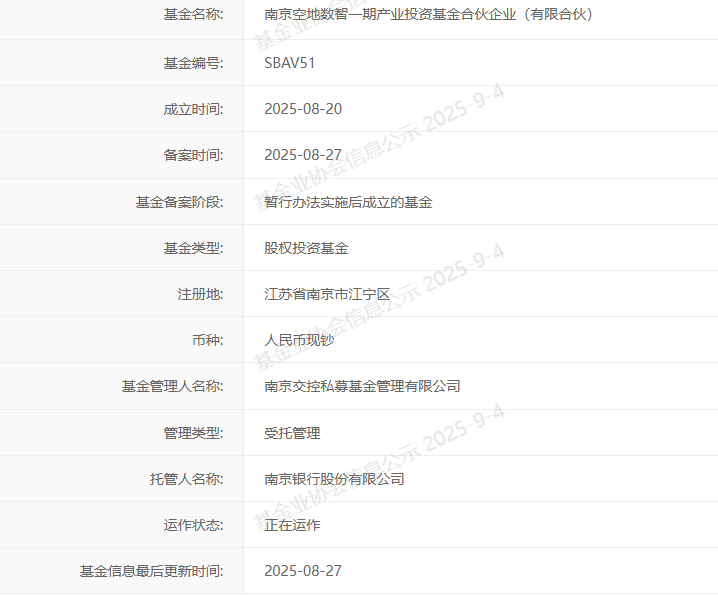
南京空地数智一期产业基金完成备案
Sou Hu Cai Jing· 2025-09-04 09:33
Core Insights - Jiangning District state-owned enterprise mother fund has participated in the investment of Nanjing Kongdi Shuzhi Phase I Industrial Investment Fund, which has completed registration with the Asset Management Association of China and officially started its investment activities [1] Group 1: Fund Details - Fund Name: Nanjing Kongdi Shuzhi Phase I Industrial Investment Fund Partnership (Limited Partnership) [2] - Fund Number: SBAV51 [2] - Fund Size: 900 million RMB [2] - Fund Management Company: Nanjing Jiaokong Private Fund Management Co., Ltd. [2] - Custodian: Nanjing Bank Co., Ltd. [2] - Fund Focus Areas: Low-altitude economy, commercial aerospace, intelligent connected vehicles [2] Group 2: Investment Activities - The fund has successfully attracted Nanjing Weizhi Feilian Drone Technology Co., Ltd. to establish a talent innovation port [2] - Nanjing Weizhi Feilian focuses on automated inspection and information processing needs in cultural tourism, emergency response, and firefighting sectors using drones [2] - The company aims to build a comprehensive industrial hub integrating drone inspection remote control platforms and real-time information recognition and processing [2]
二季度新进重仓股超800只,QFII调仓瞄准这几个方向
第一财经· 2025-09-04 06:21
Core Viewpoint - The article discusses the significant movements of foreign institutional investors (QFII) in the A-share market as of the end of Q2 2025, highlighting their investment strategies and sector preferences [3][4]. Summary by Sections QFII Holdings Overview - As of the end of Q2 2025, QFII held shares in 1,145 A-share companies, with a total market value exceeding 1,400 billion yuan [4]. - In Q2, QFII initiated positions in 813 new stocks, increased holdings in 173 stocks, reduced holdings in 126 stocks, and maintained positions in 33 stocks [5][11]. Sector Distribution and Adjustments - QFII showed notable adjustments in sectors such as machinery, hardware equipment, chemicals, and electrical equipment, while increasing holdings in banking, textiles, and non-ferrous metals [5][12]. - New investments were made in the industrial trade and telecommunications sectors, whereas coal and building materials saw overall reductions [12]. Top QFII Holdings - The top ten QFII holdings by market value include: - Ningbo Bank (361.63 billion yuan) - Nanjing Bank (231.94 billion yuan) - Shengyi Technology (95.50 billion yuan) - Shanghai Bank (45.22 billion yuan) - Zijin Mining (33.83 billion yuan) [9][10]. - The highest number of QFII holdings were in banking stocks, with Nanjing Bank and Ningbo Bank seeing increases in Q2 [7][10]. New Entrants and Market Movements - Among the new QFII heavyweights, the top three by market value were: - Haowei Group (1.45 billion yuan) - Jianghuai Automobile (675 million yuan) - Guai Bao Pet (493 million yuan) [11]. - QFII's new heavyweights included companies like Tianfeng Securities and Shengyi Technology, with significant movements in their stock values [8][11]. Sector Performance - Over 60% of QFII's heavy stocks were concentrated in machinery, hardware equipment, chemicals, electrical equipment, automotive parts, pharmaceuticals, and software services [13]. - The hardware equipment sector had the highest new investment value at 40.79 billion yuan, followed by machinery at 30.07 billion yuan and chemicals at 27.65 billion yuan [14][15].





银行研究框架及25H1业绩综述:营收及利润增速双双转正
GOLDEN SUN SECURITIES· 2025-09-04 06:14
Investment Rating - The report indicates a positive outlook for the banking industry, with overall revenue and net profit growth rates turning positive in the first half of 2025, at 1.0% and 0.8% respectively, showing improvements from the previous quarter [4]. Core Insights - The banking sector's net interest margin for the first half of 2025 is reported at 1.42%, a decrease of 10 basis points compared to the previous year, but the decline is narrowing due to improved cost management on the liability side [5]. - Non-interest income, particularly from fees and commissions, has increased by 3.1% year-on-year, driven by a recovery in wealth management and a more active market environment [5]. - The asset quality remains stable, with a non-performing loan ratio of 1.23% and a provision coverage ratio of 239%, indicating a solid credit environment [5]. Summary by Sections Financial Performance Overview - The overall revenue and net profit growth for listed banks in the first half of 2025 were 1.0% and 0.8%, respectively, with both metrics showing improvement from the first quarter [4][22]. - The total assets of listed banks reached 321.3 trillion yuan, growing by 6.35% year-to-date, with loans and advances totaling 179.4 trillion yuan, accounting for 55.84% of total assets [21][24]. Income Sources - Net interest income decreased by 1.3% year-on-year, but the decline rate has slowed, reflecting better management of funding costs [5]. - Fee and commission income grew by 3.1% year-on-year, benefiting from a recovering market and the gradual impact of regulatory changes [5]. - Other non-interest income saw a significant increase of 10.7%, primarily due to favorable market conditions in the bond market [5]. Asset Quality and Management - The non-performing loan ratio remained stable at 1.23%, with a provision coverage ratio of 239%, indicating a robust asset quality [5]. - The credit cost for the first half of 2025 was 0.81%, a decrease of 5 basis points year-on-year, suggesting manageable credit risks [5]. Loan Growth and Composition - Loan growth was primarily driven by corporate lending, with significant contributions from infrastructure and manufacturing sectors [20]. - Personal loan growth was weaker, with a year-on-year increase of only 3.6%, reflecting a cautious approach to consumer lending amid rising risks [20]. Investment and Market Conditions - The investment asset proportion decreased to 34% as banks adjusted their strategies in response to market volatility [20]. - The overall yield on bonds fluctuated significantly, prompting banks to engage in tactical trading to enhance returns [20].



熊猫债发行主体不断丰富凸显我国债市强大“磁吸力”
Zheng Quan Ri Bao· 2025-09-03 16:26
Group 1 - The issuance of Panda bonds by the New Development Bank, amounting to 7 billion yuan, highlights the growing role of emerging economies in the global financial system [1] - The total issuance of Panda bonds in the interbank market has reached 111.2 billion yuan this year, with foreign government institutions, international development organizations, and multinational corporations accounting for 50% of the issuance, an increase of 27 percentage points compared to the entire year of 2024 [1][2] - The diversification of issuers in China's bond market indicates a significant enhancement in its internationalization level, attracting global capital participation [2][3] Group 2 - Panda bonds are becoming an important RMB financing channel for foreign institutions, with various international development organizations and multinational companies participating in the market [3] - The Chinese bond market offers a comparative advantage in financing costs, with relatively low interest rates and significant market stability, making it attractive for global quality issuers [3][4] - The robust growth of the Chinese economy provides a solid foundation for the bond market, offering issuers stable expectations [4]


金融中报观|银行零售业务梯队格局背后,谁在领跑,谁在补课
Bei Jing Shang Bao· 2025-09-03 14:17
Core Insights - The competitive landscape of retail banking in A-shares is becoming clearer as the 2025 mid-year reports are disclosed, revealing a distinct tiered structure in retail AUM (Assets Under Management) [1][2] - The first tier consists of major state-owned banks and China Merchants Bank, all exceeding 16 trillion yuan in retail AUM, while the second tier includes joint-stock banks and some leading city commercial banks [1][2] - The retail business performance is mixed, with many banks facing pressure on retail revenue and net profit, highlighting a structural issue of profit growth without revenue increase [1][6] Tiered Structure of Retail AUM - The first tier banks, including Industrial and Commercial Bank of China (ICBC) and Agricultural Bank of China (ABC), lead with AUM exceeding 16 trillion yuan, with ICBC at over 24 trillion yuan and ABC at 23.68 trillion yuan [2][3] - China Construction Bank (CCB) and Postal Savings Bank of China also show strong performance, with CCB managing over 22 trillion yuan and Postal Savings Bank at 17.67 trillion yuan [2] - China Merchants Bank, known as the "king of retail," has a retail AUM of 16.03 trillion yuan, reflecting a 7.39% increase from the previous year [2] Second Tier Performance - The second tier banks have retail AUM ranging from 1 trillion to 6 trillion yuan, with notable growth from banks like Bank of Communications at 5.79 trillion yuan and Industrial Bank at 5.52 trillion yuan [3] - Joint-stock banks are active in this tier, with CITIC Bank and Shanghai Pudong Development Bank also showing significant growth in retail AUM [3] Third Tier Characteristics - The third tier banks have retail AUM mostly below 1 trillion yuan, with Nanjing Bank and Shanghai Rural Commercial Bank showing notable growth rates of 14.25% and 3.99% respectively [4] - Regional banks are leveraging local advantages to deepen market penetration, but face challenges in competing with larger banks [5] Retail Profitability Challenges - The retail banking sector is undergoing significant adjustments, with a shift in customer demand towards diversified financial solutions, which raises the bar for product innovation and service customization [6] - Leading banks like ICBC and China Merchants Bank are showing resilience, with ICBC's net profit rising by 46.05% despite a slight revenue decline [6][7] - However, some banks, including ABC and Ping An Bank, are experiencing declines in both revenue and net profit, indicating a challenging environment [7] Asset Quality Concerns - The retail banking sector is facing challenges in asset quality, particularly in personal loans, with rising non-performing loan (NPL) ratios reported by several banks [9][10] - For instance, China Merchants Bank's retail loan NPL ratio increased to 1.04%, while Chongqing Rural Commercial Bank's rose to 2.04% [9] - Some banks, like Ping An Bank and Industrial Bank, have managed to improve their asset quality through refined risk management practices [10] Strategic Recommendations - Analysts suggest that banks, especially smaller ones, should focus on enhancing their support for small and micro enterprises and optimizing financial resource allocation to uncover new growth points [8] - There is a call for banks to improve their digital capabilities and customer experience to better compete with larger institutions [8]


