
CSEC,China Shenhua(601088)

Search documents
中国神华(601088) - 中国神华关于发行股份及支付现金购买资产并募集配套资金暨关联交易事项的进展公告
2025-09-12 10:01
证券代码:601088 证券简称:中国神华 公告编号:临 2025-056 中国神华能源股份有限公司 关于发行股份及支付现金购买资产 并募集配套资金暨关联交易事项的进展公告 本公司董事会及全体董事保证本公告内容不存在任何虚假记载、误导性陈述 或者重大遗漏,并对其内容的真实性、准确性和完整性承担法律责任。 一、本次交易的基本情况 中国神华能源股份有限公司("中国神华"或"公司")拟发行 A 股股份 及支付现金购买控股股东国家能源投资集团有限责任公司持有的煤炭、坑口煤电 以及煤制油煤制气煤化工等相关资产并于 A 股募集配套资金("本次交易")。 根据《上市公司重大资产重组管理办法》等相关法律法规的规定,本次交易构成 关联交易,预计不构成重大资产重组,本次交易不会导致公司实际控制人变更。 二、本次交易的进展情况 2025 年 8 月 16 日在上海证券交易所网站披露的《中国神华能源股份有限公司发 行股份及支付现金购买资产并募集配套资金暨关联交易预案》及相关公告。公司 股票于 2025 年 8 月 18 日开市起复牌。 自预案披露以来,公司及其他相关方正在积极推进本次交易的相关工作。截 至本公告披露日,本次交易的中介 ...
中国神华(01088) - 海外监管公告
2025-09-12 09:36
茲載列中國神華能源股份有限公司於 2025 年 9 月 13 日在上海證券交 易所網站(www.sse.com.cn)刊登的「關於發行股份及支付現金購買資 產並募集配套資金暨關聯交易事項的進展公告」文件,僅供參閱。 承董事會命 中國神華能源股份有限公司 總會計師、董事會秘書 香港交易及結算所有限公司及香港聯合交易所有限公司對本公告之 內容概不負責,對其準確性或完整性亦不發表任何聲明,並明確表示 概不就因本公告全部或任何部份內容而產生或因倚賴該等內容而引 致之任何損失承擔任何責任。 ( 在中華人民共和國註冊成立的股份有限公司 ) (股份代碼:01088) 海外監管公告 本公告乃根據香港聯合交易所有限公司證券上市規則第 13.10B 條而 做出。 中国神华能源股份有限公司("中国神华"或"公司")拟发行 A 股股份 及支付现金购买控股股东国家能源投资集团有限责任公司持有的煤炭、坑口煤电 以及煤制油煤制气煤化工等相关资产并于 A 股募集配套资金("本次交易")。 根据《上市公司重大资产重组管理办法》等相关法律法规的规定,本次交易构成 关联交易,预计不构成重大资产重组,本次交易不会导致公司实际控制人变更。 宋靜剛 北 ...
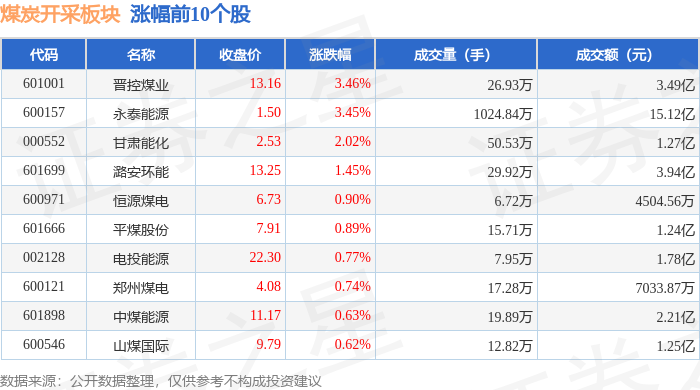
煤炭开采板块9月12日跌0.33%,新大洲A领跌,主力资金净流出1.61亿元
Zheng Xing Xing Ye Ri Bao· 2025-09-12 08:37
Core Viewpoint - The coal mining sector experienced a slight decline of 0.33% on September 12, with New Dazhou A leading the losses, while the overall market indices showed modest gains [1][2]. Group 1: Market Performance - The Shanghai Composite Index closed at 3883.69, up 0.22%, and the Shenzhen Component Index closed at 12996.38, up 0.13% [1]. - The coal mining sector's individual stock performance varied, with notable gainers including Jin Kong Coal Industry (up 3.46%) and Yongtai Energy (up 3.45%) [1]. Group 2: Stock Details - Key stocks in the coal mining sector included: - Jin Kong Coal Industry: Closing price 13.16, volume 269,300, turnover 3.49 billion [1]. - Yongtai Energy: Closing price 1.50, volume 10,248,400, turnover 1.51 billion [1]. - New Dazhou A: Closing price 5.11, down 2.11%, volume 126,600, turnover 65.03 million [2]. Group 3: Capital Flow - The coal mining sector saw a net outflow of 161 million from main funds, while retail investors contributed a net inflow of 115 million [2][3]. - Notable capital flows included: - Yongtai Energy: Main funds net inflow of 152 million, retail net outflow of 61.77 million [3]. - Shaanxi Coal Industry: Main funds net inflow of 52.84 million, retail net outflow of 40.82 million [3].


国泰海通:从全球视角看电力供需 煤电仍是压舱石
智通财经网· 2025-09-12 06:41
Group 1 - The core viewpoint is that the fundamental reason for the frequent global power shortages is the rapid growth in global electricity demand, while the supply side's structural bottlenecks have not been effectively resolved. Traditional energy generation, represented by coal power, will remain a stabilizing force in the global electricity system in the medium to long term [1][3] - Global electricity demand is expected to grow at a rate of 4.4% in 2024, significantly outpacing the global GDP growth of 2.9%. This growth is driven by three deep-seated factors: deep electrification in the industrial sector, rapid expansion of data centers driven by artificial intelligence, and increased extreme weather events due to global climate change [1][2] - The supply side of the electricity market faces structural bottlenecks, with renewable energy sources like wind and solar power unable to provide stable support for electricity demand due to their intermittent nature. Issues such as aging grid infrastructure and weak regional dispatch capabilities further exacerbate the disconnect between electricity generation and availability [2][3] Group 2 - Traditional energy generation, particularly coal power, is being reconsidered as a necessary stabilizing force to address the growing electricity supply gap. The U.S. is expected to restart coal power generation in 2025, marking a significant shift in energy development strategies among developed countries [3] - The demand for coal resources remains high in developing countries, while developed countries are also adjusting their energy strategies, indicating that the peak pressure for coal phase-out may have passed [3]




2025年1-4月全国工业出口货值为48793.3亿元,累计增长5.1%
Chan Ye Xin Xi Wang· 2025-09-12 01:03
Group 1 - The core viewpoint of the article highlights the growth in China's industrial export value, with a reported value of 12,468.8 billion yuan in April 2025, reflecting a year-on-year increase of 0.9% [1] - Cumulative industrial export value from January to April 2025 reached 48,793.3 billion yuan, showing a cumulative year-on-year growth of 5.1% [1] - The article references a report by Zhiyan Consulting, which provides a deep assessment of the industrial cloud market in China from 2025 to 2031, indicating potential investment opportunities [1] Group 2 - The listed companies include Gansu Energy (000552), New Dazhou A (000571), Jizhong Energy (000937), and others, indicating a focus on the energy and industrial sectors [1] - Zhiyan Consulting is recognized as a leading industry consulting firm in China, specializing in comprehensive industry research reports and customized services [1] - The data presented is sourced from the National Bureau of Statistics, emphasizing the reliability of the statistics used in the analysis [1]


从全球视角看电力供需,煤电仍是压舱石
GUOTAI HAITONG SECURITIES· 2025-09-11 11:23
Investment Rating - The report maintains an "Overweight" rating for the coal sector, highlighting the sustained demand for coal in the global energy landscape [5][11]. Core Insights - The fundamental cause of frequent global electricity shortages is the rapid growth in electricity demand, which is not matched by effective solutions to supply-side structural bottlenecks. Traditional energy sources, particularly coal, remain crucial for the stability of the global electricity system in the medium to long term [3][11]. - Global electricity demand is projected to grow at a rate of 4.4% in 2024, significantly outpacing the global GDP growth of 2.9%. This growth is driven by three main factors: deep electrification in industrial sectors, rapid expansion of data centers driven by artificial intelligence, and increased electricity demand due to extreme weather events caused by climate change [9][15][27]. Summary by Sections Investment Recommendations - The report suggests that the pressure on coal resources may have peaked, and it anticipates a continued increase in global coal demand over the next 5-10 years. Recommended companies include China Shenhua, China Coal Energy, Shaanxi Coal and Chemical Industry, Yanzhou Coal Mining, and Jinneng Holding Group [11][12]. Global Electricity Demand Growth - The report notes that global electricity demand is expected to grow significantly, with emerging economies maintaining high growth rates and developed economies beginning to recover. By 2024, electricity demand in China is projected to increase by 6.8%, contributing 54% to global demand growth [19][20]. - The International Energy Agency (IEA) forecasts that global electricity demand will continue to grow at an average annual rate of 3.3% in 2025 and 3.7% in 2026, despite potential slowdowns due to trade tariffs and economic uncertainties [15][19]. Global Electricity Supply Challenges - The report highlights that the supply side has not effectively addressed structural bottlenecks, leading to frequent electricity shortages. Despite significant investments in renewable energy, issues such as aging grid infrastructure and inadequate energy storage systems hinder the effective absorption and utilization of new clean energy sources [10][55]. - The report emphasizes that traditional coal-fired power generation remains a critical stabilizing force in the global electricity system, especially as developed countries like the U.S. are expected to restart coal power generation to meet rising electricity demands [11][56]. Traditional Energy's Role - Coal power is projected to continue playing a vital role in the global energy landscape, with the U.S. expected to see a 6% increase in coal consumption by 2025. This shift indicates a potential adjustment in energy strategies among developed nations [11][56]. - The report also notes that while the share of coal in global energy generation is decreasing, it still represents the largest source of electricity generation globally [11][56].
炭本溯源系列3:中国煤炭成本十年变迁:刚性抬升重塑安全边际
Changjiang Securities· 2025-09-11 05:36
Investment Rating - The report maintains a "Positive" investment rating for the coal industry [11]. Core Insights - The report emphasizes that the systematic increase in coal costs over the past decade has solidified the safety margin for coal prices, with current cash cost support for port thermal coal prices at approximately 550 RMB/ton [3][9]. - It highlights that the coal price bottom is unlikely to return to the low levels seen in 2015, reinforcing the profitability and dividend safety margins for coal companies [3][9]. Summary by Sections Introduction - The report introduces the importance of cost research in establishing the safety margin for coal prices, indicating that a high cost-supported price bottom can enhance dividend value [6][20]. Overall Cost Trends - Over the past decade, coal company costs have increased by nearly 50%, with a CAGR of approximately 4% [6][24]. - The weighted average sales cost for coal in 2024 is projected to be 300 RMB/ton, down 2% year-on-year, while the complete cost is expected to be 380 RMB/ton, down 3% year-on-year [6][24]. Cost Structure - The cost structure for coal companies in 2024 is composed of labor costs (32%), other expenses (30%), raw materials (14%), depreciation (12%), safety costs (9%), and manufacturing costs (3%) [7][41]. - Labor costs, depreciation, and safety expenses have seen the most significant increases over the past decade, with labor costs rising by 28 RMB/ton [7][41]. Cost Curve Analysis - The cash cost curve for port thermal coal has shifted, with the 90th percentile cash cost now supporting prices around 550 RMB/ton [8][9]. - The complete cost curve for thermal coal has also increased, with the 90th percentile complete cost now between 370-423 RMB/ton [8][9]. Investment Recommendations - The report suggests that the systematic increase in costs has solidified the safety margin for coal prices, recommending several companies for investment based on their resilience and growth potential [9][11]. - Recommended companies include Yanzhou Coal Mining Company, Jinneng Holding, and China Shenhua Energy [9].


中国神华20250910
2025-09-10 14:35
Summary of China Shenhua's Conference Call Company Overview - **Company**: China Shenhua Energy Company Limited - **Period**: First half of 2025 Key Financial Metrics - **Net Profit**: 24.6 billion RMB, with basic earnings per share of 1.24 RMB [2][3] - **Operating Cash Flow**: 45.8 billion RMB [2][3] - **Total Profit**: 37.6 billion RMB, a year-on-year decrease of 8.6% [2][3] - **Dividend**: Proposed interim cash dividend of 0.98 RMB per share, representing 79% of net profit [2][3][22] Industry Context - **Coal Industry Performance**: Overall profit in the coal industry declined by 53%, yet China Shenhua demonstrated strong profitability and risk resilience [3] - **Sales Volume**: Coal sales volume reached 205 million tons, with a significant drop in purchased coal sales by 31% year-on-year [2][3][9] Operational Highlights - **Production Cost**: Self-mined coal production cost decreased by 7.7% to 177.7 RMB per ton due to effective cost control measures [2][5] - **Resource Acquisition**: Successful asset injection from Hanjin Energy added 7.31 billion tons of resources, increasing total reserves to 41.58 billion tons [2][5] - **Sales Strategy**: Focused on self-produced coal sales amidst weak downstream demand, leading to a strategic reduction in purchased coal sales [6][9] Revenue Diversification - **Diversified Income**: Non-electricity revenue reached 5 billion RMB, supporting overall profit despite a 7% decline in thermal power generation [4][25] - **Long-term Contracts**: Annual contracts now include both electricity and non-electricity coal, enhancing pricing and volume stability [12] Cost Management - **Cost Control**: Significant reduction in production costs, with a focus on optimizing operational efficiency [5][19] - **Labor Costs**: Notable decrease in labor costs, expected to continue in the second half of the year [18][19] Future Outlook - **Acquisition Plans**: Thirteen asset acquisitions are underway, with expected preliminary results by mid-2026 [4][24] - **Dividend Policy**: Commitment to a sustainable high-return dividend policy, with a minimum payout ratio of 65% for 2025-2027 [22][23] Challenges and Responses - **Market Demand**: Addressing insufficient downstream demand through strategic sales adjustments and operational efficiency improvements [6][9] - **Coal Production Trends**: Anticipated challenges in coal production costs due to geological and operational factors, with a long-term upward trend expected [28] Additional Insights - **Safety Production Costs**: Fluctuations in safety production costs based on regulatory compliance and operational needs [20][21] - **Non-operating Income**: No significant impairment or extraordinary expenses reported in the first half of 2025 [26][27] This summary encapsulates the key points from the conference call, highlighting China Shenhua's financial performance, operational strategies, and industry context while addressing potential challenges and future outlook.
央企上市公司提质提速,优质资产注入不停
Sou Hu Cai Jing· 2025-09-10 12:31
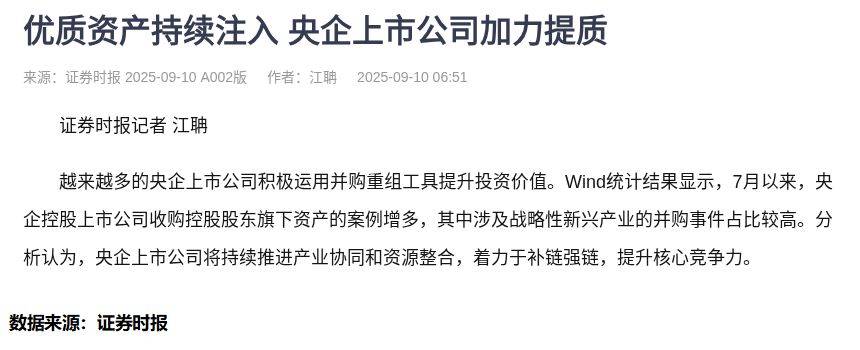
Group 1 - Recent surge in mergers and acquisitions among state-owned enterprises (SOEs) in China, with notable cases including China General Nuclear Power's acquisition of four nuclear power companies and China Shenhua's acquisition of 13 companies to resolve industry competition issues [1][2] - The State-owned Assets Supervision and Administration Commission (SASAC) has emphasized the encouragement of SOEs to integrate quality assets, leading to improved efficiency in merger and acquisition approvals [2][3] - Despite the apparent prosperity in SOE mergers, there are underlying complexities that may not be immediately visible, suggesting a need for caution [2][3] Group 2 - The perception of market conditions can vary significantly between institutional investors and retail investors, with institutional interests often opposing those of retail investors [3][5] - A historical example is provided with the price surge of Vitamin D3, where despite a significant price increase, many related stocks did not perform well, highlighting the importance of institutional participation in stock performance [3][5] - Institutional investors exhibit distinct trading behaviors, focusing on structured processes such as building positions and managing exits, which can be identified through quantitative analysis tools [9][10] Group 3 - The current SOE merger wave requires careful analysis of institutional involvement, as not all mergers will lead to stock price increases; only those with sustained institutional participation are worth monitoring [10] - The market operates like a battlefield where information is crucial, and understanding capital movements is essential for retail investors to navigate the complexities of the market [10]


煤炭开采行业2025年中报综述:煤价筑底拖累2025H1业绩,现阶段煤价回升叠加板块低拥挤度,煤炭迎来底部配置机遇
Guohai Securities· 2025-09-10 05:03
Investment Rating - The report maintains a "Recommended" rating for the coal mining industry [1] Core Viewpoints - The coal price has reached a bottom, leading to a potential investment opportunity as prices rebound alongside low sector congestion [1][12] - The performance of the coal mining sector in the first half of 2025 has been negatively impacted by falling coal prices, with significant declines in revenue and profit for major coal companies [33][36] - Despite the challenges, the report suggests that the current market pessimism regarding coal prices has been largely priced in, indicating a potential for recovery [12] Summary by Sections 1. Overview of H1 2025 - In H1 2025, the coal supply-demand balance was loose, resulting in a decline in the average coal price [19][21] - The total revenue for 28 key coal companies was CNY 553.918 billion, down 17.8% year-on-year, with net profit dropping 31.5% to CNY 72.284 billion [33][36] - Coal production increased by 1.6% to 615 million tons, while sales volume decreased by 1.8% to 561 million tons [50] 2. Financial Performance - The average sales price of coal fell by 20% to CNY 480 per ton, while the average cost decreased by 9% to CNY 306 per ton, leading to a 33% drop in gross profit [5][8] - The average gross margin for the 28 coal companies was 36%, down 7.4 percentage points year-on-year [8] - Operating cash flow decreased by 27% to CNY 1,042.20 billion, with a slight increase in the average debt-to-asset ratio to 53.2% [9][12] 3. Market Dynamics - The coal price for Q2 2025 continued to decline, but signs of recovery were noted in Q3 due to seasonal demand and supply constraints [10][12] - The report highlights that the coal sector's low congestion levels and high dividend yields present a compelling case for bottom-fishing investments [12] 4. Investment Strategy - The report recommends focusing on companies with strong fundamentals and cash flow, such as China Shenhua, Shaanxi Coal, and Yanzhou Coal [12][14] - It emphasizes the importance of monitoring the evolving supply-demand dynamics and potential policy impacts on the coal market [12][19]