
Changshu Bank(601128)

Search documents
机构密集“踩点”银行股息差与资产质量等成焦点
Zhong Guo Zheng Quan Bao· 2025-09-29 20:45
Core Viewpoint - The article highlights the increasing interest of institutional investors in regional banks, particularly in the Yangtze River Delta, due to their strong performance and resilience in a developed economic region [1][2]. Group 1: Institutional Research Focus - As of September 29, 2023, A-share listed banks have been surveyed over 300 times by more than 2000 institutions, with regional banks in the Yangtze River Delta receiving significant attention [1]. - Institutions are particularly focused on net interest margin stability, potential asset quality risks, and future credit allocation strategies during their research [2][3]. Group 2: Financial Performance of Regional Banks - Changshu Bank reported a revenue of 6.062 billion yuan, a year-on-year increase of 10.10%, and a net profit of 1.969 billion yuan, up 13.51% [2]. - The bank also declared its first interim cash dividend since its listing, distributing 0.15 yuan per share, totaling 499 million yuan [2]. Group 3: Investment Trends in Banking Sector - The investment logic for bank stocks is shifting from valuation recovery to deep value discovery of high-quality banks amid industry differentiation [3]. - As of September 29, 2023, the Shenwan Primary Bank Index closed at 4000.30 points, with a year-to-date increase of 2.33%, while individual stocks like Agricultural Bank, Qingdao Bank, and Pudong Development Bank rose over 20% [4]. - Institutional investments in bank stocks have increased, with insurance funds actively purchasing shares in various banks, indicating a preference for high dividend returns and stable earnings [4].

常熟银行上市九周年:一张小微蓝图绘到底 拥抱村行改革新机遇
Shang Hai Zheng Quan Bao· 2025-09-29 17:46
Core Insights - Jiangsu Changshu Rural Commercial Bank has achieved significant growth, with total assets exceeding 400 billion yuan, total deposits surpassing 300 billion yuan, and total loans exceeding 250 billion yuan as of June 30 this year [2][4] - The bank maintains a low non-performing loan ratio of 0.76% and a high provision coverage ratio of 489.53%, indicating a strong risk management framework [2][4] Group 1: Growth and Performance - Over the past nine years since its listing, the bank has transitioned from a scale of 100 billion yuan to 400 billion yuan, marking a significant milestone [4] - In the first half of this year, the bank reported operating income of 6.062 billion yuan, a year-on-year increase of 10.10%, and a net profit attributable to shareholders of 1.969 billion yuan, up 13.51% year-on-year [4] - The bank has consistently achieved double-digit growth in revenue and net profit for 16 consecutive quarters [4] Group 2: Strategic Focus - The bank's mission is to serve the "three rural issues" and small micro-enterprises, which has been its core focus since its establishment [4][6] - The bank has developed a unique financial service model, "Changyin Microfinance," which integrates advanced micro-lending technology with a standardized process to effectively serve small businesses [6][7] - The bank aims to become a leader in rural finance and a benchmark for inclusive finance, emphasizing a differentiated development path [4][6] Group 3: Shareholder Returns - Since its listing, the bank has returned over 5.56 billion yuan in cash dividends to shareholders, with an average dividend payout ratio exceeding 28% [5] - In 2025, the bank introduced a mid-term dividend plan, distributing 0.15 yuan per share, totaling 499 million yuan, with a dividend payout ratio of 25.27% [5] Group 4: Expansion and Innovation - The bank has initiated the establishment of investment management village banks, enhancing its service network in rural areas [9][10] - The "village-to-branch" reform has been implemented to optimize resource allocation and reduce management costs, with successful integration of village banks into the bank's structure [9][10] - The bank's management emphasizes a culture of innovation and continuity, ensuring alignment with its strategic goals [7][10]


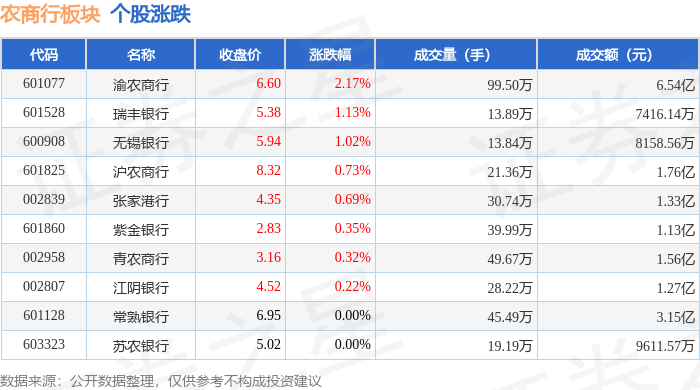
农商行板块9月29日涨0.94%,渝农商行领涨,主力资金净流出6645.88万元
Zheng Xing Xing Ye Ri Bao· 2025-09-29 08:45
Market Performance - The rural commercial bank sector increased by 0.94% on September 29, with Yunnan Rural Commercial Bank leading the gains [1] - The Shanghai Composite Index closed at 3862.53, up 0.9%, while the Shenzhen Component Index closed at 13479.43, up 2.05% [1] Individual Stock Performance - Yunnan Rural Commercial Bank (601077) closed at 6.60, with a rise of 2.17% and a trading volume of 995,000 shares, amounting to a transaction value of 654 million [1] - Other notable performers include Ruifeng Bank (601528) with a 1.13% increase, Wuxi Bank (600908) with a 1.02% increase, and Shanghai Rural Commercial Bank (601825) with a 0.73% increase [1] Capital Flow Analysis - The rural commercial bank sector experienced a net outflow of 66.4588 million from institutional investors, while retail investors saw a net inflow of 22.9898 million [1] - Specific stocks like Qingnong Bank (002958) had a net inflow of 9.1251 million from institutional investors, while Su Nong Bank (603323) had a net inflow of 613.43 million [2] Detailed Capital Flow for Selected Stocks - Yunnan Rural Commercial Bank had a significant net outflow of 50.7024 million from institutional investors, but a net inflow of 54.2507 million from retail investors [2] - Common trends show that while some banks like Zhangjiagang Bank (002839) attracted retail inflows, others like Changshu Bank (601128) faced substantial outflows from institutional investors [2]

上市银行不良出清与拨备压力观察
Guoxin Securities· 2025-09-29 02:04
Investment Rating - The industry is rated as "Outperform the Market" [2][3] Core Viewpoints - The stability of asset quality in the banking sector is attributed to the gradual clearing of non-performing loans across various sectors over the past 15 years, which has mitigated the impact on bank financial statements [1][2] - Banks have proactively adjusted their loan structures to reduce risk exposure, particularly by decreasing the proportion of loans to sectors experiencing rising non-performing loans [1][2] - The impact of non-performing loans on profit statements has been minimized due to banks' preemptive provisioning strategies, which have allowed for smoother profit reporting [1][2] - Non-credit areas of non-performing assets have also been cleared or are at a minimal level, contributing to the overall stability of bank risk profiles [1][2] Summary by Sections Non-Performing Loan Exposure and Clearing - The banking sector has experienced a 15-year process of risk resolution, with non-performing loans being gradually exposed and cleared [12] - The manufacturing and retail sectors have seen significant reductions in non-performing loans, achieving a return to levels similar to those seen in 2010 [26][30] Real Estate Sector - The real estate sector's non-performing loan ratio peaked in 2023 but has since shown signs of recovery, although it remains elevated [35][37] - The overall impact of real estate risks on bank loan portfolios is limited due to the relatively small proportion of real estate loans compared to total loans [37][38] City Investment Loans - The non-performing loan ratio for city investment loans has been declining since 2023, aided by debt reduction efforts [41][44] Retail Loans - Retail loan categories, including personal housing loans and credit card loans, are currently experiencing rising non-performing rates, indicating ongoing risk exposure [50][53] Other Loan Categories - Other loan categories, such as utilities and miscellaneous public loans, have minimal impact on overall bank risk due to their low non-performing rates [60][63] Loan Structure Adjustments - Banks have actively adjusted their loan structures in response to risk exposures, shifting focus towards lower-risk personal loans [66][68] Provisioning Strategies - Banks have utilized provisioning to smooth profit impacts from non-performing loans, with historical data indicating a capacity to release significant net profits from existing provisions [81][82] Investment Recommendations - The report suggests focusing on banks with strong asset quality and low provisioning pressure, such as Chengdu Bank and Changsha Bank, while also recommending cyclical stocks like Ningbo Bank and Changshu Bank for potential recovery [105]

上市银行“十四五回望”之资负结构与息差变迁
CMS· 2025-09-28 15:09
Investment Rating - The report maintains a recommendation for the banking industry [3] Core Insights - The report provides a comprehensive analysis of the asset-liability structure and interest margin changes of 42 A-share listed banks during the "14th Five-Year Plan" period, highlighting a shift towards corporate loans on the asset side and a stronger retail focus on the liability side [12][14] - The asset-liability structure indicates a significant increase in the proportion of corporate loans, rising from 57.02% to 63.22% from the end of 2020 to mid-2025, while the proportion of demand deposits decreased from 41.94% to 30% [12][14] - The report notes a decline in both asset yield and interest margin, with the yield on interest-earning assets dropping from 4.43% to 3.32% and the net interest margin decreasing from 2.23% to 1.53% during the same period [14][15] Summary by Sections Overall Asset-Liability Structure and Interest Margin Changes - The asset-liability structure shows an increase in loan-to-earning asset ratio from 54.19% to 56.49%, with corporate loans making up a larger share of total loans [14][15] - The average yield on interest-earning assets decreased significantly, with the loan yield falling from 5.34% to 3.82% [15] - The net interest margin for listed banks remains higher than that of commercial banks, despite a decline [14][15] Changes in Each Banking Sector's Asset-Liability Structure and Interest Margin - City commercial banks experienced a more significant increase in the proportion of corporate loans, with their interest margin narrowing less compared to other banks [18] - The report highlights that the proportion of deposits in interest-bearing liabilities for state-owned banks decreased, while it increased for rural commercial banks [18] - The decline in interest-bearing liabilities' cost rate was most pronounced in city commercial banks, leading to a smaller reduction in their interest margin [18]






46岁副行长任职资格获批,常熟银行核心高管均从基层成长
2 1 Shi Ji Jing Ji Bao Dao· 2025-09-28 06:26
Core Viewpoint - Changshu Bank has approved the appointment of Cheng Pengfei as Vice President, highlighting the bank's focus on nurturing talent from within and maintaining a youthful management team [1][2]. Group 1: Leadership and Management - Cheng Pengfei, born in July 1979, has a background in various roles within Changshu Bank, including positions in the funding operations center and asset management [1]. - The bank's management emphasizes a culture of innovation and compliance, with a commitment to supporting agriculture and small enterprises [2]. - The average age of the bank's management team is 47 years, indicating a youthful and dynamic leadership [2]. Group 2: Financial Performance - As of June 2024, Changshu Bank's total assets reached 401.23 billion yuan, reflecting a year-to-date increase of 9.45% [3]. - The bank reported a revenue of 6.06 billion yuan for the first half of the year, marking a year-on-year growth of 10.10% [3]. - The net profit attributable to shareholders was 1.969 billion yuan, with a year-on-year increase of 13.51% [3]. - The non-performing loan ratio stood at 0.76%, a slight decrease of 0.01 percentage points from the beginning of the year [3]. - The bank's provision coverage ratio was 489.53%, down by 10.98 percentage points compared to the start of the year [3]. Group 3: Dividend Distribution - On September 8, 2024, Changshu Bank completed its mid-term dividend distribution for 2025, with a cash dividend of 0.15 yuan per share, totaling 497 million yuan [3].
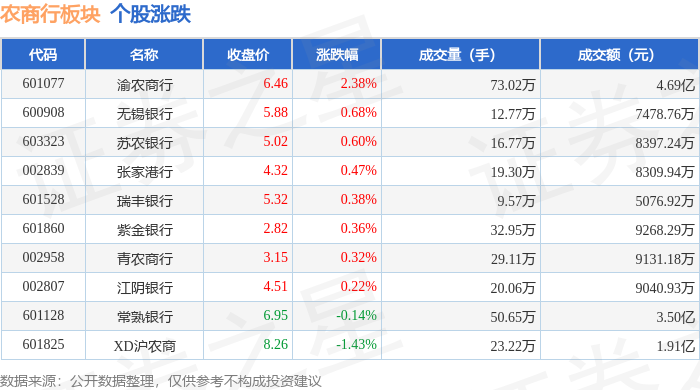
农商行板块9月26日跌0.74%,XD沪农商领跌,主力资金净流出3021.09万元
Zheng Xing Xing Ye Ri Bao· 2025-09-26 08:48
Market Overview - On September 26, the rural commercial bank sector declined by 0.74% compared to the previous trading day, with XD Hu Nong leading the decline [1] - The Shanghai Composite Index closed at 3828.11, down 0.65%, while the Shenzhen Component Index closed at 13209.0, down 1.76% [1] Individual Stock Performance - The following stocks in the rural commercial bank sector showed varying performance: - Chongqing Rural Commercial Bank (601077) closed at 6.46, up 2.38% with a trading volume of 730,200 shares [1] - Wuxi Bank (600908) closed at 5.88, up 0.68% with a trading volume of 127,700 shares [1] - Su Nong Bank (603323) closed at 5.02, up 0.60% with a trading volume of 167,700 shares [1] - Zhangjiagang Bank (002839) closed at 4.32, up 0.47% with a trading volume of 193,000 shares [1] - Ruifeng Bank (601528) closed at 5.32, up 0.38% with a trading volume of 95,700 shares [1] - Other banks like Jiangyin Bank (002807) and Changshu Bank (601128) showed minor fluctuations [1] Capital Flow Analysis - The rural commercial bank sector experienced a net outflow of 30.21 million yuan from institutional investors and 22.38 million yuan from retail investors, while retail investors saw a net inflow of 52.59 million yuan [1] - Specific capital flows for individual banks include: - Changshu Bank (601128) had a net inflow of 8.26 million yuan from institutional investors but a net outflow of 34.30 million yuan from retail investors [2] - Zijin Bank (601860) saw a net inflow of 7.99 million yuan from institutional investors [2] - Other banks like Su Nong Bank (603323) and Zhangjiagang Bank (002839) experienced significant net outflows from institutional investors [2]


多家银行下调存款利率!应对零售存款流失,加码“固收+”
券商中国· 2025-09-26 03:20
Core Viewpoint - Since September, local small and medium-sized banks have been continuously lowering deposit interest rates to alleviate net interest margin pressure and follow the lead of larger banks [1][3]. Group 1: Deposit Rate Adjustments - On September 25, several banks in Henan, including Luoyang Rural Commercial Bank, announced reductions in RMB deposit rates, with the highest cut reaching 35 basis points [2][3]. - The new rates for fixed-term deposits at Luoyang Rural Commercial Bank are now 0.75% for three months, 1.00% for six months, 1.30% for one year, and 1.35% for two years, reflecting a reduction of 15 basis points [3]. - Other banks, such as Jieyang Rural Commercial Bank and Shanghai Huarui Bank, have also lowered rates across various deposit products, indicating a broader trend among local banks to adjust rates following national banks [3]. Group 2: Retail Deposit Trends - There is a noticeable outflow of retail deposits as customers shift to investment products with higher returns, such as cash management and fixed-income bank wealth management products, which offer annual yields of 2% to 3% [2][5]. - Retail deposit growth has significantly slowed, with banks facing challenges in attracting new customers and retaining existing deposits [5][6]. - Data shows that major banks like China Merchants Bank and Ping An Bank experienced a decline in retail deposit growth rates in the first half of 2025 compared to the same period in 2024, with decreases of 3.43 and 3.73 percentage points, respectively [8]. Group 3: Wealth Management Strategies - In response to declining retail deposits, banks are focusing on expanding their wealth management services, leveraging the recent bullish trends in capital markets [9][10]. - Wealth management products, particularly those linked to equity funds, are becoming key revenue drivers for banks as they seek to retain customer assets [9]. - The "fixed income plus" product category is seen as a new pathway for banks to attract deposits in a low-interest-rate environment, highlighting the need for diversified investment options [10].



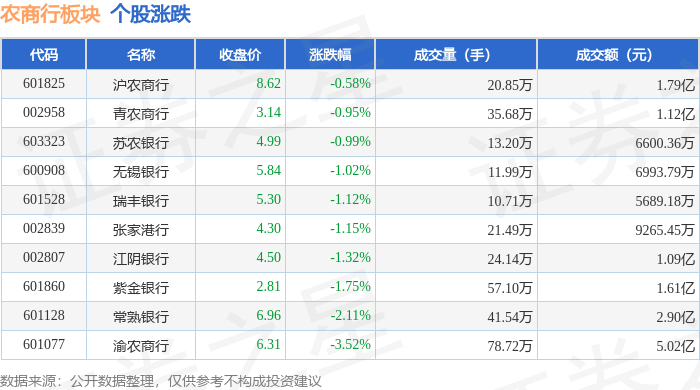
农商行板块9月25日跌1.62%,渝农商行领跌,主力资金净流出311.16万元
Zheng Xing Xing Ye Ri Bao· 2025-09-25 08:37
Market Overview - On September 25, the rural commercial bank sector declined by 1.62%, with Chongqing Rural Commercial Bank leading the drop [1] - The Shanghai Composite Index closed at 3853.3, down 0.01%, while the Shenzhen Component Index closed at 13445.9, up 0.67% [1] Individual Stock Performance - The closing prices and changes for key rural commercial banks are as follows: - Hu Nong Commercial Bank: 8.62, down 0.58% - Qing Nong Commercial Bank: 3.14, down 0.95% - Su Nong Bank: 4.99, down 0.99% - Wuxi Bank: 5.84, down 1.02% - Rui Feng Bank: 5.30, down 1.12% - Zhangjiagang Bank: 4.30, down 1.15% - Jiangyin Bank: 4.50, down 1.32% - Zijin Bank: 2.81, down 1.75% - Changshu Bank: 6.96, down 2.11% - Chongqing Rural Commercial Bank: 6.31, down 3.52% [1] Capital Flow Analysis - The rural commercial bank sector experienced a net outflow of 3.11 million yuan from main funds, while speculative funds saw a net inflow of 5.88 million yuan, and retail investors had a net outflow of 2.77 million yuan [1] - Detailed capital flow for individual banks shows: - Jiangyin Bank: Main funds net inflow of 12.09 million yuan, retail net outflow of 14.79 million yuan - Wuxi Bank: Main funds net inflow of 11.99 million yuan, retail net outflow of 8.76 million yuan - Su Nong Bank: Main funds net inflow of 11.61 million yuan, retail net outflow of 8.11 million yuan - Chongqing Rural Commercial Bank: Main funds net outflow of 27.42 million yuan, retail net inflow of 34.26 million yuan - Zijin Bank: Main funds net outflow of 33.66 million yuan, retail net inflow of 16.64 million yuan [2]

常熟银行跌2.11%,成交额1.76亿元,主力资金净流入107.39万元
Xin Lang Cai Jing· 2025-09-25 03:31
Core Points - The stock price of Changshu Bank dropped by 2.11% on September 25, reaching 6.96 CNY per share, with a total market capitalization of 23.083 billion CNY [1] - The bank's main business revenue composition includes personal business (51.80%), corporate business (28.08%), funding business (19.34%), and other business (0.78%) [1] - As of June 30, 2025, Changshu Bank reported a net profit of 1.969 billion CNY, a year-on-year increase of 13.51% [2] Financial Performance - Year-to-date, Changshu Bank's stock price has increased by 6.99%, but it has seen declines of 0.85% over the last five trading days, 5.82% over the last 20 days, and 5.95% over the last 60 days [1] - The bank has distributed a total of 5.560 billion CNY in dividends since its A-share listing, with 2.622 billion CNY distributed in the last three years [3] Shareholder Information - As of June 30, 2025, the number of shareholders decreased by 4.29% to 41,300, while the average number of circulating shares per person increased by 14.93% to 80,392 shares [2] - The top ten circulating shareholders include Hong Kong Central Clearing Limited, which holds 105 million shares, an increase of 8.6851 million shares from the previous period [3]