
Guotai Haitong Securities(601211)

Search documents
国泰海通(601211) - 国泰海通证券股份有限公司关联交易管理办法
2025-08-29 11:58
第一章 总则 国泰海通证券股份有限公司 关联交易管理办法 第一条 为规范国泰海通证券股份有限公司(以下简称公司)的关联交易, 保护公司和全体股东的合法权益,根据《中华人民共和国公司法》、《中华人民 共和国证券法》、《上海证券交易所股票上市规则》(以下简称《上交所上市规 则》,其中上海证券交易所以下简称上交所)、《上海证券交易所上市公司自律 监管指引第 5 号——交易与关联交易》、《香港联合交易所有限公司证券上市规 则》(以下简称《联交所上市规则》,其中香港联合交易所以下简称联交所)等 有关法律、法规、部门规章、规范性文件以及公司股票上市地上市规则(以下合 称相关规则),结合《国泰海通证券股份有限公司章程》(以下简称《公司章程》) 及公司实际情况,制定本办法。 第二条 根据中国证券监督管理委员会(以下简称中国证监会)及上交所 的相关规定,关联交易是指公司或者其控股子公司及控制的其他主体与公司关联 人之间发生的转移资源或义务的事项。 根据联交所的规定,关连交易是指公司或其附属公司与关连人士进行的交 易以及与第三方进行的指定类别交易(如《联交所上市规则》第14A章所界定)。 第三条 公司关联交易应当定价公允、决策程 ...
国泰海通(601211) - 国泰海通证券股份有限公司信息披露事务管理制度
2025-08-29 11:58
国泰海通证券股份有限公司 信息披露事务管理制度 第一章 总则 第二章 信息披露义务人及其职责 第二条 除非文中另有所指,本制度所称信息是指可能影响投资者决策或 对公司证券及其衍生品种交易的价格产生较大影响的信息,以及相关规则和证券 监管部门要求披露的其他信息。 第五条 本制度所称信息披露义务人,是指公司及其董事、高级管理人员、 股东、实际控制人,收购人,重大资产重组、再融资、重大交易有关各方等自然 人、单位及其相关人员,破产管理人及其成员,以及法律、行政法规和公司股票 上市地证券监管机构规定的其他承担信息披露义务的主体。 第六条 信息披露义务人应当忠实、勤勉地履行职责,按照相关规则,及 时、公平披露信息,并保证所披露的信息真实、准确、完整、简明清晰、通俗易 懂,不得有虚假记载、误导性陈述或重大遗漏。 第一条 为规范国泰海通证券股份有限公司(以下简称公司)信息披露工 作,维护公司、股东、客户、债权人及其它利益相关人的合法权益,根据《中华 人民共和国公司法》、《中华人民共和国证券法》、《上市公司信息披露管理办法》 (以下简称《信息披露管理办法》)、《上市公司信息披露暂缓与豁免管理规定》、 《上海证券交易所股票上市 ...
国泰海通(601211) - 国泰海通证券股份有限公司董事会薪酬考核与提名委员会工作规则
2025-08-29 11:58
国泰海通证券股份有限公司 董事会薪酬考核与提名委员会工作规则 第一章 总则 第一条 为保障国泰海通证券股份有限公司(以下简称公司)董事会薪酬 考核与提名委员会(以下简称委员会)依法独立、规范、有效地行使职权,完善 公司治理结构,确保本委员会的工作效率和科学议事,根据《中华人民共和国公 司法》《中华人民共和国证券法》《证券公司监督管理条例》《上市公司治理准则》 《证券公司治理准则》《香港联合交易所有限公司证券上市规则》等有关法律、 法规、部门规章、规范性文件以及公司股票上市地上市规则(以下合称相关规则) 和《国泰海通证券股份有限公司章程》(以下简称《公司章程》)的规定,结合公 司实际情况,制定本规则。 第二条 委员会是董事会下设的专门委员会,对董事会负责,向董事会报 告工作。 第二章 人员构成与组织机构 第三条 委员会由三名以上董事组成,委员会成员应当具有与委员会职责 相适应的专业知识和工作经验,其中独立董事应占多数;委员会需委任至少一名 不同性别的董事;委员会委员由董事长提名,报董事会批准。 第四条 委员会设主任委员一名,由独立董事委员担任。主任委员由董事 长提名,报董事会批准。 第五条 委员的任期与该名董事 ...
国泰海通:上半年营收238.7亿元人民币;上半年净利润157.37亿元,同比增长213.74%
Hua Er Jie Jian Wen· 2025-08-29 11:45
风险提示及免责条款 市场有风险,投资需谨慎。本文不构成个人投资建议,也未考虑到个别用户特殊的投资目标、财务状况或需要。用户应考虑本文中的任何 意见、观点或结论是否符合其特定状况。据此投资,责任自负。 国泰海通:上半年营收238.7亿元人民币;上半年净利润157.37亿元,同比增长213.74%。 ...
国企改革ETF: 富国中证国有企业改革交易型开放式指数证券投资基金二0二五年中期报告
Zheng Quan Zhi Xing· 2025-08-29 11:35
Group 1 - The fund is named "Fullgoal CSI State-Owned Enterprise Reform ETF" and aims to closely track the underlying index while minimizing tracking deviation and error [3][4] - The fund's total shares at the end of the reporting period were 31,320,773 [3] - The fund's investment strategy involves a full replication method, constructing a stock investment portfolio based on the composition and weight of the underlying index [3] Group 2 - The fund's performance indicators show a realized loss of -615,237.11 RMB and a total profit of -1,243,666.30 RMB for the reporting period [4] - The fund's net asset value at the end of the reporting period was 33,159,457.62 RMB, with a net asset value per share of 1.0587 RMB [4][13] - The cumulative net value growth rate of the fund was 5.87% [4] Group 3 - The fund's performance benchmark is the CSI State-Owned Enterprise Reform Index return rate [3] - The fund's net value growth rate for the reporting period was -1.31%, while the benchmark's return rate was -1.72% [4][13] - The fund's management strictly adheres to relevant laws and regulations, ensuring fair trading practices and independent investment decision-making [10][11] Group 4 - The fund's total assets decreased from 61,943,884.93 RMB at the end of the previous year to 33,338,484.62 RMB at the end of the reporting period [16] - The fund's liabilities also decreased significantly from 454,617.83 RMB to 179,027.00 RMB during the same period [16] - The fund's management company, Fullgoal Fund Management Co., Ltd., was established in 1999 and is one of the first batch of fund management companies approved by the China Securities Regulatory Commission [4]


国泰海通:硫化物固态电解质有望成为全固态电池主流选择 前瞻布局硫化锂企业有望受益
智通财经网· 2025-08-29 06:53
Core Insights - Sulfide solid-state batteries are expected to become the mainstream choice due to their superior overall performance, with lithium sulfide being the core raw material and a vast potential market space attracting numerous companies [1][2]. Group 1: Industry Trends - The market for sulfide solid-state batteries is poised for growth, driven by high ionic conductivity, safety, and energy density advantages, with lithium sulfide as a key raw material [1]. - The industry is currently transitioning from technology validation to large-scale production, indicating a critical phase for market players [1]. Group 2: Production Methods - The mainstream preparation routes for lithium sulfide include solid-phase, liquid-phase, and gas-phase methods, each with its own advantages and disadvantages [2]. - Solid-phase methods are suitable for large-scale production but have high energy consumption and lower product purity [2]. - Liquid-phase methods address some of the shortcomings of solid-phase methods, offering higher purity and better results, although achieving stable batch production remains challenging [2]. - Gas-phase CVD methods are suitable for producing high-purity and uniform lithium sulfide [2]. Group 3: Competitive Landscape - Numerous companies are entering the lithium sulfide research and development space, leading to breakthroughs in process innovation, production line implementation, and performance validation [3]. - The industry is moving towards a phase of accelerated supply scale for lithium sulfide [3].
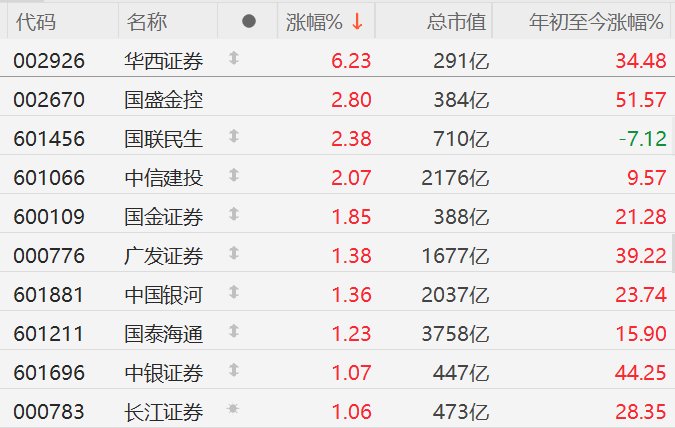
券商股上涨,华西证券涨超6%
Ge Long Hui· 2025-08-29 03:08
Group 1 - A-shares of brokerage stocks have risen, with Huaxi Securities increasing by over 6% [1] - Guosheng Financial Holdings, Guolian Minsheng, and CITIC Securities have all risen by over 2% [1] - Other notable increases include Guojin Securities, GF Securities, China Galaxy, Guotai Junan, Zhongyin Securities, and Changjiang Securities, all rising by over 1% [1] Group 2 - Huaxi Securities has a market value of 29.1 billion and a year-to-date increase of 34.48% [2] - Guosheng Financial Holdings has a market value of 38.4 billion and a year-to-date increase of 51.57% [2] - Guolian Minsheng has a market value of 71 billion but a year-to-date decrease of 7.12% [2] - CITIC Securities has a market value of 217.6 billion and a year-to-date increase of 9.57% [2] - Guojin Securities has a market value of 38.8 billion and a year-to-date increase of 21.28% [2] - GF Securities has a market value of 167.7 billion and a year-to-date increase of 39.22% [2] - China Galaxy has a market value of 203.7 billion and a year-to-date increase of 23.74% [2] - Guotai Junan has a market value of 375.8 billion and a year-to-date increase of 15.90% [2] - Zhongyin Securities has a market value of 44.7 billion and a year-to-date increase of 44.25% [2] - Changjiang Securities has a market value of 47.3 billion and a year-to-date increase of 28.35% [2]







A股券商股上涨,华西证券涨超6%
Ge Long Hui A P P· 2025-08-29 02:47
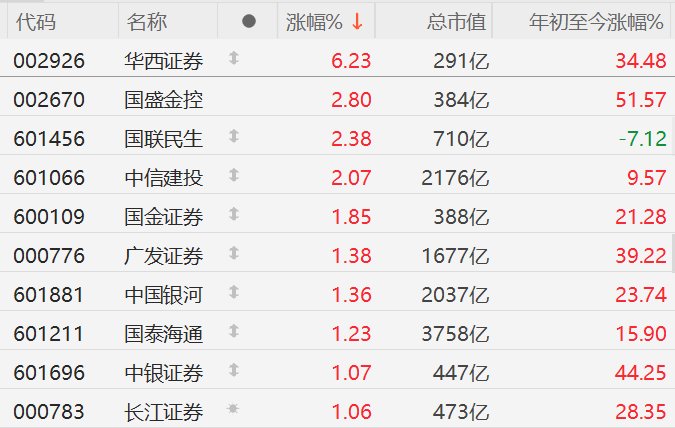
Group 1 - A-share brokerage stocks have seen significant increases, with Huaxi Securities rising over 6% and several others, including Guosheng Financial Holdings and Zhongxin Jinkong, increasing by more than 2% [1] - The following are the performance metrics of selected brokerage stocks: - Huaxi Securities: 6.23% increase, market cap of 29.1 billion, year-to-date increase of 34.48% - Guosheng Financial Holdings: 2.80% increase, market cap of 38.4 billion, year-to-date increase of 51.57% - Guolian Minsheng: 2.38% increase, market cap of 71 billion, year-to-date decrease of 7.12% - Zhongxin Jinkong: 2.07% increase, market cap of 217.6 billion, year-to-date increase of 9.57% [2] - Other notable brokerage stocks include: - Guojin Securities: 1.85% increase, market cap of 38.8 billion, year-to-date increase of 21.28% - GF Securities: 1.38% increase, market cap of 167.7 billion, year-to-date increase of 39.22% - China Galaxy: 1.36% increase, market cap of 203.7 billion, year-to-date increase of 23.74% [2] Group 2 - The MACD golden cross signal has formed, indicating a positive trend for these stocks [2]
国泰海通:加关税影响了多少美国通胀?
Ge Long Hui· 2025-08-29 02:04
Group 1: Tariff Policy - The actual average import tariff rate in the U.S. increased by only 6.6 percentage points compared to the end of 2024, which is significantly lower than market expectations [1] - The changes in the U.S. import structure and the low proportion of taxable goods are the main reasons for the lower-than-expected tariff collection [1] - In the second half of the year, the average import tariff rate is expected to rise further with the implementation of new tariff rates and gradual enforcement of industry tariffs [1] Group 2: Impact on U.S. Enterprises - U.S. enterprises are currently bearing approximately 63% of the tariff costs, while consumers are responsible for less than 40% [2] - The transmission of tariff costs to enterprises has been slow, but as inventory is gradually consumed and trade policy uncertainty decreases, enterprises are likely to continue raising prices [2] - However, due to increased consumer sensitivity to prices, enterprises may still need to absorb a significant portion of the tariff costs [2] Group 3: Consumer Inflation - The dependence on imports is high for categories such as auto parts, new cars, clothing, and furniture [3] - If the average import tariff rate in the U.S. rises by 10% within the year, it could push the PCE year-on-year growth rate to 3.1% and the core PCE year-on-year growth rate to 3.4%, assuming stable demand [3] - A significant decline in demand could help alleviate inflationary pressures in the U.S. [3]
国泰海通:9月后美联储能否连续降息具有较高不确定性
Zhi Tong Cai Jing· 2025-08-28 23:16
Group 1: Tariff Policy - The actual average import tariff rate in the U.S. increased by only 6.6 percentage points compared to the end of 2024, which is significantly lower than market expectations [1] - The changes in the U.S. import structure and the low proportion of taxable goods are the main reasons for the weaker-than-expected tariff enforcement [1] - In the second half of the year, the average import tariff rate is expected to rise further due to the implementation of new tariff rates and gradual enforcement of industry tariffs [1] Group 2: Import Costs and Price Dynamics - The U.S. import price index, which reflects the dollar prices paid by importers excluding tariffs, shows no significant decline in import costs for goods other than energy and food since the implementation of equivalent tariffs in April [2] - U.S. companies are currently bearing about 63% of the tariff costs, while consumers are responsible for less than 40% [2] - As inventory is gradually consumed and trade policy uncertainty decreases, companies may continue to raise prices, although consumer sensitivity to prices may lead to companies absorbing a portion of the tariff costs [2] Group 3: Consumer Inflation - Goods such as auto parts, new cars, clothing, and furniture have a high dependency on imports, but the transmission of tariffs to prices in these categories remains unclear [3] - If the average import tariff rate in the U.S. rises by 10% this year, it could push the year-on-year growth rate of PCE to 3.1% and core PCE to 3.4%, assuming stable demand [3] - The "slow heating" inflation provides the Federal Reserve with room for a rate cut in September, but the uncertainty remains regarding the possibility of consecutive rate cuts thereafter [3]