Bank Of Shanghai(601229)

Search documents
上市银行“十四五回望”之资负结构与息差变迁
CMS· 2025-09-28 15:09
Investment Rating - The report maintains a recommendation for the banking industry [3] Core Insights - The report provides a comprehensive analysis of the asset-liability structure and interest margin changes of 42 A-share listed banks during the "14th Five-Year Plan" period, highlighting a shift towards corporate loans on the asset side and a stronger retail focus on the liability side [12][14] - The asset-liability structure indicates a significant increase in the proportion of corporate loans, rising from 57.02% to 63.22% from the end of 2020 to mid-2025, while the proportion of demand deposits decreased from 41.94% to 30% [12][14] - The report notes a decline in both asset yield and interest margin, with the yield on interest-earning assets dropping from 4.43% to 3.32% and the net interest margin decreasing from 2.23% to 1.53% during the same period [14][15] Summary by Sections Overall Asset-Liability Structure and Interest Margin Changes - The asset-liability structure shows an increase in loan-to-earning asset ratio from 54.19% to 56.49%, with corporate loans making up a larger share of total loans [14][15] - The average yield on interest-earning assets decreased significantly, with the loan yield falling from 5.34% to 3.82% [15] - The net interest margin for listed banks remains higher than that of commercial banks, despite a decline [14][15] Changes in Each Banking Sector's Asset-Liability Structure and Interest Margin - City commercial banks experienced a more significant increase in the proportion of corporate loans, with their interest margin narrowing less compared to other banks [18] - The report highlights that the proportion of deposits in interest-bearing liabilities for state-owned banks decreased, while it increased for rural commercial banks [18] - The decline in interest-bearing liabilities' cost rate was most pronounced in city commercial banks, leading to a smaller reduction in their interest margin [18]





研报掘金丨申万宏源研究:首予上海银行“增持”评级,基本面步入底部企稳区间
Ge Long Hui· 2025-09-28 05:44
Core Viewpoint - Shanghai Bank's fundamentals are stabilizing as credit structure transforms and risks are systematically resolved, with high dividend advantages and convertible bond themes likely to boost its valuation during the bank sector's recovery phase [1] Group 1: Financial Performance - The expected dividend payout ratio for the first half of 2025 is 32.2%, translating to a projected dividend yield of 5.6% based on the current stock price [1] - Forecasted net profit growth rates for the parent company from 2025 to 2027 are 2.1%, 3.5%, and 5.6% respectively [1] Group 2: Valuation and Investment Rating - The closing price on September 25 corresponds to a price-to-book (PB) ratio of 0.51 for 2025, with a target valuation of 0.6 times PB, indicating an 18% upside potential [1] - The company is given an "overweight" rating for the first time [1] Group 3: Economic Context - Shanghai Bank is positioned in a key economic and financial center, which will allow it to benefit significantly from economic recovery if positive trends continue [1] - The bank's performance elasticity is expected to become more pronounced with the anticipated economic recovery [1]

固收深度报告20250927:从42家上市银行半年报解读银行债券投资“攻守道”





Soochow Securities· 2025-09-27 14:32
1. Report Industry Investment Rating No information about the report industry investment rating is provided in the given content. 2. Core Viewpoints of the Report - External environment factors such as interest rate fluctuations, bond supply - demand, and policy orientation jointly impact bond investment returns. In H1 2025, the bond investment of 42 listed banks showed certain characteristics in scale, structure, and profit and loss, but there are still challenges in maintaining stable returns in the future [1]. - The overall bond investment scale of 42 listed banks expanded steadily in H1 2025. There were differences in the investment structure among different types of banks, with state - owned banks and city commercial banks having stable growth in the bond allocation portfolio, while joint - stock banks and rural commercial banks increased their efforts in the bond trading portfolio. The bond investment portfolio generally presented a pattern of "stable foundation and flexible gain" [1]. - The coupon income of 42 listed banks was generally stable in H1 2025 but showed a slight year - on - year decline. The fair value change loss was significant, and the investment income increased. However, the bond investment of the banking industry still faces pressure to maintain stable returns [1]. 3. Summary According to the Table of Contents 3.1 42 Listed Banks' Bond Investment Volume - **Overall Bond Investment Scale: Steady Expansion**: In H1 2025, the total scale of the three types of bond - type financial assets of 42 listed banks showed a steady expansion trend. The growth of debt investment - type financial assets measured at amortized cost was relatively slow, while the growth of trading financial assets measured at fair value and included in current profits and losses was relatively large, indicating that banks increased the proportion of trading positions [9]. - **Differentiated Bond Investment Distribution Structures among Different Bank Types**: In H1 2025, state - owned banks and city commercial banks showed stable growth in the bond allocation portfolio, which may be related to their participation in the primary - market issuance of important national and regional bond varieties. Joint - stock banks and rural commercial banks slightly weakened their bond allocation power but significantly increased their efforts in the bond trading portfolio, showing a differentiated feature of "stable allocation by large banks and prominent trading flexibility by small and medium - sized banks" [13]. - **Bond Investment Allocation Tilted towards Government - Related Bonds**: In H1 2025, commercial banks increased their allocation of government - related bonds, with an average month - on - month increase of about 10% for state - owned banks, joint - stock banks, and city commercial banks, and a slightly smaller increase for rural commercial banks. The allocation of financial bonds and other bonds was differentiated. All banks held a relatively large scale of government - related bonds, followed by financial bonds and credit - related bonds [18]. - **Correlation between Financial Asset Types and Bond Variety Structures**: The banking industry maintained a stable growth of interest - rate bonds in the bond allocation portfolio and increased the allocation of credit bonds, while the allocation of financial bonds was relatively weak. In the bond trading portfolio, interest - rate bonds and financial bonds were the core varieties, with a more significant increase than credit bonds, showing a "stable foundation and flexible gain" pattern [22]. 3.2 42 Listed Banks' Bond Investment Profit and Loss - **Coupon Income: Generally Stable and Still the Main Source of Income**: In H1 2025, the total coupon income of 42 listed banks decreased slightly year - on - year. Although the scale of held - to - maturity bonds increased, the decline in the coupon rate of newly issued bonds led to a decrease in coupon income. In the future, coupon income is still expected to be the main source of bond investment income for commercial banks [26]. - **Fair Value Change Loss: Losses in the Trading Level**: In H1 2025, the total fair value change loss of 42 listed banks decreased significantly year - on - year, indicating that it was difficult to obtain capital gains through short - term trading in the volatile bond market, and there were floating losses in bond trading [28]. - **Investment Income: Growth in All Bank Types**: In H1 2025, the actual investment income of 42 listed banks in the bond field increased significantly year - on - year. Although the book value appreciation of bond - type trading financial assets and other debt investment - type financial assets was not as good as that of the previous year, banks could still increase their investment income by selling floating - profit old bonds and waiting for the maturity of high - coupon bonds [31]. 3.3 Attribution and Summary - **External Environment Driving Factors: Interest Rate Fluctuations, Bond Supply - Demand, and Policy Orientation Jointly Impact Bond Investment Returns**: In H1 2025, the "more adjustments and fewer opportunities" bond market environment led to a general decline in the prices of existing bonds, resulting in a significant year - on - year decline in the fair value change loss of listed banks' bond investment. The supply of national bonds, local government bonds, and policy - based financial bonds increased, but the coupon rate of newly issued bonds decreased, leading to a decline in coupon income. Regulatory policies indirectly affected bond investment performance [35]. - **Banking Industry's Bond Investment Pressure and Future Outlook** - Overall Income Shows a Positive Trend but There Are Still Hidden Concerns: In H1 2025, the actual bond investment income of 42 listed banks increased slightly year - on - year, but the coupon income faced downward pressure in the interest - rate downward cycle, and it was more difficult to obtain spread income through band trading. Since H2 2025, the "stock - strong and bond - weak" pattern has emerged, and the loss caused by fair value change will be more obvious [3]. - Different Bank Types Show Differentiated Performance, and State - owned Banks' Pressure Is Relatively Controllable: State - owned banks can maintain a certain profit - making ability in the low - interest - rate volatile bond market due to their advantages in bond allocation and trading portfolios. Joint - stock banks, city commercial banks, and rural commercial banks are more vulnerable, and they may increase their capital allocation in the equity market, commodity market, and related structured fixed - income products in the future [3].
上海银行(601229):重塑信贷结构,化风险夯实基本面
Shenwan Hongyuan Securities· 2025-09-26 13:57
Investment Rating - The report assigns an "Accumulate" rating for Shanghai Bank, marking its first coverage [1]. Core Views - The report emphasizes the transformation of the credit structure and the resolution of risks, which are expected to solidify the bank's fundamentals. It highlights that the bank's return on equity (ROE) is anticipated to stabilize as the credit structure evolves and risks are systematically addressed [6][9]. Summary by Sections 1. Historical Valuation - Since 2020, Shanghai Bank's valuation has remained at the bottom of the industry due to adjustments in credit structure and profitability challenges. The bank's ROE has been consistently lower than the average of listed city commercial banks, with a 2023 ROE of 10.4%, which is 2.30 percentage points below the average [4][22]. 2. Market Expectations - The report identifies three major changes that could stabilize ROE: 1. A decisive optimization of the credit structure, with significant reductions in consumer loans and corporate real estate loans since 2019 [6]. 2. Gradual resolution of asset quality pressures, with a notable decrease in retail non-performing loan (NPL) rates [6]. 3. Effective management of funding costs, which is expected to stabilize loan pricing [6]. 3. New Valuation Point - The report suggests that with the transformation of the credit structure and the orderly resolution of risks, Shanghai Bank's fundamentals are entering a stabilization phase. The bank's high dividend yield and potential for valuation recovery in the banking sector are highlighted, with an expected 18% upside based on a target price-to-book (PB) ratio of 0.6 for 2025 [6][9]. 4. Investment Analysis Opinion - The report concludes that the bank's fundamentals are stabilizing, supported by low valuation and high dividend yield. It anticipates a net profit growth of 2.1%, 3.5%, and 5.6% for 2025-2027, respectively, and recommends an "Accumulate" rating based on these projections [9][10].
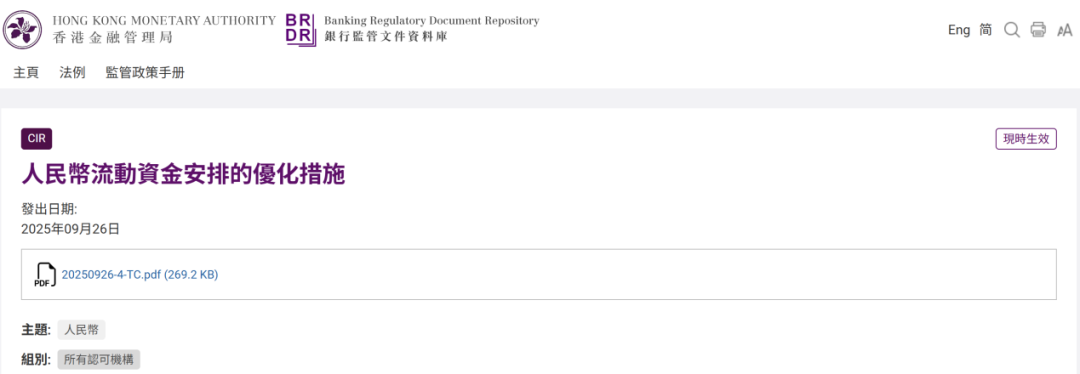
香港金管局公布人民币流动资金安排优化措施,将于10月9日生效
Zhong Guo Ji Jin Bao· 2025-09-26 10:26
Core Viewpoint - The Hong Kong Monetary Authority (HKMA) announced the optimization of the Renminbi liquidity arrangement to better meet the liquidity demands arising from the growth of offshore Renminbi business, effective from October 9, 2025 [1][3]. Summary by Sections Optimization Measures - The HKMA will replace the existing Renminbi Trade Financing Liquidity Arrangement with the "Renminbi Business Liquidity Arrangement," maintaining a total liquidity amount of 40 billion Renminbi, redistributing it to 30 billion Renminbi for daytime and 10 billion Renminbi for overnight liquidity [3]. - New T+1 repurchase agreements with two-week and one-month terms will be introduced, alongside existing one-day and one-week options, with rates referencing current market rates [3]. Implementation Phases - **Phase 1 (Effective October 9, 2025)**: Banks will access the new arrangement at lower rates, based on the Shanghai Interbank Offered Rate, eliminating a previous 25 basis point premium. The arrangement will also allow banks to provide Renminbi trade financing through overseas branches [4]. - **Phase 2 (Effective December 1, 2025)**: Specific Renminbi capital expenditure and working capital loans will be included in the eligible business scope, enhancing predictability and stability in Renminbi funding costs for banks [5]. - **Phase 3 (Effective February 2, 2026)**: Introduction of a third-party repurchase service by the Central Moneymarkets Unit (CMU), allowing banks to change collateral during the repurchase period, transitioning to a more automated operation [5]. Market Context - The HKMA noted significant growth in offshore Renminbi business, with the loan-to-deposit ratio for Renminbi in the banking sector rising from approximately 20% in September 2022 to over 90% by June 2025, indicating increasing demand for long-term Renminbi loans [7]. - The HKMA's measures aim to ensure sufficient liquidity in the market to support the expansion of offshore Renminbi business and promote its use in the real economy [8].

上海银行股份有限公司关于实施2025年中期权益分派时“上银转债”停止转股的提示性公告
Shang Hai Zheng Quan Bao· 2025-09-25 19:44
炒股就看金麒麟分析师研报,权威,专业,及时,全面,助您挖掘潜力主题机会! 证券代码:601229 证券简称:上海银行 公告编号:临2025-052 ● 证券停复牌情况:适用 因实施2025年中期权益分派,公司的相关证券停复牌情况如下:自本次普通股权益分派实施公告前一交 易日(2025年10月9日)至权益分派股权登记日期间,"上银转债"将停止转股,本次权益分派股权登记 日后的第一个交易日起"上银转债"恢复转股。 ■ 注:停牌终止日及复牌日可在公司后续发布的可转债转股价格调整公告中查阅。 一、2025年中期普通股权益分派基本情况 优先股代码:360029 优先股简称:上银优1 可转债代码:113042 可转债简称:上银转债 上海银行股份有限公司关于实施2025年中期权益分派时 "上银转债"停止转股的提示性公告 上海银行股份有限公司(以下简称"公司")董事会及全体董事保证本公告内容不存在任何虚假记载、误 导性陈述或者重大遗漏,并对其内容的真实性、准确性和完整性承担法律责任。 重要内容提示: 联系部门:董事会办公室 联系电话:021-68476988 联系传真:021-68476215 联系地址:中国上海市黄浦区中山 ...
银行投资基金:现状洞察、费改破局与逻辑重塑
KAIYUAN SECURITIES· 2025-09-25 14:41
Investment Rating - The investment rating for the banking industry is "Positive" (maintained) [1] Core Insights - The banking sector is experiencing a shift in fund investment behavior, with banks redeeming low-yield money market funds and increasing their holdings in credit bond funds to enhance returns [5][57] - The total fund holdings of listed banks reached approximately 6.37 trillion yuan, accounting for 2.03% of total assets as of the end of the first half of 2025 [15][18] - The proportion of fund investments in the fair value through profit or loss (FVTPL) category is 48.5%, with city commercial banks showing even higher ratios [15][22] Summary by Sections 1. Fund Investment Participation and Scale - The self-managed fund holdings of listed banks as of June 2025 were approximately 6.37 trillion yuan, with shareholding banks and city commercial banks having significant investment scales of 2.84 trillion yuan and 1.72 trillion yuan, respectively [15][18] - The investment in money market funds decreased to 9.10%, while the proportion of passive index bond funds increased to 7.90% [23][25] 2. Changes in Fund Investment Behavior - Banks are redeeming money market funds and low-yield rate bond funds while increasing their investment in credit bond funds [5][57] - The redemption pressure for money market funds was primarily concentrated in the first quarter of 2025, driven by liquidity management needs and yield enhancement [49][55] 3. Future Expansion and Impact of Redemption Fee Reform - Smaller banks have greater expansion potential in fund investments, driven by the need for redundant fund screening and tax-exempt income [3][3] - The implementation of redemption fee reforms may catalyze preventive redemptions by banks, leading to a preference for customized bond funds and bond ETFs [3][3]




上海银行:关于实施2025年中期权益分派时“上银转债”停止转股的提示性公告
Zheng Quan Ri Bao Zhi Sheng· 2025-09-25 12:13
证券日报网讯 9月25日晚间,上海银行发布公告称,因实施2025年中期权益分派,公司的相关证券停复 牌情况如下:自本次普通股权益分派实施公告前一交易日(2025年10月9日)至权益分派股权登记日期 间,"上银转债"将停止转股,本次权益分派股权登记日后的第一个交易日起"上银转债"恢复转股。 (编辑 楚丽君) ...
上海银行(601229) - 上海银行关于实施2025年中期权益分派时“上银转债”停止转股的提示性公告
2025-09-25 08:47
上海银行股份有限公司关于实施 2025 年中期权益分派时 "上银转债"停止转股的提示性公告 上海银行股份有限公司(以下简称"公司")董事会及全体董事保证本公告 内容不存在任何虚假记载、误导性陈述或者重大遗漏,并对其内容的真实性、准 确性和完整性承担法律责任。 重要内容提示: | 证券代码:601229 | 证券简称:上海银行 | 公告编号:临 2025-052 | | --- | --- | --- | | 优先股代码:360029 | | 优先股简称:上银优 1 | | 可转债代码:113042 | | 可转债简称:上银转债 | 证券停复牌情况:适用 因实施 2025 年中期权益分派,公司的相关证券停复牌情况如下:自本次普通 股权益分派实施公告前一交易日(2025 年 10 月 9 日)至权益分派股权登记日期间, "上银转债"将停止转股,本次权益分派股权登记日后的第一个交易日起"上银 转债"恢复转股。 | 证券代码 | 证券简称 | 停复牌类型 | 停牌 | 停牌 | 停牌 | 复牌日 | | --- | --- | --- | --- | --- | --- | --- | | | | | 起始日 | 期 ...
城商行板块9月25日跌0.94%,重庆银行领跌,主力资金净流出2.78亿元
Zheng Xing Xing Ye Ri Bao· 2025-09-25 08:37
Market Performance - The city commercial bank sector declined by 0.94% on September 25, with Chongqing Bank leading the decline [1] - The Shanghai Composite Index closed at 3853.3, down 0.01%, while the Shenzhen Component Index closed at 13445.9, up 0.67% [1] Individual Stock Performance - Chongqing Bank closed at 8.94, down 1.65% with a trading volume of 170,700 shares and a transaction value of 153 million [1] - Other notable declines include Xi'an Bank down 1.50% to 3.95, Zhengzhou Bank down 1.48% to 2.00, and Qingdao Bank down 1.44% to 4.78 [1] - Shanghai Bank and Xiamen Bank also saw declines of 1.43% and 1.39%, respectively [1] Capital Flow Analysis - The city commercial bank sector experienced a net outflow of 278 million from institutional investors, while retail investors saw a net inflow of 152 million [1] - The table indicates that Suzhou Bank had a significant net outflow from institutional investors of 48.08 million, while Qilu Bank had a net inflow of 25.86 million [2] - Chongqing Bank specifically had a net outflow of 5.68 million from institutional investors but a net inflow of 10.91 million from retail investors [2]