AGRICULTURAL BANK OF CHINA(601288)

Search documents
农业银行15连阳再创历史新高,年内累涨超60%
Xin Lang Cai Jing· 2025-10-23 01:47
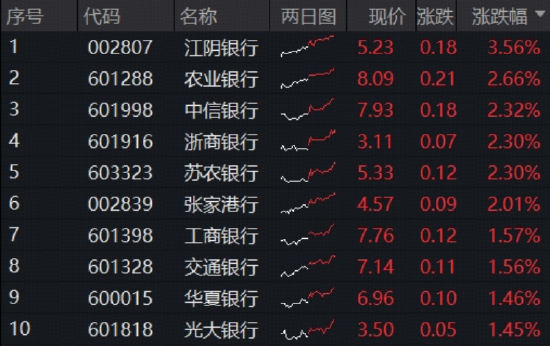
A股市场银行板块再度逆势上扬,其中,邮储银行涨超3%,青岛银行、江阴银行、农业银行、兴业银 行、光大银行、浙商银行、中信银行、交通银行、民生银行、南京银行、工商银行、中国银行、张家港 行、建设银行、北京银行涨超1%。值得注意的是,农业银行15连阳,再创历史新高,年内累涨超 60%。 ...

银行业倾力做好金融“五篇大文章”
Jin Rong Shi Bao· 2025-10-23 01:25
Core Insights - The financial services sector has significantly improved its quality and efficiency in supporting the real economy during the "14th Five-Year Plan" period, with a focus on enhancing financial support for key strategic areas and weak links in economic and social development [1][2]. Financial Support for the Real Economy - Over the past five years, the banking and insurance sectors have provided an additional 170 trillion yuan to the real economy through various financing methods, including loans, bonds, and equity [1]. - The average annual growth rates for loans in scientific research technology, medium to long-term loans for manufacturing, and infrastructure loans are 27.2%, 21.7%, and 10.1%, respectively [1]. - The balance of inclusive loans for small and micro enterprises has reached 36 trillion yuan, which is 2.3 times that of the end of the "13th Five-Year Plan," with interest rates decreasing by 2 percentage points [1]. Support for Technological Innovation - Financial institutions have strengthened their support for technology credit, with the balance of loans to high-tech enterprises nearing 19 trillion yuan and an annual growth rate exceeding 20% [2]. - A "technology-industry-finance" virtuous cycle is being formed, with banks improving financial services for technology enterprises throughout their lifecycle [2][3]. Inclusive Finance Development - The development of inclusive finance is crucial for transforming the economic development model and enhancing social equity [4]. - During the COVID-19 pandemic, 17 trillion yuan in loans received deferred repayment support, benefiting over 10 million businesses [6]. - In the past five years, 31.5 trillion yuan in loans have been issued to poverty-stricken areas, with nearly 400 billion yuan in microloans for impoverished populations [6]. Agricultural Financial Support - Agricultural Bank has prioritized food security as a key financial service, providing comprehensive support for grain and important agricultural products [7]. - The balance of the "Grain Farmer e-loan" product reached 140.1 billion yuan, supporting 910,000 grain and oil planting entities [7]. Green Finance Initiatives - The banking sector has made significant contributions to green finance, supporting infrastructure upgrades, low-carbon technology innovation, and energy transitions [8]. - National Development Bank has financed various projects, including renewable energy and ecological restoration, contributing to the overall green transformation of the economy [8].


A股,又一只翻倍股诞生!北向资金,最新重仓股出炉!
2 1 Shi Ji Jing Ji Bao Dao· 2025-10-22 14:07
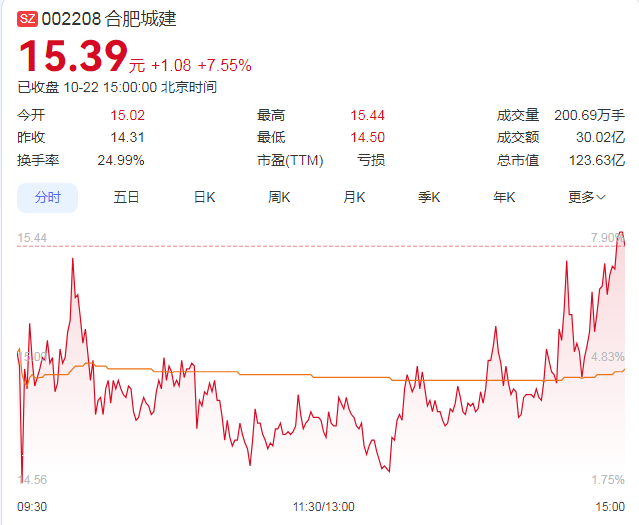
Group 1: Stock Performance - Hefei Urban Construction's stock price surged by 101% since September 30, with a recent increase of 7.55% on October 22, closing at 15.39 CNY per share [1] - The total market capitalization of Hefei Urban Construction reached 12.363 billion CNY, with a trading volume of 3.002 billion CNY on the same day [1] Group 2: Company Overview - Hefei Urban Construction primarily engages in real estate sales and leasing, holding a strong reputation in Anhui Province, particularly in the industrial real estate sector [3] - The company is recognized as the largest developer and operator of standardized industrial factories in Anhui Province through its wholly-owned subsidiary, Hefei Industrial Investment Industrial Technology Development Co., Ltd. [3] Group 3: Market Trends - As of the end of Q3, northbound funds held approximately 2.58 trillion CNY in A-shares, marking a 12.66% increase from the end of Q2 [4] - The battery and semiconductor sectors attracted significant northbound fund investments, with the battery sector's holdings increasing by 125.38 billion CNY to 300.626 billion CNY [4] Group 4: Banking Sector - Agricultural Bank of China achieved a market capitalization of 2.83 trillion CNY, surpassing Industrial and Commercial Bank of China to become the largest in A-shares [6] - The bank's stock price rose by 23% since September 25, reflecting strong market performance [6][8] Group 5: Earnings Reports - Over half of the companies that released Q3 earnings reports showed a quarter-on-quarter increase in net profit, with 21 companies reporting over 50% growth [9] - Notable performers included Guangpu Co., with a Q3 net profit of 24.14 million CNY, reflecting a 4687% increase from Q2, largely due to a low base effect [9]





农行市值达2.75万亿元领涨银行股,估值修复行情能否持续
Di Yi Cai Jing· 2025-10-22 13:16
Core Viewpoint - The A-share banking sector has shown strong performance, with Agricultural Bank of China (ABC) reaching a historical high in stock price and market capitalization, indicating a significant valuation recovery in the banking sector [1][2]. Group 1: Agricultural Bank of China Performance - On October 22, ABC's stock price closed at 8.09 yuan, marking a historical high and a total market capitalization of 2.75 trillion yuan, with a price-to-book ratio of 1.06, breaking the long-standing "below book value" situation of state-owned banks [1][2]. - ABC has experienced a "14 consecutive days of gains" trend, with a year-to-date increase of 51.05%, significantly outperforming Industrial and Commercial Bank of China (ICBC), which has a year-to-date increase of 12.14% [2]. - The stock's strong performance is attributed to high dividend yields from quality assets and stable earnings, which provide solid support for the stock price [2]. Group 2: Factors Driving Valuation Recovery - The recovery in the banking sector's valuation is driven by three main factors: sustained inflow of long-term capital, stabilization of fundamentals, and a shift in market style [4]. - Long-term capital inflows, particularly from insurance companies, asset management companies (AMCs), and industrial capital, have provided robust purchasing power for bank stocks [4][5]. - The fundamental recovery is reflected in improved revenue growth and profitability forecasts for listed banks, with expected revenue growth of 1% and profit growth of 1.5% for the first three quarters of 2025 [5]. Group 3: Market Conditions and Investor Sentiment - The market's perception of bank stocks has shifted, with a historical tendency to undervalue banks at a price-to-book ratio below 1, now being reassessed due to the banks' operational resilience and compounding effects [3]. - The recent increase in global risk aversion, particularly following U.S. trade policy announcements, has led to a defensive shift towards bank stocks, which are characterized by low valuations and high dividends [6]. - Analysts suggest that the banking sector is entering a bottoming phase, with expectations of a more certain investment window in the fourth quarter and early next year, despite ongoing uncertainties in performance and external environments [7].
金信智能中国2025跑输大盘20%:“智能主题”基金却重仓银行,三季度踏空行情
Feng Huang Wang Cai Jing· 2025-10-22 12:58
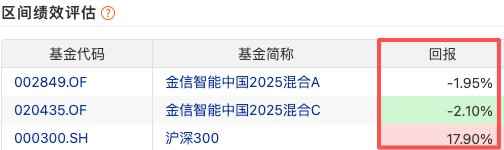
Core Viewpoint - The phenomenon of investment style drift is evident in the third-quarter report of the Jinxin Fund's Intelligent China 2025 Flexible Allocation Mixed Fund, which, despite its stated investment goal of focusing on intelligent enterprises, has heavily invested in traditional financial stocks, leading to poor performance and significant underperformance compared to peers [1][10]. Fund Performance - Jinxin Intelligent China 2025 Mixed Fund reported returns of -1.95% for Class A and -2.10% for Class C in the third quarter, while the benchmark return was 12.19%, and the CSI 300 index rose by 17.90%, indicating a nearly 20% underperformance against the index [2][3]. - Year-to-date performance as of October 21 shows Class A with a return of 14.90%, ranking 1417 out of 2303 similar products, and a six-month return of 11.87%, lagging the CSI 300 by nearly 10 percentage points [4][5]. Investment Strategy and Holdings - The fund's investment objective is to focus on enterprises providing intelligent production, design, and services, including sectors like smart machinery and smart healthcare [6]. - However, the top ten holdings for the third quarter were entirely traditional financial stocks, including major banks such as Industrial and Commercial Bank of China and China Construction Bank, indicating a significant deviation from its stated investment strategy [8][10]. Investor Sentiment - Investors have expressed concerns regarding the fund's strategy, questioning the rationale behind its heavy allocation to traditional financial stocks instead of intelligent enterprises, leading to skepticism about the fund's alignment with its stated goals [11][13]. Regulatory and Market Implications - The drift in investment style raises compliance concerns, as frequent style changes can mislead investors regarding the product's risk profile, potentially leading to greater scrutiny and pressure on the fund's future performance [14].






金信智能中国2025跑输大盘20%:“智能主题”基金却重仓银行,三季度踏空行情
凤凰网财经· 2025-10-22 12:48
Core Viewpoint - The article highlights the phenomenon of style drift in public funds, specifically focusing on the Jin Xin Fund's "Intelligent China 2025" mixed fund, which has deviated from its stated investment goal of focusing on intelligent enterprises by heavily investing in traditional financial stocks, resulting in poor performance compared to the market [3][4][11]. Group 1: Fund Performance - Jin Xin Intelligent China 2025 mixed fund reported a negative return of -1.95% and -2.10% for its A and C shares respectively in Q3, significantly underperforming the benchmark return of 12.19% and the CSI 300 index which rose by 17.90%, leading to a performance gap of nearly 20% [4][5]. - Year-to-date performance as of October 21 shows the fund's A shares with a return of 14.90%, ranking 1417 out of 2303 similar products, indicating a mid-to-low tier performance [6][7]. - The fund's total management scale decreased by 25.7% from 7.59 billion to 5.64 billion yuan in Q3 [6]. Group 2: Investment Strategy and Holdings - The fund's stated investment objective is to focus on enterprises providing intelligent production, design, and services, including sectors like smart machines and smart healthcare [8]. - However, the top ten holdings in Q3 were entirely traditional financial stocks, including major banks like ICBC and Ping An Bank, indicating a significant deviation from its stated investment strategy [9][10]. - The fund's historical trend shows a consistent increase in bank stock holdings since 2017, with at least 8 out of the top 10 holdings being bank stocks since 2018, demonstrating a long-standing style drift [11]. Group 3: Investor Sentiment and Concerns - Investors have expressed concerns regarding the fund's management and investment strategy, questioning the rationale behind the heavy allocation to traditional financial stocks despite the fund's focus on intelligent enterprises [12][15]. - The fund managers acknowledged the market volatility in Q3 but maintained that their strategy focused on the financial services sector's intelligence, which contrasts sharply with their actual stock selections [14][15]. - The article notes that frequent style shifts can lead to confusion among investors regarding the fund's positioning, potentially misleading them about the risk profile of the product [15].

A股集体下跌!场内近3000股飘绿
Qi Huo Ri Bao Wang· 2025-10-22 12:34
Group 1 - A-shares experienced a collective decline on October 22, with the Shanghai Composite Index slightly down by 0.07% to 3913.76 points, the Shenzhen Component down by 0.62% to 12996.61 points, and the ChiNext Index down by 0.79% to 3059.32 points [1] - The total trading volume in the Shanghai, Shenzhen, and Beijing markets was 1690.5 billion yuan, a decrease of over 200 billion yuan compared to the previous day [1] - Nearly 3000 stocks were in the red, with sectors such as coal, non-ferrous metals, brokerage, and semiconductors declining, while the oil sector saw strong gains, with companies like Keli Co., Ltd. rising over 10% [1] Group 2 - Goldman Sachs released a report suggesting that despite potential pullbacks in Chinese stocks, investors should shift their mindset from "selling on highs" to "buying on lows," predicting a 30% increase in the MSCI China Index by the end of 2027 [2] - Dongguan Securities noted that the index is at a high point, with increased capital divergence, warning of potential short-term fluctuations due to profit-taking, but also highlighted that economic recovery in Q4 is expected to be supported by policies [2] - The report emphasized that the expectation of interest rate cuts by the Federal Reserve could attract foreign capital inflows, enhancing the allocation value of A-shares and potentially driving domestic funds into the stock market [2]

结束上攻,转跌!
中国基金报· 2025-10-22 12:06
Market Overview - After two consecutive days of gains, the Hong Kong stock market experienced weakness and volatility on October 22, with the Hang Seng Index closing down 0.94% at 25,781.77 points, the Hang Seng Tech Index down 1.41%, and the Hang Seng China Enterprises Index down 0.85% [4][5] - Southbound capital saw a net inflow of approximately 10 billion HKD today [5] Sector Performance Technology Sector - The technology sector saw widespread declines, with major stocks such as NetEase and BYD Electronics dropping over 4%, and Kuaishou, Bilibili, and Baidu Group falling over 2% [7][8] Banking Sector - The banking sector was active, with Agricultural Bank of China reaching a new high, closing up 1.56% at 5.85 HKD per share. Other banks like Chongqing Bank, Zheshang Bank, and CITIC Bank also saw gains exceeding 1% [10][11] Pharmaceutical Sector - The innovative drug sector opened high but closed lower, with the Hang Seng Innovation Drug Index down 2.46%. After a significant deal, Innovent Biologics saw its stock price drop nearly 2% by the end of the day [22][23] Gold Sector - The gold sector faced pressure due to a sharp drop in international gold prices, with companies like Lingbao Gold down 4.75% and major jewelry stocks also declining [12][13] Notable Company Developments Agricultural Bank of China - Agricultural Bank of China reported a market capitalization of 300.87 billion HKD and a premium of 51.47% compared to its A-share price [11] Innovent Biologics - Innovent Biologics announced a global strategic partnership with Takeda Pharmaceutical involving three core assets, with an upfront payment of 1.2 billion USD and potential milestone payments of up to 10.2 billion USD [23] Lingbao Gold - Lingbao Gold announced a 4.5% discount on the placement of 3.71 million H-shares, aiming to raise approximately 2.707 billion HKD for inventory reserves and store expansion [17][18] Guanghe Communication - Guanghe Communication debuted on the Hong Kong Stock Exchange, closing down 11.72%. The company reported a revenue decline of 9.02% year-on-year for the first half of 2025 [25][26]


重要信号,银行向上逼近“牛熊分界线”!双百亿银行ETF(512800)逆市10连阳,农行涨2.6%再创新高!
Xin Lang Ji Jin· 2025-10-22 11:43
Group 1 - The core viewpoint of the articles highlights the strong performance of the banking sector in the A-share market, with 39 out of 42 bank stocks rising, including Agricultural Bank of China achieving a 14-day consecutive increase, reaching a historical high [1][4] - Jiangyin Bank saw a rise of over 3%, while other banks like CITIC Bank, Zheshang Bank, and others also reported gains exceeding 2% [1][2] - The banking ETF (512800) experienced a significant inflow of funds, with a total of 5.987 billion yuan accumulated in the last 10 days, indicating strong investor interest [4][5] Group 2 - The banking sector is characterized by high dividend yields and low valuations, with the China Securities Banking Index's price-to-book ratio (PB) at 0.71, placing it in the lower range of the past decade [3][4] - The sector's defensive attributes are becoming more attractive to investors amid rising market uncertainties, presenting a potential opportunity for allocation [3][4] - Historical data suggests that the banking sector tends to perform well at the end of the year, with a 70% probability of absolute returns in November-December and an 80% probability in January [4]


强者恒强,银行ETF逆市10连阳,“AI双子星”盘中脉冲!BD“新王”诞生,港股通创新药ETF(520880)放量溢价
Xin Lang Ji Jin· 2025-10-22 11:43
Market Overview - The market experienced a day of low trading volume with all three major indices retreating, while the Shanghai Composite Index slightly fell by 0.07% but managed to hold above the 3900-point mark [1] - A-shares saw a trading volume of less than 1.7 trillion yuan, marking the lowest level since August 6 [1] - The banking sector showed resilience, with Agricultural Bank of China rising by 2.66%, achieving a 14-day consecutive increase and setting a new historical high [1][3] Banking Sector - The double-hundred billion bank ETF (512800) recorded a strong performance with a 10-day consecutive rise, closing up 0.85% with a trading volume of 1.189 billion yuan [5][7] - A total of 42 bank stocks in A-shares saw 39 gainers and 3 losers, indicating strong sector performance [3] - The banking sector's price-to-book ratio (PB) is at 0.71, which is in the lower range of the past decade, and the dividend yield stands at 4.04%, enhancing its attractiveness amid rising market uncertainties [6][7] AI Sector - The AI sector showed signs of activity with the "AI twins" - the ChiNext AI ETF (159363) and the Sci-Tech Innovation AI ETF (589520) both experiencing intraday gains exceeding 1% [1] - The total market capitalization of Cambricon Technologies has returned to 600 billion yuan, with its stock rising over 4% [9] - The Sci-Tech Innovation AI ETF (589520) saw a maximum intraday increase of 1.33%, reflecting strong interest in the domestic AI industry chain [11] Innovative Drug Sector - A significant milestone was reached with Innovent Biologics securing a record-breaking 11.4 billion USD business development deal, marking a new high for Chinese innovative drug BD transactions [3][19] - Despite the overall market retreat, the Hong Kong Stock Connect innovative drug ETF (520880) experienced strong buying interest, with a trading volume of 374 million yuan, indicating a potential "bottom-fishing" sentiment [17][19] - The innovative drug sector is expected to remain active, especially in the fourth quarter, which historically sees concentrated BD transactions [19]