PICC(601319)

Search documents
非车险“报行合一”,推动行业高质量发展
HUAXI Securities· 2025-07-04 06:32
Investment Rating - The industry investment rating is "Recommended" [1] Core Viewpoints - The recent notification from the National Financial Supervisory Administration aims to strengthen the regulation of non-auto insurance, promoting high-quality development in the industry through measures such as "reporting and implementation in unison" [1][2] - The non-auto insurance sector has been experiencing continuous losses, with cumulative losses of approximately 40 billion from 2020 to 2024, despite accounting for about 20% of the total premium income in the property insurance industry in 2023 [4][5] - The implementation of "reporting and implementation in unison" is expected to improve the loss situation in the non-auto insurance sector, potentially reducing expense ratios by around 1 percentage point and enhancing cash flow [4][6] Summary by Sections Regulatory Requirements - The notification outlines four main requirements for property insurance companies regarding non-auto insurance operations, including optimizing assessment mechanisms, adhering to fair and reasonable rate-setting principles, strictly executing approved insurance terms, and establishing a mechanism for periodic rate review and dynamic adjustment [2][3] Business Quality Improvement - The "reporting and implementation in unison" initiative is anticipated to enhance business quality by allowing insurance companies to redirect resources from harmful competition to improving pricing capabilities and claims service levels, thereby fostering high-quality development in the non-auto insurance sector [5][6] Market Dynamics - The experience from auto insurance indicates that the "reporting and implementation in unison" approach may amplify the advantages of leading companies, intensifying the "Matthew effect" in the industry, where larger firms gain a greater market share [6]




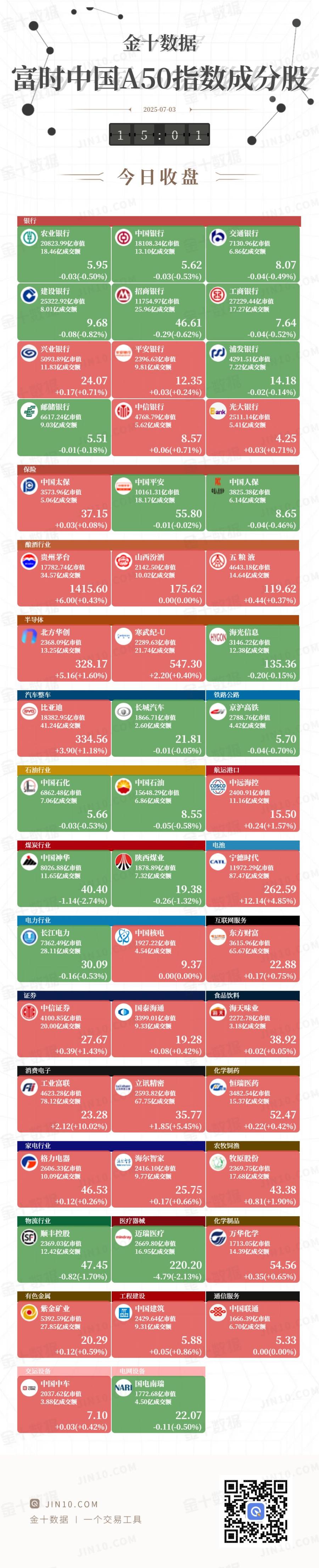
金十图示:2025年07月03日(周四)富时中国A50指数成分股今日收盘行情一览:证券、消费电子、家电等板块收高,石油、煤炭等板块收低,银行、保险等板块涨跌不一
news flash· 2025-07-03 07:05
富时中国A50指数连续 金十图示:2025年07月03日(周四)富时中国A50指数成分股今日收盘行情一览:证券、消费电子、家电等板块收高,石油、煤 炭等板块收低,银行、保险等板块涨跌不一 -0.01(-0.18%) +0.06(+0.71%) +0.03(+0.71%) 保险 中国太保 中国平安 12,000 中国人保 电机 3825.38亿市值 3573.96亿市值 10161.31亿市值 5.06亿成交额 18.17亿成交额 6.14亿成交额 55.80 37.15 8.65 +0.03(+0.08%) -0.01(-0.02%) -0.04(-0.46%) 酸酒行业 贵州茅台 五粮液 山内对酒 17782.74亿市值 2142.50亿市值 4643.18亿市值 34.57亿成交额 10.02亿成交额 14.64亿成交额 1415.60 175.62 119.62 +6.00(+0.43%) 0.00(0.00%) +0.44(+0.37%) 术学体 北方华创 寒武纪-U 海光信息 HYGON 2368.09亿市值 2289.63亿市值 3146.22亿市值 13.25亿成交额 21.74亿成交额 12. ...





★四部门召开科技金融工作交流推进会 加快构建科技金融体制 全方位支持科技创新
Shang Hai Zheng Quan Bao· 2025-07-03 01:56
Core Viewpoint - The meeting emphasized the need for a collaborative approach among financial management departments, technology sectors, and financial institutions to implement policies that support technological innovation and enhance the financial ecosystem for tech enterprises [1][2][3]. Group 1: Policy Implementation - The meeting focused on the characteristics of funding needs throughout the lifecycle of technology enterprises and discussed the utilization of various financial tools such as bank credit, technology insurance, capital markets, venture capital, and technology innovation bonds [1]. - Financial management and technology departments are urged to explore mechanisms that align with technological innovation, providing comprehensive support for early, small, long-term, and hard technology investments [2]. - The meeting highlighted the importance of enhancing the service capabilities of financial institutions to better cater to the needs of technology enterprises, including optimizing internal mechanisms and financial product systems [3]. Group 2: Financial Ecosystem Development - A proposal was made to establish a "technology board" in the bond market and utilize risk-sharing tools for technology innovation bonds to support equity investment institutions [2]. - The meeting called for the improvement of the financial ecosystem supporting technological innovation, including the promotion of an "innovation points system" and the establishment of a coordinated mechanism for technology finance [2]. - Financial institutions are encouraged to provide comprehensive financial services throughout the lifecycle of technology enterprises, enhancing their organizational structure, talent pool, and risk management systems [3]. Group 3: Industry Insights - Representatives from technology enterprises shared their experiences regarding financial support for growth, indicating that recent policies have boosted their confidence in achieving high-quality development [3]. - Financial institutions expressed their commitment to enhancing their service systems to support technological innovation and promote a virtuous cycle among technology, industry, and finance [3]. - The venture capital market faces structural issues such as funding shortages and mismatched investment durations, which technology innovation bonds are expected to address by broadening fundraising sources and stabilizing market expectations [5].



★从风险保障到融资活水 保险业双向赋能助力民营经济高质量发展
Zhong Guo Zheng Quan Bao· 2025-07-03 01:56
Core Viewpoint - The insurance industry plays a crucial role in supporting the development of the private economy by providing diversified risk protection and funding solutions, which is essential for both economic growth and the industry's own development [1][3]. Group 1: Product Innovation - The insurance industry is actively innovating products to meet the diverse insurance needs of private enterprises, including customized products like "Employee Welfare Insurance" for SMEs and specialized insurance for various sectors such as automotive repair and catering [2][3]. - Insurance companies are developing a comprehensive product service system tailored to the characteristics of different industries within the private economy, addressing their unique insurance demands [2][3]. Group 2: Support for Technological Innovation - Private enterprises are key players in technological innovation, but they face complex risks that require tailored insurance solutions throughout their lifecycle [3][4]. - Insurance companies are establishing a risk protection system for technology enterprises, including specialized insurance for first-time technology equipment and new materials, as well as knowledge property risk assessment models [3][4]. Group 3: Financial Support - Insurance funds provide long-term and stable financial support to private enterprises through equity and bond investments, helping to alleviate financing difficulties [5][6]. - Several insurance companies have initiated large-scale funds to support private enterprises in various sectors, including technology and health care, with significant capital commitments [5][6]. Group 4: Collaboration and Policy Support - The insurance industry is enhancing collaboration with government and banking sectors to create a "government-bank-insurance" model, facilitating resource allocation to private enterprises [6]. - The financial regulatory authority is promoting policies to support financing for small and private enterprises, aiming to stabilize the economy and enhance the overall financial ecosystem [6].
中国人保(601319) - H股公告
2025-07-02 09:15
I. 法定/註冊股本變動 | 1. 股份分類 | 普通股 | 股份類別 H | | | 於香港聯交所上市 (註1) | | 是 | | | --- | --- | --- | --- | --- | --- | --- | --- | --- | | 證券代號 (如上市) | 01339 | 說明 | | | | | | | | | | 法定/註冊股份數目 | | | 面值 | | 法定/註冊股本 | | | 上月底結存 | | | 8,726,234,000 | RMB | | 1 RMB | | 8,726,234,000 | | 增加 / 減少 (-) | | | 0 | | | RMB | | 0 | | 本月底結存 | | | 8,726,234,000 | RMB | | 1 RMB | | 8,726,234,000 | | 2. 股份分類 | 普通股 | 股份類別 | A | | | 於香港聯交所上市 (註1) | | 否 | | | --- | --- | --- | --- | --- | --- | --- | --- | --- | --- | | 證券代號 (如上市) | 60131 ...
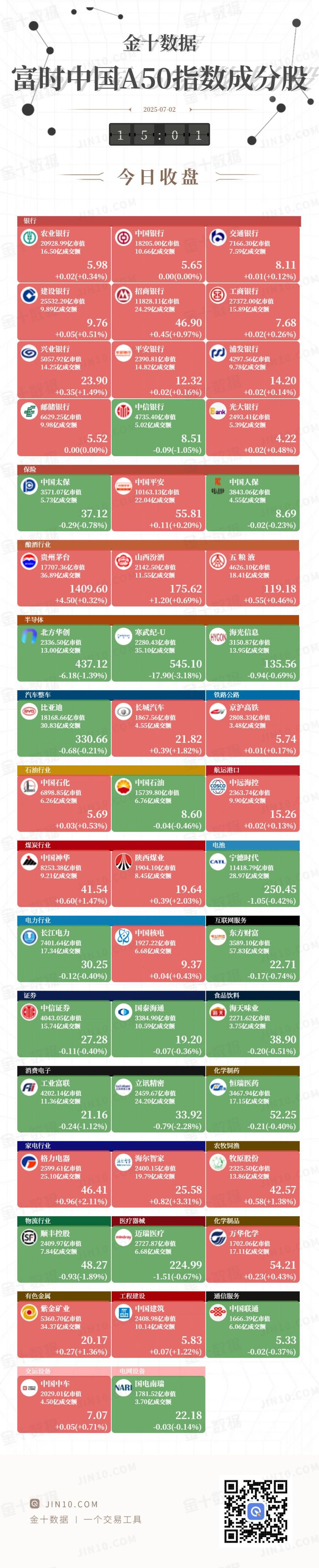
金十图示:2025年07月02日(周三)富时中国A50指数成分股今日收盘行情一览:家电、白酒、有色金属等板块收高,证券、消费电子、物流等板块收低
news flash· 2025-07-02 07:05
Market Overview - The FTSE China A50 Index components showed mixed performance with sectors like home appliances, liquor, and non-ferrous metals rising, while sectors such as securities, consumer electronics, and logistics declined [1]. Sector Performance Home Appliances - Gree Electric Appliances had a market capitalization of 259.96 billion, with a trading volume of 25.10 billion and an increase of 0.96 (+2.11%) [3]. - Haier Smart Home reported a market cap of 240.01 billion, with a trading volume of 19.79 billion and an increase of 0.82 (+3.31%) [3]. Liquor Industry - Kweichow Moutai had a market capitalization of 1,770.74 billion, with a trading volume of 36.89 billion and an increase of 4.50 (+0.32%) [3]. - Wuliangye Yibin reported a market cap of 214.25 billion, with a trading volume of 11.55 billion and an increase of 1.20 (+0.69%) [3]. Non-Ferrous Metals - The sector showed positive performance, contributing to the overall rise in the index [1]. Securities - CITIC Securities had a market capitalization of 404.30 billion, with a trading volume of 10.59 billion and a decrease of 0.11 (-0.40%) [4]. - Guotai Junan Securities reported a market cap of 338.49 billion, with a trading volume of 15.74 billion and a decrease of 0.07 (-0.36%) [4]. Consumer Electronics - Industrial Fulian had a market cap of 420.21 billion, with a trading volume of 24.20 billion and a decrease of 0.24 (-1.12%) [4]. - Luxshare Precision reported a market cap of 245.97 billion, with a trading volume of 17.15 billion and a decrease of 0.79 (-2.28%) [4]. Logistics - SF Holding had a market capitalization of 272.79 billion, with a trading volume of 17.11 billion and a decrease of 1.51 (-0.67%) [4]. Energy Sector - China Shenhua Energy had a market cap of 190.41 billion, with a trading volume of 8.45 billion and an increase of 0.60 (+1.47%) [3]. - China Petroleum & Chemical Corporation reported a market cap of 1,573.98 billion, with a trading volume of 6.26 billion and a decrease of 0.04 (-0.46%) [3].



在风雨中筑起“金融屏障” 福建金融系统全力支持灾后重建
Jin Rong Shi Bao· 2025-07-02 01:55
Group 1 - Typhoon "Doksuri" made landfall in Fujian on July 28, 2023, causing severe damage with approximately 2.67 million people affected and direct economic losses of 14.755 billion yuan [1] - The financial system in Fujian has been proactive in disaster response, providing timely financial services to affected communities [1][2] Group 2 - Jinjiang Rural Commercial Bank launched a special credit loan product called "Jinqing Assistance Loan" with a total quota of 800 million yuan, offering interest subsidies to support small and medium-sized enterprises affected by the typhoon [2] - Within a month after the typhoon, Jinjiang Rural Commercial Bank issued nearly 50 million yuan in "Jinqing Assistance Loans" to support local businesses [2] Group 3 - Zhangzhou Rural Commercial Bank provided a 1.7 million yuan no-repayment loan to a fish farming company affected by the typhoon, helping them resume operations [3] - The People's Bank of China (PBOC) in Fujian increased support for disaster recovery by implementing policies to guide local financial institutions in providing credit support for recovery efforts [3] Group 4 - Agricultural Bank of China in Xiamen expedited the payment of wages for 532 migrant workers on the day of the typhoon's landfall, ensuring timely salary disbursement despite adverse conditions [4] - China Merchants Bank in Quanzhou facilitated a cross-border payment of over 51 million USD for a chemical company facing operational challenges due to the typhoon [4] Group 5 - The PBOC in Fujian emphasized the importance of disaster prevention and response, urging financial institutions to strengthen risk management and ensure service continuity during the typhoon [5][6] - The PBOC also opened a green channel for disaster relief fund transfers, allocating 100 million yuan to severely affected areas [6] Group 6 - Financial institutions in Fujian utilized data-driven approaches to identify and assist affected clients, providing tailored credit support to those facing repayment difficulties [7] - Affected financial credit villages received targeted assistance, with 75,000 yuan in credit support provided to 10 households in a disaster-hit village [7] Group 7 - Insurance companies in Xiamen quickly processed claims for disaster insurance, with the first claim payment made within hours of the typhoon's impact [8][9] - The Xiamen government implemented a catastrophe insurance program to support disaster relief efforts, with over 200 claims processed during the typhoon [9]


【年度课题】基于巨灾债券的地方特色农产品保险风险分散机制研究
Sou Hu Cai Jing· 2025-07-02 01:48
Core Viewpoint - The article discusses the challenges and opportunities in the insurance of local specialty agricultural products, emphasizing the potential of catastrophe bonds as a solution to enhance risk management and financial sustainability in this sector [2][3][9]. Group 1: Challenges in Specialty Agricultural Insurance - The local specialty agricultural products industry is increasingly important for rural economic development and farmer income, but it faces significant risks due to climate change, with annual loss rates reaching 12%-15% [2]. - Traditional insurance models are struggling with high payout rates and low coverage, exemplified by Hebei Province's insurance payout rate of 97% in 2022, and certain products like soybean insurance reaching 172% [2][4]. - The unique risk attributes of specialty agricultural products include strong geographic dependence, high market sensitivity, and ecological vulnerability, leading to a national insurance participation rate of only 42% [4]. Group 2: Catastrophe Bonds as a Solution - Catastrophe bonds connect the insurance market with capital markets, offering a new approach to address the "cold supply and demand" issue in specialty agricultural insurance [3][5]. - The introduction of catastrophe bonds could reduce expected payouts for insurance companies by 20%-30%, potentially lowering pure premium rates by 15%-25% [5]. - The research focuses on optimizing risk dispersion efficiency through catastrophe bonds, analyzing different regional specialty industries, and exploring the synergy between policy support and capital markets [5][6]. Group 3: International Comparisons and Local Practices - International experiences from the U.S., Japan, and Canada provide valuable insights into agricultural catastrophe risk dispersion models, highlighting the importance of policy collaboration and innovative tools [6]. - Local case studies, such as the Ningxia goji berry and Sichuan wheat industries, demonstrate effective implementation of catastrophe bonds, significantly improving risk coverage and financial efficiency [8][9]. - The research indicates that catastrophe bonds can enhance fiscal subsidy efficiency by 40%-80% and reduce insurance company cost ratios by 20%-30% [9]. Group 4: Policy Recommendations - Recommendations include constructing a multi-layered risk dispersion system, improving risk dispersion mechanisms to lower insurance premiums, and promoting the application of catastrophe bonds [9]. - Emphasis is placed on institutional innovation and technological empowerment to enhance risk governance effectiveness, including establishing collaborative mechanisms between insurance and industry [9].

中国人民保险集团(01339) - 2024 Q4 - 电话会议演示
2025-07-01 12:41
Financial Performance Highlights - The group's insurance revenue reached RMB 537709 million, a 67% increase compared to 2023[103, 104] - Net profit attributable to equity holders of the company increased by 888% to RMB 42151 million[20, 104] - Total investment income increased significantly by 862% to RMB 822 billion[41, 87] - The group's total assets increased by 135% to RMB 1766321 million[26, 104] - The annual cash dividend per share increased by 154% to RMB 0180[28] Segment Performance - PICC P&C's insurance revenue increased by 61% to RMB 485223 million[103, 104] - PICC Life's insurance revenue increased by 230% to RMB 22384 million[103, 104] - PICC Health's insurance revenue increased by 62% to RMB 27217 million[103, 104] Key Initiatives and Innovation - Green insurance provided risk protection of RMB 184 trillion[33, 53] - Technology insurance provided risk protection of RMB 31 trillion[33] - Premiums from products dedicated to technological activities increased by 180%[65]
蚂蚁金服概念下跌1.72%,主力资金净流出62股
Zheng Quan Shi Bao Wang· 2025-07-01 10:25
Group 1 - Ant Group concept declined by 1.72%, ranking among the top declines in the concept sector, with stocks like Jida Zhengyuan and Cuiwei Co. hitting the limit down [1][2] - Major stocks in the Ant Group concept saw significant net outflows, totaling 4.616 billion yuan, with 62 stocks experiencing outflows, and 12 stocks seeing outflows exceeding 100 million yuan [2][3] - The top net outflow stock was Hengsheng Electronics, with a net outflow of 659 million yuan, followed by Cuiwei Co. and Lakala with outflows of 607 million yuan and 548 million yuan respectively [2][3] Group 2 - Among the stocks in the Ant Group concept, 21 stocks experienced price increases, with Anni Co. leading with a 10% increase, followed by ST Gaohong and Jingneng Electric Power with increases of 4.92% and 4.45% respectively [1][4] - The overall market sentiment reflected a mixed performance across various concept sectors, with the top gainers including the China Shipbuilding System and Cell Immunotherapy, while sectors like Digital Currency and Ant Group concept faced declines [2][4] - The trading volume and turnover rates varied significantly among the stocks, with Hengsheng Electronics showing a turnover rate of 5.35% and a price decline of 4.32% [3]