
NCI(601336)

Search documents
25H1上市险企人身险成本盘点:新单成本平均同比下降 65bps
Huachuang Securities· 2025-09-04 07:43
Investment Rating - The industry investment rating is "Recommended" with expectations of exceeding the benchmark index by more than 5% in the next 3-6 months [24]. Core Insights - The average new business cost for listed insurance companies has decreased by 65 basis points year-on-year as of H1 2025, driven by adjustments in preset interest rates and the integration of individual insurance channels [2][12]. - The VIF breakeven yield for listed insurance companies is estimated to be in the range of 2.21% to 3.39%, while the NBV breakeven yield is between 1.5% and 2.89% [2]. - The report indicates that the quality of liability management in the insurance industry is gradually improving, with a potential slowdown in the speed of convergence of "interest spread gains" [12]. Summary by Sections New Business Cost Analysis - The average new business cost for listed insurance companies has shown a significant decline, with a decrease of 61 basis points quarter-on-quarter and 65 basis points year-on-year [2]. - The report anticipates that as new business continues to flow in, the existing cost may trend downward [2]. Breakeven Yield Metrics - The VIF breakeven yield for major insurance companies is as follows: China Life (2.43%), Ping An (2.51%), China Pacific (2.21%), New China Life (3.00%), China Re (3.39%), and Sunshine Insurance (2.80%) [3][10]. - The NBV breakeven yield for the same companies is: China Life (1.50%), Ping An (1.73%), China Pacific (1.76%), New China Life (2.68%), China Re (2.89%), and Sunshine Insurance (2.30%) [11]. Investment Recommendations - The report recommends the following order of preference for investment: China Pacific Insurance, China Life H, China Re H, and Sunshine Insurance H. If the equity market continues to outperform expectations, New China Life H is also recommended; if there are signs of recovery in the real estate sector, Ping An is recommended [12].



新华保险股价连续4天下跌累计跌幅7.96%,鹏华基金旗下1只基金持6.7万股,浮亏损失36.38万元
Xin Lang Cai Jing· 2025-09-04 07:36
Core Viewpoint - Xinhua Insurance has experienced a decline in stock price, with a cumulative drop of 7.96% over the past four days, reflecting market volatility and potential investor concerns [1][2]. Company Overview - Xinhua Life Insurance Co., Ltd. was established on September 28, 1996, and listed on December 16, 2011. The company is headquartered in Beijing and primarily engages in life insurance business [1]. - The revenue composition of Xinhua Insurance includes traditional insurance at 59.47%, dividend insurance at 35.37%, and other businesses at 5.89% [1]. Fund Holdings - Penghua Fund has a significant position in Xinhua Insurance, with its Penghua Research Selected Mixed Fund (007146) holding 67,000 shares, unchanged from the previous period, representing 1.22% of the fund's net value [2]. - The fund has incurred a floating loss of approximately 38,900 yuan today, with a total floating loss of 363,800 yuan during the four-day decline [2]. - The Penghua Research Selected Mixed Fund was established on May 6, 2019, with a current size of 321 million yuan. It has achieved a year-to-date return of 30.84% and a one-year return of 50.95% [2].

资负联动显效 新华保险长期分红险首年保费增超2000倍
Zhong Guo Jing Ying Bao· 2025-09-04 05:25
Core Insights - The core viewpoint of the article emphasizes that Xinhua Insurance is in a significant opportunity period during the "14th Five-Year Plan" and aims to enhance its "insurance + investment + service" collaborative development model while focusing on cost control and maintaining growth in intrinsic value [1] Financial Performance - In the first half of the year, Xinhua Insurance achieved original insurance premium income of 121.26 billion yuan, a year-on-year increase of 22.7% [1] - New business value reached 6.182 billion yuan, growing by 58.4% year-on-year [1] - Total assets amounted to approximately 1.78 trillion yuan, reflecting a 5% increase compared to the end of the previous year [1] - Net profit attributable to shareholders was 14.8 billion yuan, up 33.5% year-on-year [1] - The company plans to distribute a mid-term cash dividend of 0.67 yuan per share, totaling approximately 2.09 billion yuan, which accounts for 14.1% of the net profit attributable to shareholders for the first half of 2025 [1] Business Segments - The intrinsic value of Xinhua Insurance reached 279.39 billion yuan, an 8.1% increase from the end of the previous year [2] - Premium income from long-term insurance first-year premiums was 39.62 billion yuan, a significant increase of 113.1% [2] - The individual insurance channel generated premium income of 72.53 billion yuan, a 5.5% year-on-year increase [2] - The bancassurance channel achieved premium income of 46.2 billion yuan, a 65.1% increase, with long-term insurance first-year premiums growing by 150.3% [3] Product Strategy - Traditional insurance premiums reached 74.30 billion yuan, a 36.2% increase, with dividend insurance premiums growing by 24.9% to 18.27 billion yuan [4] - The company has established a dynamic adjustment mechanism for product preset interest rates to enhance product competitiveness [4] - New business value is a crucial indicator of business quality and sustainability, with a continued high performance in the first half of the year [5] Service Ecosystem - Xinhua Insurance has significantly invested in the elderly care finance sector, with an investment balance of 16.1 billion yuan, a 290% increase [6] - The company has established 40 quality elderly care communities across 28 cities, providing integrated services for health, living, and travel [6] - Nearly 15,000 customers have gained access to elderly care community rights, generating nearly 20 billion yuan in premiums [6] Strategic Focus - The company is committed to high-quality development through value growth, structural optimization, and quality enhancement [7]
遵义金融监管分局同意新华人寿遵义中心支公司仁怀支公司变更营业场所
Jin Tou Wang· 2025-09-04 03:41
Core Viewpoint - The Zunyi Financial Regulatory Bureau approved the request from New China Life Insurance Co., Ltd. Zunyi Branch to change the business location of its Renhuai Branch [1] Group 1 - New China Life Insurance Co., Ltd. Renhuai Branch will relocate its business premises to a new address in Guizhou Province, Zunyi City, Renhuai City, Yanjin Street Office, Guojucheng, Jiubohui, Building 2, Units 2-1, 2-3, 3-8, 3-9, and 3-30, 3-31 [1] - The company is required to handle the change and obtain new permits in accordance with relevant regulations [1]
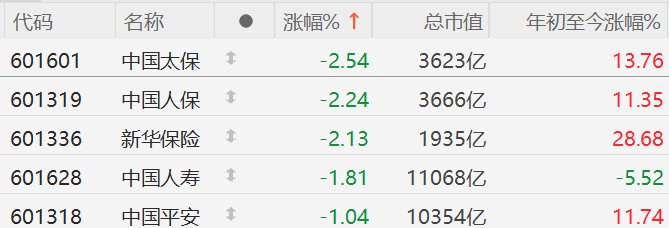
A股保险股普跌,中国太保、中国人保跌超2%
Ge Long Hui A P P· 2025-09-04 03:25
Core Viewpoint - The A-share market has seen a general decline in insurance stocks, with major companies experiencing significant drops in their stock prices [1] Group 1: Stock Performance - China Pacific Insurance (601601) decreased by 2.54%, with a total market capitalization of 362.3 billion and a year-to-date increase of 13.76% [2] - China Insurance (601319) fell by 2.24%, holding a market cap of 366.6 billion and a year-to-date increase of 11.35% [2] - New China Life Insurance (601336) dropped by 2.13%, with a market capitalization of 193.5 billion and a year-to-date increase of 28.68% [2] - China Life Insurance (601628) saw a decline of 1.81%, with a market cap of 1,106.8 billion and a year-to-date decrease of 5.52% [2] - Ping An Insurance (601318) decreased by 1.04%, with a market capitalization of 1,035.4 billion and a year-to-date increase of 11.74% [2] Group 2: Market Signals - A MACD golden cross signal has formed, indicating potential upward momentum for some stocks in the insurance sector [2]


五大险企上半年投资成绩:股票配置“乘势跃升”,规模增长近29%
Huan Qiu Wang· 2025-09-04 01:51
Core Viewpoint - The five major listed insurance companies in China reported significant growth in their investment portfolios and stock allocations as of June 30, 2025, reflecting a strategic shift towards long-term capital investment in equities [1][2][4]. Investment Performance - As of June 30, 2025, the total investment of the five major insurance companies reached 19.72 trillion yuan, a 7.52% increase from 18.34 trillion yuan at the end of 2024 [1]. - The total stock investment by these companies amounted to 1.846429 trillion yuan, marking a 28.71% increase from 1.434571 trillion yuan at the end of 2024 [2]. - China Ping An's stock investment reached 649.29 billion yuan, up 48.45% year-on-year, with a stock allocation ratio of 12.6% [2]. - China Life's equity financial assets accounted for 20% of its total investments, with stock and fund allocations of 620.14 billion yuan and 350.70 billion yuan, respectively [3]. Strategic Asset Allocation - Insurance companies are increasingly focusing on high-dividend value stocks and growth sectors such as technology and advanced manufacturing [4][6]. - The investment strategy emphasizes a balanced approach, maintaining a low duration gap between assets and liabilities while optimizing equity allocation [6][7]. - China Pacific Insurance is increasing its allocation to long-term interest rate bonds and innovative quality assets, including ABS and public REITs [7]. Market Response and Challenges - The insurance sector is responding to market volatility by employing strategies such as OCI accounts and FVOCI accounting classifications to mitigate the impact of market fluctuations on profits [4][8]. - Challenges include market volatility affecting solvency, accounting mismatches under new financial instrument standards, liquidity management, and the need for enhanced research capabilities in selecting high-dividend and growth stocks [8].
以股息补票息 险企增配权益资产 每年入市增量资金或超6000亿元
Zhong Guo Jin Rong Xin Xi Wang· 2025-09-04 00:38
Core Viewpoint - The A-share insurance sector is increasing its equity asset allocation in response to low interest rates and asset scarcity, with a projected annual increase of over 600 billion yuan in equity investments over the next three years [1][7]. Group 1: Performance of Major Insurance Companies - Four out of five major listed insurance companies reported year-on-year growth in net profit for the first half of 2025, with notable increases from Xinhua Insurance (33.5% to 14.8 billion yuan), China Pacific Insurance (11% to 27.9 billion yuan), and China Life (6.9% to 40.9 billion yuan) [1][2]. - Xinhua Insurance achieved a remarkable 1842% increase in investment income, reaching 18.76 billion yuan, primarily due to increased capital gains from asset sales [2]. Group 2: Asset Allocation Trends - All five major insurance companies increased their stock investment ratios, with China Ping An's stock investment ratio rising by 2.9 percentage points to 10.5%, and Xinhua Insurance's increasing by 1.4 percentage points to 11.6% [2][3]. - The overall stock and fund allocation ratio for listed insurance companies increased by 1.3 percentage points to 13.9%, with a total increase of nearly 480 billion yuan in allocation [3]. Group 3: Future Investment Strategies - Insurance companies are focusing on high-dividend stocks and growth sectors for future investments, with expectations of a stable increase in equity allocations [6][7]. - China Life and China Ping An expressed optimism about the A-share market, emphasizing the importance of high-dividend stocks and sectors representing new productive forces [6][7]. Group 4: Market Conditions and Challenges - Despite the increased allocation to equity assets, the average net investment yield for listed insurance companies fell to 3.0%, approaching the rigid liability cost of around 3% [4][5]. - The demand for long-term stable yield assets is rising due to the characteristics of liabilities and the pressure from low interest rates [5][7].
73家人身险公司上半年合计实现净利润1858亿
Zheng Quan Ri Bao· 2025-09-04 00:14
Core Insights - The life insurance industry in China has shown a significant recovery in net profits for the first half of the year, driven by business structure optimization, cost reduction measures, and improved investment returns [1][3]. Group 1: Profitability Overview - As of September 3, 73 life insurance companies reported a total net profit of 185.8 billion yuan, representing a year-on-year increase of approximately 25% [2][6]. - Out of these, 52 companies were profitable, collectively earning 190.08 billion yuan, while 21 companies reported losses totaling 4.27 billion yuan [2][3]. - Major profitable companies included Ping An Life, China Life, and China Pacific Life, each exceeding 10 billion yuan in net profit, with Ping An Life leading at 50.6 billion yuan [2][4]. Group 2: Losses and Challenges - The company with the highest loss was Hengqin Life, with a loss of 839 million yuan, followed by Bank of China Samsung Life and Aixin Life with losses of 543 million yuan and 384 million yuan, respectively [3][4]. - The competitive landscape is increasingly challenging for smaller insurance companies, which struggle against larger firms in terms of brand, capital, distribution channels, and talent [5][6]. Group 3: Strategic Adjustments - Companies are adjusting product pricing and business structures, including lowering product preset interest rates and promoting the transformation of dividend-type products, which has effectively reduced rigid liability costs [3][4]. - New business value has improved due to proactive optimization of business structures and cost reduction initiatives, with first-year premium income from regular premium products increasing by 25.5% year-on-year [4][5]. Group 4: Market Trends and Future Outlook - The "Matthew Effect" is evident, with the top seven life insurance companies accounting for over 80% of the industry's total net profit [5][6]. - Analysts expect continued improvement in the insurance industry's liability side, with a recovery in asset performance anticipated as macroeconomic conditions improve [6].
发挥长钱长投优势险资系私募偏好大蓝筹
Zhong Guo Zheng Quan Bao· 2025-09-03 22:42
Group 1 - A new insurance-funded private equity firm, Hengyi Chiying (Shenzhen) Private Fund Management Co., Ltd., has completed registration with an initial fund size of 30 billion yuan [1] - The total number of insurance-funded private equity firms has reached seven, with a combined trial amount of 222 billion yuan [1][2] - The investment strategy of these firms is focused on long-term and value investments, favoring leading companies in energy and infrastructure sectors such as China Petroleum, China Shenhua, and Daqin Railway [1][4] Group 2 - The first batch of insurance capital long-term investment reforms was approved in October 2023, with China Life and Xinhua Insurance each contributing 25 billion yuan to establish a 50 billion yuan company fund [2] - As of now, six insurance-funded private equity securities investment funds are operational, with significant holdings in major companies [2][3] - The Honghu Zhiyuan Fund has become a major shareholder in China Petroleum and China Shenhua, with holdings valued at approximately 1.857 billion yuan and 2.116 billion yuan respectively [2][3] Group 3 - The Honghu Zhiyuan series of funds emphasizes a long-term investment approach, focusing on stable dividend yields through low-frequency trading and long-term holding [4] - The total assets of the Honghu Zhiyuan Fund I reached 57.112 billion yuan, with a net profit of 9.68 billion yuan in the first half of the year [3][4] - Insurance companies are establishing private equity funds to leverage their long-term investment advantages, supporting the capital market and promoting stable, sustainable investment returns [4]






今年上半年多家险企银保新业务价值同比翻倍 重新站上“C位”,银保渠道何以狂飙?
Mei Ri Jing Ji Xin Wen· 2025-09-03 19:22
Core Viewpoint - The insurance industry is transitioning from a focus on short-term and lump-sum sales to a high-quality development era, driven by regulatory changes and a shift in product structure towards long-term and protection-oriented products [1][2][5]. Group 1: Industry Trends - The "reporting and operation integration" policy has led to a significant reduction in commissions, resulting in a high growth rate of new business value in the bancassurance channel in 2024 and 2025 [1][2]. - Major insurance companies reported substantial increases in new business value from bancassurance channels in the first half of 2025, with Ping An Life at 5.972 billion yuan (up 168.6%), Taikang Life at 3.604 billion yuan (up 155.97%), and Xinhua Insurance at 3.267 billion yuan (up 137.08%) [1][3]. Group 2: Company Strategies - Xinhua Insurance's bancassurance channel achieved a first-year premium of 24.939 billion yuan (up 150.3%), with a focus on long-term products and a strategic emphasis on balancing scale and value [2][3]. - Ping An Life's bancassurance channel reported new business premiums of 22.875 billion yuan (up 74.67%), with a significant contribution from regular premium products [3]. - Taikang Life's bancassurance channel achieved a scale premium of 41.660 billion yuan (up 82.6%), with a new business value contribution of 3.604 billion yuan [3]. Group 3: Market Potential - The bancassurance channel has significant growth potential, with only 3% to 5% of bank customers currently purchasing insurance, indicating a large untapped market [6]. - The demand for insurance products is evolving, with increasing needs for health and retirement products driven by an aging population and diverse customer requirements [5][6]. Group 4: Collaboration and Service Enhancement - The bancassurance model is undergoing a transformation from a simple distribution model to a more integrated approach, focusing on customer needs and enhancing service capabilities [8][9]. - Major companies are expanding their bancassurance networks and improving collaboration with banks to enhance service delivery and customer experience [9][10].