ICBC(601398)

Search documents
“AI+金融”系列专题研究(一):行业拐点已至,金融是AI应用落地的绝佳“试验田”
Haitong Securities International· 2025-11-18 07:25
Investment Rating - The report suggests a positive investment outlook for the financial industry, highlighting its strong alignment with AI application and digital transformation needs [3][7]. Core Insights - The financial industry is identified as an ideal "testing ground" for AI applications due to its data-intensive nature and the increasing demand for digital transformation [1][7]. - The release of DeepSeek R1 in 2025 is anticipated to be a pivotal moment for local AI deployment in financial institutions, enhancing model reasoning capabilities and reducing costs [3][7]. - AI applications are rapidly penetrating core business areas and back-office functions within various financial institutions, with the potential to reshape business processes and organizational structures [3][7]. Summary by Sections Investment Recommendations - The report emphasizes the financial sector's need for digital transformation, which aligns well with the characteristics of large models in AI. It predicts a shift from "digital intelligence" to "artificial intelligence" in financial institutions [7]. - Key areas to focus on include: 1. Financial information services with relevant companies like Tonghuashun, Jiufang Zhitu Holdings, and Guiding Compass [8]. 2. Third-party payment services, particularly New大陆 and New国都, with related companies like Lakala [9]. 3. Bank IT, focusing on companies such as Yuxin Technology, Jingbeifang, and Guodian Yuntong [9]. 4. Securities IT, with a focus on companies like Hengsheng Electronics and Jinzhen Shares [10]. 5. Insurance IT, highlighting companies like Newzhisoft and Zhongke Soft [11]. Industry Drivers and Policy Support - The report discusses the strong internal and external drivers for AI application in finance, including the continuous expansion of IT spending by financial institutions and supportive government policies [14][25]. - The maturity of large model technology and its alignment with the financial industry's needs are emphasized, indicating a shift towards industry adaptation [14][18]. Technical Aspects - The report outlines two main technical paths for AI integration in finance: general models trained with financial data and specialized financial models [36]. - DeepSeek R1 is highlighted as a significant advancement in AI deployment for financial institutions, offering enhanced reasoning capabilities and cost efficiency [45][52]. - The report notes that the performance of DeepSeek R1 has improved significantly, with accuracy rates in complex reasoning tasks rising from 70% to 87.5% after updates [48]. Market Trends - The financial sector's technology investment is projected to grow significantly, with a total expected investment of 650 billion yuan by 2028, reflecting a compound annual growth rate of approximately 13.3% [25][31]. - The report indicates a notable increase in AI-related procurement projects within the financial sector, with 133 large model projects initiated in 2024 alone [27][35].




银行业投资策略:中期分红抢筹行情尾声阶段如何布局?
Guoxin Securities· 2025-11-18 05:12
Core Viewpoints - The mid-term dividend rush in the banking sector is nearing its end but is not yet finished, potentially extending until the end of November [4][11][26] - The four major banks have announced mid-term dividends earlier this year compared to last year, with the record date for dividends set for mid-December, which is nearly one month earlier than last year [7][11] - The recent rise in the banking sector is primarily driven by changes in market investment style, with mid-term dividends acting as a catalyst [4][11][26] Investment Strategy Post-Dividend Rush - After the mid-term dividend rush, the banking sector may experience short-term fluctuations, but it is unlikely that the overall trend has ended [5][14][26] - There are expected investment opportunities in the banking sector before the main spring rally is identified, suggesting that investors should overlook short-term volatility [5][16][26] - The demand for insurance funds and the need for asset allocation in a low-interest-rate environment make stable bank stocks attractive [5][16][26] Stock Selection Recommendations - Focus on high-dividend, fundamentally strong stocks in the short term, while also considering quality stocks for potential upside [6][26] - Recommended stocks include Industrial and Commercial Bank of China and China Merchants Bank for their stability, as well as Ningbo Bank and Chongqing Bank for their upward momentum [6][26] - Low-valuation banks such as Changsha Bank and Chongqing Rural Commercial Bank are also suggested for consideration [6][26] Market Performance Insights - The banking index has shown a cumulative increase of 7.7% from October 14 to November 14, 2025, with individual banks like ICBC and ABC showing significant gains [11][26] - The cumulative gains of the four major banks from December 2024 were 12.5%, 11.0%, 10.2%, and 10.0%, respectively, indicating a strong performance leading into the new year [7][11] Fundamental Analysis - The banking sector's fundamentals are expected to stabilize, with net interest margins showing signs of improvement [23][26] - The asset quality of listed banks is at its best level in recent years, with retail non-performing loans gradually being cleared [23][26]



行业深度报告:2025Q4上市银行AC潜在兑现及回补债券评估
KAIYUAN SECURITIES· 2025-11-18 05:10
Investment Rating - The industry investment rating is optimistic (maintained) [1] Core Insights - The report highlights that listed banks have sold approximately 2 trillion yuan in bonds to realize floating profits from their available-for-sale (AC) accounts in the first three quarters of 2025 [13] - It is estimated that in Q4 2025, listed banks will need to sell about 900 billion yuan in bonds to support non-interest income [10] - The cumulative floating profit of listed banks' AC accounts is approximately 3.3 trillion yuan as of the end of H1 2025, accounting for 58.3% of the total revenue for the year 2024 [30] Summary by Sections Investment Growth - Since 2024, the investment growth rate of listed banks' AC accounts has consistently lagged behind the growth rate of financial investments, with a year-on-year growth of 11.5% in Q3 2025, which is 4.28 percentage points lower than that of financial investments [13][15] - The growth rates for different types of banks from Q2 2023 to Q2 2025 are as follows: state-owned banks 14.7%, joint-stock banks 2.8%, city commercial banks 9.7%, and rural commercial banks -3.8% [13] Bond Selling and Profit Realization - The report estimates that the floating profit realization ratio for listed banks' AC accounts in the first three quarters of 2025 is about 3.06%, with a bond selling scale of approximately 2.04 trillion yuan [36] - The selling proportions for different bank types are: state-owned banks 2.26%, joint-stock banks 5.29%, city commercial banks 5.57%, and rural commercial banks 9.65%, with rural commercial banks showing the highest selling intensity [36] Financial Performance - The floating profit from the sale of bonds in the first three quarters of 2025 is estimated to be 1,078 billion yuan, which represents 2.50% of the total revenue, an increase of 1.59 percentage points compared to 2024 [22][25] - The breakdown of floating profit realization ratios by bank type is as follows: state-owned banks 2.24%, joint-stock banks 2.44%, city commercial banks 3.79%, and rural commercial banks 5.52% [22] Investment Recommendations - The report suggests a bottom-line allocation to large state-owned banks, with beneficiaries including Agricultural Bank of China and Industrial and Commercial Bank of China [6] - Core allocations should focus on leading comprehensive banks such as China Merchants Bank, CITIC Bank, and Industrial Bank [6] - Flexible allocations can be made to banks like Jiangsu Bank, Chongqing Bank, and Chongqing Rural Commercial Bank [6]




粤港澳融合发展“金”彩纷呈
Jin Rong Shi Bao· 2025-11-18 05:10
Group 1: Event Overview - The 15th National Games, a large-scale comprehensive event, is jointly hosted by Guangdong, Hong Kong, and Macau for the first time, showcasing regional collaboration and cultural integration [1][2] - The event enhances the synergy of the Greater Bay Area, transitioning from "hard connectivity" to "soft connectivity" and "heart connectivity" [1] Group 2: Financial Services and Innovations - Financial institutions from the three regions have collaborated to provide seamless financial services for participants and spectators, including optimized cross-border payment solutions [2] - The Bank of China Macau branch led the issuance of 2.5 billion RMB offshore local government bonds to support the event, with 1.5 billion RMB specifically allocated for the Games and related infrastructure [3] Group 3: Economic Impact and Consumer Behavior - The "ticket root economy" has emerged, allowing event tickets to be used for various tourism and cultural experiences, driving consumer spending [4][5] - Banks are leveraging the event to extend financial services across various sectors, including dining, travel, and retail, with promotional activities to stimulate consumption [6] Group 4: Merchandise and Consumer Trends - The event's mascots have gained significant popularity, leading to a surge in sales of related merchandise, with total sales reaching 680 million RMB by November 15 [7][8] - The event has significantly boosted tourism and retail activity in the Greater Bay Area, with increased searches for transportation, accommodation, and attractions [8]
险资持续加仓红利资产!标普红利ETF(562060)连续吸金超1.2亿元
Xin Lang Ji Jin· 2025-11-18 03:31
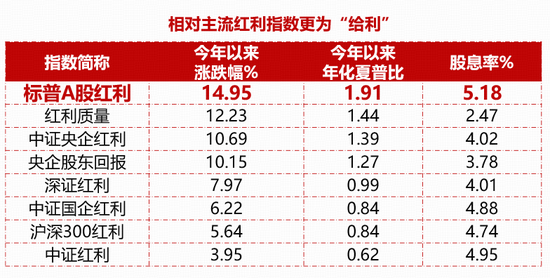
Group 1 - Insurance capital has significantly increased its holdings in the stock market, with a total of 732 listed companies held, amounting to approximately 1,011.3 million shares, an increase of 120.25 million shares from the previous quarter [1] - The preference for high dividend and low valuation stocks is particularly notable, with significant increases in holdings for companies like Agricultural Bank of China, Postal Savings Bank, Industrial and Commercial Bank of China, and Hualing Steel [1] - Insurance capital has expanded its investments in sectors such as banking, steel, real estate, media, and automotive, showing a sustained interest in dividend-paying assets [1] Group 2 - The "slow bull" market in A-shares is positively influencing the investment ecosystem of insurance capital, with a focus on high dividend assets reflecting a pursuit of stable returns and long-term investment value recognition [2] - The S&P China A-Share Dividend Opportunities Index, which tracks 100 high dividend companies, has a current dividend yield of 5.18%, with a yield spread of 3.37 percentage points over the latest 10-year government bond yield [2] - The S&P A-Share Dividend Index has outperformed similar dividend indices this year, with a return of nearly 15% and an annualized Sharpe ratio of 1.91, indicating significant advantages [2][3] Group 3 - The S&P Dividend ETF (562060) has been included as a financing and securities lending target, enhancing trading strategies and liquidity, with an average trading volume of 49.38 million yuan over the last three trading days [4] - Recent market volatility has led to increased capital inflow into the S&P Dividend ETF, with a net inflow of 7.565 million yuan over five days and a total of over 120 million yuan in the last ten days [4] Group 4 - In the context of increasing macroeconomic uncertainty and pressure on fixed-income asset yields, dividend assets are becoming a crucial "defensive shield" and a "ballast" for returns [5] - As the domestic economy transitions to a high-quality development phase, the market's pricing focus is shifting from growth expectations to dividend returns, aligning with trends in mature markets [5] - The long-term allocation of capital and policy support for dividends are establishing a solid foundation for the sustainability of dividend strategies [5] Group 5 - The S&P A-Share Dividend Total Return Index has achieved a cumulative return of 2,596.59% from 2005 to September 2025, with an annualized return of 17.64% [7] - The market may be entering a consolidation phase after the overheated trading in the computing power sector, making the S&P Dividend ETF a valuable asset for a balanced investment strategy [7]



两只大牛股 停牌核查!
Zhong Guo Zheng Quan Bao· 2025-11-17 23:29
Core Insights - The news highlights significant developments in various companies and industries, including stock trading suspensions, major asset restructurings, and regulatory reforms in the cosmetics sector. Company News - Pingtan Development announced a stock price increase of 255.19% from October 17 to November 17, leading to a trading suspension for verification due to significant deviation from the company's fundamentals [6] - Haixia Innovation's stock rose by 185.89% during the same period, prompting a similar trading suspension for verification [6] - Zhu Min Group plans to sell 100% equity of its Gree Real Estate to Tuo Jie Holdings for 5.518 billion yuan, marking a significant asset restructuring to focus on its core duty-free business [7] - Yaxing Chemical disclosed a plan to acquire 100% of Shandong Tianyi Chemical, introducing new fine chemical products and marking a major asset restructuring [8] - Industrial and Commercial Bank of China announced the full redemption of 900 billion yuan in 10-year subordinated bonds, exercising its redemption option [8] - Contemporary Amperex Technology Co., Ltd. (CATL) reported a planned transfer of 45.6324 million shares by shareholder Huang Shilin at a price of 376.12 yuan per share, representing a 3.75% discount [8] - Xiaopeng Motors reported Q3 revenue of 20.38 billion yuan, a year-on-year increase of 101.8%, with a narrowed net loss of 380 million yuan [8] - Jiarong Technology is planning to acquire all shares of Hangzhou Lanran Technology, which may constitute a major asset restructuring [8] Industry News - The National Medical Products Administration released guidelines for cosmetic regulation reform, aiming for a more robust regulatory framework by 2030 and achieving international standards by 2035 [1] - The State Administration of Foreign Exchange reported that in October, banks settled 1.5194 trillion yuan and sold 1.394 trillion yuan, with cumulative settlements of 14.7941 trillion yuan and sales of 14.2201 trillion yuan from January to October [2] - The Ministry of Finance reported a 29.5% year-on-year increase in stamp duty revenue, with securities transaction stamp duty rising by 88.1% [3] - A joint notice from the Ministry of Commerce and other departments outlined plans for the silk industry, targeting the establishment of leading enterprises and a modern industrial system by 2028 [4]


上市银行集体撒钱 上百亿“现金红包”在路上
Mei Ri Shang Bao· 2025-11-17 23:04
Core Viewpoint - A number of listed banks in China are set to distribute substantial cash dividends to shareholders, with a total of approximately 2,637 billion yuan in cash dividends announced for the 2025 interim period, reflecting a trend of increasing shareholder returns in the banking sector [1][4]. Group 1: Dividend Announcements - Several banks, including Suzhou Bank, Hangzhou Bank, Nanjing Bank, and CITIC Bank, have announced their interim dividend distributions for 2025, with total cash dividends amounting to about 179.4 billion yuan for the week of November 17-21 [1][2]. - Suzhou Bank plans to distribute 9.39 billion yuan, Hangzhou Bank 27.55 billion yuan (up 24.10% year-on-year), Nanjing Bank 37.86 billion yuan, and CITIC Bank 104.61 billion yuan [2][3]. Group 2: Overall Dividend Trends - A total of 24 A-share listed banks have disclosed their 2025 interim dividend plans, with cumulative cash dividends reaching 2,637.90 billion yuan [4]. - Among the nine joint-stock banks, seven have either implemented or will implement interim cash distributions, with three banks, including CITIC Bank, distributing over 100 billion yuan each [3][4]. Group 3: Future Dividend Prospects - More banks are expected to announce or advance their interim dividend plans, with Jiangyin Bank and Zhejiang Commercial Bank already indicating their intentions [5]. - The trend of stable and continuous dividends is seen as a reflection of banks' operational strength and a signal to attract long-term stable capital [6]. Group 4: Market Implications - The high dividend payouts are expected to boost market confidence and enhance the defensive value of bank stocks in a low-interest-rate environment, making them attractive for medium to long-term investments [1][6]. - The stability of bank dividends and the relatively low valuations in the sector suggest a continued trend of long-term capital allocation towards bank stocks [6].


富国稳健双景债券型证券投资基金基金份额发售公告
Shang Hai Zheng Quan Bao· 2025-11-17 19:12
2、本基金的基金类型是债券型证券投资基金,基金运作方式是契约型开放式,基金存续期限为不定 期。 3、本基金的销售机构包括直销机构和代销机构(如有)。其中直销机构是指富国基金管理有限公司 (以下简称"本公司"或"基金管理人"),包括直销中心和网上交易系统。代销机构包括中国工商银行股 份有限公司。基金管理人可根据有关法律法规的要求,选择其它符合要求的机构代理销售本基金,并在 基金管理人网站公示。 登录新浪财经APP 搜索【信披】查看更多考评等级 基金管理人:富国基金管理有限公司 基金托管人:中国工商银行股份有限公司 重要提示 1、富国稳健双景债券型证券投资基金(以下简称"本基金")于2025年8月6日获得中国证监会准予注册 的批复(证监许可【2025】1665号)。中国证监会对本基金的注册并不代表中国证监会对本基金的风险 和收益做出实质性判断、推荐或者保证,也不表明投资于本基金没有风险。 4、本基金将于2025年11月26日至2025年12月16日通过各销售机构公开发售,基金管理人可根据募集情 况适当调整本基金的募集期限并及时公告。 5、本基金发售对象为符合法律法规规定的可投资于证券投资基金的个人投资者、机构投资 ...
工商银行:已行使赎回权,全额赎回合计900亿元二级资本债券
Xin Lang Cai Jing· 2025-11-17 14:42
Core Viewpoint - Industrial and Commercial Bank of China (ICBC) has fully redeemed its 10-year fixed-rate subordinated bonds, totaling 90 billion yuan, issued in September and November 2020 [1] Group 1: Bond Issuance - ICBC issued a total of 90 billion yuan in subordinated bonds in two tranches in the national interbank bond market [1] - The bonds have a maturity of 10 years and were issued in September and November 2020 [1] Group 2: Redemption Details - The bonds included an issuer call option, allowing ICBC to redeem them at face value on the last day of the fifth interest period, specifically on September 24, 2025, and November 16, 2025 [1] - ICBC has exercised its redemption right and fully redeemed the bonds [1]
银行三季度净息差环比持平,股份行回升1BP!三类银行机构利润下滑
Xin Lang Cai Jing· 2025-11-17 12:24
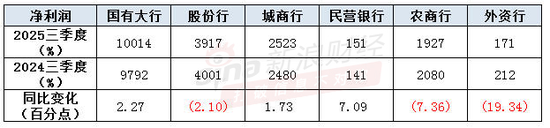
Core Insights - The banking sector in China reported a slight decline in net profit for the first three quarters of 2025, with a total of 1.87 trillion yuan, representing a year-on-year decrease of 0.02%, although the decline has narrowed compared to the first half of the year [1][6] Profitability - State-owned banks, city commercial banks, and private banks saw an increase in net profit, with private banks leading at a growth rate of 7.09% [1][3] - The net profit for state-owned banks was 1.00 trillion yuan, while city commercial banks and private banks reported 252.3 billion yuan and 15.1 billion yuan, respectively [3] - In contrast, joint-stock banks, rural commercial banks, and foreign banks experienced declines in net profit, with decreases of 2.1%, 7.36%, and 19.34%, respectively [1][3] Net Interest Margin - The net interest margin (NIM) for commercial banks remained stable at 1.42% in Q3, with private banks having the highest NIM at 3.83% [1][8] - State-owned banks had the lowest NIM at 1.31%, while joint-stock banks saw a slight increase of 0.01 percentage points to 1.56% [8][9] - Year-on-year, all types of banks experienced a decline in NIM, with state-owned and rural commercial banks both down by 0.14 percentage points [9][10] Asset Quality - As of the end of Q3 2025, the non-performing loan (NPL) balance for commercial banks was 3.5 trillion yuan, with an NPL ratio of 1.52%, reflecting a slight increase of 0.03 percentage points from the previous quarter [13][14] - Foreign banks had the lowest NPL ratio at 1.06%, while rural commercial banks had the highest at 2.82% [14] - Only state-owned banks saw a decrease in NPL ratios compared to the end of the previous year, while other types of banks experienced varying degrees of increase [14] Provision Coverage - The loan loss provision balance for commercial banks was 7.3 trillion yuan, with a provision coverage ratio of 207.15%, both showing a decrease from the previous quarter [16]