ICBC(601398)

Search documents
【财闻联播】工行调整黄金积存业务!2025年证券交易印花税增长57.8%
Sou Hu Cai Jing· 2026-01-30 12:39
Macroeconomic Dynamics - The Ministry of Finance announced that the securities transaction stamp duty is expected to reach 203.5 billion yuan in 2025, representing a growth of 57.8% [1] Energy Sector - The National Development and Reform Commission and the National Energy Administration will increase the proportion of fixed costs recovered through capacity pricing for coal-fired power plants to no less than 50% [2] Telecommunications Industry - According to the China Academy of Information and Communications Technology, the domestic smartphone shipment in December 2025 is projected to be 24.473 million units, a year-on-year decline of 29.1%. For the entire year of 2025, the total smartphone shipment is expected to be 307 million units, down 2.4% year-on-year [3] Financial Institutions - China International Capital Corporation (CICC) expects its net profit attributable to shareholders to be between 8.542 billion yuan and 10.535 billion yuan in 2025, reflecting a year-on-year increase of 50% to 85% [9] Market Data - The A-share market showed mixed results on January 30, with the Shanghai Composite Index down 0.96% and the ChiNext Index up 1.27%. The total trading volume was approximately 283.55 billion yuan, a decrease of about 39.44 billion yuan from the previous trading day [10] Company Dynamics - Sino Medical announced an expected revenue of 519 million to 526 million yuan for 2025, with a year-on-year growth of 13% to 15%. The net profit attributable to shareholders is projected to be between 43 million and 50 million yuan, indicating a significant year-on-year increase of 2767% to 3233% [13]






【财闻联播】工行调整黄金积存业务!2025年证券交易印花税增长57.8%
券商中国· 2026-01-30 12:16
★ 宏观动态 ★ 财政部:2025年证券交易印花税增长57.8% 1月30日,财政部举行新闻发布会,介绍2025年财政收支情况。会上,财政部国库司副司长郑涌介绍,2025 年,证券交易印花税达到2035亿元,增长57.8%。 两部门:将通过容量电价回收煤电机组固定成本的比例提升至不低于50% 国家发展改革委、国家能源局发布关于完善发电侧容量电价机制的通知。其中提出,完善煤电及天然气发电容 量电价机制。各地按照《关于建立煤电容量电价机制的通知》(发改价格〔2023〕1501号)要求,将通过容量 电价回收煤电机组固定成本的比例提升至不低于50%,可结合当地市场建设、煤电利用小时数等实际情况进一 步提高。省级价格主管部门可对天然气发电建立容量电价机制,容量电价按照回收天然气发电机组一定比例固 定成本的方式确定。 中国信通院:2025年12月国内市场手机出货量2447.3万部,同比下降29.1% 据中国信通院,2025年12月,国内市场手机出货量2447.3万部,同比下降29.1%,其中,5G手机2213.2万部, 同比下降27.3%,占同期手机出货量的90.4%。2025年1-12月,国内市场手机出货量3.07亿部 ...


黄金市场风险抬升 国有大行调整黄金积存业务
Sou Hu Cai Jing· 2026-01-30 11:47
Core Viewpoint - The recent adjustments in personal gold accumulation business by major state-owned banks indicate a response to market volatility and risk management, as gold prices have experienced significant fluctuations recently [1][3][11]. Group 1: Bank Adjustments - China Construction Bank has raised the minimum amount for personal gold accumulation to 1500 yuan, effective February 2, 2026, following similar adjustments by other major banks [1][3]. - Agricultural Bank of China has implemented a risk assessment requirement for clients engaging in gold accumulation transactions, effective January 30, 2026, to enhance consumer protection [7][8]. - Industrial and Commercial Bank of China has also adjusted its risk assessment criteria for clients participating in gold accumulation, requiring a balanced risk profile or higher starting January 12, 2026 [8]. Group 2: Market Trends - Gold prices have seen a significant drop, with a daily decline of over 5% on January 30, 2026, as the market begins to adjust after a period of strong price increases [9][11]. - The international gold price rose approximately 65% throughout 2025, but has started to show signs of correction in early 2026, indicating a potential shift in market dynamics [10][11]. - Analysts suggest that the current gold price increase reflects a broader change in how global risks are priced, with expectations that gold could reach 6000 USD per ounce in the long term, despite short-term volatility [12].


2026 年,机构行为的新变化:交易增强,配置重构
Changjiang Securities· 2026-01-30 11:44
1. Report Industry Investment Rating - No relevant content provided. 2. Core Viewpoints - In 2026, the strategy differentiation of major financial institutions will reshape the bond market landscape. The trading attributes of banks will be enhanced, and the pressure to exchange floating profits will be reduced. If the regulatory constraints on interest - rate sensitivity indicators are relaxed, it may provide long - term bond allocation space for banks. Securities firms' proprietary trading will continue the aggressive strategy of "bond foundation, equity enhancement" with regulatory support. Wealth management will fully enter the "true net - value" era, with product closure and defensive allocation becoming the mainstream. Public funds are expected to repair the liability side through the new fee regulations, the duration strategy may be reopened, and the use of hedging tools will increase. Insurance institutions will focus on long - term allocation, increasing their allocation of long - duration interest - rate bonds and high - dividend assets. The overall trading attributes of the market will be enhanced, and the allocation strategies will gradually diversify [3]. 3. Summary by Related Catalogs 3.1 Bank - Overall, it shows the characteristics of "configuration adjustment and trading enhancement". In 2026, if China follows the Basel regulatory new rules, large banks are expected to release about 1 trillion yuan of government bond allocation space, and the ability to undertake long - term bonds will be marginally improved. The trading attributes of state - owned large banks are gradually strengthening, and they will continue to maintain high trading activity in 2026. If the cost - performance of inter - bank certificates of deposit rises in the future, the bond - allocation strength of rural commercial banks may moderately recover [15]. - Constrained by the deepening of the asset - liability term mismatch, the ability of large banks to undertake long - term bonds is limited. However, if China implements the adjusted international regulatory standards, it is estimated that about 1 trillion yuan of bond - allocation capacity will be added for large banks. In 2025, the AC account proportion of various banks decreased, and the OCI account proportion increased. In 2026, although the pressure on banks to make up for the performance gap by realizing floating profits will weaken, there are still incentives to realize floating profits [16][21]. - State - owned large banks' trading volume of 7 - 10Y treasury bonds and policy - financial bonds in 2025 increased, and the proportion of trading volume also increased compared with the previous two years, showing an active trading strategy. It is expected that this high trading activity will continue in 2026 [29]. - Since the beginning of 2025, affected by the new capital regulations and the decline in the cost - performance of certificates of deposit, the bond - allocation behavior of rural commercial banks in the secondary market has significantly shrunk. If the cost - performance of certificates of deposit recovers and the capital occupation pressure eases in 2026, the bond - allocation strength may moderately recover [32][33]. 3.2 Wealth Management - In 2026, wealth management will fully enter the "true net - value" operation mechanism. In terms of products, "fixed - income +", closed - end and minimum holding - period products will be used to deal with net - value fluctuations; in terms of operation, the management requirements for duration, leverage and liquidity will continue to increase, and the asset allocation will focus on stability and term matching [40]. - In 2026, in the context of low - interest rates and the full - completion of valuation rectification, the scale and number of "fixed - income +" products are expected to continue to grow. The proportion of "fixed - income +" products in fixed - income wealth management is expected to rise steadily [41][42]. - After the full - completion of valuation rectification, the net - value stability constraint of wealth management products has been significantly enhanced. The closed - end and quasi - closed - end operation characteristics of new products are expected to be further strengthened in 2026 [44]. - In 2026, wealth management institutions will pay more attention to the liquidity safety cushion. The proportion of high - liquidity assets in wealth management asset allocation is likely to remain relatively high [50]. - In 2026, wealth management drawdown is expected to be controllable and will change around interest - rate fluctuations. Wealth management institutions may deepen the application of multi - asset allocation strategies to reduce the impact of bond - market fluctuations on net value [52]. - In 2026, the allocation value of amortized - cost bond funds will be further highlighted. The re - investment demand of the expired funds of amortized - cost bond funds is expected to support the short - end credit - bond market [58]. 3.3 Public Funds - In 2026, with the implementation of the new fee regulations for public funds, the bond - market sentiment is expected to be moderately repaired, and the stability improvement of the liability side may create conditions for reopening the duration strategy. The development of innovative tools such as stock - bond constant ETFs is expected to introduce incremental funds, and the number of funds using the negative - duration strategy may increase. The supervision of customized funds and dividend mechanisms will continue to be optimized [65]. - In 2025, the leverage ratio of bond funds decreased, and the duration fluctuated greatly. In 2026, the liability - side and asset - side durations of public funds are expected to increase [66]. - The implementation of the new fee regulations for public funds in 2026 is expected to promote the moderate repair of the bond market and the internal optimization of the bond - fund pattern [71]. - In 2026, the pure - bond fund market may face product - pattern adjustment. The smooth development of stock - bond constant ETFs may bring incremental funds to the equity and interest - rate bond markets and weaken the traditional "stock - bond seesaw" effect in the short term [76]. - In 2026, the number of funds using the negative - duration strategy may increase to manage risk exposure in the context of low - interest rates and high volatility in the bond market [79]. - In 2026, there is still room for optimization of customized funds and dividend mechanisms in the public - fund industry. The regulatory authorities may put forward rectification requirements for customized funds with a high institutional - holding ratio and optimize the dividend mechanism [82][84]. 3.4 Insurance - In 2026, the investment strategy of insurance institutions is expected to shift from "trading" to "allocation - based". The turnover rate of interest - rate bonds such as treasury bonds has declined, and the asset - allocation structure will be further optimized [87]. - In 2025, affected by the regulatory reduction of the liability - side pricing ceiling, new - policy attractiveness weakened, and premium growth slowed down. Insurance funds preferred a Carry - based strategy, with a decline in the turnover rate of interest - rate bonds and a stable or rising allocation weight [88]. - As of Q3 2025, bonds still accounted for more than 50% of insurance - fund asset allocation, but the growth rate of equity investment was relatively fast. In 2026, if the new fee regulations weaken the cost - performance of bond funds, some insurance funds may shift to equity assets, but it will not significantly affect their bond - market allocation [94]. - In 2026, under the dual - system drive of the new asset - liability regulations and new accounting standards, insurance institutions will significantly increase their allocation of long - duration interest - rate bonds and high - grade general credit bonds and reduce the allocation of bank Tier 2 capital bonds. The proportion of participating insurance is expected to continue to increase, and the equity - asset allocation will focus on high - dividend and low - valuation stocks [100][101]. 3.5 Securities Firms' Proprietary Trading - In 2026, the bond - allocation of securities firms' proprietary trading will continue to focus on interest - rate bonds and high - grade credit bonds, and the equity - allocation is expected to achieve "both quantity and quality improvement" under regulatory encouragement, with a preference for standardized products such as broad - based index constituent stocks and liquid ETFs [103]. - From March 2021 to November 2025, the bond - holding scale of securities firms' proprietary trading increased, and the proportion of interest - rate bonds rose. In 2026, the bond - holding scale is expected to continue to grow, and the credit - bond allocation will continue to concentrate on high - grade bonds [104][105]. - In 2025, the floating - profit scale of securities firms' proprietary trading turned from negative to positive, and they showed advantages in stop - profit operation and holding - cost control [109]. - Regulatory support for securities firms' proprietary trading to increase equity - asset allocation has increased. In 2026, securities firms may further increase their equity - asset allocation, with a possible preference for standardized products [114].
工行建行同日调整黄金积存业务 风控再升级
Jin Rong Jie· 2026-01-30 11:44
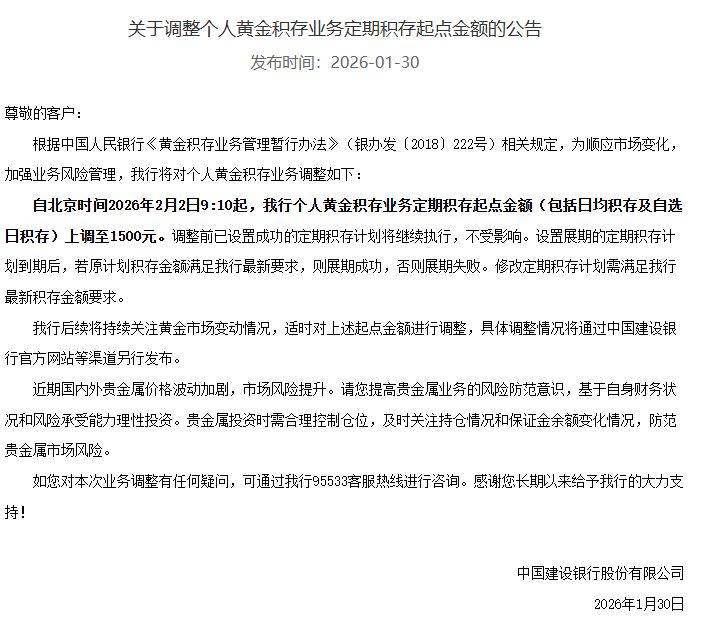
银行频道更多独家策划、专家专栏,免费查阅>> 建设银行发布关于调整个人黄金积存业务定期积存起点金额的公告,自北京时间2026年2月2日9:10起, 建设银行个人黄金积存业务定期积存起点金额(包括日均积存及自选日积存)上调至1500元。调整前已 设置成功的定期积存计划将继续执行,不受影响。设置展期的定期积存计划到期后,若原计划积存金额 满足建设银行最新要求,则展期成功,否则展期失败。修改定期积存计划需满足建设银行最新积存金额 要求。后续将持续关注黄金市场变动情况,适时对上述起点金额进行调整。 责任编辑:山上 今日工行、建行双双发公告,对个人黄金积存业务规则作出调整:工商银行发布关于调整如意金积存业 务及部分品牌实物黄金产品销售业务办理规则并修订如意金积存业务协议的公告。自2026年2月7日起, 在周末以及法定节假日等非上海黄金交易所交易日,工商银行将对如意金积存业务进行限额管理,限额 类型包括全量或单一客户单日积存/赎回上限、单笔积存或赎回总量上限等,并进行动态设置,提金不 受影响。 ...
国有银行接连出手 黄金积存业务迎重大调整
Jin Tou Wang· 2026-01-30 11:21
Core Viewpoint - The gold market is experiencing significant volatility, with the London gold spot price surpassing $5,500 per ounce on January 29, leading to a surge in domestic gold investment interest. In response, several banks, including Industrial and Commercial Bank of China (ICBC), China Construction Bank (CCB), and Ping An Bank, have implemented adjustments to their gold accumulation and fixed deposit services to manage risks and guide investor behavior [1]. Group 1: Yield Adjustments - The first category involves a reduction in yields, focusing on optimizing the rules for gold fixed deposits and accumulation. Ping An Bank announced that starting February 4, 2026, the yield for its gold accumulation business will be adjusted, with the current account yield dropping to 0.01%, and fixed deposit yields set at 0.2% for 3 months, 0.4% for 6 months, and 0.8% for 1 year. Existing customers will retain their current rates for fixed deposits made before the new rules take effect [2]. Group 2: Business Threshold and Rules Adjustments - The second category includes adjustments to business thresholds and processing rules, such as raising the minimum investment amount and implementing limit management. CCB announced that effective February 2, 2026, the minimum amount for personal gold accumulation will be raised to 1,500 yuan, marking the fourth increase in the past year. Previously, the threshold had been raised from 700 yuan to 1,200 yuan [2]. - ICBC has focused on managing non-trading day operations by implementing dynamic limit management for its gold accumulation business starting February 7, 2026. This will cover daily accumulation and redemption limits for all customers, with specific limits adjusted based on market volatility [3]. Group 3: Risk Management Enhancements - The third category involves upgrading risk management protocols to enhance investor suitability assessments. Several banks, including Agricultural Bank of China, have begun requiring higher risk tolerance evaluations for individual clients participating in gold accumulation transactions. ICBC has mandated that only clients rated C3 (balanced) and above can engage in gold accumulation starting January 12, 2026, while Agricultural Bank has restricted participation to cautious investors and above from January 30, 2026 [3].



工商银行(601398):大行工匠,基业长青
Changjiang Securities· 2026-01-30 11:15
Investment Rating - The report recommends a "Buy" rating for Industrial and Commercial Bank of China (ICBC) based on its solid fundamentals and long-term investment value [2][12]. Core Insights - The asset-liability structure of ICBC reflects the real economy, with the bank's market share entering an upward cycle amid economic structural transformation [8][22]. - The net interest margin is expected to stabilize, with core revenue growth projected to turn positive by 2026, following a prolonged period of declining interest rates [10][49]. - The bank's asset quality is resilient, with low volatility in risk indicators, and a strong provision coverage ratio, indicating ample capacity to absorb potential losses [11][49]. Summary by Relevant Sections Asset-Liability Structure - ICBC's asset-liability structure aligns with the transformation of the real economy, with a notable increase in market share as the bank adapts to the economic transition [22][23]. - The bank's market share has been on the rise since 2022, reflecting its competitive advantages in low-cost funding and resource allocation [8][23]. Credit Structure and Economic Transition - The credit structure is evolving to match the economic transition, with a renewed focus on corporate loans, particularly in emerging manufacturing sectors [36][39]. - The bank's loan distribution is increasingly concentrated in key economic regions, such as the Yangtze River Delta, which shows higher growth rates compared to national averages [39][41]. Interest Rate Cycle and Revenue Growth - The current low-interest-rate environment has seen the net interest margin reach historical lows, but the report anticipates stabilization at around 1.20% [10][49]. - Core revenue, including interest and fee income, is expected to rebound, with a projected positive growth rate for net interest income by 2026 [10][12]. Asset Quality and Risk Management - ICBC's asset quality remains robust, with a low expected increase in non-performing loans, particularly in retail segments [11][49]. - The bank maintains a provision coverage ratio above 200%, providing a buffer against potential credit losses [11][49]. Investment Recommendations - The anticipated dividend yield for ICBC's A and H shares in 2026 is projected at 4.39% and 5.37%, respectively, making it an attractive investment option compared to government bond yields [12][14]. - The report emphasizes the bank's strong dividend investment appeal, particularly in the context of a favorable risk-return profile [12][14].
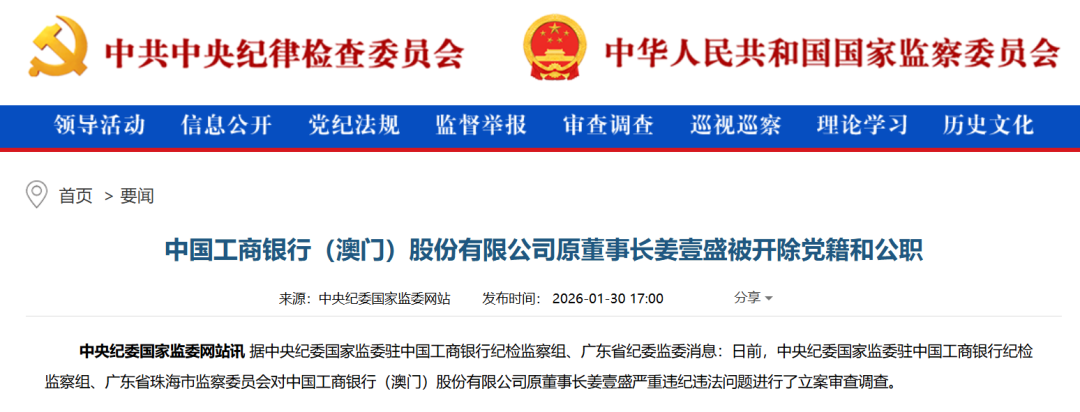
姜壹盛,被“双开”!擅权妄为、造成国有资产重大风险、非法收受巨额财物……
Zhong Guo Ji Jin Bao· 2026-01-30 11:09
Core Viewpoint - The former chairman of Industrial and Commercial Bank of China (Macau) Limited, Jiang Yisheng, has been expelled from the Party and public office due to serious violations of discipline and law, highlighting ongoing financial corruption issues within the bank [1][2]. Group 1: Investigation and Findings - The Central Commission for Discipline Inspection and the National Supervisory Commission have initiated an investigation into Jiang Yisheng for serious violations of discipline and law [2]. - Jiang Yisheng was found to have lost his ideals and beliefs, acted disloyally to the Party, and resisted organizational scrutiny [3]. - He ignored the spirit of the Central Eight Regulations, accepting gifts, cash, and entertainment that could influence his official duties, and misused public resources [3]. Group 2: Violations and Consequences - Jiang Yisheng's actions included serious violations of political, organizational, and work discipline, leading to significant risks to state assets and illegal financial gains [4]. - He has been expelled from the Party and public office, with his illegal gains confiscated, and his case has been referred to the judicial authorities for prosecution [4]. - The investigation revealed that Jiang Yisheng had a long career within the bank, holding various significant positions before becoming the chairman in March 2018 and leaving in June 2023 [4]. Group 3: Broader Context - Several other officials within the Industrial and Commercial Bank of China have also faced disciplinary actions recently, indicating a broader crackdown on corruption within the institution [5].
卫星扎堆「上天」,银行风控卷出「新高度」
Xin Lang Cai Jing· 2026-01-30 10:41
Core Insights - The commercial space industry is experiencing a surge in interest and investment, driven by increased policy support and the active participation of various sectors, including traditional banking [1][25][27]. Group 1: Policy and Industry Trends - Beijing has issued measures to promote the development and utilization of commercial satellite remote sensing data from 2026 to 2030, encouraging the construction of differentiated commercial satellite constellations with clear commercial value and application prospects [2][26]. - The banking sector, traditionally seen as unrelated to space, is now actively engaging in commercial space initiatives, with banks like China Merchants Bank and Shanghai Pudong Development Bank launching their own satellites [3][28]. Group 2: Satellite Launches and Applications - On January 16, 2024, China Merchants Bank's "Zhaoyin Jinkui" and Shanghai Pudong Development Bank's "Pudong Smart" satellites were successfully launched, both part of China's first global low-orbit satellite IoT constellation, "Tianqi Constellation" [4][29]. - The "Zhaoyin Jinkui" satellite is designed for high-precision monitoring of construction progress for first-hand mortgage properties, while the "Pudong Smart" satellite aims to enhance intelligent risk control and provide critical financial services during extreme scenarios like natural disasters [6][31]. Group 3: Evolution of Banking Risk Control - The trend of banks launching satellites signifies a shift from traditional ground-based data reliance to a "heaven and earth collaboration" model, enhancing risk control capabilities in response to complex and changing realities [12][45]. - Satellites provide high-resolution optical, radar, and multispectral sensors, offering banks a stable and objective "God's eye view" to address the core pain point of information asymmetry in traditional risk control [13][36]. Group 4: Innovations in Risk Management - The "Zhaoyin Jinkui" satellite can increase monitoring accuracy to over 95%, significantly improving traditional post-loan inspection efficiency [38]. - The integration of satellite technology with AI and deep learning, as seen in the "Dashanque" system by WeBank, allows for precise analysis of agricultural data, aiding in the determination of reasonable credit limits for farmers [38][40]. Group 5: Future Implications for Banking and Space - The banking sector's involvement in commercial space may lead to deeper due diligence and value discovery, as banks seek to understand and engage with the complexities of the commercial space industry [21][43]. - The future of financial competition may hinge on the ability to create intelligent collaborative networks between "starry skies" and "real ground," positioning banks to leverage new opportunities in the evolving commercial space landscape [24][46].



又一家大行上调黄金积存业务门槛!
第一财经· 2026-01-30 10:40
Core Viewpoint - The article discusses the recent increase in gold price volatility and the corresponding adjustments made by major banks in China to their gold accumulation business, reflecting a heightened focus on risk management in response to market changes [3][4]. Group 1: Bank Adjustments - China Construction Bank announced an increase in the minimum amount for personal gold accumulation business to 1500 yuan, effective February 2, 2026, following previous increases from 700 yuan to 800 yuan and then to 1000 yuan in 2025 [3]. - Agricultural Bank of China has added risk tolerance assessment requirements for personal customers participating in gold accumulation transactions starting January 30, 2026 [4]. - Industrial and Commercial Bank of China raised the risk assessment level for personal customers from "C1-Conservative" to "C3-Balanced" as of January 12, 2026, and increased the minimum amount for its gold accumulation business from 1000 yuan to 1100 yuan on January 8, 2026 [4]. Group 2: Market Conditions - The international gold price experienced a significant drop starting January 29, 2026, after a period of continuous increase, leading to increased market volatility [3]. - Construction Bank has advised customers to enhance their risk awareness regarding precious metals investments due to the heightened market risks and to manage their positions and margin balances carefully [3].