BANK OF CHANGSHA(601577)

Search documents
多家银行保险机构取消监事会 业内:由审计委员会行使职权将为公司治理提供更多灵活选择
Mei Ri Jing Ji Xin Wen· 2025-05-21 10:41
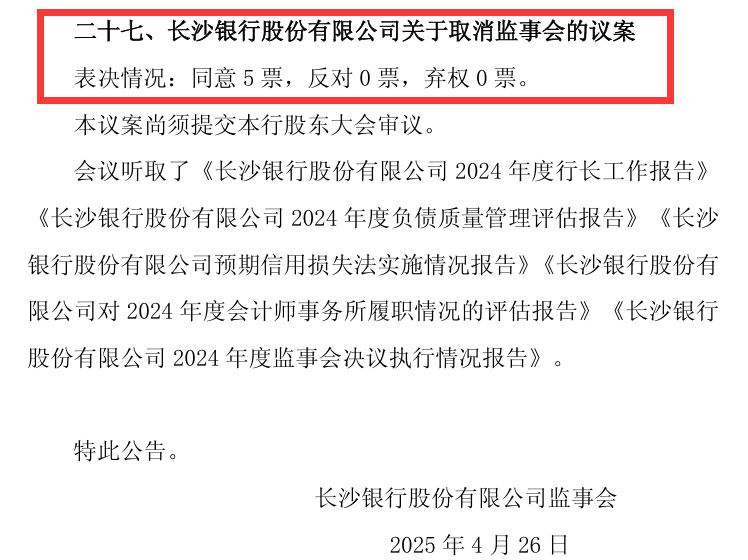
Core Viewpoint - The recent trend of financial institutions, including banks and insurance companies, to abolish supervisory boards reflects a significant reform in corporate governance, driven by changes in the Company Law of the People's Republic of China [1][6][12]. Group 1: Abolishment of Supervisory Boards - Changsha Bank has decided to abolish its supervisory board, transferring its functions to the audit committee of the board of directors [1]. - Many financial institutions, including major state-owned banks and insurance companies, are following suit, indicating a broader shift in governance practices [1][6]. - The new Company Law allows limited liability companies to establish an audit committee within the board of directors to perform the functions of a supervisory board, thus eliminating the need for a separate supervisory board [6][9]. Group 2: Regulatory Changes and Implications - The National Financial Regulatory Administration has issued new regulations that allow trust companies to set up audit committees within their boards, further promoting the idea of eliminating supervisory boards [2][6]. - The changes aim to enhance operational efficiency by reducing redundancy in oversight functions, as the roles of supervisory boards and audit committees often overlap [2][8]. - The flexibility provided by the new governance structure is expected to lead to more tailored governance models that suit the specific needs of different financial institutions [9][10]. Group 3: Impact on Corporate Governance - The shift to a single-tier governance model allows boards to exercise oversight more directly, potentially improving decision-making efficiency in a rapidly changing financial environment [9][10]. - Smaller financial institutions may benefit from reduced operational costs by not having a supervisory board, while larger institutions may require more complex oversight mechanisms [9][10]. - The transition to audit committees taking on supervisory roles is seen as a way to innovate governance structures and improve compliance management [10][12]. Group 4: Concerns and Future Considerations - There are concerns regarding the effectiveness of audit committees in fulfilling the oversight roles traditionally held by supervisory boards, particularly regarding potential conflicts of interest [11][12]. - Experts suggest that while the new structure may reduce costs, it is crucial to ensure that adequate checks and balances remain in place to maintain effective governance [11][12]. - Future modifications to the Company Law may be necessary to address the evolving needs of corporate governance in the financial sector [12].





万亿长沙银行的进阶密码:当区域银行遇上产业升级
雪球· 2025-05-21 08:44
Core Viewpoint - Changsha Bank has demonstrated strong growth in asset scale and profitability, leveraging regional economic development and innovative financial services to enhance its competitive position in the market [1]. Group 1: Credit Investment Acceleration - In 2024, Changsha Bank's corporate loans increased by 561 billion, while retail loans rose by 47 billion, indicating a focus on corporate lending [3]. - The bank's loans in key sectors such as technology, green finance, and inclusive finance saw significant growth rates of 17.9%, 23.1%, and 15.9% respectively, reflecting its alignment with national policy [3]. - The county-level financial sector has become a highlight, with county loans growing by 18.7% and deposits by 14.5%, showcasing the bank's commitment to regional financial initiatives [4]. Group 2: Steady Profit Growth - In 2024, Changsha Bank achieved a revenue of 25.936 billion, a year-on-year increase of 4.57%, and a net profit of 7.827 billion, up 4.87% [7]. - The bank's non-interest income grew significantly, with net income from fees and commissions increasing by 53.08%, indicating successful implementation of its "light capital strategy" [7][8]. - Retail customer assets under management reached 455.208 billion, reflecting a growth of 13.75% year-on-year, highlighting the bank's focus on wealth management [7]. Group 3: Future Layout - Changsha Bank is advancing in retail, digital, and green finance, with personal deposits growing by 14.99% to 386.489 billion, and personal loans increasing by 2.57% [10]. - The bank has launched innovative products such as the "VISA card rapid issuance" service and has received multiple awards for its contributions to credit card business [11]. - In green finance, the bank's green loan balance reached 52.829 billion, growing by 23.14%, and it successfully issued green bonds worth 5 billion [13].

上市银行25Q1业绩总结:其他非息拖累盈利,息差下行压力趋缓
Dongxing Securities· 2025-05-19 07:45
Investment Rating - The report indicates a cautious outlook for the banking sector, with expected revenue and net profit growth rates for listed banks in 2025 projected at approximately -1% and 0% respectively [3][9]. Core Insights - The overall revenue and net profit growth rates for listed banks in Q1 2025 were -1.7% and -1.2% year-on-year, reflecting a decline compared to Q4 2024 [3][9]. - The performance of different types of banks varied significantly, with city and rural commercial banks leading in growth due to improved scale and net interest margin, while state-owned banks showed weaker performance [3][10]. - The net interest margin for listed banks in Q1 2025 was 1.37%, a decrease of 13 basis points year-on-year, but the decline was less severe than in the previous year [3][9]. Summary by Sections Revenue and Profit Overview - Listed banks experienced a decline in revenue and net profit growth rates, with Q1 2025 figures at -1.7% and -1.2% respectively, marking a drop of 1.8 percentage points and 3.5 percentage points from Q4 2024 [3][9]. - The decline in net interest income was attributed to a narrowing interest margin and challenges in volume compensating for price [9]. Asset Quality and Provisioning - The asset quality remained stable, with a decrease in non-performing loan ratios and a reduction in provisioning pressure, as banks continued to report lower provisions in a challenging income environment [3][9]. - The provision coverage ratio for listed banks decreased to 238% in Q1 2025, reflecting a trend of reduced provisioning amid stable asset quality [3][9]. Investment Recommendations - The report suggests that the banking sector's configuration value is enhanced by both fundamental and liquidity factors, with a focus on key index-weighted stocks such as China Merchants Bank and Industrial and Commercial Bank of China [3][9]. - The report highlights the potential for mid-sized banks to attract capital for growth, particularly in the context of capital replenishment and profitability [3][9].





长沙银行总行组织架构及2024年经营情况分析
数说者· 2025-05-14 22:55
Core Viewpoint - Changsha Bank has shown strong growth in assets and profitability, positioning itself favorably among national commercial banks, despite facing some asset quality pressures. Group 1: Company Overview - Changsha Bank was established in 1997 and has undergone several name changes, with its current name adopted in 2008 and listed on the Shanghai Stock Exchange in 2018 [1] - The largest shareholder is the Changsha Municipal Finance Bureau, holding 16.82% of shares as of March 2025, followed by Hunan Communication Industry Service Co., Ltd. with 8.09% [1] - As of the end of 2024, Changsha Bank has 13 branches across Hunan province and one in Guangzhou, along with three subsidiaries and a workforce of 9,779 employees [1] Group 2: Financial Performance - As of the end of 2024, Changsha Bank's total assets reached 1.15 trillion yuan, a year-on-year increase of 12.42%, ranking 25th among 42 A-share listed banks and 8th among city commercial banks [4] - The bank achieved operating income of 25.936 billion yuan in 2024, up 4.57% year-on-year, and a net profit attributable to shareholders of 7.827 billion yuan, an increase of 4.87% [6] - Changsha Bank's operating income and net profit surpassed those of national peers such as Hengfeng Bank and Bohai Bank, indicating strong growth [6][7] Group 3: Interest Margin and Income - The net interest margin for Changsha Bank remained above 2% at 2.11% in 2024, despite a decrease of 20 basis points from 2023, ranking second among A-share listed commercial banks [11] - The loan portfolio grew by 11.61%, reaching 545.109 billion yuan, contributing to a net interest income of 20.564 billion yuan, which accounted for 79.29% of total operating income [13] Group 4: Asset Quality - As of the end of 2024, the non-performing loan (NPL) ratio was 1.17%, a slight increase of 2 basis points from the previous year, indicating a moderate level of asset quality [14] - The provision coverage ratio stood at 312.80%, providing a solid buffer against potential asset deterioration [14] - However, the overdue loan ratio reached 1.80%, indicating pressure on asset quality, with the proportion of special mention loans rising to 2.63% [17]

蓝山科技案二审落槌保代承担连带责任 行业责任边界或重塑
Shang Hai Zheng Quan Bao· 2025-05-12 18:53
Core Viewpoint - The ruling in the Blue Mountain Technology case establishes a precedent for holding individual sponsors liable for civil compensation to investors in cases of securities fraud, signaling a shift in the accountability of financial intermediaries in the capital market [1][2][3]. Group 1: Case Background - Blue Mountain Technology, a former New Third Board listed company, inflated its revenue by over 800 million yuan and profits by over 80 million yuan through fictitious business activities from 2017 to 2019, leading to significant false records in its public offering documents [2][3]. - The case involved four intermediary institutions, including Hu Long Securities, which failed to conduct due diligence and issued reports containing false statements [2][3]. Group 2: Legal Implications - The Beijing High Court's decision mandates that two project-signing sponsors and Hu Long Securities bear joint liability for 40% of the losses incurred by investors due to the false statements in the application materials for the selected layer listing [3][5]. - This ruling is significant as it marks the first instance in China where sponsors are required to bear civil compensation liability to investors, potentially leading to increased accountability for individual practitioners in the securities industry [1][4]. Group 3: Industry Impact - The judgment sends a strong message to the capital market, emphasizing that both intermediary institutions and individual practitioners must ensure high standards of professional conduct to avoid substantial civil liabilities [2][6]. - As regulatory scrutiny intensifies, it is anticipated that more individuals, including intermediaries and executives, will be named as defendants in securities fraud cases and may face joint compensation responsibilities [6].
长沙银行: 长沙银行股份有限公司2024年度股东大会资料
Zheng Quan Zhi Xing· 2025-05-12 13:51
(股票代码:601577) 五、股东需要发言或提问的,应先经会议主持人许可。 股东发言或提问时应首先报告姓名(或所代表股东)及持有 股份数额。股东发言或提问应与本次股东大会议题相关。 六、本行董事和高级管理人员应当认真负责、有针对性 地集中回答股东的问题。股东发言、提问时间和本行董事、 高级管理人员集中回答问题时间合计控制在 30 分钟以内。 二、在会议主持人宣布现场出席会议的股东和代理人数 及其所持有表决权的股份总数之前,会议现场登记终止。在 停止会议登记后进场的在册股东或股东代表,可列席会议, 但不享有本次会议的现场表决权。 三、股东参加股东大会,应当认真履行其法定义务,会 议开始后应将手机铃声置于无声状态,尊重和维护其他股东 合法权益,保障大会的正常秩序。 四、股东及股东代理人参加股东大会依法享有表决权、 发言权、质询权等权利。根据《公司章程》规定,股权登记 日(即 2025 年 5 月 15 日)质押本行股权数量达到或超过其 持有本行股份的 50%的股东,及在本行授信逾期的股东,其 投票表决权将被限制。 二〇二五年五月 关于长沙银行股份有限公司 2024 年度财务决算暨 2025 年度财务预算 关于长 ...
长沙银行(601577) - 长沙银行股份有限公司2024年度股东大会资料
2025-05-12 12:30
2024 (股票代码:601577) 二〇二五年五月 | | | | | --- | --- | --- | | y | 기 | 1 | | 会议议程 1 | | --- | | 会议须知 2 | | 长沙银行股份有限公司 2024 年度董事会工作报告 4 | | 长沙银行股份有限公司 年度监事会工作报告 2024 13 | | 《长沙银行股份有限公司 年年度报告》及摘要 21 2024 | | 关于长沙银行股份有限公司2024年度财务决算暨2025年度财务预算 | | 方案的议案 22 | | 长沙银行股份有限公司 年度利润分配预案 2024 30 | | 长沙银行股份有限公司资本管理规划(2025 年-2027 年) 33 | | 关于长沙银行股份有限公司续聘 2025 年度会计师事务所的议案 38 | | 长沙银行股份有限公司 2024 年度关联交易专项报告 40 | | 关于长沙银行股份有限公司 2025 年度日常关联交易预计额度的 | | 议案 47 | | 关于《长沙银行股份有限公司未来三年(2025 年-2027 年)股东回报 | | 规划》的议案 55 | | 关于延长向不特定对象发行可转换公 ...
长沙银行2024年年报:资产3年跨3个“千亿级”台阶,县域金融优势凸显
Mei Ri Jing Ji Xin Wen· 2025-05-07 08:42
Core Viewpoint - Hunan Province is evolving as a significant transportation hub and an innovative ground for the transformation of traditional industries and the integration of emerging industries, with Changsha Bank playing a crucial role in this development [1] Group 1: Financial Performance - Changsha Bank reported total assets of 1.15 trillion yuan, an increase of over 120 billion yuan year-on-year, marking three consecutive years of asset growth exceeding 100 billion yuan [1] - For the year 2024, the bank achieved an operating income of 25.94 billion yuan, a year-on-year increase of 4.57%, and a net profit attributable to shareholders of 7.83 billion yuan, up 4.87% [2] - The bank's net interest margin stood at 2.11%, with net interest income growing by 2.68% due to optimized deposit structure and effective cost control [2] - As of the end of 2024, the bank's total assets reached 1.1467 trillion yuan, a year-on-year increase of 126.72 billion yuan, representing a growth rate of 12.42% [2] Group 2: Loan and Deposit Growth - County loans accounted for nearly 60% of the bank's new loans, with a county loan balance of 201.37 billion yuan, reflecting a year-on-year increase of 316.72 billion yuan [4] - The bank's county deposit balance reached 234.17 billion yuan, an increase of 29.6 billion yuan, with a growth rate of 14.47% [4] - The bank's "One County, One Specialty" loan program saw a balance of 6.582 billion yuan, a significant increase of 68.1% year-on-year [3] Group 3: Strategic Initiatives - In 2024, Changsha Bank launched its new ten-year strategy, focusing on the "Five Major Articles" of finance, with over 150 billion yuan allocated to these areas [6] - The bank has developed a robust digital finance platform, connecting over 2,300 government services and achieving over 11.6 million users in online channels [7] - The bank aims to become a leading "green ecological bank" by promoting green finance, with a green loan balance of 52.829 billion yuan, up 23.14% year-on-year [6] Group 4: Community Engagement - Changsha Bank is committed to enhancing financial services in rural areas through a three-tiered service network and initiatives like "Thousand Enterprises, Ten Thousand Households" outreach [6][7] - The bank's inclusive finance efforts resulted in a balance of 68.283 billion yuan in loans to small and micro enterprises, an increase of 15.91% [6]
长沙银行股份有限公司2024年度暨2025年第一季度业绩说明会预告公告
Shang Hai Zheng Quan Bao· 2025-05-06 19:11
Core Viewpoint - Changsha Bank will hold a performance briefing for the 2024 annual report and the first quarter of 2025 on May 14, 2025, to communicate with investors regarding operational performance, development strategies, and profit distribution plans [3][4]. Group 1: Meeting Details - The meeting is scheduled for May 14, 2025, from 10:00 to 11:00 AM [2][4]. - It will take place at the Shanghai Stock Exchange Roadshow Center and will be conducted in an interactive online format [2][4]. Group 2: Participation Information - Investors can participate online during the meeting by logging into the Shanghai Stock Exchange Roadshow Center [5]. - Questions can be submitted from May 7 to May 13, 2025, through the Roadshow Center's website or via the bank's email [5]. Group 3: Contact Information - The contact for inquiries is the Board Office, with a provided phone number and email address for communication [6][7].
银行业2025年一季报综述:预期内盈利承压,拥抱稳定、可持续、可预期的回报确定性
Shenwan Hongyuan Securities· 2025-05-06 11:18
Investment Rating - The report maintains a positive outlook on the banking sector, highlighting it as a low-volatility dividend play in a counter-cyclical environment and a strong performer in absolute returns during a pro-cyclical phase [6]. Core Insights - The first quarter of 2025 saw a decline in both revenue and net profit for listed banks, with revenue and net profit down 1.7% and 1.2% year-on-year, respectively. The main reasons for this decline were the expected decrease in interest margins and pressure from non-interest income [3][12]. - Loan growth has remained stable, with a year-on-year increase of 7.9% in the first quarter. Notably, banks in Jiangsu and Zhejiang, as well as Chengdu, continue to show strong economic performance, while Chongqing has emerged as a new growth area with loan growth exceeding 16% [3][4]. - The average net interest margin for listed banks was 1.54% in the first quarter, reflecting a slight quarter-on-quarter increase of 2 basis points, supported by a decrease in the cost of interest-bearing liabilities [4][12]. - The non-performing loan (NPL) ratio for listed banks decreased to 1.23%, with an estimated annualized NPL generation rate of approximately 0.63% [5][19]. - The report emphasizes the importance of focusing on high-dividend yield banks, particularly those with solid provisions and growth opportunities in favorable policy environments [6][19]. Summary by Sections Performance Overview - The first quarter of 2025 saw a significant impact from the decline in interest margins and non-interest income, leading to a negative growth in both revenue and profit for listed banks [10][12]. - The report indicates that the performance of state-owned banks was below expectations, while city and rural commercial banks generally met expectations [3][19]. Loan and Credit Analysis - Loan growth has been stable, with a year-on-year increase of 7.9% in the first quarter. The report highlights that the demand for loans from small and medium-sized enterprises has weakened, affecting the growth rates of rural commercial banks [3][4]. Interest Margin and Cost Analysis - The report notes that the average net interest margin for listed banks improved slightly, with a quarter-on-quarter increase attributed to a reduction in the cost of interest-bearing liabilities [4][12]. Asset Quality and Risk Management - The NPL ratio for listed banks decreased to 1.23%, with proactive measures taken to manage and dispose of non-performing assets [5][19]. - The report indicates that the retail sector is experiencing some risk exposure, but overall asset quality remains stable [5][19]. Investment Recommendations - The report recommends focusing on banks with high dividend yields and solid fundamentals, particularly those that are well-positioned to benefit from favorable policy changes [6][19].