CPIC(601601)

Search documents
文件:中国太保寻求发行2030年到期、至多156亿港元的可转换债券。
Xin Lang Cai Jing· 2025-09-10 09:24
文件:中国太保寻求发行2030年到期、至多156亿港元的可转换债券。 ...

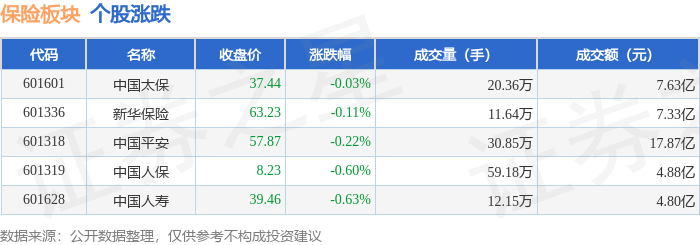
保险板块9月10日跌0.4%,中国人寿领跌,主力资金净流入7670.97万元
Zheng Xing Xing Ye Ri Bao· 2025-09-10 08:37
Core Viewpoint - The insurance sector experienced a decline of 0.4% on September 10, with China Life leading the drop, while the overall market indices showed slight increases [1] Group 1: Market Performance - The Shanghai Composite Index closed at 3812.22, up 0.13% [1] - The Shenzhen Component Index closed at 12557.68, up 0.38% [1] Group 2: Individual Stock Performance - China Pacific Insurance (601601) closed at 37.44, down 0.03% with a trading volume of 203,600 shares and a turnover of 763 million yuan [1] - New China Life Insurance (601336) closed at 63.23, down 0.11% with a trading volume of 116,400 shares [1] - Ping An Insurance (601318) closed at 57.87, down 0.22% with a trading volume of 308,500 shares and a turnover of 1.787 billion yuan [1] - China Reinsurance (601319) closed at 8.23, down 0.60% with a trading volume of 591,800 shares and a turnover of 488 million yuan [1] - China Life Insurance (601628) closed at 39.46, down 0.63% with a trading volume of 121,500 shares [1] Group 3: Capital Flow Analysis - The insurance sector saw a net inflow of 76.7097 million yuan from institutional investors, while retail investors experienced a net outflow of 8.7733 million yuan [1] - Major stocks like Ping An Insurance had a net inflow of 68.3403 million yuan from institutional investors, but a net outflow of 35.2692 million yuan from retail investors [2] - New China Life Insurance had a net inflow of 47.1744 million yuan from institutional investors, with a net outflow of 3.79353 million yuan from retail investors [2]





非银金融债指南针系列之三:财险行业评分模型构建与结果分析
Western Securities· 2025-09-10 07:37
1. Report Industry Investment Rating No information about the industry investment rating is provided in the report. 2. Core Viewpoints of the Report - The report conducts a comprehensive analysis of the property insurance industry's business operations, regulatory policies, and builds a scoring model to rank the risks of 11 property insurance companies with outstanding sub - debt as of September 3, 2025. It aims to recommend bond targets with relatively high risk - return ratios for investors with different risk preferences [1]. - Through multi - dimensional indicators such as qualitative and quantitative ones, the report analyzes the credit risks of the property insurance industry to assist investment decisions [2]. 3. Summary by Relevant Catalogs 3.1 Property Insurance Company Business Operation Status - **Insurance Business**: Industry - wide, the proportion of property insurance company premium income remains around 30%, with positive but slowing growth. The ratio of life insurance to property insurance premium income is about 7:3. Since 2018, property insurance company premium income has shown positive growth, but the growth rate has declined, and it has been below 10% after 2021. By the end of 2024, the original premium income of property insurance companies was about 1.69 trillion yuan, with a growth rate of 6.55%. The diversification of insurance types is a key concern, with motor vehicle insurance still dominant but its proportion decreasing, while the proportions of liability insurance, agricultural insurance, and health insurance have increased slightly [17][18]. - **Investment Business**: The proportion of property insurance company investment assets is generally lower than that of life insurance companies, but it remains at a relatively high level. The financial investment yield of property insurance companies has declined overall, while the comprehensive investment yield has shown an upward trend. From the first half of 2022 to the end of 2024, the financial investment yield of property insurance companies fluctuated and decreased, reaching 3.05% by the end of 2024, lower than that of life insurance companies. In 2024, the comprehensive investment yields of property and life insurance companies increased significantly. The balance of property insurance company insurance funds has increased with premium income, with an increase in the proportion of bond investments and a decrease in bank deposits [24][27]. 3.2 Property Insurance Company Financial Aspects - The main difference between life and property insurance companies is that the comprehensive cost ratio cannot accurately measure the profitability of life insurance companies because the earned premium of life insurance companies does not deduct life insurance liability reserves and long - term health insurance liability reserves, resulting in a large "bubble" in earned premium [31]. - The liquidity regulatory indicators, recognized assets, and recognized liabilities of property insurance companies are similar to those of life insurance companies. 3.3 Property Insurance Industry Regulatory Points and Compliance Penalty Situations - **Regulatory Policies**: Property insurance regulatory policies are oriented towards serving the real economy, emphasizing "price reduction, quality improvement, and efficiency enhancement" to protect consumer rights. For example, the reform of motor vehicle insurance has put pressure on insurance company premium income and profit growth, while agricultural insurance has developed rapidly under the background of rural revitalization [30][35]. - **Regulatory Ratings**: The risk comprehensive rating is an important indicator for measuring the solvency of insurance companies, and property insurance companies, similar to life insurance companies, focus on this regulatory indicator. Additionally, the regulatory rating in the "Insurance Company Regulatory Rating Method" issued by the National Financial Supervision and Administration in January 2025 also needs attention [38]. - **Compliance Penalties**: Property insurance companies are more frequently penalized than other insurance companies, with fines being the main form of administrative penalty. In 2024, property insurance companies accounted for 59.43% of the total fines in the insurance industry, and the amount of fines for property insurance companies was generally higher [39][43]. 3.4 Property Insurance Industry Credit Analysis Core Indicators and Model Construction - **Credit Analysis Core Indicators**: The report constructs a credit analysis scoring model from four dimensions: corporate governance, operational strength, financial performance, and risk management. - **Corporate Governance**: The shareholder background of property insurance companies is mainly state - owned enterprises, with relatively low shareholder default risks. The average proportion of state - owned legal person shareholding in the top ten shareholders of property insurance companies is 61.51%, and 75% of property insurance companies are state - owned enterprises [52][53]. - **Operational Level**: In terms of overall scale, there is a significant "head effect" among property insurance companies, with China Property Insurance and Ping An Property Insurance being prominent. The insurance business income is highly correlated with the total asset scale, and the market concentration is relatively high. The dispersion degree of insurance business and the claim settlement ratio of property insurance companies vary greatly, and the investment business risks of Yingda Property Insurance and Beibu Gulf Property Insurance are relatively low [55][58][62]. - **Financial Level**: Yingda Property Insurance has relatively stronger overall profitability. The average operating expenditure - to - income ratio of sample property insurance companies from 2022 - 2024 was 96.0%, the average comprehensive cost ratio was 99.2%, and the average comprehensive investment yield was 3.0% [67]. - **Risk Management**: In terms of solvency, property insurance companies have a relatively thick "safety cushion." As of the end of 2024, the average comprehensive solvency adequacy ratio of sample property insurance companies was 255.8%, and the average core solvency adequacy ratio was 188.4%. Most sample insurance companies have a risk rating of A or above, with Yingda Property Insurance receiving the highest rating [69]. - **Adjustment Items**: China Property Insurance, CPIC Property Insurance, and Ping An Property Insurance have good credit risk indicators, with Ping An Property Insurance having an advantage in risk management [75]. - **Scoring Results and Verification**: The report uses the minimum - maximum normalization method to score 11 property insurance companies with outstanding bonds as of September 3, 2025. The correlation coefficient between the 3 - year ChinaBond valuation yield and the credit score of property insurance companies is - 0.89, indicating a strong negative correlation, which verifies the scoring results [77][78]. 3.5 Insurance Company Subject Investment Value Judgment - **Subjects with a Score Above 70**: China Property Insurance, CPIC Property Insurance, and Yingda Property Insurance are above the trend line, with high scores and low risks, suitable for investors seeking stable returns and bottom - position allocation assets [5][82]. - **Subjects with a Score between 50 - 70**: Sunshine Property Insurance is slightly above the trend line, with a current outstanding bond valuation yield of not less than 2.2% and relatively controllable risks. It is suitable for investors with certain requirements for absolute returns and relatively stable liability ends [5][90].
深化改革进入“深水区” 上市险企个险渠道提质增效成主旋律
Jin Rong Shi Bao· 2025-09-10 07:35
Group 1 - The core viewpoint of the articles indicates that the individual insurance channel of listed life insurance companies is under pressure, with premium growth lagging behind the bank insurance channel, which has seen double-digit increases [1][2] - In the first half of the year, five major listed life insurance companies achieved a total premium income of 9,628.14 billion yuan, reflecting a year-on-year growth of 1.01% [1][2] - The individual insurance channel remains a crucial source of premium income, contributing over 70% to the total premium income of these companies [1] Group 2 - Except for China Ping An, all other four listed life insurance companies reported positive growth in individual insurance channel premium income, with China Life achieving 4,044.48 billion yuan (up 2.64%), Taikang Life at 1,373.8 billion yuan (up 0.9%), New China Life at 725.26 billion yuan (up 5.5%), and PICC Life at 354.14 billion yuan (up 3%) [2] - The growth in individual insurance premiums is primarily supported by renewal premiums, while new business premiums have declined for most companies, except for New China Life [2] Group 3 - The average monthly first-year commission income for Taikang Life's core sales force was 7,120 yuan, down 13.4% year-on-year, while Ping An Life's agents earned 9,898 yuan per person per month, a decrease of 17.3% [3] - The decline in agent activity and income is attributed to the implementation of regulatory requirements and product transformation, which are expected to stabilize in the future [3] Group 4 - Since the regulatory "cleaning up and improving quality" initiative began in 2019, the individual insurance channel has seen a significant reduction in personnel, dropping from a peak of 9.12 million to around 2 million [4] - Despite the reduction in personnel, the new business value in the individual insurance channel has shown significant improvement, with Ping An Life's new business value increasing by 17% year-on-year [4] Group 5 - The reduction in personnel has led to a noticeable improvement in the efficiency and quality of the individual insurance channel, driven by marketing system reforms and digital empowerment [5][6] - Taikang Life has optimized its team structure and enhanced its capabilities through digital initiatives, resulting in a 12.7% year-on-year increase in average monthly first-year premium per core salesperson [6] Group 6 - The ongoing transformation of the individual insurance channel is focused on professionalization and specialization, as indicated by the recent regulatory guidance aimed at upgrading the personal agency channel [7][8] - Long-term strategies emphasize improving the quality and productivity of agents to adapt to increasingly complex insurance products [7][8]
上市险企银保渠道迈向优质发展之路 从拼费用到拼实力
Jin Rong Shi Bao· 2025-09-10 07:28
Core Viewpoint - The mid-term performance reports from listed insurance companies indicate a significant increase in both premium scale and business value through the bancassurance channel, suggesting a revitalization of this channel after the strict implementation of the "reporting and operation integration" policy for two years [1][2]. Summary by Sections Premium Income and Business Value Growth - In the first half of the year, five listed life insurance companies achieved a total premium income of 2549.97 billion yuan through the bancassurance channel, representing a year-on-year growth of 46.9% [2]. - Specific contributions include: China Life at 724.44 billion yuan (up 45.7%), PICC Life at 531.04 billion yuan (up 24.1%), New China Life at 461.6 billion yuan (up 65.1%), Taikang Life at 416.6 billion yuan (up 82.6%), and Ping An at 415.97 billion yuan (up 37.5%) [2]. - The contribution of the bancassurance channel to the total premium income of these five companies increased from 14.2% to 19.3% year-on-year [2]. New Business Value and Key Performance Indicators - The bancassurance channel has become a crucial driver for the growth of new business value, with PICC Life reporting that nearly 60% of its premium income came from this channel, leading to a 71.7% year-on-year increase in new business value [2]. - Ping An achieved a new business value of 59.72 billion yuan, marking a significant year-on-year growth of 168.6% [2]. Long-term Premium Income and Strategic Importance - Key indicators for future premium income, such as the first-year premium income from long-term insurance, showed substantial growth, with China Life and New China Life reporting year-on-year increases of 112.4% and 150.3%, respectively [3]. - Executives from various companies emphasized the bancassurance channel's contribution to value, with statements highlighting its importance as a pillar for company value sources [3]. Regulatory Changes and Cost Structure - The implementation of the "reporting and operation integration" policy has led to a more rational fee structure in the bancassurance channel, with regulatory measures aimed at addressing long-standing issues of high costs and unreasonable fee structures [4]. - The regulatory changes have resulted in a unified standard for commissions on long-term premium products, which is expected to enhance the value of new business despite initial declines in new single premium income [5]. Expansion and Collaboration - The removal of restrictions on the number of insurance companies that can collaborate with a single bank branch has facilitated broader cooperation between leading insurance companies and banks, enhancing competitive advantages [6]. - Companies are focusing on optimizing product offerings and improving service quality to adapt to the new competitive landscape, with significant growth in bancassurance channel performance reported by several firms [6][7]. Future Outlook and Challenges - Companies are optimistic about the future of the bancassurance channel, with plans to enhance sustainable development capabilities and strengthen partnerships with key banks [7]. - Challenges remain, including the need for insurance companies to improve product design and service capabilities to meet the heightened expectations of bank customers regarding product profitability and value [7].
中国太保亮相2025年服贸会
Ren Min Wang· 2025-09-10 07:16
Core Viewpoint - China Pacific Insurance (CPIC) is showcasing its commitment to digital transformation and sustainable development at the 2025 China International Service Trade Fair, emphasizing its strategic upgrade from a "risk bearer" to a "risk manager" and "guardian of a better life" [1][5] Group 1: Digital Transformation and Innovation - CPIC is focusing on enhancing its technological capabilities and transforming service scenarios through a dual approach of "hardcore technology capability enhancement" and "scenario value transformation" [1][3] - The company is implementing a new generation "Artificial Intelligence+" strategic plan, with plans to increase investment over the next five years to build an enterprise-level AI capability system [1][3] - CPIC has launched an innovative "carbon neutrality + comprehensive insurance protection" model for major national events, providing a complete carbon neutrality service solution [1][2] Group 2: Risk Management and Service Optimization - CPIC is transitioning from traditional insurance to proactive risk management, exemplified by the establishment of a "Cybersecurity Insurance Innovation Alliance" and the development of a comprehensive risk reduction service system [3] - In agriculture insurance, CPIC is utilizing AI and satellite remote sensing technologies to create an intelligent disaster prevention and reduction service system [3] - The company has significantly improved operational efficiency in health insurance claims processing, achieving an 80% increase in productivity through advanced technologies [3] Group 3: Addressing Demographic Challenges - CPIC is addressing the challenges of an aging population with its "Hundred-Year Life Blue Smart Companion" product, integrating health and technology to enhance the quality of life for the elderly [4] - The company is leveraging satellite technology for dynamic management in major engineering projects, enhancing risk assessment and monitoring capabilities [4] Group 4: Future Directions - CPIC plans to continue advancing its "Artificial Intelligence+" strategy and exploring innovative models like "integrated air, land, and space" to contribute to national strategies and high-quality service trade development [5]
“科技减损+再保补位” 我国巨灾保险体系更具韧性
Jin Rong Shi Bao· 2025-09-10 06:27
Core Insights - The insurance industry is actively enhancing its resilience and risk management capabilities in response to increasing extreme weather events due to global climate change [1][2][5] Group 1: Industry Response to Catastrophic Risks - Listed insurance companies are leveraging digital and intelligent technologies throughout the entire process of disaster risk reduction, shifting from "passive acceptance" of losses to "proactive reduction" [2] - China Pacific Insurance has developed various types of catastrophe insurance, providing risk coverage exceeding 600 billion yuan in the first half of 2025 [4] - China Reinsurance is enhancing its catastrophe risk protection and climate risk response capabilities, participating in pilot projects across 21 provinces and cities [6] Group 2: Risk Reduction Initiatives - China Life Insurance reported a net loss of 2.51 billion yuan due to major disasters in the first half of 2025, a decrease of 38.3% year-on-year, with disaster impact on the comprehensive claims ratio at 1 percentage point [2][3] - The company has implemented a risk reduction service platform, "Wanxiang Cloud," achieving full-process digital upgrades and enhancing collaboration with the China Meteorological Administration [2] - China Pacific Insurance is continuously improving its agricultural insurance disaster response mechanism, reaching 206,000 farming households with risk reduction services [4] Group 3: Reinsurance Mechanisms - The insurance industry is optimizing reinsurance mechanisms to enhance financial resilience against catastrophic risks, implementing a "proportional + excess" catastrophe protection system [5][6] - China Reinsurance has adjusted its reinsurance contract structures to focus on catastrophe risk pain points, increasing the reinsurance ratio for various contracts [6] - The overall reinsurance market is experiencing fluctuations in renewal rates, with some business lines maintaining upward pressure on rates despite increased losses from global catastrophic events [7]

港股内险股午后涨幅扩大 中国太保涨4.85%
Mei Ri Jing Ji Xin Wen· 2025-09-10 06:24
每经AI快讯,内险股午后涨幅扩大,截至发稿,中国太保(02601.HK)涨4.85%,报32.84港元;中国人保 (01339.HK)涨3.28%,报6.93港元;中国财险(02328.HK)涨3.27%,报18.93港元;中国人寿(02628.HK)涨 3%,报23.38港元。 (文章来源:每日经济新闻) ...

从“赔本赚吆喝”到“盈利破冰” 新能源车险迎关键转折
Jin Rong Shi Bao· 2025-09-10 06:16
Core Insights - The auto insurance business remains a cornerstone for the property insurance sector, with the top three insurers (PICC, Ping An, and Taikang) generating a total premium income of 306.2 billion yuan, accounting for over 60% of the industry [1][2] - The new energy vehicle (NEV) insurance sector is experiencing a turnaround, with several leading insurers achieving underwriting profitability, indicating a potential recovery for the industry [1][4] - The implementation of the "reporting and pricing together" policy has effectively curbed chaotic competition in the market, allowing insurers to focus more on risk management and service enhancement [3][7] Auto Insurance Performance - The top three property insurers reported a combined auto insurance premium income of 306.28 billion yuan in the first half of the year, representing 68% of the total auto insurance market [2] - Premium growth rates for PICC, Ping An, and Taikang were 3.4%, 3.6%, and 2.8% respectively, below the industry average growth rate of 4.5% [2] - The combined cost ratio for these insurers showed significant improvement, with PICC at 94.2% (down 2.2 percentage points), Ping An at 95.5% (down 2.6 percentage points), and Taikang at 95.3% (down 1.8 percentage points) [2][4] New Energy Vehicle Insurance Growth - The NEV insurance market has seen rapid growth, with premium income expected to rise from 24.6 billion yuan in 2020 to 140.9 billion yuan by 2024, reflecting a compound annual growth rate of 55% [4] - NEV insurance premiums are projected to reach approximately 480 billion yuan by 2030, making up over 40% of total auto insurance premiums [4] - Ping An reported insuring 5.75 million NEVs in the first half of the year, a 49.3% increase year-on-year, with premium income of 21.7 billion yuan, up 46.2% [4] Challenges and Strategies - Despite some insurers achieving profitability in NEV insurance, the overall industry still faces challenges, particularly in commercial vehicle insurance, which remains unprofitable [5][7] - The industry is focusing on risk reduction as a core strategy to improve the quality of NEV insurance operations, with initiatives aimed at lowering repair costs and enhancing service levels [7][8] - Insurers are collaborating with manufacturers to optimize vehicle designs and improve risk management through data utilization [8]